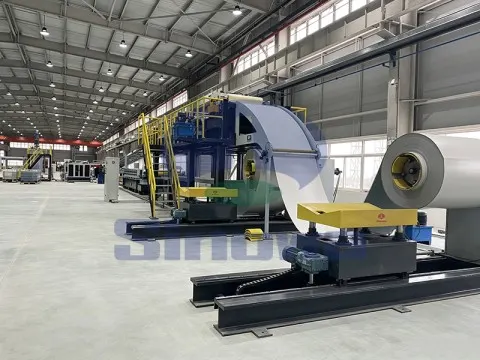
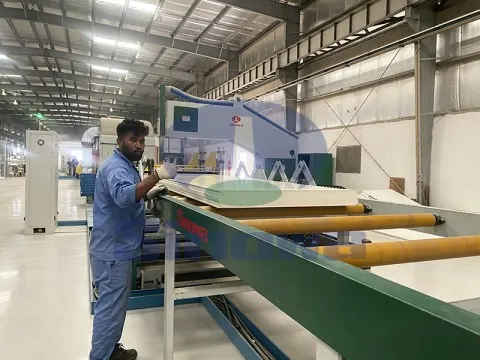
sandwich panel line
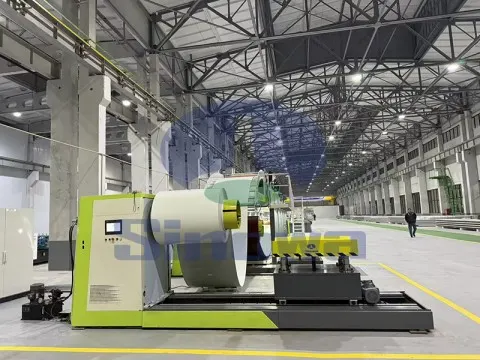
A complete sandwich panel line consists of multiple interconnected functional systems that cooperate seamlessly to realize automated and streamlined production. The raw material conveying and pretreatment system serves as the initial link of the entire production workflow, undertaking the feeding and preliminary processing of surface metal sheets and internal core materials. Metal substrates such as color-coated steel sheets and galvanized steel sheets are transported to the processing platform through automatic conveying devices, where leveling and deburring procedures are carried out to eliminate surface wrinkles, edge burrs and uneven thickness defects generated during raw material storage and transportation. This pretreatment process ensures the flatness and surface uniformity of the substrates, laying a solid foundation for subsequent composite molding. Meanwhile, lightweight core materials including foam materials, rock wool and glass wool are quantitatively transported through special conveying equipment, with auxiliary structures to avoid core material scattering and density unevenness during feeding. All raw material feeding procedures adopt automatic metering control to maintain consistent feeding volume, effectively preventing product quality fluctuations caused by manual feeding errors.
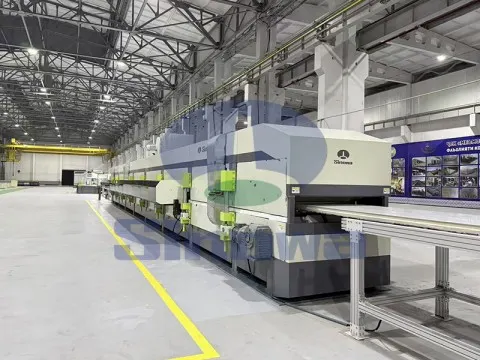
After raw material pretreatment, the production process enters the gluing and composite pressing stage, which is the core procedure determining the bonding strength and overall structural stability of sandwich panels. The production line is equipped with an intelligent gluing system that evenly coats high-performance adhesive on the inner surfaces of the upper and lower metal substrates. The gluing speed and coating thickness can be adjusted according to different material characteristics and production requirements, forming a uniform and dense adhesive layer without overflow or missing coating. In the subsequent composite pressing unit, multi-group pressing rollers with precise pressure control are adopted to closely bond the surface substrates with the intermediate core materials. The pressing system can maintain constant pressure throughout the molding process, and the internal temperature of the pressing cabin is stably controlled within a reasonable range to accelerate adhesive curing and enhance the integration between layers. Compared with traditional processing equipment, this optimized pressing structure effectively reduces the probability of interlayer separation and hollow bulging of finished panels, significantly improving the overall durability and compression resistance of the products.
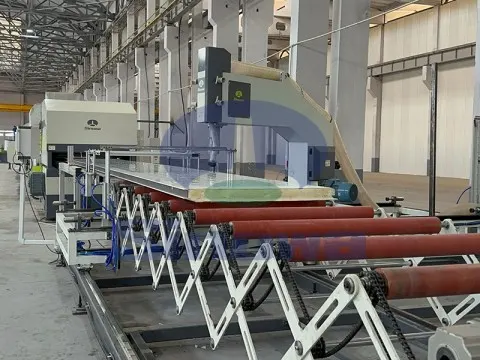
The continuous forming and cutting system further realizes standardized sizing and shaping of semi-finished sandwich panels. After composite pressing, the initially molded panels are continuously conveyed along the production track, and the shaping mechanism calibrates the panel width and flatness in real time to ensure consistent external dimensions of each batch of products. The high-precision cutting device installed at the rear section of the production line adopts intelligent induction positioning technology, which can automatically identify the panel conveying length and complete fixed-length cutting without manual marking and measurement. The cutting blade is made of wear-resistant materials, capable of achieving smooth and burr-free cutting sections, avoiding material deformation and edge damage during cutting. In addition, the cutting system supports flexible adjustment of cutting parameters, enabling the production line to process panels of different lengths to meet the customized size demands of different construction projects. The automated cutting mode not only improves production efficiency but also minimizes material waste generated by manual cutting operations.
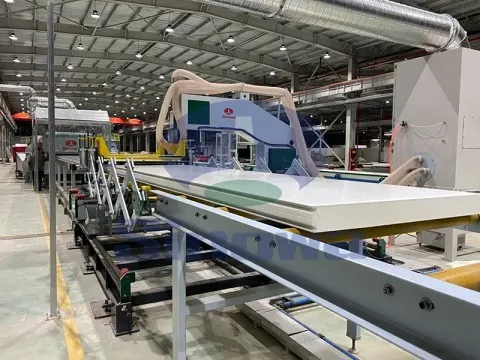
The post-processing and finished product sorting system acts as the final guarantee for the quality of sandwich panels, including surface cleaning, edge trimming, stacking and packaging functions. After cutting, residual adhesive and tiny metal debris on the panel surface are removed by the automatic cleaning device, which enhances the surface smoothness and appearance quality of the panels. The edge trimming mechanism precisely polishes the four edges of the panels to eliminate sharp corners and irregular edges, making the panels safer and more convenient for on-site assembly. Subsequently, the qualified finished panels are automatically stacked by the mechanical stacking device, with adjustable stacking height and neat arrangement to save storage space. The packaging unit adopts waterproof and dustproof packaging materials to wrap the stacked panels, preventing surface scratches, moisture corrosion and dust contamination during transportation and storage. All post-processing procedures are completed in an automated assembly line, reducing manual contact with finished products and lowering the risk of artificial damage.
This series of sandwich panel production lines has prominent performance advantages in actual industrial production. In terms of automation level, the whole production process is controlled by an integrated intelligent control system, which can centrally adjust the operating parameters of each functional unit. Operators only need to set production parameters on the human-machine interaction interface to realize unattended continuous operation of the assembly line. The system has real-time monitoring functions for equipment operating status, which can automatically identify abnormal conditions such as equipment jamming and parameter deviation, and trigger prompt feedback to reduce equipment failure downtime. In terms of production efficiency, the continuous circulating production structure shortens the interval between each processing link, and the daily output of the production line can meet the mass procurement needs of large-scale construction projects. Meanwhile, the modular equipment layout simplifies the internal transmission path of materials, reducing energy consumption during equipment operation and realizing energy-saving production.
In terms of product compatibility, the production line can adapt to the processing requirements of various types of sandwich panels. By adjusting the feeding mechanism and pressing parameters, it can produce thermal insulation panels with foam cores, fireproof panels with rock wool cores and sound insulation panels with glass wool cores. The surface metal substrates can also be replaced according to usage scenarios, meeting the differentiated performance requirements of different industries. The finished sandwich panels produced by this equipment have excellent thermal insulation performance, effectively reducing the energy consumption of building temperature regulation; they also feature good fire resistance, sound insulation and shock resistance, adapting to harsh usage environments such as low-temperature cold storage and humid industrial workshops. In addition, the lightweight characteristics of the panels reduce the bearing load of building structures, lowering the construction difficulty and comprehensive engineering cost.
From the perspective of equipment operation and maintenance, the sold sandwich panel production lines adopt a simplified structural design, with independent and detachable functional modules for easy daily inspection and parts replacement. Key moving components are equipped with wear-resistant protective structures to extend the service life of the equipment under long-term high-intensity operation. The lubrication system is arranged in a targeted manner for friction parts, which can regularly supplement lubricating oil to reduce mechanical wear and operating noise. The equipment shell adopts anti-corrosion metal materials, which can resist external moisture and dust erosion, ensuring stable operation in different factory environments. Moreover, the production line is equipped with a safe and humanized operating logic, with multiple emergency protection devices installed. Once abnormal operating conditions occur, the equipment can automatically stop running to avoid safety hazards for operators and equipment damage.
In the context of the booming global green building industry, the market application prospects of sandwich panel production lines are extremely broad. The acceleration of urban infrastructure construction, the expansion of industrial park scale and the increasing demand for temporary movable buildings in various regions have continuously driven the market consumption of sandwich panels. Many building material manufacturers choose to purchase automated production lines to expand production scale and optimize product quality. This type of production line not only meets the mass production demand of the building materials industry but also adapts to the customized production mode of small-batch and multi-specification products, bringing flexible operation space for enterprise production and operation. In addition, with the continuous improvement of environmental protection production standards in various countries, the production line adopts closed material transmission and dust removal structures, which can effectively control dust and adhesive volatile emissions during the production process, conforming to the current green and environmentally friendly production development trend.
For investors and building material processing enterprises looking to expand production capacity, purchasing a high-quality sandwich panel production line is an effective way to improve market competitiveness. The production line has reasonable overall structural design, stable operating performance and low later maintenance cost, which can create stable economic benefits for enterprises in the long-term production process. Compared with scattered single processing equipment, the integrated assembly line saves factory space, reduces manual labor investment, and simplifies the production management process. The products manufactured have uniform quality and wide application coverage, which can meet the procurement needs of engineering contractors, building material distributors and construction enterprises. In addition, the equipment has strong scalability, and subsequent functional modules can be added according to market demand changes to expand the production types of panels, realizing the long-term sustainable development of production enterprises.
In conclusion, the available sandwich panel production lines integrate advanced production technology, automated control logic and humanized structural design, covering all processing links from raw material processing to finished product packaging. With the advantages of stable operation, wide compatibility, high production efficiency and low comprehensive consumption, the equipment can effectively help building material manufacturers realize standardized and large-scale production of sandwich panels. Driven by the continuous development of the global construction industry and the upgrading of energy-saving building materials, high-performance sandwich panel production lines will occupy a more important position in the building materials manufacturing market. This equipment is suitable for new production plants and old production line renovation projects, providing reliable production support for enterprises to seize market share and optimize product structure, and it is an ideal processing equipment choice for the modern building materials industry.
Sinowa is a professional manufacturer of sandwich panel machine in china, we provide diversified and high-performance sandwich panel production lines, including fully automatic continuous PU sandwich panel line and customized special lines to meet mass production and personalized order demands. These sandwich panel lines support processing multiple foam core materials, such as PU, PIR, mineral wool, rock wool and glass wool, covering different insulation and fireproof standards.
Featuring stable operation, high efficiency, energy saving and easy maintenance, our PU sandwich panel line deliver sandwich panels with excellent thermal insulation, fire resistance, sound insulation and lightweight durability. The finished panels are widely applied in industrial workshops, warehouse roofing and wall cladding, cold storage insulation, serving global construction and industrial insulation markets.
https://www.cnsinowa.com/sandwich-panel-machines/sandwich-panel-production-line-for-sale.html