 sandwich panel line
A reliable sandwich panel production line supplier is committed to designing and building highly integrated and automated production systems that can adapt to diverse raw material combinations and production demands. A complete production line involves multiple interconnected mechanical systems, covering raw material pretreatment, automatic feeding, continuous compounding, constant temperature curing, fixed-size cutting, surface trimming and finished product conveying. Each functional module is precisely matched in operating speed and processing parameters to ensure the continuity and stability of the entire production process. Unlike single mechanical equipment, the integrated production line emphasizes the collaborative operation of all components, and professional suppliers always take overall production logic and long-term operating stability as the core design concepts during the equipment development stage. They conduct in-depth research on the physical characteristics of different core materials and surface materials, so that the production line can realize adaptive adjustment for various raw material formulas.
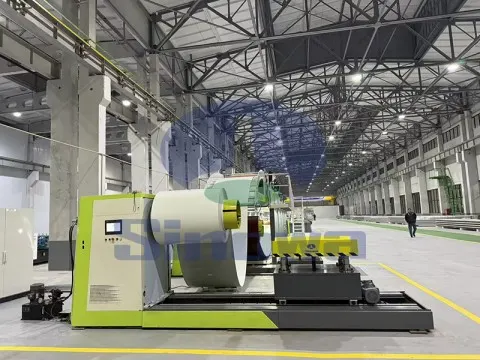
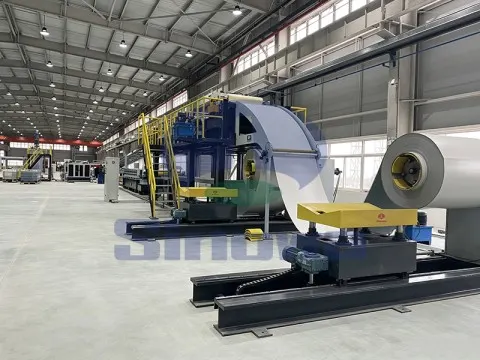
The structural design of modern sandwich panel production lines fully reflects the integration of mechanical automation and intelligent control technology. The whole production system is mainly composed of raw material conveying units, surface material processing units, core material laying and shaping units, thermal pressing and curing units, precision cutting units and intelligent control units. In the raw material processing link, the equipment realizes automatic sorting and preliminary shaping of raw materials, removing impurities and defective parts that affect product quality. For flexible surface materials, the rolling and unwinding structure can maintain constant tension during operation, effectively avoiding surface wrinkles, deformation and uneven stretching in the high-speed moving state. This precise tension control technology is crucial to ensure the flatness and appearance quality of finished panels, and it is also one of the key technical advantages mastered by excellent suppliers.
In the core material processing stage, professional suppliers optimize the internal structure of the production line according to the physical properties of different core materials. Common core materials include foam polymer materials and inorganic fiber materials, which have distinct differences in density, porosity and compression resistance. For porous foam core materials, the production line is equipped with uniform spraying and pouring devices to ensure that the foaming raw materials are evenly distributed between the upper and lower surface materials, forming a dense and consistent foaming structure after chemical reaction. For inorganic fiber core materials, the equipment adopts layered paving and compacting structures to arrange fiber materials neatly and tightly, improving the overall compression resistance and fire resistance of composite panels. All material feeding links adopt quantitative metering devices, which can accurately control the feeding amount of raw materials and avoid performance differences between batches of products caused by raw material proportion deviation.
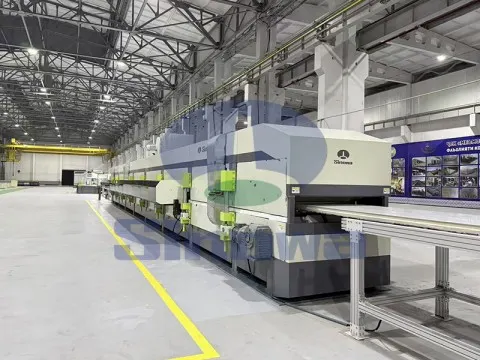
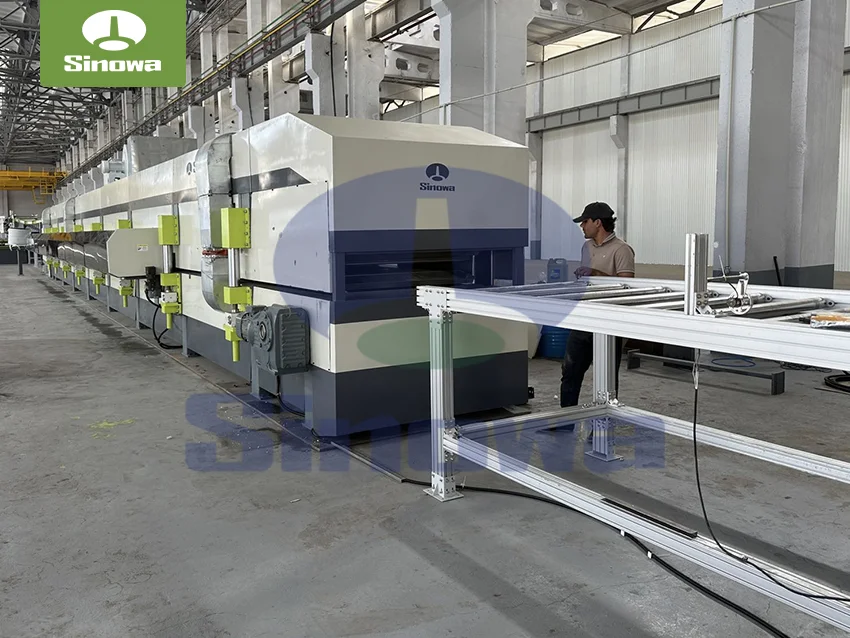
The compounding and curing process is the core link that determines the bonding strength and structural stability of sandwich panels, and it is also the key optimization direction for professional production line suppliers. After the surface materials and core materials are initially combined, the semi-finished products are sent to the constant temperature curing area through the conveying track. The internal space of the curing area is equipped with evenly distributed heating components and air circulation structures, which can maintain a stable temperature field inside the area. A moderate temperature environment can accelerate the curing reaction of the bonding medium between layers, so that the surface materials and core materials can form a firm integrated structure. During this process, the intelligent sensing system monitors the internal temperature and operating speed in real time, and automatically fine-tunes the operating parameters according to the production state to prevent product quality defects such as degumming and bulging caused by excessive temperature or insufficient curing time. Suppliers keep optimizing the temperature control logic and internal insulation structure of the curing area to reduce energy consumption while ensuring curing efficiency.
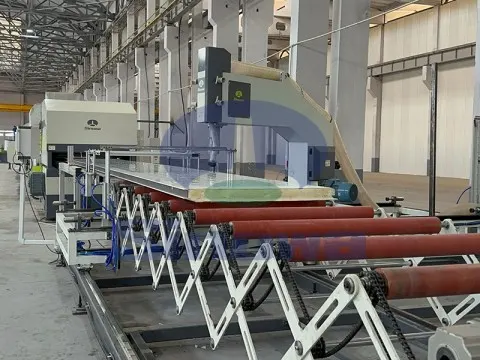
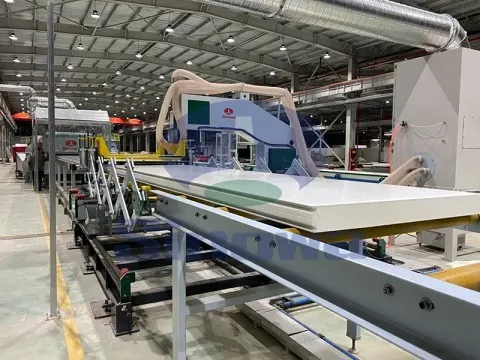
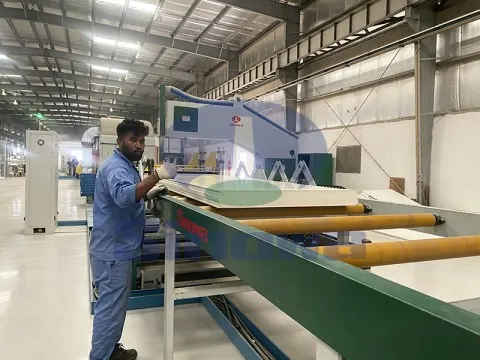
After the curing process is completed, the continuous plate strips enter the precision cutting and trimming stage. The production line is equipped with high-speed cutting assemblies, which can complete fixed-length cutting according to customized dimensional requirements. The cutting components adopt high-hardness structural materials, which can maintain stable cutting accuracy during long-term continuous operation, ensuring neat and smooth cutting sections without burrs or edge warping. At the same time, the edge trimming device can polish and modify the edges of the panels to eliminate tiny irregularities generated in the compounding process and further improve the appearance finish of finished products. All cutting and trimming actions are linked with the front-end conveying system, realizing synchronous operation without manual intervention, which greatly improves production efficiency and reduces the error rate caused by human operation.
Excellent sandwich panel production line suppliers not only focus on the mechanical performance of equipment, but also pay attention to the humanized design of the overall production line. The equipment layout follows the principles of reasonable flow direction and compact space occupation, which can effectively save the floor area of the production workshop and facilitate the daily management of production enterprises. The key operating parts of the production line are equipped with closed protective structures to reduce dust and noise generated during mechanical operation, creating a cleaner and safer production environment. In addition, the equipment reserves convenient maintenance channels for vulnerable parts, and the modular structural design enables operators to quickly disassemble, replace and debug components, effectively shortening the equipment maintenance cycle and reducing the shutdown loss caused by equipment failure.
In terms of intelligent control, modern production lines adopt integrated control systems with simple and intuitive operation logic. The centralized control panel can display the operating status of each module in real time, including conveying speed, curing temperature, raw material consumption and cutting parameters. Production personnel can complete parameter setting, mode switching and equipment start-stop control through simple operation steps. The system has an automatic early warning function, which can identify abnormal data such as equipment stalling, temperature fluctuation and raw material blockage in the production process, and feed back fault information in a timely manner to help staff quickly locate and solve problems. Suppliers continuously upgrade the control system logic according to the actual production feedback of users, optimize the human-computer interaction mode, and reduce the professional threshold for equipment operation.
When providing production line solutions for customers, professional suppliers will conduct targeted scheme design combined with customers' production scale, product positioning and application scenarios. For small and medium-sized manufacturing enterprises with flexible production demands, suppliers provide compact and cost-effective simplified production lines, which can meet the production needs of conventional specification panels and have low requirements for workshop space and personnel matching. For large-scale manufacturers with mass production demands, suppliers design fully automated large-scale production lines with higher operating speed and stronger continuous production capacity, and expand the supporting functions of the equipment to realize the diversified production of multi-specification and multi-material composite panels. This differentiated customization service enables each customer to obtain production equipment that matches their own development needs.
In addition to equipment manufacturing and sales, high-quality suppliers also provide comprehensive after-sales technical services throughout the cycle. In the equipment installation stage, professional technical personnel complete on-site assembly, debugging and line connection work to ensure that all modules operate in coordination and meet the production design standards. In the early stage of equipment operation, suppliers provide systematic operation training for customer staff, including daily operation specifications, parameter adjustment methods, common fault identification and daily maintenance skills. In the long-term use stage of the equipment, suppliers provide remote technical consultation and regular return visit services to track the equipment operation status, give targeted optimization suggestions according to the customer's production data, and help customers continuously improve production efficiency and product qualification rate.
With the increasing awareness of environmental protection in the global manufacturing industry, energy conservation and emission reduction have become important indicators for suppliers to optimize production line performance. Advanced production lines adopt energy-saving heating structures and low-power transmission components, which effectively reduce energy consumption per unit of products. At the same time, the equipment is equipped with waste collection devices, which can recycle leftover materials generated in the cutting process, realizing secondary utilization of raw materials and reducing resource waste. Suppliers keep researching and applying environmentally friendly processing technologies, optimizing the internal mechanical friction structure to reduce energy loss during equipment operation, so as to balance production efficiency and environmental protection benefits.
In the international market, the market competitiveness of sandwich panel production line suppliers depends on equipment stability, technical innovation capability and service completeness. Different regions have different requirements for panel performance due to climatic conditions and industrial standards. For high-latitude cold regions, suppliers will strengthen the low-temperature resistance of equipment components and optimize the thermal insulation structure of the curing system to adapt to low-temperature production environments. For high-temperature and humid regions, the equipment is treated with anti-corrosion and rust prevention to extend the service life of mechanical structures. This regional adaptive optimization capability enables suppliers to steadily expand their market coverage and meet the differentiated production needs of global customers.
Looking at the long-term development trend of the industry, the technological iteration speed of sandwich panel production lines is constantly accelerating. With the continuous upgrading of new composite materials, suppliers need to continuously carry out technological research and development, adjust equipment structural parameters and processing technologies to adapt to new material formulas and new product standards. In the future, production lines will develop towards higher intelligence, stronger integration and lower energy consumption. More automated detection devices will be embedded in the production link to realize real-time identification and elimination of defective products. The data management system will record the whole production process data to provide reliable data support for enterprise production optimization and quality control.
In conclusion, sandwich panel line suppliers are important promoters of the composite material manufacturing industry. They rely on professional mechanical design capability, mature production technology and perfect service system to provide reliable equipment support for sandwich panel manufacturers. From raw material processing to finished product output, every optimization detail of the production line is derived from the in-depth research and technical precipitation of suppliers. In the context of the continuous prosperity of the global construction industry and the continuous expansion of composite material application fields, excellent suppliers will continue to focus on technological innovation, optimize product performance and service system, and create more efficient, stable and environmentally friendly production equipment for the industry, so as to promote the sustainable and high-quality development of the entire sandwich panel manufacturing industry.
Sinowa is a professional manufacturer of sandwich panel machine in china, we provide diversified and high-performance sandwich panel production lines, including fully automatic continuous PU sandwich panel line and customized special lines to meet mass production and personalized order demands. These sandwich panel lines support processing multiple foam core materials, such as PU, PIR, mineral wool, rock wool and glass wool, covering different insulation and fireproof standards.
Featuring stable operation, high efficiency, energy saving and easy maintenance, our PU sandwich panel line deliver sandwich panels with excellent thermal insulation, fire resistance, sound insulation and lightweight durability. The finished panels are widely applied in industrial workshops, warehouse roofing and wall cladding, cold storage insulation, serving global construction and industrial insulation markets.
https://www.cnsinowa.com/sandwich-panel-machines/sandwich-panel-production-line-supplier.html