sandwich panel line
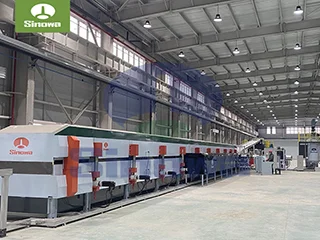
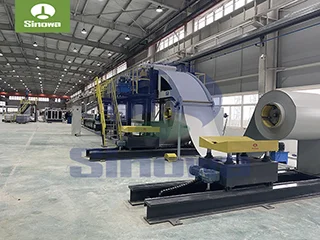
At its core, the structure of a soundproof insulation board production line follows a continuous, linear workflow that begins with raw material preparation and ends with finished product finishing and packaging, eliminating manual handling at key stages to enhance product uniformity and production efficiency. The initial stage consists of a raw material storage and metering system, where bulk materials such as mineral fibers, polymer binders, lightweight aggregates, and functional additives are stored in sealed silos or hoppers to prevent moisture absorption and contamination. Automated weighing and dosing equipment precisely measures each component according to pre-set formulations, ensuring consistent material ratios that directly impact the final board’s performance; this level of accuracy is vital, as even minor variations in material composition can alter sound transmission rates, thermal conductivity, and mechanical strength. Following metering, the raw materials are transferred to a high-speed mixing station, where dry ingredients are blended uniformly before the addition of liquid binders or water, creating a homogeneous mixture that forms the base matrix of the insulation board. For fiber-based boards, this mixing process is optimized to preserve fiber integrity, as long, intact fibers contribute significantly to both sound absorption and structural stability.
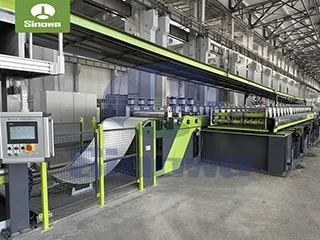
The next critical phase in the production line is forming and shaping, which varies significantly based on the type of insulation board being manufactured, but follows a standardized automated process across all configurations. For wet-process composite boards, the mixed slurry is evenly spread onto a continuous moving conveyor belt, often lined with a protective facing material to enhance surface smoothness and structural integrity. A precision leveling roller then compresses the slurry to the desired thickness, removing excess air bubbles and ensuring a uniform density across the entire board surface; this step is crucial for consistent sound insulation performance, as uneven density can create weak points where sound waves can easily penetrate. For dry-process and fiber-based boards, such as mineral wool or fiberglass boards, the forming stage involves fiber laying and needle punching or hot pressing, where loose fibers are distributed evenly in a layered format and bonded together under controlled heat and pressure to form a rigid, porous board structure. The production line integrates temperature and pressure control systems that monitor and adjust parameters in real time, ensuring the bonding process is complete without over-compression, which could reduce the porous structure responsible for sound absorption.
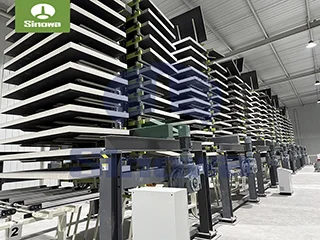
After forming, the semi-finished boards move through a curing and drying section, a key structural component that determines the board’s final mechanical strength and durability. This section typically consists of a series of temperature-controlled drying chambers or continuous oven tunnels, where boards are exposed to gradual, controlled heating to remove moisture, cure binders, and solidify the composite structure. The curing process is carefully calibrated to avoid rapid temperature changes, which can cause warping, cracking, or internal stress in the boards; slow, uniform drying ensures the boards maintain their shape and structural integrity over long-term use. Once cured, the boards proceed to a cooling station, where ambient air circulation brings them to room temperature before further processing. The final structural stages of the production line include precision cutting, edge trimming, and surface treatment. Automated cutting equipment, guided by digital control systems, trims the continuous board sheets into standard or custom sizes, with clean, straight edges that facilitate easy installation on construction sites. Some production lines also include optional surface treatment stations, such as sanding, laminating, or grooving, to enhance the board’s compatibility with adhesives, paints, or decorative finishes, expanding its versatility for different applications.
Beyond structural design, the performance of soundproof insulation boards produced by these lines is defined by a set of core physical and functional properties that make them indispensable in modern building and industrial projects. The primary performance metrics include acoustic performance, thermal insulation capacity, mechanical strength, moisture resistance, and dimensional stability, all of which are directly shaped by the production line’s process control and raw material formulation. Acoustically, these boards operate through two key mechanisms: sound insulation and sound absorption. Sound insulation refers to the ability to block airborne sound waves from passing through the board, a function driven by the board’s density, thickness, and homogeneous structure; denser boards with minimal voids are more effective at blocking high-frequency noise such as voices, electronics, and traffic, while porous boards excel at absorbing sound waves, reducing echo and reverberation within enclosed spaces. This dual acoustic performance makes the boards suitable for both separating spaces to prevent sound transfer and improving internal acoustic quality within a single room.
Thermally, the insulation performance of these boards is measured by thermal conductivity, with lower values indicating better heat retention and energy efficiency. The porous, fibrous, or cellular internal structure of the boards traps stationary air within small pockets, and air is a natural poor conductor of heat, creating an effective thermal barrier that reduces heat transfer between the interior and exterior of a building. This thermal insulation capability not only enhances indoor comfort by maintaining consistent temperatures but also reduces the load on heating, ventilation, and air conditioning systems, contributing to long-term energy savings. Mechanically, the boards are designed to have sufficient compressive strength, flexural strength, and impact resistance to withstand handling, transportation, and installation stresses, as well as long-term structural loads in wall, ceiling, and floor applications. High-quality boards produced by well-designed production lines maintain their structural integrity under normal building loads, without sagging, cracking, or crumbling over time. Additionally, good moisture resistance prevents the boards from absorbing water, which can degrade both thermal and acoustic performance, promote mold growth, and reduce lifespan; the production process often includes hydrophobic additives and controlled curing to enhance water repellency without compromising other performance traits.
Dimensional stability is another key performance feature, ensuring the boards do not expand, contract, or warp with changes in temperature and humidity, a critical factor for tight-fitting installation and long-term performance. Boards with high dimensional stability maintain their original size and shape, creating seamless joints that prevent sound leaks and thermal bridging, which are common issues with low-quality insulation materials. The production line’s precise forming, curing, and cooling processes directly influence this stability, as uniform material distribution and controlled drying eliminate internal stresses that cause dimensional changes. Collectively, these performance properties make soundproof insulation boards a versatile material that outperforms traditional single-function insulation or soundproofing materials, offering a cost-effective, space-saving solution for integrated thermal and acoustic management.
Soundproof insulation boards are categorized into several distinct types based on their raw material composition, manufacturing process, and core performance characteristics, each optimized for specific application scenarios, and the production line is adaptable to produce these different types with minimal reconfiguration. The most common categories include mineral fiber boards, fiberglass composite boards, foam-based composite boards, gypsum-based acoustic boards, and plant fiber composite boards, each with unique structural and functional advantages. Mineral fiber boards, typically made from basalt, slag, or other natural mineral raw materials processed into fine fibers, are known for their exceptional fire resistance, high sound absorption, and reliable thermal insulation. Produced through a high-temperature melting, fiberization, and hot-pressing process, these boards have a dense, porous structure that effectively blocks mid-to-low frequency noise, such as machinery vibration and traffic rumble, and maintains stable performance in high-temperature environments. They are rigid, durable, and resistant to pests and rot, making them suitable for both interior and exterior building applications, as well as industrial facilities.
Fiberglass composite boards are made from fine glass fibers bonded with thermosetting resins, offering a lightweight yet strong alternative to mineral fiber boards. These boards have an open porous structure that delivers excellent sound absorption, particularly for high-frequency noise, and low thermal conductivity for efficient insulation. They are highly flexible in terms of thickness and density, and the production line can easily adjust fiber density and resin content to tailor performance for specific needs; fiberglass boards are also moisture-resistant and non-combustible, making them ideal for indoor applications where weight and ease of handling are important. Foam-based composite boards, produced by injecting or mixing polymer foams with rigid facing materials, feature a closed-cell structure that provides exceptional sound insulation (airborne sound blocking) and superior thermal insulation, with very low thermal conductivity. These boards are lightweight, easy to cut and install, and effective at preventing sound transfer between rooms, making them popular for residential and commercial interior construction. While their sound absorption is lower than porous fiber boards, their sound insulation performance is unmatched for separating living or working spaces.
Gypsum-based acoustic boards are a specialized type of soundproof insulation board that combines gypsum core with added fibers and porous fillers, designed primarily for interior wall and ceiling applications. These boards offer moderate sound insulation and good sound absorption, along with excellent fire resistance and smooth surface finish, allowing for direct painting or wallpapering without additional surface treatment. The production process for gypsum-based boards is more streamlined, with a wet-forming and rapid drying process that enables high output volumes, making them a cost-effective choice for standard residential and commercial projects. Plant fiber composite boards, made from renewable plant fibers such as wood fiber, bamboo fiber, or agricultural waste fibers bonded with eco-friendly binders, are a sustainable alternative with good acoustic and thermal performance. These boards have a natural porous structure, low environmental impact, and are suitable for eco-conscious building projects, offering sufficient sound absorption and insulation for indoor living spaces, offices, and public buildings.
The versatility of soundproof insulation boards produced by these automated lines is reflected in their wide range of applications across residential, commercial, industrial, and public infrastructure sectors, with each type of board selected based on the specific acoustic and thermal requirements of the space. In residential construction, these boards are extensively used in apartment buildings, townhouses, single-family homes, and condominiums to address common noise issues between adjacent units, from footfall impact noise to airborne noise from televisions, conversations, and household appliances. They are installed in interior walls, partition walls, suspended ceilings, and underfloor structures, creating private, quiet living spaces while improving energy efficiency by reducing heat loss in winter and heat gain in summer. Home theaters, music rooms, and home offices benefit greatly from the sound absorption properties of these boards, eliminating echo and ensuring clear audio quality without disturbing other household members.
In commercial and public buildings, the applications are even more diverse, covering offices, schools, hospitals, hotels, shopping malls, libraries, and auditoriums. Open-plan offices often use these boards in partition walls and ceiling panels to reduce background noise and improve speech clarity, enhancing employee focus and productivity; private meeting rooms and executive offices rely on the sound insulation properties to ensure confidentiality. Educational facilities such as classrooms, lecture halls, and school auditoriums use soundproof insulation boards to minimize external noise interference and reduce internal reverberation, creating an optimal learning environment where students can hear instructions clearly and teachers can communicate effectively. Hospitals and medical clinics require quiet spaces for patient recovery, rest, and confidential consultations, and these boards are used in patient rooms, operating room corridors, and medical offices to block noise from medical equipment, foot traffic, and other wards, promoting faster healing and maintaining patient privacy.
Hotels, restaurants, and hospitality venues use these boards to create tranquil guest rooms, private dining areas, and lobby spaces, enhancing the customer experience by reducing noise from hallways, adjacent rooms, and busy public areas. Libraries, museums, and art galleries rely on the acoustic performance to maintain quiet, focused environments for visitors, while also benefiting from the thermal insulation to protect sensitive collections and artifacts. In industrial and manufacturing settings, soundproof insulation boards are used to line factory walls, machinery enclosures, and workshop partitions to reduce noise pollution from heavy machinery, production equipment, and industrial processes, protecting workers from prolonged exposure to high noise levels and complying with workplace acoustic safety standards. They are also used in power plants, warehouses, and logistics facilities to control noise and improve thermal management, creating safer and more comfortable working conditions for employees.
Additionally, these boards find applications in transportation infrastructure, such as train stations, airports, and bus terminals, where high levels of ambient noise from vehicles and passenger traffic require effective sound control. They are used in wall cladding, ceiling panels, and waiting area partitions to reduce noise reverberation and create more pleasant waiting environments. Entertainment venues, including theaters, concert halls, recording studios, and cinema halls, depend on high-performance soundproof insulation boards to achieve precise acoustic control, blocking external noise and optimizing internal sound quality for audiences and performers. The boards’ ability to balance sound absorption and insulation ensures clear audio reproduction, eliminating echo and sound distortion that can ruin the entertainment experience.
The design and functionality of soundproof insulation board production lines continue to evolve alongside advancements in material science and manufacturing automation, with a focus on improving production efficiency, reducing material waste, and enhancing product performance consistency. Modern production lines integrate digital control systems that monitor every stage of the manufacturing process, from raw material metering to final cutting, allowing for real-time adjustments to ensure each batch of boards meets the desired performance specifications. The modular structure of these lines also allows for easy upgrades and customization, enabling manufacturers to adapt to changing market demands for sustainable materials, higher acoustic performance, and specialized board sizes. As global emphasis on building energy efficiency and indoor environmental quality grows, the role of these production lines becomes increasingly important, as they enable the mass production of high-quality, multi-functional soundproof insulation boards that meet the diverse needs of modern construction and industrial projects without relying on brand differentiation or external certifications.
In summary, the soundproof insulation board production line is a sophisticated, integrated manufacturing system that combines structural precision, automated process control, and material science to produce boards with exceptional dual performance of sound management and thermal insulation. Its well-designed linear structure ensures efficient, consistent production, while the resulting boards offer a unique combination of acoustic performance, thermal efficiency, mechanical strength, and versatility across multiple types. From residential buildings to industrial facilities, public infrastructure to entertainment venues, these boards play a vital role in creating comfortable, quiet, energy-efficient spaces, making the production line a cornerstone of modern material manufacturing. The ongoing refinement of production processes and material formulations will continue to expand the capabilities and applications of these boards, solidifying their position as an essential component in sustainable, high-performance building design and industrial noise control solutions.
https://www.cnsinowa.com/sandwich-panel-machines/soundproof-insulation-board-production-line.html