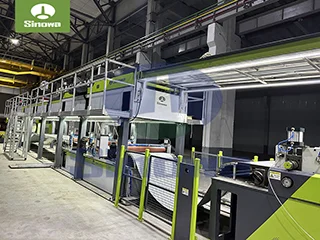
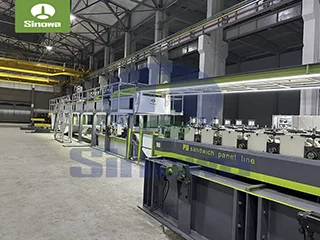
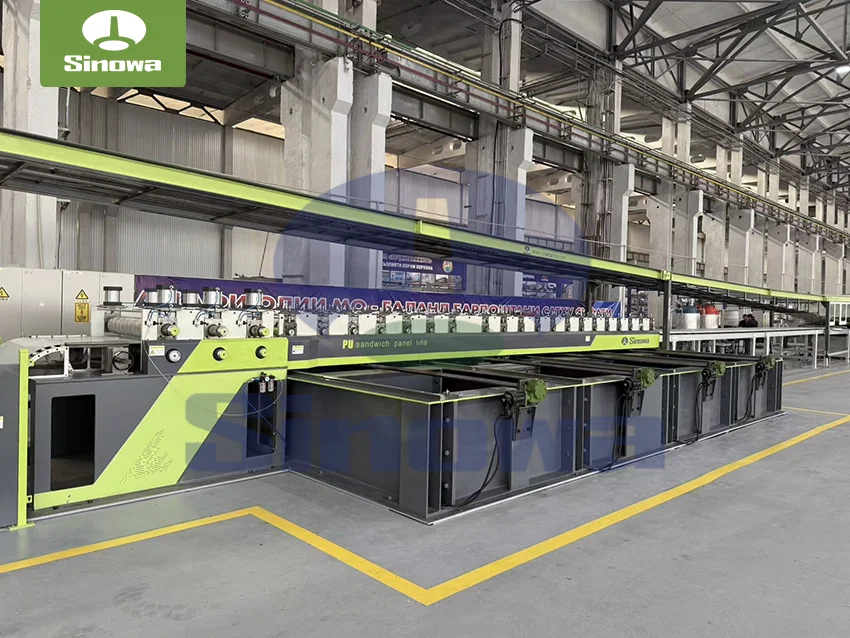
 sandwich panel machine
To understand the significance of the PIR sandwich panel machine, it is first essential to recognize the unique properties of PIR foam that make it an ideal core material for prefabricated house panels. PIR is a thermosetting plastic formed by the reaction of polyols and isocyanates, characterized by a closed-cell structure that provides excellent thermal insulation properties—far superior to traditional insulation materials such as EPS (expanded polystyrene) or XPS (extruded polystyrene). Its low thermal conductivity ensures that prefabricated houses maintain stable internal temperatures, reducing energy consumption for heating and cooling and contributing to environmental sustainability. Additionally, PIR foam exhibits high fire resistance, meeting strict fire safety standards, which is a critical requirement for residential buildings. It also boasts impressive structural strength-to-weight ratio, meaning that PIR sandwich panels are lightweight yet capable of withstanding significant loads, reducing the overall weight of prefabricated structures and simplifying transportation and installation. However, harnessing these properties effectively requires a manufacturing process that ensures precise control over material mixing, foaming, and composite bonding—tasks that the PIR sandwich panel machine is designed to perform with exceptional accuracy.
The operational process of a PIR sandwich panel machine is a seamless integration of multiple stages, each optimized to ensure the production of high-quality panels. The process typically begins with raw material preparation, where the outer facing materials (in the form of coils) are unwound and fed into the machine through a series of guiding and leveling rollers. These rollers ensure that the facings are flat and properly aligned, preventing wrinkles or misalignment that could affect the final product's quality. Depending on the specific requirements of the prefabricated house panels, the outer facings may undergo additional preprocessing steps, such as profiling to create corrugated or trapezoidal shapes that enhance structural rigidity. Simultaneously, the raw materials for the PIR foam core—including polyols, isocyanates, catalysts, foaming agents, and flame retardants—are stored in separate tanks and precisely measured by metering pumps. The accuracy of these metering pumps is crucial, as any deviation in the ratio of raw materials can compromise the foam's properties, affecting insulation, fire resistance, and bonding strength.
Once the raw materials are prepared, the machine proceeds to the foaming and composite bonding stage—a critical phase that defines the integrity of the PIR sandwich panel. The measured PIR raw materials are injected into a high-pressure mixing head, where they are thoroughly mixed to initiate the foaming reaction. The mixed material is then uniformly distributed onto the lower facing material, which is moving along a conveyor belt. As the lower facing advances, the upper facing material is fed over the foaming PIR core, and the entire assembly is introduced into a continuous laminating press. This press applies precise pressure and temperature to the composite structure, ensuring that the PIR foam expands evenly to fill the space between the two facings and forms a strong bond with both. The temperature and pressure parameters are carefully controlled to optimize the foaming reaction and ensure complete curing of the PIR foam. This stage is particularly important for achieving a consistent core density, which directly impacts the panel's thermal insulation and structural performance. Modern PIR sandwich panel machines are equipped with advanced control systems that monitor and adjust these parameters in real time, ensuring uniformity across the entire production run.
After the composite structure has been cured in the laminating press, it moves to the cooling and cutting stage. The newly formed PIR sandwich panel is passed through a cooling zone, where it is gradually cooled to room temperature to stabilize its structure and prevent warping. Once cooled, the panel is fed into a precision cutting system, which trims the edges to ensure uniform dimensions and cuts the panel into the required lengths according to customer specifications. Some advanced machines also offer additional processing capabilities, such as edge sealing or grooving, which prepare the panels for easy assembly on the construction site. Edge sealing, in particular, is beneficial for enhancing the panel's moisture resistance, preventing water ingress that could degrade the PIR core over time. Throughout the entire process, the machine operates continuously, minimizing production downtime and maximizing efficiency—a key advantage for meeting the high-volume demands of the prefabricated housing industry.
One of the most notable features of modern PIR sandwich panel machines is their modular design, which provides exceptional flexibility and adaptability. Prefabricated house panels come in a wide range of specifications, including different thicknesses, sizes, and facing materials, to accommodate various architectural designs and climate conditions. Modular machines allow manufacturers to easily reconfigure components or switch between different production settings to produce panels with varying characteristics. For example, by adjusting the metering pumps and laminating press parameters, the same machine can produce panels with different core thicknesses (ranging from 10mm to 200mm or more) or switch between producing wall panels, roof panels, or cold storage panels—all of which are commonly used in prefabricated housing. This flexibility eliminates the need for multiple specialized machines, reducing capital investment and increasing production efficiency. Additionally, modular design simplifies maintenance and repair, as individual components can be easily accessed and replaced without disrupting the entire production line.
Automation is another key attribute of modern PIR sandwich panel machines, contributing significantly to their efficiency and reliability. Advanced machines are equipped with centralized control systems that integrate all production stages, allowing operators to monitor and control the entire process from a single console. These control systems use sensors and feedback mechanisms to detect and correct any deviations in production parameters, such as material flow rates, temperature, or pressure, ensuring consistent product quality. Automation also reduces the need for manual intervention, minimizing the risk of human error and improving workplace safety. For example, automated guiding and leveling systems ensure precise alignment of the outer facings, while automated cutting systems guarantee accurate dimensions without the need for manual measurement. Furthermore, some machines offer remote monitoring and control capabilities, allowing manufacturers to oversee production operations from off-site locations and quickly address any issues that may arise. This level of automation not only improves production efficiency but also reduces labor costs, making PIR sandwich panel production more economically viable.
The role of PIR sandwich panel machines in promoting the growth of the prefabricated housing industry cannot be overstated. Prefabricated construction is favored for its ability to reduce construction time, minimize on-site waste, and improve construction quality—advantages that are particularly important in response to the growing demand for affordable and sustainable housing. PIR sandwich panels, produced efficiently by these machines, are a key enabler of these benefits. Their lightweight nature reduces transportation costs and simplifies on-site assembly, allowing prefabricated houses to be constructed in a fraction of the time required for traditional brick-and-mortar buildings. Additionally, the excellent thermal insulation properties of PIR panels reduce energy consumption, making prefabricated houses more energy-efficient and environmentally friendly. For example, in cold climates, PIR-insulated prefabricated houses require less heating, while in hot climates, they remain cooler with minimal air conditioning, reducing carbon emissions and energy bills for homeowners.
Moreover, PIR sandwich panel machines contribute to the standardization of prefabricated house components, which is essential for the scalability of prefabricated construction. By producing panels with consistent dimensions and properties, these machines ensure that components from different production batches are interchangeable, simplifying the assembly process and reducing the risk of errors. This standardization also allows manufacturers to mass-produce panels, meeting the high-volume demands of large-scale prefabricated housing projects. In addition, the ability to produce customized panels quickly and efficiently enables architects and designers to explore more innovative and diverse prefabricated housing designs, expanding the appeal of prefabricated construction in the residential market.
The environmental impact of PIR sandwich panel machines and the panels they produce is another important consideration in today's sustainable construction landscape. Modern machines are designed with energy efficiency in mind, incorporating features such as low-power motors, heat recovery systems, and optimized heating and cooling processes to minimize energy consumption. Additionally, the use of PIR foam as an insulation material contributes to reduced energy use in buildings, which is a major factor in reducing greenhouse gas emissions. Many PIR foam formulations also use environmentally friendly foaming agents, such as cyclopentane, which have low global warming potential, replacing older, more harmful alternatives. Furthermore, the prefabricated construction process, enabled by these machines, generates significantly less on-site waste compared to traditional construction, as most of the manufacturing is done in a controlled factory environment where waste can be efficiently collected and recycled. The lightweight nature of PIR sandwich panels also reduces transportation-related emissions, as more panels can be transported in a single trip.
In addition to residential prefabricated housing, PIR sandwich panels produced by these machines find applications in a wide range of other construction projects, including industrial warehouses, commercial buildings, cold storage facilities, and temporary structures. This versatility further enhances the value of PIR sandwich panel machines, allowing manufacturers to diversify their product offerings and tap into multiple market segments. For example, in cold storage facilities, PIR sandwich panels are ideal due to their excellent thermal insulation and moisture resistance, while in industrial warehouses, their structural strength and durability make them suitable for large-span roof and wall applications. The ability of the machine to produce panels for different applications with minimal reconfiguration makes it a highly versatile and cost-effective investment for manufacturers.
As the prefabricated construction industry continues to grow, the demand for advanced PIR sandwich panel machines is expected to increase, driving further technological innovations. Future machines are likely to incorporate even higher levels of automation, with the integration of artificial intelligence (AI) and machine learning algorithms to optimize production processes in real time. These technologies could enable predictive maintenance, where the machine detects potential issues before they occur, minimizing downtime and reducing maintenance costs. Additionally, advancements in material science may lead to the development of new PIR foam formulations with enhanced properties, such as improved fire resistance, higher thermal insulation, or greater sustainability, and machines will need to adapt to process these new materials efficiently. There is also a growing trend towards the integration of digital technologies, such as Building Information Modeling (BIM), which could allow manufacturers to seamlessly integrate panel production with the overall building design process, improving accuracy and reducing errors.
Despite the many advantages of PIR sandwich panel machines, there are also challenges that manufacturers and users need to address. One of the main challenges is ensuring the consistent quality of raw materials, as the performance of PIR foam is highly dependent on the quality of polyols, isocyanates, and other additives. Manufacturers must establish strict quality control processes for raw material sourcing and testing to ensure that only high-quality materials are used. Another challenge is the need for regular maintenance of the machine to ensure optimal performance. The complex nature of the machine's components, such as metering pumps, mixing heads, and laminating presses, requires regular inspection and maintenance to prevent wear and tear and ensure accurate operation. Additionally, operators need to be properly trained to operate the machine effectively, as improper operation can lead to product defects, reduced efficiency, or safety hazards.
In conclusion, the PIR sandwich panel machine plays a pivotal role in the modern prefabricated housing industry, enabling the efficient production of high-performance PIR sandwich panels that combine excellent thermal insulation, fire resistance, and structural strength. Its advanced design, featuring modularity and automation, provides manufacturers with the flexibility and efficiency needed to meet the diverse and growing demands of the prefabricated construction market. By streamlining the production process, ensuring consistent quality, and promoting sustainability, the PIR sandwich panel machine contributes significantly to the advancement of prefabricated construction, making it a more viable, efficient, and environmentally friendly alternative to traditional construction methods. As technology continues to evolve, these machines will undoubtedly become even more advanced, further driving innovation in the prefabricated housing sector and helping to address the global challenges of affordable and sustainable housing. Whether for residential, industrial, or commercial applications, the PIR sandwich panel machine remains an indispensable tool in the quest for more efficient, safe, and sustainable building practices.
https://www.cnsinowa.com/sandwich-panel-machines/pir-sandwich-panel-machine-for-prefabricated-house-panels.html