sandwich panel line
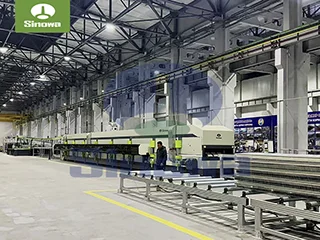
The overall operational logic of the thermal insulation sandwich panel production line is based on the composite molding principle of double-sided surface materials and intermediate thermal insulation core materials. Through automated mechanical coordination, the production line completes the precise laying, uniform compounding, pressure shaping, constant temperature curing and fixed-size cutting of multi-layer materials in an uninterrupted operating state. The surface materials used for production are usually high-toughness metal sheet coils with good weather resistance and structural bearing capacity, which provide reliable surface protection and mechanical support for the finished panels. The intermediate core materials cover a variety of thermal insulation materials with low thermal conductivity, including polymer foam materials and inorganic fiber thermal insulation materials. Different core material configurations endow the finished panels with differentiated thermal insulation performance, fire resistance level and structural characteristics, enabling the production line to meet the diversified material demand of different engineering scenarios.
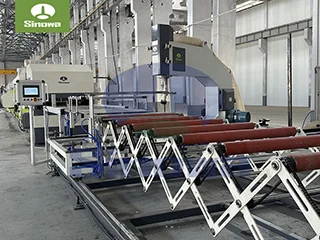
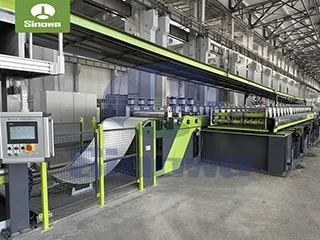
The complete production flow of the thermal insulation sandwich panel line starts from the raw material feeding link, covering multiple sequential and coordinated operation sections, each of which undertakes independent functional tasks and forms a closed-loop continuous production system through intelligent linkage control. The first stage of production is the surface material unwinding and pretreatment process. The coiled metal surface materials are stably placed on the automatic unwinding equipment of the production line, and the equipment releases the coiled materials at a constant and controllable speed through hydraulic and mechanical transmission structures, ensuring the flatness and tension stability of the surface materials in the conveying process. In order to eliminate the surface stress and structural deformation generated during the coiling and storage of metal sheets, the production line is equipped with a multi-stage leveling and trimming mechanism in the pretreatment section. The precision leveling rollers carry out multi-point pressure calibration on the metal sheet surface to eliminate local wrinkles and uneven flatness, while the edge trimming device cuts off the irregular edges on both sides of the sheet to ensure the consistent width of the surface materials entering the subsequent composite process, laying a foundation for the dimensional accuracy of the final finished panels.
In addition to shaping and trimming, the surface material pretreatment link also includes surface cleaning and auxiliary film laying processes. The automatic cleaning device removes dust, oil stains and residual impurities on the surface of the metal sheet, avoiding the problem of weak bonding between the surface material and the core material caused by surface contaminants. For products requiring surface protection functions, the production line can complete the automatic laying of protective films on the surface of metal sheets in the pretreatment stage. The film laying mechanism adopts elastic pressure fitting design to ensure the tight fitting of the protective film and the sheet surface without bubbles and wrinkles, effectively protecting the surface finish of the panels in the subsequent production, transportation and construction processes. After the completion of pretreatment, the upper and lower surface materials are conveyed to the composite molding area along the fixed track of the production line, forming a parallel feeding state with equal spacing, which prepares for the filling and compounding of the intermediate thermal insulation core materials.
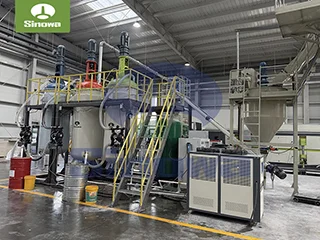
The core material laying and composite filling stage is the key link that determines the thermal insulation performance and structural uniformity of the sandwich panels, and different operation processes are adopted according to the physical characteristics of different core materials. For polymer foam core materials, the production line adopts automatic proportional mixing and pouring technology. The raw material components of foam materials are transported to the high-precision mixing system through closed conveying pipelines, and the intelligent metering system controls the feeding ratio and flow rate of each component in real time to ensure the uniformity of the mixed foam raw materials. The mixed liquid foam is evenly poured on the surface of the lower metal sheet through the precision pouring head that moves horizontally at a constant speed. With the continuous advancement of the sheet, the foam liquid gradually spreads and fills the gap between the upper and lower surface materials, and completes the foaming expansion process in a closed space. The vibration leveling structure configured in this section can effectively eliminate the internal voids of the foaming core material, optimize the compactness and uniformity of the intermediate layer, and avoid the local thermal insulation performance attenuation caused by hollow structures inside the panels.
For inorganic fiber thermal insulation core materials such as mineral wool and glass wool, the thermal insulation sandwich panel machine adopts fiber opening, carding and paving integrated process. The raw fiber materials are sent to the opening equipment through the automatic feeding system, and the clustered fiber raw materials are fully dispersed and decontaminated through mechanical stirring and carding. The carded uniform fiber filaments are laid layer by layer on the lower surface material through the quantitative paving mechanism, forming a continuous and uniform fiber felt layer with fixed thickness. The multi-layer overlapping paving mode ensures the isotropy of the internal structure of the core material, avoids the problem of uneven thermal insulation and mechanical strength caused by fiber agglomeration or sparse distribution, and improves the overall structural stability of the composite panels. In the paving process, the production line can adjust the paving thickness and density of the fiber core material according to the production parameters, so as to produce sandwich panels with different thermal insulation thickness specifications to adapt to different thermal insulation engineering requirements.
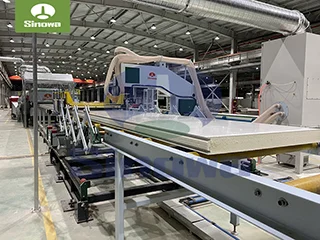
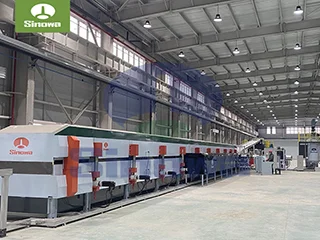
The composite pressing and heating curing unit is the core functional section of the entire thermal insulation sandwich panel production machine, undertaking the tasks of multi-layer material bonding, structural shaping and performance curing. The pre-laminated semi-finished panels composed of upper and lower surface materials and intermediate core materials are stably conveyed into the closed pressing space composed of upper and lower circulating pressing belts. The pressing system adopts segmented pressure regulation design, which can apply uniform and stable pressure on the whole panel area, effectively squeeze out the residual air between layers, and promote the tight bonding between the core material and the surface materials. The constant temperature heating system matched with the pressing section realizes gradient temperature control in the curing space. The temperature parameters are adjusted according to the material characteristics of different core materials, providing the optimal temperature environment for foam curing and fiber bonding agent solidification.
During the pressing and curing process, the continuous circulating operation of the pressing belts ensures that the panels maintain a fixed thickness and flatness without displacement and deformation during the continuous conveying process. The closed curing space can effectively reduce the loss of heat energy, improve the curing efficiency while ensuring the consistency of the curing degree of each part of the panels. For polymer foam core materials, the constant temperature curing process can promote the complete reaction of foam raw materials, form a dense closed-cell structure, and maximize the thermal insulation and heat preservation performance of the foam materials. For inorganic fiber core materials, the heating and pressing process accelerates the solidification of the internal bonding agent, so that the scattered fiber filaments form an integral stable structure, improving the tensile strength and compression resistance of the core material layer, and avoiding fiber falling and structural loosening in the later use process. After continuous pressing and curing for a fixed period, the multi-layer composite materials complete permanent integrated bonding and structural shaping, forming a complete sandwich panel prototype with stable performance.
After the curing and shaping process is completed, the panels enter the cooling and shaping buffer section. The high-temperature panels just out of the curing space have slight thermal expansion stress, and direct cutting and processing will easily lead to dimensional deviation and surface deformation. The thermal insulation board production line is equipped with a natural air cooling and auxiliary heat dissipation system in the buffer section, which gradually reduces the internal and surface temperature of the panels through circulating air flow, releases the internal thermal stress, and makes the overall structure of the panels more stable. The length of the cooling buffer section is matched with the production speed of the entire line, which can realize synchronous cooling and conveying without affecting the continuous production rhythm, ensuring that the panels maintain excellent flatness and dimensional stability in the subsequent precision processing links.
The precision trimming and fixed-length cutting section is responsible for the final shaping and size standardization of the finished panels. The continuous long strip panels after cooling and shaping are first sent to the edge trimming mechanism on both sides, which accurately cuts off the redundant composite materials on both sides of the panels according to the set width parameters, ensuring that the overall width of the panels is uniform and the edge sections are flat and smooth. The trimmed panels are then conveyed to the fixed-length cutting unit, and the high-precision sensing system tracks the conveying speed and length of the panels in real time, sends cutting signals to the servo cutting mechanism, and completes the instantaneous fixed-length cutting operation. The cutting mechanism adopts high-speed stable cutting mode, which can realize non-stop cutting in the continuous conveying state of the panels, effectively improving production efficiency while ensuring that the cutting section is flat and without burrs, and the dimensional error of each finished panel is controlled within a very small range.
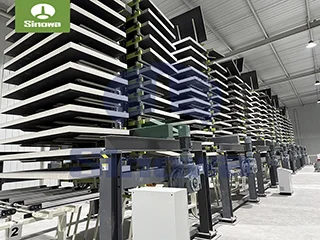
The final operation links of the thermal insulation panel production line include automatic sorting, stacking and protective packaging. The cut single finished panels are screened and sorted through the conveying and sensing system, and unqualified products with dimensional deviation and surface defects are automatically identified and eliminated, while the qualified panels are stably conveyed to the automatic stacking platform. The intelligent stacking mechanism adjusts the stacking sequence and spacing according to the panel specifications, neatly stacks the panels layer by layer, and avoids surface friction and collision damage between panels during stacking. After the stacking is completed, the automatic packaging equipment wraps and binds the stacked finished products, forming a closed protective packaging structure, which can effectively prevent dust pollution, surface scratch and moisture erosion during transportation and storage, and ensure that the finished panels can maintain stable performance and appearance quality before leaving the factory.
The overall structural design of the thermal insulation sandwich panel manufacturing line has excellent flexibility and compatibility, which can adapt to the production of multiple types of sandwich panels by adjusting process parameters and matching auxiliary mechanisms. By replacing the core material feeding system and adjusting the curing temperature, pressing pressure and conveying speed parameters, the production line can switch between the production of polymer foam sandwich panels and inorganic fiber sandwich panels, realizing the multi-functional production of a single equipment line. This flexible production mode greatly reduces the equipment investment cost for production enterprises and improves the utilization rate of production equipment. At the same time, the production line supports the adjustment of panel thickness, width and length parameters, and can customize and produce finished panels of different specifications according to the actual needs of engineering projects, meeting the personalized material demand of different construction scenarios.
In terms of production performance advantages, the fully automated continuous operation mode of the thermal insulation sandwich panel production equipment greatly reduces the dependence on manual operation. From raw material feeding to finished product packaging, most of the processes are completed by mechanical equipment and intelligent control system, which not only reduces the labor cost of production, but also avoids the product quality fluctuation caused by manual operation errors. The unified parameter setting and standardized process flow make the thermal insulation performance, structural strength and dimensional accuracy of each batch of finished panels maintain high consistency, effectively improving the overall qualification rate of products. Compared with the traditional intermittent production equipment, the continuous production line has no frequent start-stop and debugging links, the production rhythm is stable, the effective production time is greatly increased, and the unit time output is significantly improved, which is very suitable for large-scale and centralized building material production tasks.
The product performance advantages brought by the precise process control of the sandwich panel production line are very prominent. The closed-cell foaming structure formed by the precise proportional mixing and constant temperature curing process of polymer core materials gives the panels extremely low thermal conductivity, which can effectively block the transmission of external heat flow and realize efficient thermal insulation and energy saving effects. The uniform fiber paving and integral pressing and curing process of inorganic core materials make the panels have excellent fire resistance and high temperature resistance on the basis of maintaining good thermal insulation performance, meeting the fire protection requirements of high-standard building engineering. The composite structure formed by the tight bonding of metal surface materials and thermal insulation core materials enables the panels to have good mechanical bearing capacity, impact resistance and bending resistance, which can adapt to complex outdoor installation environments and long-term use requirements.
In terms of operational stability and energy conservation and environmental protection, the thermal insulation sandwich panel making machine adopts optimized mechanical transmission structure and intelligent energy-saving control system. The transmission parts of the equipment are equipped with stable lubrication and buffer devices, which reduce mechanical wear and vibration noise during long-term operation, extend the service life of the equipment, and ensure the long-term stable and continuous operation of the production line. The heating and curing system adopts heat preservation and heat recovery design, which reduces heat energy loss in the production process and improves energy utilization efficiency. At the same time, the entire production process adopts closed material conveying and processing mode, which avoids the overflow and waste of raw materials, and the residual materials generated in the trimming and cutting process can be recycled and reused, which conforms to the development concept of energy conservation, consumption reduction and green environmental protection in the modern building material industry.
The application scope of the panels produced by the thermal insulation board production line covers multiple fields of modern construction and industrial facilities. In the field of industrial plant construction, the lightweight and high-strength characteristics of the panels can reduce the self-weight of the building envelope structure, simplify the construction process, shorten the construction cycle, and meet the rapid construction demand of industrial plants. In the cold chain logistics and refrigeration storage industry, the efficient thermal insulation performance of the panels can effectively maintain the stable internal temperature of the cold storage, reduce the energy consumption of refrigeration equipment, and realize the energy-saving operation of cold storage facilities. In the field of commercial buildings and public facilities, the panels have good sound insulation, heat insulation and decorative effects, which can improve the indoor comfort of buildings and meet the diversified functional needs of commercial spaces.
With the continuous upgrading of modern building industry standards and the increasing demand for energy-saving and environmental protection buildings, the thermal insulation sandwich panel machinery is also constantly optimized and iterated in technology and structure. The intelligent control system of the new generation production line realizes the integrated management of production parameter setting, operation monitoring, fault early warning and data statistics. The real-time monitoring of production data can accurately feed back the operation state of each production link, realize automatic adjustment of process parameters, and further improve the refinement level of production. At the same time, the modular design of the production line equipment facilitates daily maintenance and later function upgrading, enabling the production equipment to always adapt to the updated market demand and industry standards.
In the actual production and operation process, the standardized operation and scientific maintenance of the thermal insulation sandwich panel manufacturing machine are important guarantees to maintain stable production efficiency and product quality. The daily operation management needs to strictly follow the production process specifications, check the operating state of each functional section before starting the equipment, ensure the normal operation of the material conveying, metering and mixing, pressing and curing, cutting and stacking systems, and eliminate potential equipment faults in advance. Regular maintenance and lubrication of mechanical transmission parts, calibration of precision metering and cutting devices, and cleaning of production equipment and environment can effectively avoid product quality problems caused by equipment aging and parameter deviation, and ensure the long-term stable and efficient operation of the production line.
In conclusion, the thermal insulation sandwich panel production line, as a mature and efficient automated production system in the modern building material manufacturing industry, integrates advanced mechanical manufacturing technology and intelligent control technology, and realizes high-quality, high-efficiency and low-consumption production of thermal insulation sandwich panels through standardized and streamlined production processes. Its flexible production performance, stable product quality and excellent energy-saving and environmental protection effects make it occupy an important position in the field of building thermal insulation material production. With the continuous development of the construction industry towards energy saving, environmental protection and high efficiency, the technical performance and production level of thermal insulation panel production line will continue to be improved, providing more high-quality thermal insulation composite materials for modern building engineering and promoting the innovative development of the building thermal insulation material industry.
https://www.cnsinowa.com/sandwich-panel-machines/thermal-insulation-sandwich-panel-production-line.html