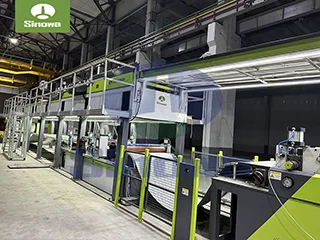
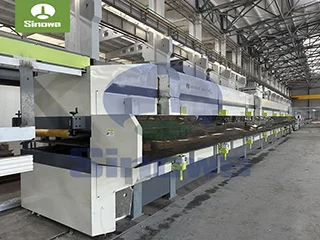
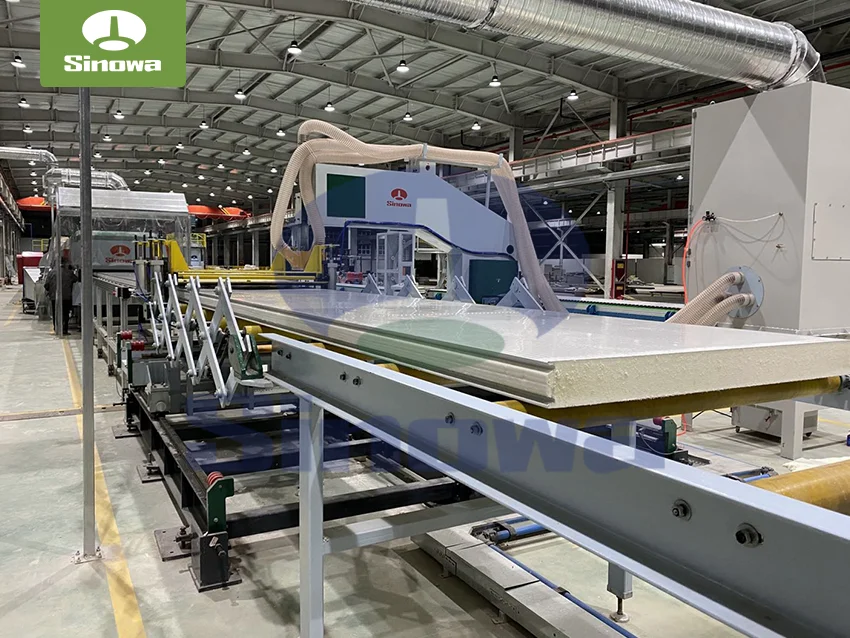
 sandwich panel machine
To understand the core value of customized PU sandwich panel production machinery, it is essential to analyze the inherent defects of traditional universal sandwich panel production line in actual industrial production scenarios. Traditional standardized machines are designed with fixed roller forming groups, fixed foaming cavity sizes and invariable pressure parameters for lamination sections, which can only produce panels with unified width, fixed core layer thickness and single surface plate profiles. When manufacturers need to switch product specifications to meet customized construction orders, they have to disassemble core mechanical parts, replace integral molds and manually calibrate operational parameters repeatedly. This frequent mechanical adjustment not only consumes massive working hours and reduces overall production continuity, but also leads to unstable bonding strength between metal surface plates and PU foam cores, inconsistent foaming density inside panel cores and uneven surface flatness of finished panels. In addition, universal production lines have poor compatibility with different surface substrate materials; they can only adapt to conventional color-coated steel plates, and are prone to plate deformation, insufficient composite adhesion and surface scratch problems when processing aluminum alloy sheets, stainless steel sheets or composite fiber decorative plates. Custom PU sandwich panel machine solve all these pain points fundamentally through whole-process personalized structural optimization and parameter debugging in the early equipment design stage. Equipment designers conduct in-depth communication with each equipment purchaser to sort out targeted production demands, including applicable types of upper and lower surface plates, required adjustable thickness range of PU foam insulation cores, customized groove and rib profiles of panel surfaces, daily continuous production capacity requirements, and actual site space conditions of production workshops. All demand indicators are converted into targeted mechanical design schemes, covering adjustable roller forming units, independently optimized high-pressure foaming systems, segmented constant-pressure lamination modules and space-saving overall layout design adapted to limited workshop areas.
The complete working workflow of custom PU sandwich panel making machine maintains continuous automated production logic consistent with mainstream composite panel production lines, while every core production link retains independent adjustable functions to support personalized product manufacturing. The whole production process starts from the automatic unwinding and surface pretreatment of raw material coils. Equipped with dual-station unwinding structures as standard configuration, customized machines support non-stop coil replacement during continuous production, effectively avoiding production shutdown losses caused by raw material replacement. Different from fixed-angle straightening rollers of ordinary machines, the straightening and correction module of customized equipment adopts electronically adjustable roller gaps and angle parameters, which can carry out adaptive surface leveling treatment for metal plates with different thicknesses and different hardness. This pretreatment link eliminates internal stress generated during metal coil processing in advance, ensuring that surface plates maintain perfect flatness in subsequent forming and composite processes, and avoiding residual deformation of finished panels after long-term installation and use. After surface pretreatment, upper and lower metal plates enter the roll forming section synchronously. The biggest advantage of customized design in this link lies in freely replaceable forming roller groups and numerical control profile adjustment systems. Manufacturers can switch roller groups according to personalized needs to produce roof panels with anti-leakage overlapping grooves, wall panels with hidden connection structures and flat decorative panels for interior building enclosure. All profile adjustment operations are completed through central intelligent control panels without manual disassembly of heavy mechanical components, greatly improving the efficiency of product specification switching.
The PU foaming and intermediate core layer injection section is the core functional module that determines the thermal insulation performance and structural stability of finished sandwich panels, and also reflects the most prominent technical advantages of customized production machines. Polyurethane composite panels rely on uniform chemical foaming reaction between two groups of liquid raw materials to form a closed-cell insulation core layer, and raw material ratio, injection flow rate, reaction temperature and foaming pressure directly determine the cell uniformity, thermal conductivity and compression resistance of foam cores. Custom PU sandwich panel production machine is equipped with independent closed-loop intelligent temperature control systems and dual-group raw material metering devices, which can realize micron-level precise adjustment of raw material mixing ratio and real-time dynamic adjustment of injection volume according to customized panel thickness requirements. For ultra-thin insulation panels used for interior decoration, the system reduces single injection volume and slows down foaming reaction speed to prevent foam expansion excess from causing panel surface bulging; for extra-thick insulation panels applied in low-temperature cold storage projects, the machine increases raw material supply appropriately and optimizes heating parameters of the foaming cavity to ensure thorough and uniform foaming inside thick core layers without hollow gaps or incomplete reaction areas. Meanwhile, the customized injection head structure can be adjusted in width matching different panel production widths, realizing full-surface uniform injection without local material shortage or raw material waste, which improves raw material utilization rate significantly compared with fixed injection structures of ordinary machines.
Following foam injection, panels enter the continuous lamination and curing section, another key module optimized for personalized production demands. Customized machines adopt segmented rubber belt pressing structures with independently adjustable pressure and temperature zones, different from the overall fixed-pressure pressing mode of standard sandwich panel line. Different surface substrate materials require different composite pressure and curing temperatures to achieve optimal bonding effect: aluminum alloy plates with good thermal conductivity need lower lamination temperature to avoid surface thermal deformation, while thick stainless steel plates require higher stable pressure to enhance mechanical bonding force between plates and foam cores. The segmented temperature and pressure control system allows operators to set independent parameters for front curing zone, middle constant-pressure composite zone and rear slow cooling zone according to material characteristics, ensuring permanent integration between surface plates and PU foam cores without delamination, cracking or edge warping problems during long-term service. In addition, according to customers' workshop height and production line length limitations, designers can customize linear lamination structures or vertical compact lamination structures for the equipment. Compact vertical lamination designs reduce overall floor space by nearly 30%, which is highly suitable for small and medium-sized building material factories with limited workshop space, while extended linear lamination structures support higher continuous production speed to meet large-scale bulk order demands of large manufacturers.
After constant-temperature curing and preliminary shaping, semi-finished panels enter the cooling conveying and fixed-length cutting module. Customized cutting systems support random setting of cutting length and cutting angle, meeting the production needs of conventional straight-edge panels and special inclined-edge panels for special building structural nodes. The cutting tool adopts wear-resistant optimized structural design adapted to different hardness of surface plates, ensuring smooth cutting sections without metal burrs or foam core fragmentation. The final links of the whole polyurethane sandwich panel production line include automatic surface cleaning, finished product conveying and layered stacking. The stacking system can be customized with adaptive lifting strokes and layered spacing according to finished panel thickness, realizing neat automatic stacking without manual secondary handling, further improving the overall automation level of the entire production line.
Beyond flexible parameter adjustment and structural personalized transformation, custom PU sandwich panel manufacturing machine also bring long-term comprehensive production benefits for building material manufacturing enterprises in actual industrial operation. Firstly, this tailored equipment effectively reduces overall production cost in long-term operation. Although customized equipment needs targeted design and structural optimization in the early stage, it eliminates repeated mold replacement, frequent parameter calibration and massive material waste caused by mismatched universal equipment and personalized production demands in later production. Stable one-time forming rate reduces defective panel rate greatly, cutting raw material loss and post-production maintenance cost. Secondly, customized production lines enhance core market competitiveness for panel manufacturers. With increasingly popular personalized modular buildings and special industrial construction projects, construction contractors are no longer satisfied with single-specification standard panels. Manufacturers equipped with customized PU sandwich panel machinery can quickly respond to small-batch, multi-specification and short-cycle customized orders, covering niche market demands that cannot be satisfied by competitors relying on traditional fixed production lines. Thirdly, human resource input is optimized comprehensively. The whole machine adopts centralized integrated intelligent control system, and all personalized parameter switching can be completed through touch screen operation. The equipment reduces dependence on senior mechanical debugging workers, realizing stable automated operation with fewer on-site operators and lowering daily labor management costs.
In terms of application scenario adaptation, customized PU sandwich panel production equipment can cover almost all segmented markets of insulation composite panels through targeted modification. For cold chain logistics and frozen warehouse construction projects that require ultra-high thermal insulation performance, the machine can be upgraded with enhanced foaming systems to produce high-density closed-cell PU sandwich panels with extremely low thermal conductivity, adapting to long-term low-temperature working environments. For clean rooms used in pharmaceutical and electronic manufacturing workshops, the equipment can be optimized with dust-free production structures and smooth non-stick conveyor belts to ensure no particle contamination on panel surfaces, meeting strict cleanliness requirements of industrial clean enclosures. For outdoor building exterior wall and roof systems in high-wind and high-rainfall areas, the roll forming structure can be customized to produce panels with enhanced waterproof lap joint structures, improving overall wind resistance and waterproof performance of building enclosure systems. Besides conventional metal-faced panels, the equipment can also be adjusted to match non-metal decorative surface substrates, producing fireproof composite sandwich panels matched with inorganic decorative plates, expanding product application boundaries further.
In terms of daily operation maintenance and later equipment upgrade, custom polyurethane sandwich panel machine adopts unified modular assembly design, bringing convenient post-sale maintenance and scalable upgrade space. All core functional components including foaming units, roller forming modules and lamination pressure components adopt standardized modular interfaces. When daily wear and failure occur in partial components, maintenance personnel can replace single modular parts directly without disassembling the whole polyurethane sandwich panel line, shortening equipment downtime and maintenance cycle. Meanwhile, reserved expansion interfaces are designed in the central control system and mechanical structure of all customized machines. With the iteration of building material industry standards and the emergence of new panel products, manufacturers can add auxiliary functional modules such as online surface quality detection systems and automatic edge sealing devices in the later stage according to production needs, realizing equipment performance upgrade without replacing the whole production line. This scalable design greatly prolongs the whole service life of customized machinery and improves the return on equipment investment for manufacturers.
Looking ahead to the future development trend of the insulation building material machinery industry, customized intelligent production will become the mainstream development direction replacing traditional standardized mechanical equipment. As global carbon neutrality goals continue to advance, the construction industry will put forward higher requirements for energy-saving level, low-carbon manufacturing process and product diversification of insulation materials. PU sandwich panels, as typical energy-saving building materials, will face more diversified and refined personalized demands in dimensions, structures, material matching and functional performance. Correspondingly, custom polyurethane sandwich panel machine will further integrate digital twin technology and automatic intelligent recognition technology in iterative upgrading. Future customized production lines will realize automatic identification of raw material plate specifications, independent matching of optimal production parameters and real-time online quality monitoring of finished panels, minimizing manual intervention in the whole production process. In addition, combined with low-carbon manufacturing concepts, the foaming system of next-generation customized machines will be optimized to improve raw material reaction utilization rate, reduce residual chemical raw materials in production process, and realize greener and more environment-friendly panel manufacturing process while maintaining stable product performance.
In conclusion, custom PU sandwich panel machinery represent user-oriented advanced manufacturing solutions in the field of composite building material machinery. They break through the rigid limitations of traditional fixed-parameter production lines, realize full-process personalized adaptation from mechanical structure, production parameters to overall line layout, and help building material manufacturers balance large-scale production efficiency and flexible customized order response capability. In the era where the global construction industry pursues energy saving, modularization and personalized architectural design, this tailored mechanical equipment not only optimizes the internal production process of panel manufacturers, but also supports the innovative upgrading of downstream energy-saving building systems. As personalized construction demands continue to grow worldwide, custom polyurethane sandwich panel production machine will maintain continuous technological iteration and occupy an increasingly important position in the global insulation building material manufacturing machinery market, providing reliable, efficient and flexible production support for the sustainable development of modern construction industry.
https://www.cnsinowa.com/sandwich-panel-machines/custom-pu-sandwich-panel-machine.html