 sandwich panel machine
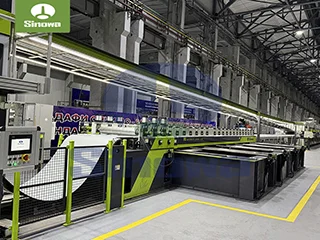
The overall structural design of a complete metal sandwich panel machine production line follows the logical sequence of raw material processing, intermediate compounding processing and finished product post-processing, and each functional unit is closely connected and coordinated with each other to ensure the continuity and stability of the entire production process without intermittent shutdowns and repeated handling of semi-finished products. The front-end part of the entire production line starts with the raw material unwinding and feeding unit, which is responsible for placing the coiled metal base materials used for the upper and lower surface layers of the sandwich panels. These metal coiled materials are the basic protective and stress-bearing layers of the finished panels, and their surface flatness and structural uniformity directly affect the appearance quality and structural performance of subsequent finished products. The unwinding unit is designed with a stable tension adjustment structure, which can maintain constant feeding tension during the continuous unwinding process of metal coils, effectively avoiding common problems such as material deviation, sheet wrinkling and edge warping caused by uneven tension in the feeding process. After the metal coil is unwound, the metal sheet will be automatically sent to the precision leveling and straightening unit, which is composed of multiple groups of staggered upper and lower leveling rollers arranged in an orderly manner. The working principle of the leveling unit is similar to the process of repeatedly rolling and flattening uneven materials, making the metal sheet undergo gradual reciprocating bending deformation from strong to weak. The large deformation correction at the inlet eliminates the macroscopic bending and uneven deformation of the original coiled material, the middle rolling section fine-tunes the local tiny uneven parts of the sheet surface, and the final outlet section performs fine smoothing to ensure that the metal sheet entering the subsequent forming process maintains an absolute flat and straight state without any residual deformation and surface fluctuation. This leveling process is a key pre-process to ensure the consistent thickness and flat appearance of the final sandwich panel, and any neglect of the leveling link will lead to uneven surface of the finished panel, inconsistent assembly gaps during on-site installation, and even affect the overall structural stress uniformity of the building enclosure.
After the leveling treatment of the metal surface sheet is completed, the sheet will be automatically transported to the continuous rolling forming unit, which is the core functional part for processing the metal surface sheet into the required contour and edge structure of the sandwich panel. Different application scenarios of metal sandwich panels require different plate edge connection structures, such as plug-in connection, lap joint connection and hidden buckle connection, and the rolling forming unit can complete the one-time cold bending and forming of various complex edge profiles by replacing different forming dies and adjusting the gap between forming rollers. The rolling forming process adopts gradual cold pressing forming technology, which avoids the damage to the metal substrate and surface protective coating caused by one-time strong bending. Each group of forming rollers carries out small-angle bending and shaping of the metal sheet in sequence, so that the metal material produces stable plastic deformation without rebound, ensuring that the size and shape of the plate edge profile processed each time are highly consistent. The entire rolling forming process is automatically controlled by the core control system, with extremely high positioning accuracy, which can effectively ensure the uniformity of the overall dimensions of each batch of produced panels. While the metal surface sheet is undergoing rolling forming, the core material automatic feeding and sorting unit at the side of the production line operates synchronously. The core insulation materials used for sandwich panels include various lightweight thermal insulation and flame retardant materials, which need to be cut into uniform fixed-size plate strips in advance and automatically and continuously fed to the middle position between the upper and lower metal surface sheets through the feeding mechanism. The feeding speed and feeding position of the core material are precisely synchronized with the conveying speed of the metal sheet to ensure that the core material is evenly distributed in the middle of the metal sheet without deviation, skew or gap accumulation, laying a solid foundation for the subsequent integrated compounding process.
The glue spraying and bonding activation unit is an indispensable key link in the entire production process of metal sandwich panels, and its working effect directly determines the bonding firmness and long-term durability between the metal surface layer and the core insulation material. The bonding quality between the metal sheet and the core material is the core performance index of the sandwich panel, which is related to whether delamination, cracking and peeling will occur during long-term use of the panel, as well as the overall structural stability and wind and pressure resistance of the building enclosure. The glue spraying unit of the modern metal sandwich panel machine adopts an automatic precise glue spraying system, which can evenly spray the environmentally friendly adhesive on the inner surface of the upper and lower metal sheets and the upper and lower surfaces of the core material according to the set glue application amount and spraying range. Before formal compounding, the equipment is also equipped with a professional preheating and glue activation structure, which uses a circulating constant temperature heating system to appropriately heat the bonded parts, fully activate the adhesion activity of the adhesive, accelerate the initial bonding reaction speed of the glue liquid, and avoid quality problems such as insufficient initial viscosity, bubbling and virtual bonding caused by insufficient glue activation. The design of the glue spraying system focuses on the uniformity of glue application and the controllability of glue amount, avoiding quality defects such as excessive glue overflow causing surface pollution and insufficient glue amount causing weak bonding. The entire glue spraying and preheating process operates in a fully automatic closed manner, which not only ensures the stability of bonding quality, but also improves the safety and environmental protection of the production process, reducing the volatilization of adhesive components and the impact on the production environment and operators.
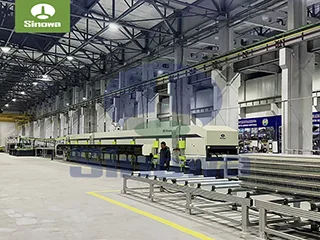
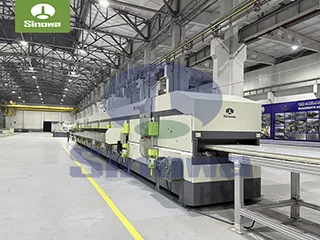
The high-pressure thermal compounding and constant temperature cooling shaping unit is the core processing section that realizes the integral bonding and forming of metal surface sheets and core materials, and is also the most critical functional part of the entire metal sandwich panel machine production line. After the metal sheets with adhesive and the core material are accurately aligned and combined, they are sent to the multi-roller high-pressure compounding mechanism together. The compounding mechanism adopts a stable hydraulic pressure adjustment system, which can provide uniform and continuous compounding pressure for the combined board body. The pressure value can be adjusted steplessly according to different metal sheet thicknesses, core material densities and bonding process requirements, ensuring that each part of the board body is evenly stressed during the compounding process. Cooperating with high-pressure compounding, the constant temperature heating system maintains the optimal bonding temperature inside the compounding area, so that the adhesive can fully react and form a stable bonding structure in a constant temperature and high-pressure environment, and the metal material and core material are closely integrated into an inseparable whole. After high-pressure thermal compounding, the initially bonded sandwich panel cannot be directly cut and used, and needs to enter the constant temperature cooling shaping area for gradual cooling and stress relief treatment. The cooling process adopts gradual cooling from high temperature to normal temperature, which can effectively release the internal stress generated by thermal expansion and cold contraction of the metal sheet and core material during the thermal compounding process, prevent the finished panel from bending, deforming and warping after being placed naturally, and ensure the long-term dimensional stability of the panel. The time and temperature of cooling shaping are automatically matched and controlled by the system according to the production speed and panel specifications, avoiding quality fluctuations caused by manual operation differences.
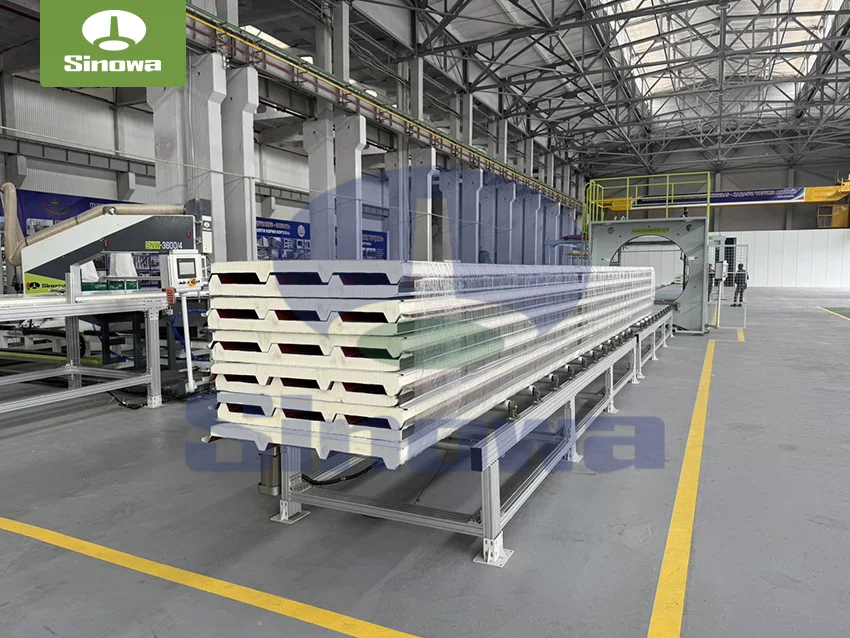
The automatic fixed-length cutting and post-processing unit is the final processing link of the metal sandwich panel machine production line, responsible for cutting the continuously produced long-strip integrated sandwich panels into finished products of standard fixed lengths according to actual user needs and engineering construction requirements. The cutting unit adopts high-precision servo drive and automatic positioning technology, which can accurately set the cutting length according to the production plan, and the positioning error is controlled within a very small range, ensuring that the length size of each finished panel is consistent and meets the engineering installation standards. The cutting tool is made of wear-resistant and high-strength materials, which can realize smooth and burr-free cutting of metal composite panels, without damaging the metal surface coating and the internal core material structure, ensuring the neat and flat cutting edge of the finished panel and facilitating the subsequent on-site assembly and connection construction. After the cutting operation is completed, the finished sandwich panels will be automatically transported to the finished product sorting and stacking unit, which realizes automatic stacking and arrangement of finished panels through a mechanical handling structure. The stacking process is stable and orderly, avoiding surface scratches, edge collision damage and panel tilting and confusion caused by manual handling. The entire post-processing link basically realizes unmanned automatic operation, and workers only need to carry out regular inspection and material transfer work, which greatly reduces labor input, improves production efficiency, and avoids product quality problems caused by manual handling errors and human factors.
The core control system of the modern metal sandwich panel machine is composed of advanced programmable control components and human-computer interaction touch operation terminals, realizing the integrated automatic control of all functional units of the entire production line. Operators only need to set the panel thickness, production speed, cutting length, compounding pressure and temperature parameters on the operation terminal according to the production requirements, and the equipment can automatically complete all processes from raw material feeding, processing and compounding to finished product cutting and stacking. The control system has an automatic deviation correction and fault monitoring function, which can automatically detect abnormal conditions such as material feeding deviation, equipment operation overload and parameter abnormity during the production process, and automatically send out prompt reminders and perform protective shutdown operations to avoid equipment failure and product batch quality problems. At the same time, the control system supports the storage and calling of multiple production process parameters, which can quickly switch production specifications when producing different types of sandwich panels, shortening the model adjustment and production preparation time, and greatly improving the flexible production capacity of the equipment. The servo motor and frequency conversion speed regulation system adopted by the transmission part of the equipment ensure the stability and accuracy of the operation speed of each unit, make the coordination rhythm of each processing link more precise, and effectively reduce the failure rate and maintenance cost of the equipment during long-term continuous operation.
The daily operation maintenance and regular equipment maintenance management are important guarantees to ensure the long-term stable operation of the metal sandwich panel machine and maintain consistent production quality. Although the modern automated production line has a high degree of automation and intelligent protection functions, the long-term continuous mechanical operation will inevitably cause normal wear and tear of mechanical parts and aging of electrical components. Daily maintenance work mainly includes cleaning the surface dust and residual adhesive dirt of each functional unit before and after production every day, checking the tightness of each transmission part and the smoothness of material conveying, and replenishing lubricating oil for the rotating and transmission parts regularly to ensure the flexible operation of mechanical structures. Regular maintenance work includes regular inspection and calibration of the leveling roller, forming die and compounding pressure roller, checking the wear degree of the cutting tool and replacing worn parts in time, detecting the operation status of the hydraulic system and constant temperature heating system, and cleaning and maintaining the internal circuit and control components of the control cabinet. Scientific and standardized maintenance management can not only extend the overall service life of the metal sandwich panel machine, reduce the frequency of equipment failure and shutdown maintenance time, but also ensure that the dimensional accuracy and product quality of the produced sandwich panels are always kept in the optimal state, avoiding production quality fluctuations caused by equipment aging and wear.
With the continuous promotion of the national prefabricated building development strategy and the continuous improvement of building energy conservation, environmental protection and safety performance requirements, the market demand for high-performance metal sandwich panels continues to grow, which also puts forward higher technical requirements for the upgrading and innovation of metal sandwich panel machines. The future development direction of metal sandwich panel machines will focus on higher automation and intelligence, more flexible production adaptability, more energy-saving and environmentally friendly production processes and higher processing precision and production efficiency. The intelligent upgrading of the equipment will realize the interconnection and data remote monitoring of the production line, realize the digital management of the production process, production output and product quality data, and facilitate production managers to grasp the production status in real time and optimize the production arrangement. The flexible production function of the equipment will be further enhanced, which can adapt to the production of sandwich panels with different core materials, different plate thicknesses and different edge profiles without complicated die replacement and parameter adjustment, meeting the personalized and diversified production needs of different engineering projects. At the same time, the equipment will further optimize the heating and hydraulic energy consumption structure, reduce energy consumption and material waste in the production process, and meet the green and low-carbon development requirements of the modern building materials industry.
In conclusion, the metal sandwich panel machine is the core intelligent equipment supporting the standardized, large-scale and high-quality production of metal sandwich panels, and its performance level directly determines the production efficiency and product quality of sandwich panel building materials, and also indirectly affects the construction quality, safety performance and service life of prefabricated buildings and various thermal insulation engineering projects. From raw material unwinding and leveling, rolling forming and core material feeding, to glue spraying activation, high-pressure thermal compounding, cooling shaping and fixed-length cutting and stacking, each functional link of the entire production line is closely coordinated and precisely controlled, forming a complete and efficient automated production system. In the context of the rapid development of the modern construction industry, the continuous technological innovation and performance upgrading of metal sandwich panel machines will continue to empower the high-quality development of the prefabricated building materials industry, provide reliable equipment support for the construction of high-efficiency, energy-saving, safe and environmentally friendly modern buildings, and create greater economic and social value for the entire construction and building materials industry chain.
https://www.cnsinowa.com/sandwich-panel-machines/metal-sandwich-panel-machine.html