 sandwich panel machine
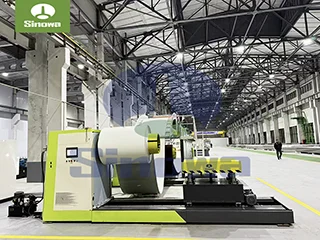
The initial stage of production focuses on base material preparation and automatic feeding, which lays a solid foundation for subsequent composite molding. The main surface raw materials of sandwich panels are coiled metal sheets with uniform surface coating and stable thickness, which need to be installed on the automatic unwinding unit of the production line. The unwinding system is designed with dual-station switching function, which enables seamless replacement of raw material coils without suspending the overall production rhythm. After being unwound, the metal sheet will pass through a multi-group leveling and calibration structure to eliminate the tiny bending, warping and surface wrinkles generated during coil storage and transportation. This leveling treatment ensures that the surface of the sheet is flat and uniform, which is a key prerequisite for tight bonding with the polyurethane foam layer in the later stage. In addition, the surface cleaning and pre-treatment process is completed in this link to remove dust, oil stains and residual impurities on the surface of the sheet, effectively improving the adhesion between the metal surface and the foam core material and preventing delamination and cracking of the finished panel during long-term use.
Following the surface pretreatment of the base sheet is the roll forming process, which shapes the flat metal sheet into the required section structure. The forming unit is composed of multiple groups of precision rolling rollers arranged in an orderly manner. Through gradual extrusion and shaping, the flat sheet is processed into corrugated, flat or special-shaped profiles according to production requirements. Each group of rolling rollers has accurate positioning and gap adjustment functions, which can ensure the uniformity of sheet forming size and avoid local deformation or dimensional deviation. The formed upper and lower metal sheets are transported forward along the fixed guide track at a constant speed, maintaining parallel and symmetrical operating states. This standardized forming and conveying mode ensures that the upper and lower surface layers of the sandwich panel can be perfectly matched in the subsequent composite process, and guarantees the overall structural regularity of the panel. The stable operation of this link greatly reduces the rate of defective products in the subsequent composite molding stage and improves the overall yield of production.
The foam material proportioning and injection stage is the core functional link of the entire production flow, and also the key process undertaken by the PU sandwich panel machine to realize the composite characteristics of sandwich panels. Polyurethane foam is formed by the chemical reaction of two-component liquid raw materials, which need to be accurately metered and evenly mixed before injection. The automatic metering system controls the feeding proportion and flow rate of the two raw materials in real time through precise power components, ensuring that the chemical components reach the optimal reaction state. After high-speed stirring and uniform mixing in the closed mixing cavity, the liquid polyurethane raw materials are evenly injected between the upper and lower metal sheets through the high-pressure injection port. The closed-loop mixing and injection design effectively avoids material waste and volatile substance leakage, and ensures the environmental friendliness and stability of the production process. The injection position and injection volume are dynamically adjusted according to the running speed of the sheet and the preset panel thickness, so that the liquid raw materials can fully cover the gap between the upper and lower layers without accumulation or shortage.
After the completion of raw material injection, the production enters the foaming and composite curing stage, which determines the core performance of the sandwich panel. With the forward transportation of the sheet, the injected polyurethane liquid undergoes rapid chemical reaction, volume expansion and gradual solidification between the upper and lower metal layers. The constant-temperature heating and pressure-maintaining laminating unit provides a stable reaction environment for foam molding. The mild and uniform temperature field promotes the full reaction of polyurethane raw materials, making the foam structure fine and uniform without hollow holes and cracks. At the same time, the continuous and stable mechanical pressure acts on the upper and lower surfaces of the panel, which can not only limit the excessive expansion of the foam to ensure the accurate thickness of the panel, but also promote the tight bonding between the foam core layer and the metal surface layer. In this process, the foam and the metal sheet form an integrated composite structure through chemical bonding and physical embedding, which endows the sandwich panel with excellent overall rigidity, thermal insulation and sound insulation performance. The length of the curing section is scientifically designed to ensure that the foam can complete sufficient reaction and solidification before leaving the laminating unit, avoiding structural instability and performance attenuation of semi-finished products.
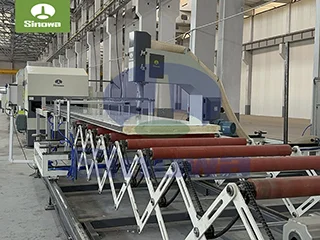
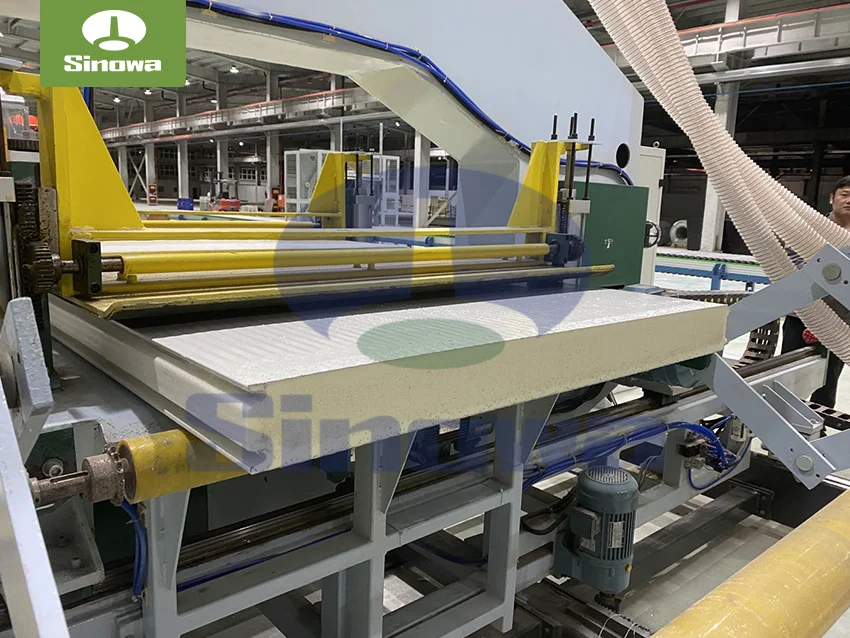
After continuous lamination and curing, the semi-finished continuous panel has formed a complete integrated structure, and then enters the fixed-length cutting and trimming process. The high-precision cutting unit matched with the polyurethane sandwich panel machine adopts dynamic follow-up cutting technology, which can complete fixed-length cutting synchronously with the running speed of the panel without stopping the production line. The intelligent control system presets the cutting length parameters according to customer demand standards, and the servo drive system accurately controls the cutting position and cutting speed to ensure that the incision is flat, smooth and free of burrs, deformation and edge warping. After cutting, the edge trimming mechanism performs fine trimming on the four sides of the panel to eliminate tiny dimensional deviations and edge defects generated in the molding process, so that the overall dimensional accuracy of the panel reaches the production standard. This automatic cutting and trimming mode not only ensures the uniformity of the size of each finished panel, but also greatly improves production efficiency and avoids the low efficiency and large error of manual cutting.
Subsequently, the cut single panels are transported to the cooling and shaping area for post-curing treatment. Although the foam has completed the main chemical reaction in the laminating stage, the internal structure of the panel still needs a period of natural cooling and stress relief to stabilize the overall performance. The circulating air cooling system in the cooling area accelerates the heat dissipation of the panel, eliminates the internal stress generated by high-temperature pressing and foaming, and prevents the finished panel from bending, deforming or shrinking after leaving the production line. In this process, the conveying speed is reasonably matched with the cooling time to ensure that each panel can obtain sufficient cooling space. At the same time, the staff conduct preliminary visual inspection on the surface of the panel during the cooling process, screening out individual products with surface scratches, unqualified bonding and abnormal foam structure, and removing defective products in time to avoid them entering the finished product stacking link.
The final stage of production is automatic stacking and finished product packaging, which realizes the standardized output and storage of products. The qualified panels after cooling and inspection are transported to the stacking station through the conveying track. The automatic stacking mechanism completes the orderly arrangement and stacking of the panels according to the preset stacking height and quantity standards. The stacking process is stable and gentle, which can effectively avoid surface collision and scratch damage of the panels. After stacking is completed, the integrated packaging device wraps the stacked panels with protective materials to prevent surface abrasion, dust pollution and moisture erosion during transportation and storage. The whole stacking and packaging process is automated, which reduces manual intervention, improves the neatness and uniformity of finished product packaging, and facilitates subsequent transportation, loading and warehouse management.
In the whole production process, the intelligent linkage control system runs through all links of the PU sandwich panel line, realizing the synchronous coordination of feeding, forming, injection, foaming, pressing, cutting and stacking. The system monitors the operating speed, temperature, pressure, material flow and other core parameters in real time, and automatically adjusts the operating state of each unit according to the production feedback, so as to ensure the stability and continuity of the production process. Once minor parameter deviation is detected, the system will make fine adjustments in time; if abnormal faults occur, it will trigger automatic protection and prompt feedback, which effectively reduces the failure rate of equipment operation and the loss of defective products. This integrated intelligent control mode makes the entire production process more standardized and efficient, and ensures that the mechanical performance, thermal insulation performance and appearance quality of each batch of sandwich panels remain stable and consistent.
It is worth noting that the standardized operation of each production link is the key to ensuring the excellent performance of finished panels. The unwinding and leveling process guarantees the flatness of the outer protective layer, the roll forming process shapes the mechanical foundation of the panel, the precise foaming injection process determines the thermal insulation and filling effect of the core layer, the constant-temperature pressure curing process realizes the integrated composite molding of the panel, and the precise cutting and automatic stacking process completes the standardized finishing of the product. All links are closely linked and mutually restricted, forming a complete closed-loop production system. The reasonable structural design and process layout of the PU sandwich panel production line make the whole production process efficient, stable and environmentally friendly, meeting the large-scale production demand of high-quality polyurethane sandwich panels for construction, industrial workshop, cold storage and thermal insulation engineering.
In actual production operation, daily maintenance and parameter debugging of equipment also play an important role in maintaining production stability. Regular cleaning of the mixing and injection system can avoid material residue blockage and ensure the uniformity of raw material mixing and injection; regular calibration of the rolling forming structure and cutting mechanism can maintain long-term dimensional accuracy of products; regular inspection of the heating and pressure system can ensure the stability of the foaming curing environment. Scientific equipment maintenance and standardized operation specifications can effectively extend the service life of the equipment, maintain the high-efficiency operation state of the production line, and continuously output high-quality and high-stability polyurethane sandwich panels. With the continuous optimization of mechanical technology and production technology, the production process of PU sandwich panel manufacturing equipment is constantly moving towards higher automation, higher precision and more energy-saving operation, providing more reliable technical support for the development of the composite panel manufacturing industry.
https://www.cnsinowa.com/sandwich-panel-machines/production-process-of-pu-sandwich-panel-machine.html