sandwich panel machine
The structural composition of PU sandwich panel production machines for multiple-sided composite boards is a modular system consisting of several core components that work in tandem to complete the panel manufacturing process. The uncoiling unit is the starting point, responsible for feeding continuous rolls of face materials into the production line. This unit is equipped with tension control mechanisms to ensure the flatness and stability of the face sheets, which can be made of various materials such as galvanized steel, pre-painted metal sheets, aluminum, fiberglass-reinforced sheets, or plywood. For multiple-sided panels, the machine may be fitted with multiple uncoilers to supply different face materials simultaneously, each aligned to form a specific side of the composite board. After uncoiling, the face sheets pass through a pre-treatment section where they are cleaned and preheated to optimize the bonding strength between the face layers and the PU foam core. Preheating is crucial as it promotes better adhesion by activating the bonding agents and ensuring the PU foam reacts uniformly with the face materials.
Following pre-treatment, the face sheets move to the roll forming unit, which shapes the materials into the desired profile. This unit consists of a series of tandem rollers that progressively bend and form the face sheets without compromising their structural integrity. For multiple-sided composite boards, the roll forming system is customizable to handle different profile designs on each side, allowing for the production of panels with varying edge configurations, grooves, or embossed patterns. The flexibility of the roll forming unit enables manufacturers to create panels tailored to specific architectural or industrial needs, such as interlocking edges for easy installation or decorative surfaces for aesthetic applications. After forming, the face sheets are guided into the foaming and laminating section, which is the core of the production machine.
The foaming and laminating section integrates a high-precision metering and mixing system that combines isocyanate and polyol, the key components of PU foam, in accurate proportions. The mixture is then uniformly dispensed onto the surface of the base face sheets, and the other face layers are immediately pressed onto the foam to form a multi-layer sandwich structure. For multiple-sided panels, this section is equipped with multiple dispensing heads and pressing mechanisms to ensure the PU foam is evenly distributed between all face layers. A double-belt laminating system is often used here to apply consistent pressure across the entire panel surface, ensuring strong adhesion between the foam core and the face sheets while maintaining the flatness of the final product. The laminating belts also transport the composite structure through a curing zone, where controlled temperature and humidity conditions facilitate the expansion and solidification of the PU foam. The curing process is carefully monitored to ensure the foam reaches its optimal density and structural stability, typically resulting in a rigid closed-cell structure that provides excellent thermal insulation and moisture resistance.
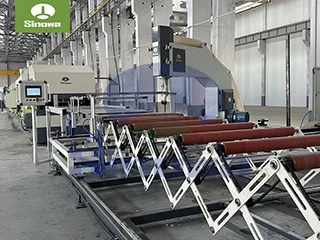
The final stages of the production machine include a cutting unit and a stacking system. The cutting unit, usually equipped with a tracking flying saw or band saw, trims the continuous composite panel into pre-set lengths with high precision, ensuring minimal tolerance and clean edges. For multiple-sided panels, the cutting mechanism is designed to handle the varying thicknesses and material combinations without causing damage to the face layers or the foam core. The stacking system then automatically collects and arranges the cut panels, preparing them for packaging or further processing. Additionally, modern machines may include optional inline modules such as embossing units, which add decorative patterns to the face sheets, or punching units, which create pre-drilled holes for easy installation. A centralized control system, typically based on programmable logic controllers (PLC), oversees the entire production process, regulating parameters such as production speed, temperature, pressure, and foam mixing ratios to maintain consistency and efficiency.
The performance of PU sandwich panel production machines for multiple-sided composite boards is characterized by several key attributes that determine their productivity, reliability, and the quality of the final product. Precision control is one of the most critical performance indicators, as it ensures the accurate mixing of PU foam components, uniform foam distribution, and consistent panel thickness. The metering system must maintain precise chemical ratios to produce foam with optimal thermal conductivity, which typically ranges from 0.022 to 0.024 W/(m·K), and a density between 32 and 60 kg/m³. This level of precision directly impacts the insulation performance and structural strength of the composite panels. Production speed is another important performance factor, with modern continuous machines capable of operating at adjustable speeds to balance output and quality. The ability to adjust speed allows manufacturers to adapt to different panel thicknesses and material combinations, ensuring optimal curing time for the PU foam regardless of production volume.
Durability and stability are also essential performance characteristics of these machines. The components in contact with PU foam and face materials must be resistant to wear, corrosion, and chemical degradation to ensure long-term operation. The roll forming rollers, for example, are typically made of high-strength steel with specialized coatings to withstand repeated pressure and friction without deforming. The control system’s stability is crucial for maintaining consistent production parameters, reducing material waste, and minimizing downtime. Advanced machines feature self-monitoring capabilities that detect deviations in temperature, pressure, or material feed, triggering automatic adjustments or alerts to prevent defective products. Energy efficiency is another key performance attribute, with modern designs incorporating energy-saving technologies such as recycled heating systems for the curing zone and variable frequency drives for motors, which reduce power consumption while maintaining production capacity.
Flexibility is a standout performance feature of these machines, allowing them to handle a wide range of face materials, foam core densities, and panel configurations. This flexibility enables manufacturers to produce multiple types of composite boards using a single machine, from standard multi-sided panels for industrial buildings to specialized panels with fire-retardant or sound-insulating properties. The ability to quickly reconfigure the machine for different products reduces setup time and increases production versatility, making it suitable for both large-scale mass production and small-batch custom orders. Additionally, the machines’ compatibility with various foam types, including polyurethane (PU) and polyisocyanurate (PIR), further enhances their flexibility, as PIR foam offers improved fire resistance compared to traditional PU foam, expanding the range of applications for the resulting composite panels.
PU sandwich panel production machines for multiple-sided composite boards can be categorized into two main types based on their production mode: continuous production lines and discontinuous (batch) production lines. Continuous production lines are designed for high-volume manufacturing, offering consistent output and efficiency for large-scale projects. These lines operate by feeding raw materials continuously through each production stage, from uncoiling to cutting, with minimal human intervention. The continuous process ensures uniform foam curing and bonding, resulting in panels with consistent quality across the entire production run. These lines are ideal for manufacturing standard-sized panels used in industrial warehouses, cold storage facilities, and prefabricated buildings, where large quantities of panels with consistent specifications are required.
Discontinuous production lines, on the other hand, are suited for small-batch production and custom-made panels. These lines operate in cycles, completing the production of a single batch of panels before starting the next. This mode allows for greater flexibility in adjusting panel dimensions, foam density, and face material combinations between batches, making it ideal for specialized applications such as custom architectural panels, soundproofing panels for commercial spaces, or panels with unique edge configurations. Discontinuous lines are often more compact than continuous lines, requiring less floor space, which makes them suitable for manufacturers with limited production capacity or those focusing on custom orders. While their production speed is lower than continuous lines, they offer greater versatility and are easier to reconfigure for different product requirements.
Another classification based on the number of sides processed is single-sided, double-sided, and multi-sided production machines. While single and double-sided machines are common for standard panels, multi-sided machines are specialized to handle three or more face layers. These machines are equipped with additional uncoilers, forming units, and dispensing heads to integrate multiple face materials into the composite structure. For example, a three-sided panel might feature metal face sheets on the front and sides, with a fiberglass sheet on the back for enhanced moisture resistance, while a four-sided panel could have different materials on each side to meet specific performance and aesthetic needs. Multi-sided machines are often used in applications where the panel is exposed on multiple sides, requiring balanced protection and performance across all surfaces.
The applications of PU sandwich panels produced by these machines are diverse, spanning the construction, industrial, cold chain, and commercial sectors, driven by the panels’ excellent combination of properties. In the construction industry, multi-sided composite panels are widely used for building envelopes, including walls, roofs, and partitions. Their thermal insulation properties help reduce energy consumption for heating and cooling, making them an eco-friendly choice for both residential and commercial buildings. The multi-sided design allows for panels that are resistant to weathering on the exterior while providing a smooth, decorative finish on the interior, eliminating the need for additional cladding or finishing materials. These panels are also used in prefabricated buildings, where their lightweight nature and easy installation speed up construction timelines, reducing labor costs and project completion time.
Industrial applications represent a major market for multi-sided PU composite panels, particularly in the manufacturing and warehouse sectors. The panels’ structural strength and durability make them suitable for use in industrial warehouses, factories, and workshops, where they can withstand heavy loads, mechanical impacts, and harsh environmental conditions. They are often used to construct partition walls, mezzanine floors, and equipment enclosures, providing both structural support and thermal insulation. In addition, the panels’ resistance to moisture and chemicals makes them ideal for use in industrial facilities handling corrosive materials or operating in high-humidity environments. The multi-sided design allows for panels that are reinforced on high-impact sides, ensuring long-term durability in demanding industrial settings.
Cold storage and refrigeration facilities are another key application area for multi-sided PU composite panels. The closed-cell structure of the PU foam core provides exceptional thermal insulation, minimizing heat transfer between the interior and exterior of the facility, which is critical for maintaining stable low temperatures. The multi-sided panels used in cold storage are often designed with moisture-resistant face materials to prevent condensation and mold growth, ensuring the integrity of the storage environment. These panels are used to construct cold rooms, refrigerated warehouses, and transport containers, where their lightweight nature reduces the overall load on the structure while providing superior insulation performance. The panels’ quick installation also minimizes downtime during the construction or renovation of cold storage facilities, which is essential for businesses in the food and pharmaceutical industries that rely on continuous cold chain operations.
Commercial spaces, such as shopping malls, airports, and office buildings, also benefit from the use of multi-sided PU composite panels. The panels’ decorative capabilities, combined with their sound insulation and fire resistance properties, make them suitable for interior design applications, including wall partitions, ceiling panels, and decorative facades. The multi-sided design allows for panels with different finishes on each side, enabling designers to create visually appealing spaces while maintaining performance requirements. For example, a panel used in an office partition might feature a sound-absorbing material on one side and a decorative laminate on the other, balancing functionality and aesthetics. Additionally, the panels’ lightweight nature reduces the load on the building’s structure, allowing for more flexible design possibilities in high-rise commercial buildings.
Specialized applications of multi-sided PU composite panels include clean rooms, food processing facilities, and modular structures. Clean rooms require panels that are easy to clean, resistant to contamination, and provide effective airtightness, all of which are offered by multi-sided PU composite panels. The smooth, non-porous face materials prevent the accumulation of dust and bacteria, making them ideal for use in pharmaceutical manufacturing, semiconductor production, and biotechnology labs. In food processing facilities, the panels’ resistance to moisture and chemicals ensures compliance with hygiene standards, while their thermal insulation properties help maintain controlled temperatures for food storage and processing. Modular structures, such as portable cabins, construction site offices, and emergency shelters, benefit from the panels’ lightweight, durable, and quick-to-install nature, allowing for rapid deployment and relocation.
The versatility of PU sandwich panel production machines for multiple-sided composite boards continues to drive innovation in their design and application. As industries increasingly demand materials that balance performance, sustainability, and cost-effectiveness, these machines are evolving to incorporate new technologies, such as bio-based PU foam components and recyclable face materials, to reduce environmental impact. Advances in control systems are also enhancing the precision and efficiency of production, allowing for tighter quality control and reduced material waste. The ability to produce multi-sided panels with tailored properties for specific applications ensures that these machines will remain a critical component in the manufacturing of composite materials for years to come, supporting the growth of sustainable construction and industrial practices worldwide.
https://www.cnsinowa.com/sandwich-panel-machines/pu-sandwich-panel-production-machine-for-multiple-sided-composite-boards.html