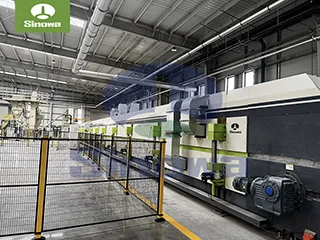
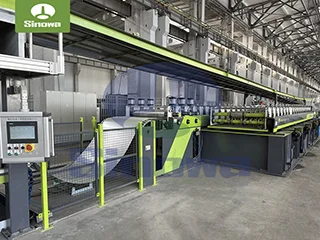
sandwich panel machine
The structure of a PU sandwich panel manufacturing machine for glass wool composite panels is a sophisticated assembly of interconnected systems, each performing a specific function to ensure continuous and consistent production. At the core of the machine lies the feeding system, which consists of decoilers, leveling devices, and feeding rollers. Decoilers are responsible for unwinding metal coils—typically made of steel or aluminum—that serve as the outer facings of the composite panel. These coils are fed into leveling devices to eliminate any wrinkles or deformities, ensuring the metal sheets maintain a flat and uniform surface before entering subsequent processes. Feeding rollers control the speed and tension of the metal sheets, synchronizing their movement with other parts of the machine to prevent misalignment during production.
Following the feeding system is the roll forming unit, which shapes the metal sheets into the desired profile. This unit comprises a series of tandem rolling stands, each equipped with precision rollers that gradually bend the metal sheets into specific configurations such as corrugated, trapezoidal, or flat profiles. The design of these rollers can be adjusted to accommodate different panel widths and thicknesses, allowing manufacturers to produce panels tailored to specific project requirements. For glass wool composite panels, the roll forming process is critical as it determines the structural integrity of the metal facings, which must be strong enough to support the glass wool core and withstand external loads during installation and use.
The glass wool handling system is a specialized component that differentiates these machines from those used for other types of PU sandwich panels. This system includes a glass wool feeding mechanism, cutting device, and spreading unit. The glass wool feeding mechanism transports bulk glass wool material—either in rolls or slabs—to the production line, where it is cut to the exact length and width matching the metal facings by a precision cutting device. The spreading unit then ensures the glass wool core is evenly distributed between the upper and lower metal facings, preventing gaps or uneven thickness that could compromise the insulation performance of the final panel. Some advanced systems also include a compression device to adjust the density of the glass wool core, optimizing its thermal and acoustic insulation properties.
The PU foaming and injection system is another vital part of the machine’s structure. This system consists of a chemical mixing unit, metering pump, and injection nozzle. The mixing unit combines polyol and isocyanate—the two main components of PU foam—along with additives such as flame retardants and catalysts, in precise proportions to ensure the foam has the desired properties. Metering pumps control the flow rate of the mixed chemicals, delivering a consistent volume of foam to the injection nozzle. The nozzle injects the liquid PU foam into the gap between the metal facings and glass wool core, where it expands and cures to form a strong bond between the components. The curing process is accelerated by a combination of heat and pressure, with the machine’s design ensuring the foam distributes evenly throughout the panel.
The final key structural component is the cooling, cutting, and stacking system. After the PU foam is injected and begins to cure, the composite panel passes through a cooling tunnel where controlled temperature and airflow accelerate the curing process and stabilize the panel’s dimensions. Once fully cured, the panel is fed into an automatic cutting machine—equipped with flying saws or circular blades—that cuts it to the required length with high precision. The stacking system then collects the cut panels, arranging them in neat piles for storage or further processing. Some machines also integrate additional features such as embossing devices for decorative finishes, punching units for pre-drilling installation holes, and packaging systems for protecting the panels during transportation.
The performance of PU sandwich panel manufacturing machines for glass wool composite panels is evaluated based on several key metrics, including production efficiency, precision, reliability, and energy efficiency. Production efficiency is measured by the machine’s output rate, which varies depending on the machine’s design and configuration. Continuous production lines can achieve higher output rates, typically ranging from several meters to over ten meters per minute, allowing manufacturers to meet large-scale project deadlines. Intermittent or semi-automatic machines, on the other hand, have lower output rates but are more suitable for small-batch production or customized orders.
Precision is a critical performance factor, as it directly impacts the quality and consistency of the final composite panels. Modern machines are equipped with advanced control systems that monitor and adjust key parameters such as foam density, panel thickness, cutting length, and metal sheet tension in real time. These control systems use sensors and feedback mechanisms to detect deviations from set parameters and make automatic adjustments, ensuring each panel meets strict dimensional and performance standards. For example, precise control of foam density ensures the panel has optimal insulation properties and structural strength, while accurate cutting length reduces material waste and improves installation efficiency.
Reliability is another important performance characteristic, especially in industrial production environments where downtime can lead to significant losses. High-quality machines are constructed with durable materials such as high-grade steel for structural components and corrosion-resistant alloys for parts exposed to chemicals or environmental factors. The modular design of many modern machines also enhances reliability by allowing for easy maintenance and replacement of components, minimizing downtime when repairs are needed. Additionally, the integration of fault self-diagnosis systems helps operators quickly identify and resolve issues, further improving the machine’s overall reliability.
Energy efficiency is becoming an increasingly important performance metric as manufacturers seek to reduce operational costs and minimize environmental impact. These machines are designed with energy-saving features such as variable frequency drives for motors, which adjust power consumption based on production demand, and efficient heating and cooling systems that reduce energy waste. The use of insulation materials in the machine’s structure also helps maintain stable operating temperatures, reducing the energy required to heat or cool the production environment. By optimizing energy efficiency, manufacturers can lower their carbon footprint while improving profitability.
PU sandwich panel manufacturing machines for glass wool composite panels can be classified into several types based on their production method, automation level, and configuration. The most common type is the continuous production line, which is designed for large-scale, high-volume production. These lines operate 24/7 with minimal manual intervention, offering high efficiency and consistent product quality. Continuous lines are equipped with integrated systems for feeding, forming, foaming, cooling, cutting, and stacking, creating a seamless production process that minimizes material waste and maximizes output.
Intermittent or batch production machines are another type, suitable for small-batch production or customized panels. These machines operate in cycles, with each cycle producing a single panel or a small batch of panels. They offer greater flexibility in terms of panel dimensions and configurations, making them ideal for manufacturers serving niche markets or handling custom orders. Intermittent machines are typically less complex and more affordable than continuous lines, making them a popular choice for small and medium-sized enterprises.
Modular production machines represent a versatile type that combines the advantages of continuous and intermittent systems. These machines consist of separate modules—such as feeding, forming, foaming, and cutting modules—that can be configured or reconfigured to meet different production needs. Modular design allows manufacturers to add or remove modules as their production requirements change, making it easy to upgrade the machine or adapt it to produce different types of composite panels. For example, a modular machine can be switched between producing glass wool composite panels and other types of PU sandwich panels by replacing the core material handling module.
Semi-automatic and fully automatic machines are classified based on their automation level. Semi-automatic machines require some manual intervention, such as loading metal coils, adjusting parameters, or stacking finished panels. They are suitable for manufacturers with limited production volume or those who prefer more control over the production process. Fully automatic machines, on the other hand, operate with little to no manual intervention, using advanced control systems and robotics to handle all production tasks. These machines offer the highest efficiency and consistency, making them ideal for large-scale production facilities.
The applications of PU sandwich panel manufacturing machines for glass wool composite panels are closely linked to the uses of the panels they produce, which are widely employed in various construction and industrial sectors. One of the primary applications is in industrial buildings and warehouses, where the panels are used for walls and roofs. The combination of glass wool and PU foam provides excellent thermal insulation, helping to maintain stable indoor temperatures and reduce energy consumption for heating and cooling. The metal facings offer high structural strength, allowing the panels to withstand heavy loads and harsh environmental conditions such as strong winds and extreme temperatures.
Cold storage and refrigeration facilities are another major application area. Glass wool composite panels produced by these machines have low thermal conductivity, making them ideal for insulating cold storage warehouses, refrigerated trucks, and food processing plants. The PU foam bond ensures the panels are airtight, preventing cold air leakage and reducing the energy required to maintain low temperatures. Additionally, the fire-resistant properties of glass wool make these panels suitable for use in facilities storing flammable materials or food products, where fire safety is a critical concern.
Commercial buildings such as shopping malls, exhibition halls, and office complexes also benefit from the use of glass wool composite panels. The panels’ acoustic insulation properties help reduce noise transmission, creating a more comfortable indoor environment for occupants. Their lightweight design makes them easy to install, reducing construction time and labor costs. Additionally, the panels can be customized with decorative finishes, making them suitable for use in high-end commercial projects where aesthetics are important.
Prefabricated and modular buildings are a growing application area for these panels, driven by the demand for fast and efficient construction. Glass wool composite panels are ideal for prefabricated structures as they can be produced in standard sizes or customized to fit specific designs, allowing for quick assembly on-site. The machines that produce these panels enable manufacturers to mass-produce prefabricated components, reducing construction time and minimizing waste. Modular buildings using these panels are commonly used as temporary offices, housing units, and emergency shelters.
Clean rooms and pharmaceutical facilities require high-performance insulation materials that meet strict hygiene and safety standards. Glass wool composite panels produced by these machines are non-toxic, non-absorbent, and resistant to mold and bacteria growth, making them suitable for use in clean rooms. The panels’ airtight construction prevents the infiltration of dust and contaminants, maintaining a sterile environment. Additionally, their fire-resistant properties ensure compliance with safety regulations for pharmaceutical and medical facilities.
Other applications include agricultural buildings such as greenhouses and livestock barns, where thermal insulation is essential for maintaining optimal growing or living conditions. The panels also find use in transportation infrastructure, such as sound barriers along highways and railways, where their acoustic insulation properties help reduce noise pollution. In addition, they are used in renovation projects to improve the energy efficiency and fire safety of existing buildings, as they can be easily installed over existing structures.
The versatility of PU sandwich panel manufacturing machines for glass wool composite panels makes them a valuable asset for manufacturers operating in diverse markets. As the demand for energy-efficient and sustainable building materials continues to grow, these machines are evolving to meet new challenges and requirements. Advances in technology are leading to more efficient, precise, and environmentally friendly machines, enabling manufacturers to produce high-quality panels at lower costs. Whether used for large-scale industrial production or small-batch custom orders, these machines play a crucial role in shaping the future of the construction and insulation materials industry.
In conclusion, PU sandwich panel manufacturing machines for glass wool composite panels are complex yet essential equipment that combines multiple systems to produce high-performance composite panels. Their structure is designed to ensure seamless integration of metal facings, glass wool core, and PU foam, while their performance is measured by efficiency, precision, reliability, and energy efficiency. Available in various types to suit different production needs, these machines support a wide range of applications across construction, industrial, commercial, and agricultural sectors. As the industry continues to prioritize sustainability and energy efficiency, the development and adoption of advanced PU sandwich panel manufacturing machines will remain key to meeting market demands and driving innovation in building materials production.
https://www.cnsinowa.com/sandwich-panel-machines/pu-sandwich-panel-manufacturing-machine-for-glass-wool-composite-panels.html