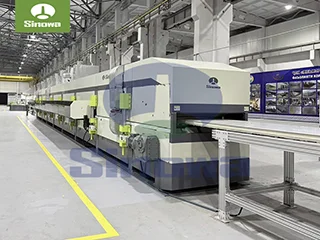
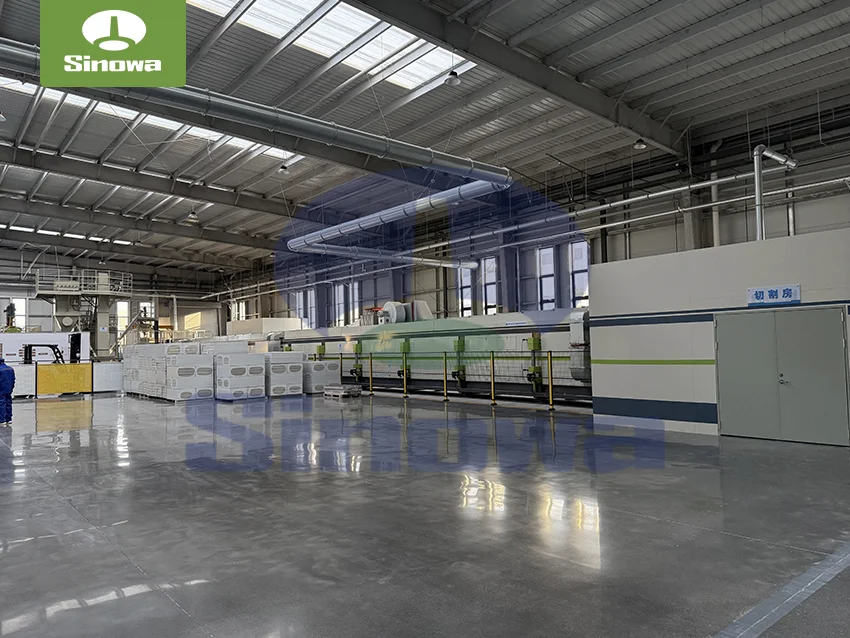
 sandwich panel machine
The functional logic and structural design of thermal insulation panel machines are centered on the composite molding characteristics of thermal insulation panels. Most mainstream thermal insulation panels adopt a typical sandwich structure, with lightweight thermal insulation core materials in the middle and high-strength protective surface materials on both sides. The common core materials include polyurethane foam, polystyrene, mineral wool, glass wool, and other lightweight porous materials, while the surface materials cover metal color plates, aluminum foil, fiberglass boards, and inorganic fireproof boards. Different material combinations endow the finished panels with differentiated thermal insulation, fireproof, waterproof, and mechanical properties, and also put forward high requirements on the structural adaptability, parameter adjustability, and processing precision of thermal insulation panel machines. Modern thermal insulation panel machines are designed with highly integrated and modular structures, which can adapt to the production needs of multi-type thermal insulation panels through parameter adjustment and partial module matching, realizing flexible switching of product specifications and performance indicators.
The complete working flow of thermal insulation sandwich panel machine presents a continuous and automated closed-loop production mode, covering raw material pretreatment, precise metering and mixing, automatic molding and compounding, constant-temperature foaming and curing, fixed-length cutting, and finished product conveying and sorting. Each link is closely connected and controlled by an intelligent system to minimize manual intervention and ensure the consistency and stability of product quality. The initial stage of production focuses on raw material pretreatment and feeding, which is the foundation for ensuring uniform panel structure and stable performance. For metal surface materials, the equipment is equipped with automatic uncoiling and leveling mechanisms, which can smoothly unfold coiled metal raw materials and eliminate surface wrinkles and structural deformations through precise roller leveling, ensuring the flatness and dimensional accuracy of the base material before molding. For inorganic fiber core materials such as glass wool and mineral wool, the supporting pretreatment modules complete impurity removal, fiber opening, and uniform carding, turning clustered raw materials into loose and uniform fiber felt structures, which effectively improves the bonding tightness between the core material and surface materials and avoids hollowing and delamination of finished panels.
The metering and mixing system is one of the core functional modules of thermal insulation panel machines, especially suitable for the production of foam-type thermal insulation panels such as polyurethane and polystyrene. This system adopts high-precision dynamic metering technology to accurately proportion various reactive raw materials including main materials, catalysts, foaming agents, flame retardants, and curing agents. The precision of raw material proportioning directly determines the foaming density, pore uniformity, thermal insulation performance, and fire resistance level of the core material. Advanced mixing modules use high-speed swirling mixing or high-pressure impact mixing to fully blend different raw material components at the molecular level, avoiding local uneven mixing, insufficient reaction, or excessive foaming. Meanwhile, the system is equipped with real-time temperature and pressure monitoring units to adjust mixing parameters according to environmental temperature and raw material characteristics, ensuring the stability of raw material reaction activity in different production environments and laying a foundation for consistent core material performance of each batch of panels.
Compounding, foaming, and curing are the key links that determine the structural forming and comprehensive performance of thermal insulation panels. After the pretreated surface materials and mixed core material raw materials enter the lamination and molding station synchronously, the equipment adopts a constant-temperature and constant-pressure composite process to bond the upper and lower surface materials with the intermediate thermal insulation core material. In the closed molding space, the foam raw materials undergo continuous chemical foaming and volume expansion, filling the entire composite gap evenly. With the cooperation of the double-belt laminating structure, the equipment maintains stable pressure and temperature throughout the molding process, enabling the foam structure to form uniform and closed tiny pores. This precise molding process not only optimizes the thermal insulation effect of the panel by reducing air heat conduction inside the core material, but also ensures the overall structural compactness of the sandwich panel. The intelligent temperature control system can accurately adjust the curing temperature according to different core material formulas and panel thickness specifications, realizing gradual and complete curing of the core material, effectively avoiding quality problems such as surface cracking, internal loose structure, and insufficient bonding strength caused by rapid temperature change or incomplete curing.
The precision cutting and post-processing module undertakes the final shaping work of finished panels. After continuous molding and curing, the integrated long-strip panel is transported to the cutting station through a stable conveying system. The high-precision flying saw cutting system equipped by the equipment can realize dynamic tracking and fixed-length cutting according to preset parameter values. Compared with traditional static cutting equipment, this dynamic cutting mode avoids production pause, ensures the continuity of the entire production line, and effectively improves production efficiency. The cutting mechanism adopts high-hardness cutting tools and stable transmission structure, which can ensure smooth and flat cutting sections without burrs, deformation, or core material shedding, meeting the fine processing requirements of panel edge quality. After cutting, the finished panels are automatically conveyed to the sorting and discharging area, and the equipment can realize automatic stacking and arrangement of finished products through the matching conveying and lifting structure, reducing manual handling links and improving the overall automation level of production.
Modern thermal insulation sandwich panel machines are endowed with excellent intelligent control and flexible production capabilities, which fundamentally solve the problems of low efficiency, unstable quality, and single product type in traditional manual and semi-mechanical production modes. The whole production process is controlled by a centralized intelligent control system, which integrates parameter setting, real-time monitoring, data recording, and fault early warning functions. Operators can complete the adjustment of panel thickness, length, density, and formula parameters through a simple human-computer interaction interface. The system can automatically store production parameters of different product specifications, realizing one-click switching of subsequent production orders and greatly improving the flexibility of small-batch and multi-specification customized production. In addition, the equipment is equipped with a complete fault detection and protection mechanism, which can real-time monitor abnormal conditions such as raw material shortage, equipment jitter, temperature and pressure deviation, and automatically trigger early warning and protection programs to avoid equipment failure and defective product generation, ensuring the safety and stability of long-term continuous operation.
Energy saving and environmental protection design is another important feature of advanced thermal insulation board production line, conforming to the global green manufacturing development trend. The equipment adopts a closed raw material conveying and mixing structure, which effectively reduces the volatilization and leakage of chemical raw materials, avoids waste of raw materials and air pollution, and improves the utilization rate of raw materials. The optimized transmission and structural design reduces mechanical operation resistance and idle energy consumption, realizing low-energy operation during high-efficiency production. At the same time, the precise formula matching technology of the equipment reduces the use of harmful additives, and the produced thermal insulation panels have low volatile content and no harmful substance precipitation, meeting the environmental protection standards of green buildings and industrial equipment. In terms of noise control, the equipment is equipped with shock absorption and noise reduction structures at key operation parts, which effectively reduces production noise and improves the on-site production environment.
The performance and technical level of thermal insulation sandwich panel line directly determine the application value and market competitiveness of thermal insulation panel products. The panels produced by high-precision automated equipment have uniform thickness, stable density, excellent thermal insulation performance, and strong structural bonding strength, and are not easy to delaminate, deform, or age during long-term use. These high-quality thermal insulation panels can effectively isolate heat transfer, reduce the energy consumption of building air conditioning, heating, and industrial equipment temperature control, and play a significant role in energy saving and consumption reduction. In the field of industrial production, standardized thermal insulation panels processed by professional machines have good fire resistance, waterproof, and corrosion resistance, which can adapt to harsh working environments such as high temperature, low temperature, and humidity, and are widely used in industrial workshops, cold storage, logistics warehouses, and petrochemical insulation projects. In the field of civil construction, lightweight and high-strength thermal insulation panels simplify building enclosure structure design, shorten construction cycles, and reduce building self-weight, helping to improve building safety and comfort.
With the continuous upgrading of downstream industry demands and industrial manufacturing technology, thermal insulation sandwich panel production line is constantly evolving towards higher automation, higher precision, stronger flexibility, and more intelligent integration. The traditional single-functional production line is gradually replaced by multi-functional integrated equipment, which can realize the integrated production of thermal insulation panels with different core materials and different surface materials through modular combination. The application of digital twin technology and remote monitoring technology enables equipment operation data to be uploaded in real time, realizing remote parameter adjustment, equipment operation status monitoring, and predictive maintenance, greatly reducing equipment maintenance costs and downtime loss. In addition, with the continuous improvement of fire protection and environmental protection standards in various industries, the equipment is also continuously optimized in formula matching and process technology, supporting the production of high-fireproof, low-carbon, and environmentally friendly new thermal insulation panels, adapting to the iterative upgrading of green building and industrial energy-saving industries.
In the context of global dual-carbon goals and vigorous development of green infrastructure construction, the market demand for high-performance thermal insulation panels continues to grow steadily, which also puts forward higher technical requirements for thermal insulation panel manufacturing equipment. As the core equipment of the thermal insulation material industry, thermal insulation panel machines undertake the important task of promoting industrial standardized production and technical innovation. The continuous progress of equipment manufacturing technology not only improves the production efficiency and product quality of thermal insulation panels, but also promotes the popularization and application of high-efficiency energy-saving materials in more fields. In the future, with the deep integration of intelligent manufacturing, green manufacturing and thermal insulation material production technology, thermal insulation sandwich panel machinery will develop in a more efficient, intelligent, low-carbon and flexible direction, providing more solid equipment support for the energy-saving and emission-reduction transformation of the construction industry and the high-quality development of the new material industry.
https://www.cnsinowa.com/sandwich-panel-machines/thermal-insulation-panel-machines.html