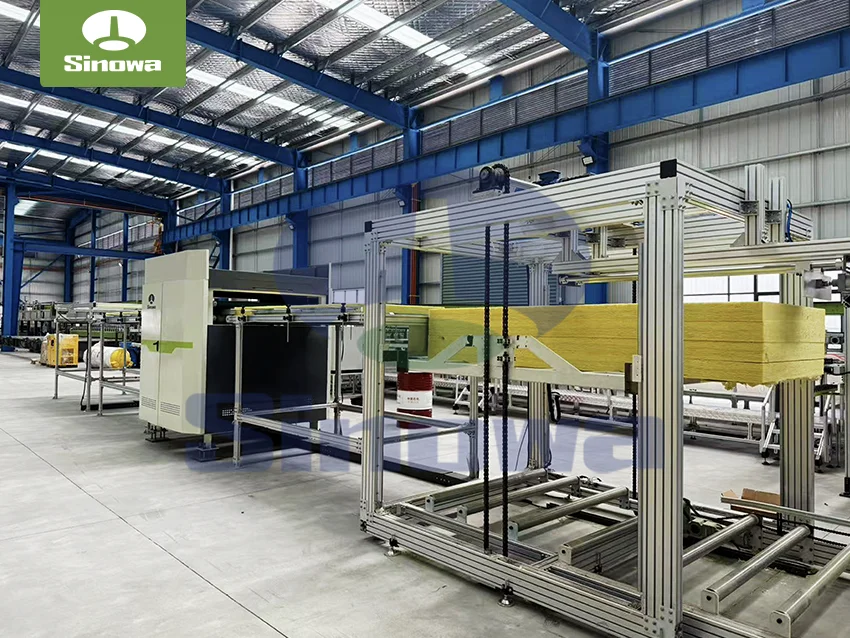
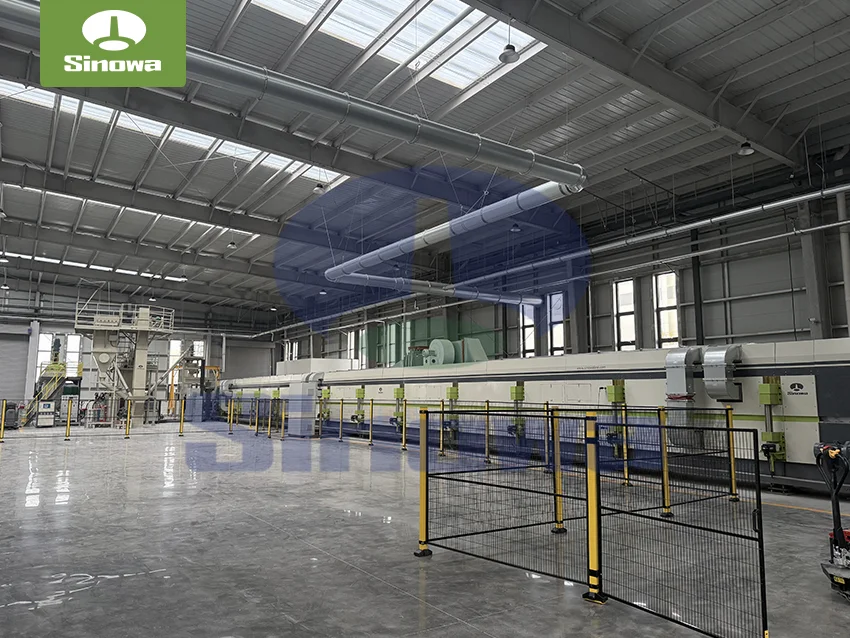
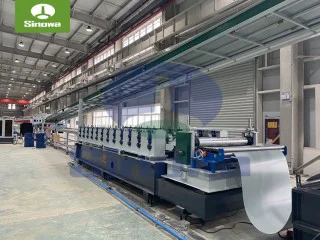
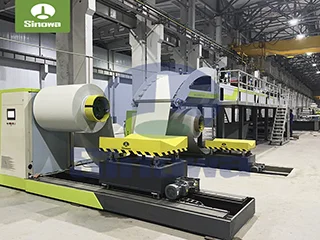
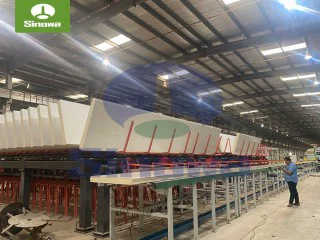
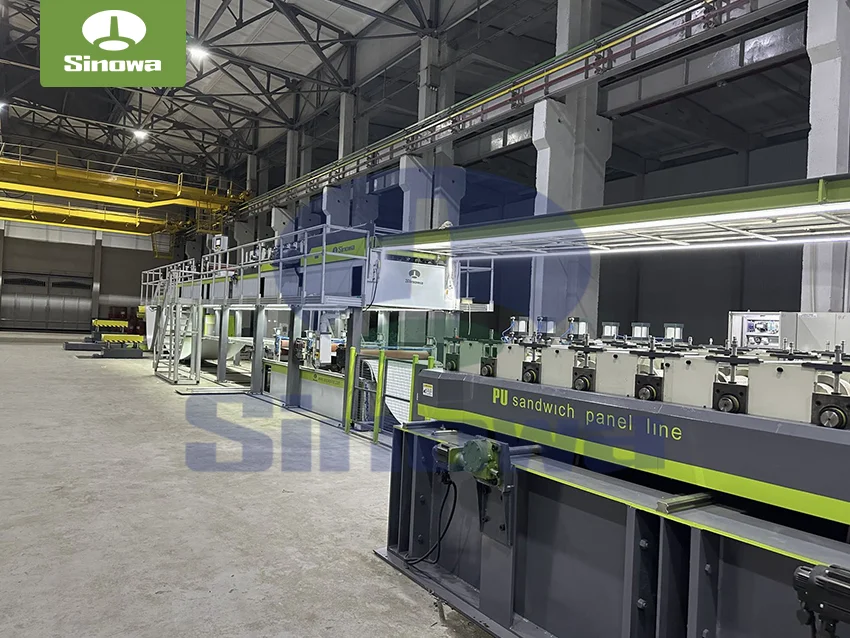
 sandwich panel machine
Production capacity stands as one of the most fundamental determinants of the overall value and market pricing of sandwich panel machine. Industrial production demands precise matching between equipment output and market order volume, and this matching principle directly shapes the hierarchical pricing structure of such machinery. Basic low-output production systems are designed for small-scale manufacturing scenarios, catering to regional market demands with limited order volume and flexible production cycles. These simplified configurations feature relatively streamlined structural designs, fewer functional modules, and lower energy consumption per unit operation, which naturally places them at a moderate investment level. In contrast, large-scale continuous production systems engineered for mass industrial manufacturing adopt integrated structural designs that enable uninterrupted round-the-clock production. These high-capacity machines deliver vastly higher daily and annual output, effectively meeting the bulk order requirements of large building material enterprises and engineering supply projects. The enhanced mechanical structure, extended operational lifespan, and stable high-efficiency output of high-capacity equipment correspond to higher manufacturing costs, forming a clear tiered difference in market pricing. Blindly pursuing ultra-high capacity equipment for small-batch production will lead to idle equipment resources and increased fixed operational costs, while low-capacity machines failing to keep pace with market order demands will restrict production expansion and market revenue growth, further highlighting the importance of capacity-based pricing rationality.
Automation and intelligent control levels serve as another core factor driving the pricing differentiation of PU sandwich panel machine. Traditional semi-automatic production equipment relies heavily on manual intervention in key links such as raw material feeding, foam injection parameter adjustment, panel pressing, and finished product cutting. Such equipment features simple control logic, basic mechanical configurations, and lower manufacturing and assembly costs, resulting in relatively low market investment thresholds. However, the extensive manual participation leads to unstable product consistency, higher error rates in production parameters, increased labor input costs, and potential material waste, indirectly raising the comprehensive operational expenses of production lines. Modern advanced PU sandwich panel production systems adopt highly integrated automatic control architectures, realizing full-process automatic operation from raw material proportioning, high-pressure foaming, continuous lamination, fixed-size cutting to finished product output. Equipped with real-time data monitoring modules and adjustable operating parameter systems, these machines can precisely control foam density, bonding strength, panel thickness and flatness, ensuring consistent product quality batch after batch. The intelligent adjustment function can automatically correct parameter deviations caused by raw material state changes and environmental fluctuations, greatly reducing product defect rates and material loss. Although the intelligent and automated upgrading of equipment increases upfront manufacturing costs and thus raises market pricing, it significantly reduces long-term labor dependence, improves production efficiency, and stabilizes product qualification rates, bringing sustained economic benefits for large-scale and long-term production operations.
Structural configuration and technological maturity of equipment exert profound influences on pricing and long-term investment value. Maturely optimized PU sandwich panel line undergo repeated technological iteration and market verification, with each structural module optimized for production stability and durability. Key functional components such as foaming systems, pressing systems and transmission structures adopt precision manufacturing processes, ensuring stable mechanical operation, low failure frequency, and strong continuous working capacity. The precise coordination between various functional units effectively avoids production jitter, uneven foaming and insufficient panel bonding problems common in poorly optimized equipment. Such technologically mature equipment requires higher precision processing standards and stricter assembly processes during production, leading to higher manufacturing costs and corresponding market pricing advantages. In comparison, newly developed or simplified structural equipment with immature technological iteration often has lower initial investment costs, but it is prone to frequent operational failures, unstable production parameters and short service life in actual production. Frequent equipment maintenance, component replacement and production shutdown debugging will generate additional hidden costs, and unqualified products caused by unstable operation will further increase production losses. Therefore, the pricing difference caused by technological maturity essentially reflects the gap between equipment stability, durability and comprehensive production capacity.
Raw material cost fluctuations in the mechanical manufacturing industry and upstream PU chemical material market changes indirectly affect the market pricing of finished sandwich panel machinery. The main frame and functional components of PU sandwich panel production line are manufactured from high-strength metal materials and precision mechanical parts, and the price fluctuation of industrial steel, mechanical accessories and electrical control components will directly change the manufacturing cost of equipment. When the upstream mechanical accessory market faces rising raw material prices or tight supply, the overall production cost of machinery manufacturers increases, which will drive a moderate upward adjustment in the market price of finished equipment. Meanwhile, the price volatility of PU raw materials such as polyols and isocyanates affects the market demand for sandwich panel finished products, thereby indirectly influencing the transaction price of production equipment. When downstream building material market demand is booming and PU raw material prices are stable, sandwich panel manufacturers have strong willingness to expand production and purchase new equipment, pushing up market demand for machinery and driving a slight increase in equipment transaction prices. On the contrary, when upstream chemical raw material prices fluctuate drastically and downstream market demand is sluggish, the equipment purchasing willingness of production enterprises declines, leading to sufficient market supply and relatively stable or slightly adjusted equipment pricing.
Market supply and demand relationship and industry competition patterns are key external factors affecting the real transaction price of polyurethane sandwich panel production line. The industrial manufacturing sector of PU sandwich panel equipment has formed a relatively complete market system after years of development. In periods of concentrated market demand, such as the peak construction season and the rapid expansion of thermal insulation material market demand, the market demand for high-efficiency and stable production equipment surges. When market demand exceeds effective supply, the transaction price of equipment will rise moderately with the increase of order volume. In the off-season of industry development or when market demand tends to be saturated, machinery manufacturers will adjust sales strategies to occupy market share, resulting in more flexible actual transaction prices and more diversified supporting service policies. In addition, industry competition further optimizes the pricing system of equipment. Homogenized basic equipment faces fierce market competition, with transparent pricing and small profit margins, while differentiated equipment with customized functions, high energy efficiency and strong stability maintains relatively stable pricing levels by virtue of unique technical advantages and user value.
Customization requirements and functional expansion demands also bring variable pricing differences to polyurethane sandwich panel line. Standardized conventional equipment is designed for universal panel production specifications, with fixed functional modules and production parameters, and its standardized mass production reduces manufacturing costs and achieves stable and transparent market pricing. However, with the diversified development of downstream building, cold storage and industrial insulation fields, many production enterprises have personalized production demands, such as special-sized panel processing, multi-density foam composite production, and multi-layer special material lamination. To meet these customized demands, equipment manufacturers need to adjust mechanical structures, optimize control programs and add functional modules according to user requirements, which increases design, processing and debugging costs. The higher the degree of personalized customization and the more complex the functional expansion, the higher the comprehensive manufacturing cost of equipment, leading to a noticeable increase in market pricing. Customized equipment can precisely match the special production needs of users, improve the applicability of production lines, and help enterprises produce differentiated products to occupy segmented markets, so the additional investment brought by customized pricing has practical industrial value.
Long-term operational cost differences further verify the rationality of differentiated pricing of polyurethane sandwich panel machine, and total investment cost should be fully considered in equipment value evaluation rather than focusing solely on initial purchase expenditure. High-priced high-end equipment usually adopts energy-saving structural design and efficient operation mode, which can effectively reduce unit energy consumption in the production process and save long-term electricity and operation costs. Its stable operational performance greatly reduces the frequency of maintenance and component replacement, lowers later maintenance and after-sales service costs, and avoids economic losses caused by production shutdowns. Moreover, high-precision production equipment can maximize the utilization rate of PU raw materials, reduce material waste in the foaming and laminating process, and create greater profit space for production enterprises in long-term continuous operation. In contrast, low-priced basic equipment saves initial investment, but has higher energy consumption, lower raw material utilization rate and more frequent failures in the production process. The accumulated additional operational and maintenance costs in the later stage often offset the advantages of low initial investment, and even lead to higher comprehensive production costs.
Installation debugging, technical training and after-sales service systems are also implicit components of equipment pricing. Complete equipment sales services include on-site installation, overall line debugging, operator technical training, daily maintenance guidance and long-term technical support. High-quality service systems require machinery manufacturers to invest more human resources and technical costs, which are implicitly reflected in equipment pricing. Equipment with comprehensive supporting services can help users quickly complete production line commissioning and put into operation, shorten the production cycle of new projects, and solve operational faults and technical problems in a timely manner in the later production process, ensuring the stable operation of production lines. Some low-priced equipment with simplified service support often lacks systematic technical training and perfect after-sales response mechanisms, requiring users to spend additional time and capital on equipment debugging and technical learning, and facing delayed problem solving in subsequent production, which affects production efficiency and project benefit realization.
In conclusion, the pricing of PU sandwich panel production machine is a comprehensive reflection of equipment performance, technical level, functional configuration, market environment and service value, without a single fixed pricing standard. The price differences in the market are essentially the value differences of equipment in production efficiency, operational stability, functional applicability and long-term service life. For market investors and production enterprises, the core of equipment selection and cost evaluation is to match the most suitable equipment configuration according to their own production scale, product positioning and long-term development plans. It is necessary to balance initial purchase cost and full-cycle operational cost, avoid simply pursuing low-priced equipment or blindly investing in high-configuration equipment, and select cost-effective production equipment through comprehensive evaluation of production demand, equipment performance and market trends, so as to realize stable production operation and sustainable economic benefit growth in the field of PU sandwich panel manufacturing.
https://www.cnsinowa.com/sandwich-panel-machines/price-of-pu-sandwich-panel-machine.html