sandwich panel line
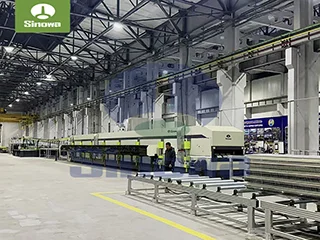
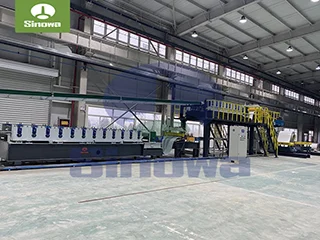
The fundamental design logic of a PUF sandwich panel production line originates from the physical and chemical properties of polyurethane foam and metallic surface substrates. Polyurethane foam is formed through the polymerization and foaming reaction of polyether polyol and isocyanate under the synergistic effect of catalysts, blowing agents, and stabilizers. The microscopic closed-cell structure generated by the chemical reaction endows the material with excellent heat insulation performance and mechanical compression resistance. Metallic sheets, as the outer protective layer of composite panels, provide tensile strength, surface flatness, and corrosion resistance for finished products. The core manufacturing goal of the entire production line is to achieve continuous and stable compounding between the liquid foam raw materials and solid metallic substrates, while ensuring consistent foam density, uniform bonding interface, and precise dimensional accuracy of finished panels. Unlike intermittent manual or semi-automatic manufacturing equipment, modern integrated production lines adopt a linear continuous layout, where each functional unit is closely connected through synchronous transmission mechanisms to minimize material transfer intervals and maintain the continuity of the production process. The overall operational rhythm of the production line follows the sequential logic of raw material preparation, surface pretreatment, liquid material mixing, continuous foaming composite, constant-temperature curing, fixed-length cutting, surface finishing, and finished product stacking, with each link restricting and coordinating with one another to form a closed-loop manufacturing system.
The front-end raw material pretreatment module constitutes the primary functional section of the entire sandwich panel production line, undertaking the processing and quality stabilization of metallic surface materials and foam chemical raw materials respectively. For metallic coiled materials used as panel surfaces, the pretreatment process starts with automatic unwinding. The coiled metallic raw materials are placed on a rotatable unwinding support, and under the traction of synchronous driving rollers, the sheet materials are slowly and evenly unfolded to eliminate the internal stress generated during the coiling and storage process. In the unfolding stage, auxiliary flattening structures are equipped to correct minor bending and wrinkling defects on the surface of the sheets, ensuring that the flatness of the substrates meets the basic composite standards. Subsequently, the metallic sheets enter the surface treatment unit, where mechanical cleaning and physical roughening operations are carried out. Dust, oil stains, and oxide layers attached to the surface of the sheets are thoroughly removed through high-pressure air blowing and friction cleaning structures. The micro-roughening treatment on the sheet surface effectively enhances the physical adhesion between the metallic substrates and liquid foam materials, avoiding interfacial delamination caused by smooth and inert metal surfaces in subsequent long-term usage. After the completion of pretreatment, the metallic sheets are transmitted to the temporary storage buffer section, where adjustable tension control devices maintain stable conveying speed and tensile force, preventing elastic deformation or position deviation of thin sheets during high-speed transmission.
In parallel with the processing of metallic substrates, the raw material supply and mixing system for polyurethane foam operates independently and collaboratively with the sheet transmission mechanism. This system mainly consists of raw material storage tanks, filter circulation pipelines, precision metering pumps, and dynamic mixing chambers. Different chemical raw materials are stored in sealed insulated tanks, with constant-temperature circulation structures installed inside the tanks to maintain the fluid viscosity and chemical activity of the raw materials within a stable range. Since the chemical reaction rate of polyurethane raw materials is highly sensitive to temperature fluctuations, the internal temperature of the storage tanks is kept within a narrow fluctuation interval to avoid inconsistent reaction activity caused by raw material temperature differences. Before entering the mixing procedure, all liquid raw materials pass through multi-stage filter screens to eliminate tiny solid impurities generated during storage and transportation, preventing impurity particles from affecting the compactness and uniformity of the foam cellular structure. The precision metering pumps accurately control the output proportion of each raw material according to the preset foaming formula, and the proportioning parameters can be dynamically adjusted based on the required foam density and hardness of finished panels. The mixed liquid materials are sent to the high-speed dynamic mixing chamber, where turbulent stirring structures rapidly blend different components to form a homogeneous foaming liquid, laying a foundation for uniform continuous foaming in the subsequent process.
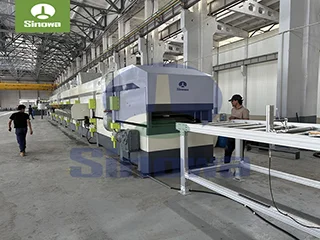
The continuous foaming and composite molding section is the core functional area of the entire sandwich panel line, determining the key physical properties such as thermal insulation efficiency, bonding strength, and overall flatness of finished panels. The uniformly mixed foaming liquid is evenly sprayed onto the surface of the lower metallic sheet through a linear discharge nozzle. The spraying flow rate and distribution range are precisely matched with the sheet transmission speed to ensure that the liquid raw materials cover the sheet surface without overflow or missing areas. Immediately after spraying, the upper metallic sheet is closed through a vertical pressing structure, forming a three-layer composite structure with the lower sheet and the intermediate foaming liquid. The composite semi-finished products then enter the fully enclosed constant-temperature foaming channel. The internal space of the channel is equipped with multi-group heating components and airflow circulation structures, which maintain a stable thermal environment required for the foaming reaction. In the early stage of material entry, the liquid mixture undergoes rapid chemical cross-linking reactions, accompanied by continuous gas generation to form dense closed-cell structures. With the gradual progress of the reaction, the foam volume expands steadily and fills the gap between the upper and lower sheets, achieving seamless bonding with the metallic substrates.
During the foaming and molding process, the continuous sandwich panel line adopts an adjustable pressure-limiting pressing structure to constrain the expansion range of the foam. The upper and lower limiting plates inside the molding channel maintain a fixed spacing, which directly defines the thickness specifications of finished panels. The elastic buffer components installed on the limiting plates can offset the instantaneous expansion pressure generated during foam foaming, avoiding local depressions or bulges on the panel surface caused by excessive pressure. Meanwhile, multiple groups of temperature sensors distributed in the foaming channel monitor the internal temperature changes in real time. Once the local temperature deviates from the preset threshold, the heating power is automatically adjusted to balance the reaction heat release of polyurethane materials, preventing quality defects such as internal voids, surface bubbles, or uneven foam density caused by abnormal temperatures. The entire foaming composite process is completed in a continuous transmission state, and the uninterrupted feeding and molding mode effectively improves production efficiency while ensuring the consistency of batch product quality.
The constant-temperature curing and shaping section undertakes the task of stabilizing the internal structure of initially molded composite panels. Although the polyurethane foam completes the basic foaming and bonding actions in the molding channel, the internal chemical cross-linking reaction has not been fully terminated, and the molecular structure still needs a certain period of heat preservation curing to enhance structural stability. The curing channel is connected to the tail end of the molding channel, with a relatively lower and more stable internal temperature. The low-speed synchronous transmission chain inside the channel drives the composite panels to move forward slowly, providing sufficient reaction time for the internal materials. During the curing process, the residual active components inside the foam continue to undergo cross-linking reactions, the cellular structure gradually solidifies and stabilizes, and the bonding force between the foam core layer and the metallic sheets is further strengthened. In addition, the slow heat dissipation environment inside the curing channel can eliminate the internal stress generated by rapid foaming, effectively reducing the probability of panel warping and deformation in the later usage cycle. The length of the curing channel and the transmission speed are designed based on the reaction characteristics of polyurethane materials, ensuring that each panel can complete the structural stabilization process before leaving the curing area.
The fixed-length cutting and edge trimming module is responsible for converting continuously molded long strip panels into finished products with standardized dimensions. After being discharged from the curing channel, the panels maintain a stable flat state and enter the intelligent cutting area. The production line is equipped with laser sensing length measurement components, which record the real-time transmission distance of the panels and send cutting instructions when the materials reach the preset length specifications. The cutting mechanism adopts high-speed rotating cutting tools with smooth and sharp cutting edges to complete vertical cutting actions in an instant. The cutting process is free of violent vibration, which avoids cracking and delamination of the foam core layer at the cutting section. For the irregular burrs and uneven edges on both sides of the panels generated in the molding process, the edge trimming devices on both sides perform synchronous milling and polishing operations. The edge trimming width can be adjusted according to the usage requirements of the panels, ensuring that the cross-sectional dimensions of each finished panel are consistent and the edges are smooth and flat. All cutting and trimming waste generated during the processing is collected by a centralized negative pressure recycling system, which concentrates the fragmented foam and metal scraps to reduce material waste and keep the production environment clean.
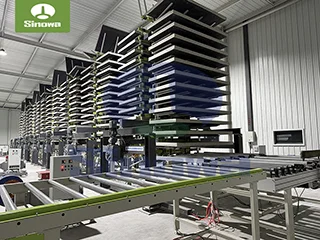
The surface finishing and finished product stacking section serves as the terminal processing link of the sandwich panel manufacturing line, realizing the final quality optimization and orderly storage of panels. After cutting and trimming, the surface of the metallic sheets may have tiny scratches and residual dust. The surface finishing unit is equipped with soft polishing rollers and static dust removal structures to gently polish the panel surface and remove static adsorption impurities, optimizing the surface smoothness and appearance quality of finished products. For panels requiring surface protection, the automatic film covering structure can attach transparent protective films to the upper and lower surfaces, preventing friction scratches and corrosion contamination during transportation and stacking. Subsequently, the qualified panels are transported to the stacking platform through the transmission rollers. The intelligent mechanical arm on the platform automatically completes the handling, alignment, and stacking of the panels. The stacking height and arrangement interval are controlled by preset programs to avoid extrusion deformation of the bottom panels caused by excessive stacking. Meanwhile, the system records the production quantity, processing time, and specification parameters of each batch of products to facilitate subsequent production data statistics and product traceability management.
The auxiliary support system of the PUF panel production line provides comprehensive operational guarantee for the stable operation of the main processing units, covering power transmission, hydraulic control, gas circuit circulation, and intelligent monitoring subsystems. The power transmission system adopts frequency conversion driving motors, which can flexibly adjust the operating speed of each transmission unit according to production demands, realizing stepless speed regulation from low-speed debugging to high-speed mass production. The hydraulic control system provides stable power support for pressing, cutting, and mechanical handling actions. The hydraulic components are equipped with damping and noise reduction structures to minimize mechanical vibration and operating noise during equipment operation. The gas circuit circulation system undertakes multiple functions such as raw material pneumatic conveying, surface air blowing cleaning, and internal pressure balance of the closed channel. The filtered dry gas ensures the cleanness of the material processing environment and avoids moisture and impurity interference affecting product quality. The intelligent monitoring system is distributed throughout all functional sections of the production line. Temperature sensors, pressure sensors, speed sensors, and vibration detection components collect real-time operational data of the equipment. The centralized control terminal displays the operating status of each unit in real time. Once abnormal parameters such as excessive temperature, blocked material transmission, and abnormal pressure appear, the system automatically triggers early warning prompts and executes emergency protection actions such as deceleration and shutdown to avoid equipment failure and batch quality problems.
In actual industrial production applications, the operational optimization of the PUF sandwich panel machine needs to comprehensively consider multiple factors such as raw material characteristics, environmental conditions, and product usage scenarios. In terms of raw material matching, the viscosity, activity, and foaming ratio of polyurethane chemical materials need to be reasonably adjusted according to the ambient temperature of the production workshop. In low-temperature production environments, the raw material preheating temperature needs to be appropriately increased to ensure the smooth progress of the foaming reaction; in high-temperature seasons, the cooling circulation efficiency of the mixing chamber should be enhanced to prevent excessive reaction speed from causing foam structural defects. For metallic sheets of different thicknesses and materials, the tension parameters of the unwinding and transmission units need to be dynamically calibrated to avoid tensile deformation of thin sheets and position deviation of thick sheets during composite molding. In addition, the cleaning and maintenance cycle of the production line directly affects the service life of the equipment and the stability of product quality. The residual foam materials in the mixing pipeline and spraying nozzle need to be regularly cleaned to prevent material solidification and blockage; the transmission rollers and pressing plates should be periodically polished and maintained to reduce surface friction damage to the metallic sheets; the circuit and gas circuit pipelines need to be inspected for aging and leakage to ensure the safety and stability of long-term continuous operation of the equipment.
Compared with traditional manual and semi-automatic panel manufacturing equipment, modern integrated PUF panel production lines have obvious advantages in production efficiency, product consistency, and resource utilization. In terms of production efficiency, the continuous linear processing mode eliminates intermediate material handling and waiting links. All processes from raw material feeding to finished product stacking are completed in a one-stop manner, effectively shortening the single-panel processing cycle and greatly improving the daily output of a single production line. In terms of product quality stability, the intelligent parameter control system realizes precise management of temperature, pressure, flow rate, and speed. The interference of human operational errors on product quality is reduced, and the indicators such as foam density, panel thickness, and bonding strength of batch products maintain a high degree of consistency. In terms of resource utilization, the closed raw material circulation pipeline reduces volatile loss of chemical materials. The centralized waste recycling system realizes secondary utilization of processing scraps. The optimized energy-saving structure reduces invalid energy consumption during equipment operation, which not only cuts down comprehensive production costs but also conforms to the energy-saving and emission-reduction development requirements of the modern manufacturing industry.
PUF panels manufactured by advanced production lines have broad application coverage in multiple industrial fields. In the building construction industry, these panels are used for the enclosure structures of prefabricated buildings, cold storage thermal insulation walls, and roof waterproof and thermal insulation layers. Their lightweight characteristics reduce the bearing pressure of building structures, and the closed-cell foam structure effectively blocks heat conduction and reduces building energy consumption. In the industrial manufacturing field, the panels serve as purification partition walls for dust-free workshops and thermal insulation linings for industrial kilns, relying on their corrosion resistance, fire retardancy, and temperature resistance to adapt to harsh industrial environments. In the logistics and transportation industry, composite panels are applied to the thermal insulation compartments of refrigerated transportation vehicles to maintain a stable internal temperature and ensure the transportation quality of perishable goods. With the continuous upgrading of downstream application demands, the functional requirements for PUF panels are becoming increasingly diversified, which also promotes the continuous technological iteration of production lines.
Looking at the long-term development trend of the industry, PUF panel manufacturing lines will evolve towards higher automation intelligence, greener environmental protection performance, and more flexible production modes. In terms of intelligent upgrading, the production line will introduce artificial intelligence algorithms and big data analysis technology to realize automatic identification of raw material status, intelligent prediction of equipment failure, and adaptive adjustment of production parameters. The unmanned operation level of the production process will be further improved to reduce labor dependence. In terms of environmental optimization, the production system will develop low-volatile and low-pollution raw material mixing processes, equipped with efficient waste gas and waste residue treatment devices to minimize the environmental impact of the production process. In terms of flexible production, the modular structural design will enable the production line to quickly switch between panels of different thicknesses and materials, meeting the personalized customized production demands of the market. At the same time, the integration of multi-process composite technology will realize the one-time molding of composite panels with special functions such as fire resistance, sound insulation, and anti-corrosion, further expanding the application boundary of products.
In conclusion, the PUF panel production line is a highly integrated modern manufacturing system that combines mechanical engineering, chemical reaction engineering, and intelligent control technology. Its complete and rigorous production workflow realizes the efficient conversion of raw materials into high-performance composite panels. Each functional unit in the production line restricts and cooperates with each other, jointly ensuring the stability, continuity, and high efficiency of the manufacturing process. With the continuous progress of industrial manufacturing technology and the continuous expansion of downstream application markets, the technological maturity and production performance of PUF panel production lines will be further improved. While satisfying the market demand for thermal insulation composite panels, the production system will continuously move towards intelligence, environmental protection, and flexibility, providing reliable technical equipment support for the high-quality development of the building thermal insulation and industrial composite material industry. In the future, with the deep integration of emerging technologies such as digital twins and automatic control, the operational precision and production potential of such production lines will reach a new height, creating greater industrial value and market benefits for the entire composite material manufacturing industry.
https://www.cnsinowa.com/sandwich-panel-machines/puf-panel-production-line.html