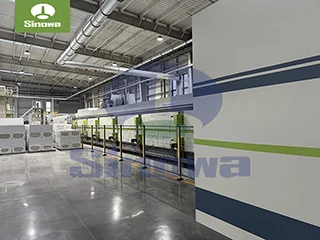
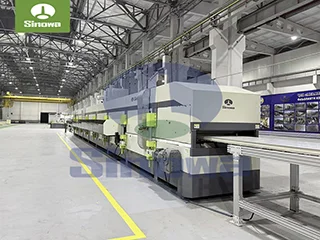
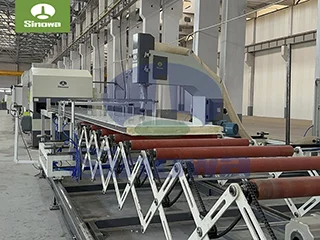
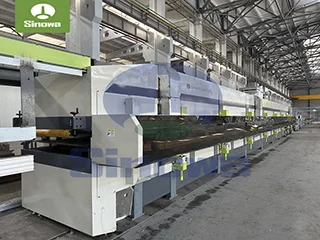
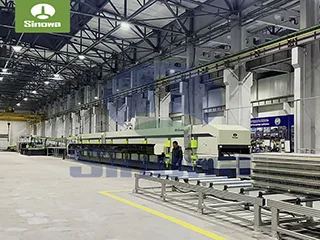
sandwich panel machine
The basic structural composition of a roof wall sandwich panel making machine follows a streamlined production logic, with multiple interconnected functional modules cooperating to complete the whole manufacturing process from raw material feeding to finished product output. Each functional module has independent mechanical characteristics and linkage operation logic, and the coordination accuracy between modules directly determines the molding quality and production efficiency of sandwich panels. The raw material feeding module is the starting part of the entire production line, which is mainly responsible for the orderly release and preliminary leveling of metal base plates and core insulation materials. Metal raw materials are transported in coiled forms, and the feeding structure is equipped with flexible unwinding components to ensure the stable output of coiled materials and avoid tensile deformation caused by uneven stress during material conveying. For the core insulation materials such as rock wool, polyurethane and polystyrene, the feeding module adopts a limiting conveying structure to maintain the flat state of the core material, preventing position deviation in the subsequent composite processing link.
Following the feeding link, the surface pretreatment and rolling forming module undertakes the shaping processing of metal plates. The flat metal base plate will pass through multiple groups of precision rolling rollers, and the orderly arranged roller sets gradually press the flat plate into the required wave-shaped or flat contour according to the preset processing parameters. These rolling rollers are made of high-strength wear-resistant metal materials, which can maintain stable forming accuracy after long-term continuous operation and reduce the wear loss caused by frequent material friction. In this processing stage, the surface of the metal plate will also undergo simple dedusting and smoothing treatment to remove surface impurities and tiny burrs, laying a good foundation for the subsequent bonding between the metal plate and the core material. The spacing and pressure of the rolling rollers can be adjusted moderately according to the production requirements, so as to adapt to metal base plates with different thicknesses and meet the molding standards of sandwich panels for different building use scenarios.
The gluing and composite pressing module is the core functional section that determines the bonding performance of sandwich panels. After the metal plate is formed and the core material is positioned, the automatic gluing structure evenly coats the environmental-friendly adhesive on the bonding surface of the core material and the metal plate. The gluing process adopts a quantitative spraying method to ensure uniform adhesive distribution and avoid quality defects such as hollowing and degumming caused by excessive or insufficient glue amount. Subsequently, the preliminarily bonded composite materials enter the thermal pressing area, where constant temperature and stable pressure are maintained to accelerate the curing reaction of the adhesive. Under the dual effect of temperature and pressure, the gaps between the metal plate and the core material are completely eliminated, forming an integrated composite structure with high bonding strength. The internal temperature and pressure parameters of the pressing area can be dynamically adjusted according to the characteristics of different core materials, so as to match the bonding curing requirements of various insulation substrates and ensure the structural compactness of finished panels.
After the composite pressing is completed, the trimming and fixed-length cutting module carries out precise finishing processing on the continuous plate body. During the continuous production process, the edges of the composite panel may have irregular residual materials and unsmooth burrs. The trimming device cuts off the redundant edge materials on both sides to ensure the neat and consistent width of the panel. The fixed-length cutting system adopts synchronous cutting technology. When the panel is continuously transported forward, the cutting tool moves synchronously with the plate body to complete the instantaneous cutting action, which avoids the production pause caused by static cutting and effectively improves the continuous production efficiency. The cutting stroke and length parameters can be set through the control terminal, realizing flexible switching of panel specifications and meeting the customized size requirements of different construction projects. The cut finished panels have smooth and flat sections without obvious cracks and deformation, which is convenient for subsequent stacking and transportation.
The final part of the sandwich panel production line is the cooling shaping and finished product stacking module. The newly cut sandwich panel still retains residual temperature, and the internal adhesive has not been completely cured. The natural air cooling structure is used to dissipate heat evenly on the surface of the panel to stabilize the internal stress of the composite structure and prevent panel warping and deformation caused by temperature difference. After the cooling and shaping process, the mechanical stacking device automatically completes the arrangement and stacking of finished panels. The stacking action is stable and orderly, which can avoid surface scratches and structural damage caused by manual handling. At the same time, the stacking height and arrangement mode can be adjusted according to the storage and transportation standards, optimizing the space utilization rate of finished product storage area and reducing the labor cost of manual sorting.
In terms of working performance, modern roof wall sandwich panel machine have obvious technical advantages in production automation and operation stability. The whole production process is controlled by an integrated electric control system, which centrally regulates the operating speed, processing parameters and linkage rhythm of each functional module. The control interface is simple and intuitive, and operators can complete parameter setting, equipment start-stop and fault detection through simple operation steps. The built-in sensing components can monitor the operating state of key parts in real time, including material conveying speed, pressing temperature, cutting position and other data. Once abnormal conditions such as material blockage and parameter deviation occur, the system will automatically trigger the early warning mechanism and perform protective shutdown to reduce equipment loss and product scrap rate. The optimized transmission structure reduces mechanical friction resistance during operation, realizing low-noise and low-vibration production operation, which not only improves the working environment of the production workshop but also extends the service life of mechanical parts.
This type of mechanical equipment has excellent material adaptability and can be compatible with multiple types of raw materials to produce differentiated sandwich panels. In terms of surface metal plates, it can process color-coated steel plates, galvanized steel plates and other metal substrates with different thicknesses, and the processed plates have uniform surface texture and strong corrosion resistance. In terms of core insulation materials, it can adapt to porous thermal insulation substrates such as rock wool, mineral wool, polyurethane foam and polystyrene foam. Different core materials endow the finished panels with different functional characteristics: rock wool core materials have excellent fire resistance and sound insulation performance, suitable for high-fire-protection-demand building enclosures; polyurethane core materials have low thermal conductivity and good thermal insulation effect, which is widely used in cold storage and constant-temperature storage buildings; polystyrene core materials have light weight and low comprehensive production cost, meeting the construction needs of temporary buildings and simple industrial facilities. Relying on flexible material matching capability, the production machine can switch production schemes according to market demand and expand the application coverage of finished products.
From the perspective of industrial application value, the popularization of roof wall sandwich panel production machine has greatly optimized the production mode of the construction material industry. In the traditional panel manufacturing mode, most processes rely on manual auxiliary operation, with low production efficiency, inconsistent product quality and high labor dependence. The integrated automatic production line realizes one-time molding from raw material processing to finished product output. The continuous production mode effectively shortens the single-panel processing cycle, and the daily production capacity is far higher than that of manual semi-automatic equipment. The unified mechanical processing standard eliminates the quality difference caused by human operation errors. The produced sandwich panels have consistent thickness, flat surface and stable structural performance, which can meet the unified installation requirements of large-scale construction projects. In addition, the compact structural design of the production line reduces the occupation of workshop space, and the modular layout is convenient for equipment transportation and workshop layout adjustment, adapting to the production site requirements of different production enterprises.
In terms of energy consumption and environmental protection, the optimized structural design of modern sandwich panel manufacturing machine conforms to the sustainable development concept of the construction industry. The transmission and power components adopt energy-saving design, which effectively reduces invalid energy consumption during equipment operation and lowers the comprehensive energy consumption per unit product. The gluing system adopts closed spraying structure to avoid adhesive volatilization and leakage, reducing the emission of harmful substances in the production process. The residual edge materials generated in the trimming process can be recycled and reused after centralized collection, which improves the utilization rate of raw materials and reduces production waste. Compared with traditional building material production equipment, this type of machine has the characteristics of low pollution, low energy consumption and high resource utilization rate, which can effectively reduce the environmental pressure in the production process and meet the increasingly strict industrial environmental protection standards.
In the actual production and use process, daily maintenance and standardized operation are crucial to maintain the stable performance of the roof wall sandwich panel line. Daily maintenance work mainly includes surface cleaning, lubrication maintenance and component inspection. It is necessary to regularly clean the dust and residual raw material debris on the surface of rolling rollers, conveying rollers and cutting tools to avoid hard impurities scratching the plate surface and affecting processing accuracy. Lubricating oil should be regularly added to the rotating and connecting parts to reduce mechanical wear and ensure flexible operation of the transmission structure. The staff need to regularly check the tightness of connecting parts and the sensitivity of sensing components, and replace severely worn parts in a timely manner to prevent equipment failure caused by component aging. In addition, operators need to receive professional operation training, strictly abide by the operation specifications to adjust production parameters, and avoid equipment damage and product quality problems caused by irregular operation.
Looking at the development trend of the construction machinery industry, roof wall sandwich panel making machines are constantly evolving towards higher automation, intelligent control and diversified processing. With the continuous progress of industrial control technology, the intelligent monitoring system of the equipment will be further optimized, realizing automatic data recording, production parameter optimization and remote operation monitoring. The upgraded mechanical structure will have stronger bearing capacity and wear resistance, adapting to long-term high-intensity continuous production. In terms of processing functions, the equipment will add more auxiliary processing links such as surface embossing and anti-corrosion coating treatment, realizing one-step completion of panel molding and surface processing and further enriching the functional attributes of finished panels. In addition, the modular detachable design will become the mainstream development direction, which is convenient for equipment transportation, installation and later maintenance, and reduces the comprehensive operation cost of production enterprises.
In conclusion, the roof wall sandwich panel making machine, as special processing equipment for composite building panels, integrates mechanical transmission, automatic control, thermal compression bonding and precision cutting technologies. It has irreplaceable important value in the field of building material production. Through reasonable structural design and stable operation performance, the equipment efficiently produces high-quality sandwich panels with thermal insulation, sound insulation, fire resistance and structural stability, providing reliable material support for various modern construction projects. With the continuous upgrading of the global construction industry and the improvement of energy-saving and environmental protection requirements, this type of mechanical equipment will continue to carry out technological innovation and performance optimization, continuously adapt to the changing market demand, and make greater contributions to the high-quality development of the construction material manufacturing industry and the upgrading of building enclosure engineering.
https://www.cnsinowa.com/sandwich-panel-machines/roof-wall-sandwich-panel-making-machine.html