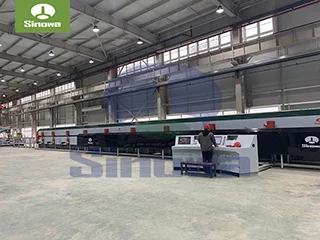
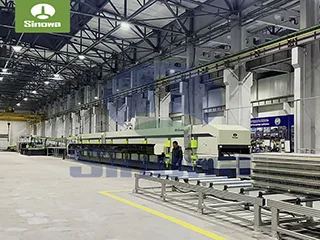
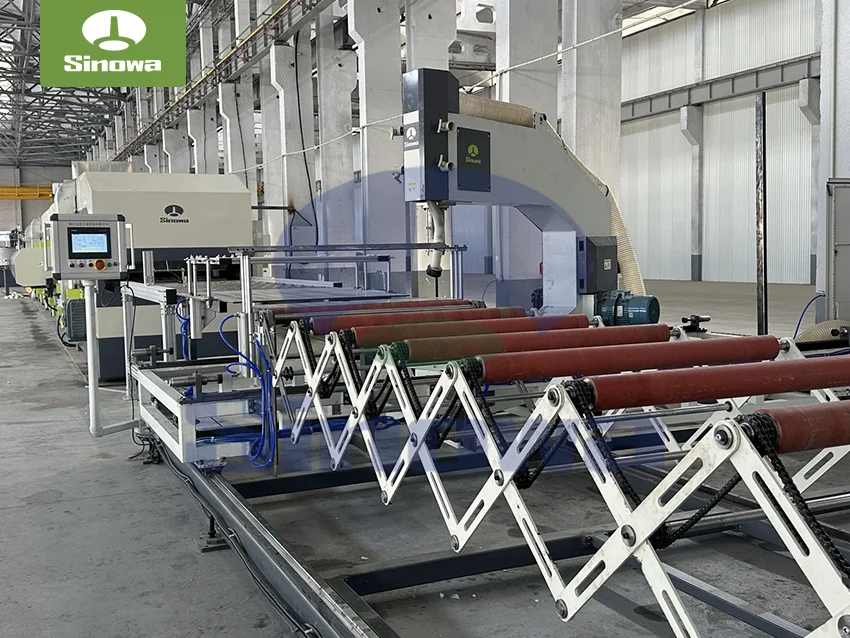
 sandwich panel machine
The overall structural design of the metal carved insulated sandwich panel machine follows the principle of continuous linear production, and the whole sandwich panel production line is composed of multiple interconnected functional modules with collaborative linkage operation, realizing seamless connection from raw material input to finished panel output without intermediate manual turnover. The front-end raw material feeding module adopts dual-station unwinding structures to place upper and lower metal coil substrates respectively. The metal substrates applied in this production line are mostly pre-coated color steel sheets with uniform surface paint layers and good corrosion resistance, which adapt to outdoor long-term exposure scenarios of building exterior walls. After being unwound, the metal sheets first enter the leveling and surface cleaning unit. This unit is equipped with multi-group parallel leveling rollers to eliminate bending stress and surface warpage generated during metal coil storage and transportation, ensuring the flatness of metal plates before carving and composite processing. Meanwhile, circulating dust removal and surface degreasing components are installed inside the unit to remove tiny dust particles, oil stains and other attachments on the metal surface. This pretreatment link is indispensable, because residual impurities on the metal surface will directly reduce the bonding tightness between the metal surface layer and the intermediate insulation core material, leading to delamination, edge warping and other quality defects of finished panels in later service.
The metal carving forming module is the core differentiated part of this equipment compared with ordinary insulated sandwich panel production machine. This module adopts precision engraved roller sets with customizable surface mold textures. When flat metal sheets pass through the gap between upper and lower carving rollers under constant traction force, uniform and consistent three-dimensional concave-convex textures are pressed on the metal surface through mechanical cold pressing forming technology. The cold pressing carving process avoids high-temperature heating damage to the surface protective coating of metal plates, retaining the original weather resistance and color stability of pre-coated metal materials. The depth, density and arrangement mode of carved textures can be adjusted by changing the roller gap and operating traction speed of the equipment, which supports flexible switching of multiple decorative styles in one sandwich panel line without replacing the whole production unit. After carving forming, the metal sheets will go through secondary shaping calibration to correct slight edge deformation caused by extrusion force in the carving process, ensuring that the dimensional tolerance of metal panels is controlled within a tiny range and matching the overall composite size requirements of subsequent sandwich structures. Unlike offline stamping carving equipment that processes single metal plates separately, the online integrated carving design of this machine keeps the metal sheet in a continuous linear conveying state throughout the process, avoiding positioning errors caused by repeated clamping of single plates and improving the overall consistency of surface decorative effects of batch panels.
Following the carving and shaping process is the intermediate insulation core material laying and composite gluing stage, which determines the core thermal insulation, sound insulation and structural bearing performance of finished sandwich panels. The equipment supports matching with two mainstream types of insulation core materials to adapt to different application scenarios and performance demands. The first type is liquid foaming core material raw materials, including polyurethane and polyisocyanurate chemical mixtures. The built-in precision metering and mixing system of the machine can proportionally blend two-component liquid raw materials according to preset process parameters, and evenly spray the mixed liquid materials between the upper carved metal sheet and the lower flat metal sheet through a full-width uniform spraying nozzle. The liquid materials undergo rapid chemical foaming reaction inside the closed composite cavity, forming a continuous and seamless foam insulation core layer that closely fits the inner surfaces of double metal layers. The second matching core material is prefabricated inorganic fiber insulation materials such as rock wool and glass wool. For solid core materials, the equipment is equipped with automatic core material conveying and positioning mechanisms, which can accurately convey strip-shaped fiber core materials to the middle of double metal sheets, and complete automatic glue coating on both sides of core materials to enhance interface bonding force. The equipment adopts independent parameter adjustment systems for different core materials, including foaming temperature control, glue coating amount adjustment and conveying speed matching functions, so as to adapt to the different curing cycle and bonding characteristics of organic foam and inorganic fiber core materials.
The continuous composite pressing and constant-temperature curing module is a key unit to realize integrated bonding of three-layer panel structures. After the upper carved metal layer, intermediate insulation core layer and lower metal base layer are assembled in place, the whole panel semi-finished product enters the double-belt constant-pressure pressing system. The system provides stable and uniform horizontal pressing force through circulating steel belts, avoiding local pressure unevenness which often occurs in intermittent plate pressing equipment. The internal closed constant-temperature curing channel maintains a stable operating temperature range, which accelerates the curing reaction of adhesive materials and foam core materials, promotes molecular bonding between metal surfaces and insulation core layers, and eliminates hidden dangers of interlayer separation in long-term use. The length of the curing channel is designed according to the sandwich panel manufacturing line operating speed, ensuring that the sandwich composite structure completes sufficient curing reaction before leaving the pressing unit, without relying on natural air cooling and curing in the subsequent process. Compared with segmented pressing equipment, the continuous integrated pressing structure reduces production gaps between single panels, improves overall production continuity, and ensures that the bonding strength of each position of long-size continuous panels remains consistent without weak bonding areas in splicing joints.
The rear-end finishing processing unit includes fixed-length cutting, edge trimming and automatic stacking functions, completing the final forming of finished panels. The high-precision servo cutting system tracks the real-time conveying speed of panels in a non-contact mode, realizing dynamic synchronous cutting without stopping the production line. This non-stop cutting mode effectively improves overall production efficiency and avoids size errors caused by start-stop vibration of the insulation board production line. The edge trimming device removes tiny burrs and residual core material overflow at the left and right edges of panels, optimizing the overall flatness and assembly accuracy of panel edges, which facilitates seamless splicing and installation of panels during on-site construction. Finally, the finished panels are automatically stacked by the hydraulic stacking mechanism, and the stacked finished products are arranged neatly for subsequent packaging and transportation. The whole production process from raw material feeding to finished product stacking is completed in one continuous line, with manual intervention only limited to regular parameter inspection and raw material replacement, realizing highly automated unmanned continuous production mode.
In terms of overall operating performance and technical advantages, the metal carved insulated sandwich panel machine has obvious comprehensive strengths compared with separate metal carving equipment and ordinary sandwich panel production lines. Firstly, the integrated design reduces intermediate handling, storage and secondary positioning links between independent equipment, cuts down overall production site space occupation by nearly one third, and lowers labor input and turnover loss in the production process. Secondly, the synchronous forming of surface carving and internal insulation composite structure ensures the overall structural integrity of panels. The carved metal surface and insulation core layer are formed and bonded synchronously under the same linear traction force, so the stress coordination between layers is better, and the panels can resist external bending force and temperature deformation more effectively in complex outdoor temperature change environments. Thirdly, the intelligent centralized control system simplifies equipment operation logic. The human-machine interaction terminal integrates all parameter setting interfaces including carving depth, production line speed, foaming ratio, pressing pressure and curing temperature. Operators can complete one-click switching of different panel specifications and decorative patterns through preset program templates, shortening the mold replacement and parameter debugging time in the early stage of production switching. In addition, the equipment is equipped with real-time operating status monitoring sensors, which can automatically alarm for abnormal parameters such as sheet deviation, insufficient glue amount and abnormal pressing pressure, and automatically trigger emergency protection actions to reduce equipment failure loss and defective panel rate.
This production equipment also takes long-term operating stability and daily maintenance convenience into full consideration in mechanical structure design. The main load-bearing frame of the whole insulation panel production line is made of thickened high-rigidity steel structures, which can resist long-term cyclic mechanical vibration generated by continuous carving extrusion and composite pressing, avoiding frame deformation affecting processing accuracy after years of operation. All transmission rollers and carving roller shafts adopt surface wear-resistant treatment technology to reduce friction loss in long-term high-frequency operation and extend the service cycle of core mechanical components. The equipment adopts modular detachable design for vulnerable parts such as nozzles, trimming blades and induction sensors. Maintenance personnel can complete independent disassembly, replacement and daily cleaning of vulnerable components without professional debugging tools, reducing later equipment operation and maintenance difficulty. Meanwhile, the reserved heat dissipation and dust removal channels inside each functional unit prevent accumulated heat and production dust from affecting the operation accuracy of electrical control components and mechanical transmission structures, adapting to long-term uninterrupted all-day industrial production working conditions.
From the perspective of market application and industrial value, panels produced by this sandwich panel machinery cover multiple mainstream scenarios in modern construction engineering. In residential prefabricated buildings, these integrated panels replace traditional external wall insulation layers and external decorative hanging plates, realizing one-time completion of wall insulation, waterproofing, wind pressure resistance and exterior decoration, shortening the overall construction cycle of residential projects and reducing on-site wet construction operations. In commercial buildings such as shopping malls, exhibition halls and office buildings, diversified carved surface textures can match different architectural design styles, meeting the personalized aesthetic demands of building exterior facades while maintaining excellent energy-saving insulation performance. In industrial plants, logistics warehouses and temporary container houses, the integrated metal carved sandwich panels have superior impact resistance and weather resistance compared with ordinary color steel sandwich panels, reducing later wall maintenance frequency. In addition, the panels are also suitable for municipal engineering facilities such as outdoor corridor canopies and landscape supporting buildings, adapting to harsh outdoor working environments with large temperature differences, strong wind and rain erosion.
Looking forward to the future development trend of such production equipment, the iteration direction of metal carved insulated sandwich panel production line will focus on three core dimensions: higher production flexibility, greener production process and deeper intelligent control. In terms of production flexibility, subsequent optimized equipment will support online free combination of different carving textures on a single panel, breaking the limitation of unified texture on the whole board and meeting the customized personalized design needs of high-end architectural projects. In terms of green production optimization, the equipment will be upgraded with residual material recovery and circulating utilization systems for foaming raw materials and adhesives, reducing raw material waste and volatile organic compound emissions in the production process, adapting to increasingly strict industrial environmental protection production standards. In terms of intelligent upgrading, the equipment will be connected with digital production management systems to realize automatic production data statistics, intelligent early warning of component wear and remote parameter debugging, helping panel manufacturing enterprises realize digital whole-process management of production scheduling, quality monitoring and equipment maintenance.
In conclusion, the metal carved insulated sandwich panel manufacturing machine solves the pain points of scattered working procedures, low integrated performance and high comprehensive production cost in the traditional separate production mode of decorative metal plates and insulation sandwich panels. Through integrated mechanical design, synchronous online processing technology and intelligent control system, it realizes efficient, stable and low-cost integrated production of decorative thermal insulation composite building materials. With the continuous advancement of prefabricated construction industry and the global promotion of building energy conservation policies, this type of integrated sandwich panel production equipment will gain wider application in the field of building material manufacturing, and continuously drive the upgrading of production technology for energy-saving decorative building envelope materials, providing reliable equipment support for the development of high-efficiency, low-carbon and aesthetic modern construction industry.
https://www.cnsinowa.com/sandwich-panel-machines/metal-carved-insulated-sandwich-panel-machine.html