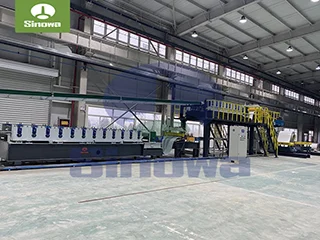
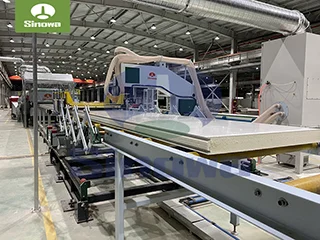
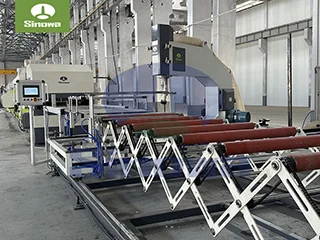
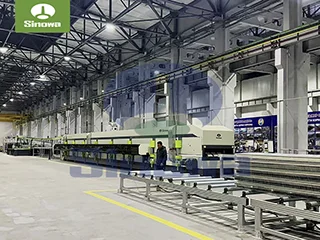
sandwich panel line
The operational logic of the continuous PU sandwich panel production line starts with the feeding and pretreatment of color steel sheet raw materials, which serves as the foundational link determining the surface quality and bonding performance of finished panels. Color steel coils, as the outer protective and decorative layers of sandwich panels, are loaded onto automatic unwinding units, which achieve steady and orderly unwinding through hydraulic and mechanical transmission structures. Equipped with automatic coil splicing functions, the system can connect new steel coils with residual coil ends without halting production, thoroughly avoiding production downtime caused by raw material replacement and greatly improving overall production continuity. After unwinding, the color steel sheets pass through multi-stage leveling and surface cleaning mechanisms, which effectively eliminate minor wrinkles, surface tension unevenness, and tiny dust or oil stains generated during coil storage and transportation. This precise pretreatment process smooths the flatness of the steel sheet surface and optimizes the surface activity of the color steel layer, creating optimal bonding conditions for the subsequent polyurethane foam core material and preventing delamination and peeling problems of panels in long-term use.
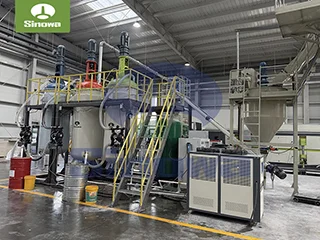
Following the surface pretreatment of color steel sheets, the production process enters the core raw material proportioning and high-pressure foaming stage, which is the key link that determines the thermal insulation, mechanical strength and structural stability of PU sandwich panels. Polyurethane foam is formed by the chemical reaction of two core raw material components, and the entire proportioning and mixing process is completed by a high-precision automatic metering and mixing system. The system adopts independent temperature-controlled storage tanks to store different chemical raw materials, maintaining a constant raw material activity by stabilizing the storage temperature, and avoiding foaming quality defects caused by raw material deterioration or activity changes. Through precision metering pumps, the two components are delivered to the high-pressure mixing head in strict proportional ratios, where high-speed impact and stirring achieve uniform and thorough mixing of raw materials. The uniformly mixed polyurethane raw materials are evenly cast on the surface of the lower color steel sheet in a continuous and quantitative manner, with the casting width and thickness adjustable according to production specifications, realizing flexible production of panels with different thermal insulation thicknesses and structural sizes.
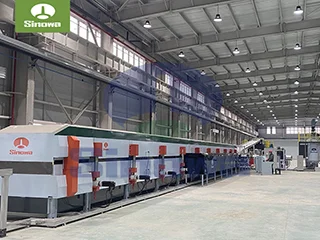
After the completion of foam casting, the upper and lower color steel sheets with foam raw materials enter the double-track laminating and curing system, which is the core functional area for realizing composite molding and solidification of sandwich panels. The double-belt conveyor structure of the system maintains constant pressure and stable conveying speed, ensuring that the upper and lower steel sheets and the intermediate polyurethane foam layer are tightly fitted without relative displacement during the composite process. The internal temperature of the laminating zone is precisely controlled through a distributed heating system, providing a stable thermal environment for the foaming expansion and chemical curing of polyurethane materials. In the constant temperature and pressure environment, the polyurethane raw materials undergo continuous foaming, expansion and cross-linking curing reactions, gradually forming a dense and uniform closed-cell foam structure. This closed-cell structure endows the sandwich panel with excellent thermal insulation performance, while the tight chemical bonding between the foam core and color steel sheets greatly enhances the overall structural integrity of the panel, enabling the product to withstand external pressure, bending and shear forces in actual use.
The synchronization control of the continuous PU sandwich panel line runs through all processing links, and the coordinated operation of unwinding speed, foaming casting volume, laminating conveying speed and curing time is realized through an integrated automatic control system. The system can dynamically adjust operating parameters according to different panel thicknesses, widths and production speeds, ensuring that the foaming degree, curing state and composite compactness of each section of the panel remain consistent. In the high-speed continuous production state, the equipment can always maintain stable processing accuracy, avoiding common quality problems such as uneven foam density, inconsistent panel thickness, and offset of steel sheets that are prone to occur in traditional intermittent production. After sufficient curing and molding in the laminating and curing section, the preliminary formed sandwich panel has stable structural performance and surface flatness, and can enter the fixed-length cutting and finishing stage.
The fixed-length cutting unit adopts a flying cutting structure that synchronizes with the PU sandwich panel production line speed, realizing dynamic cutting without stopping the machine. According to the preset length parameters of finished products, the cutting tool tracks the running speed of the panel in real time and completes accurate cutting in the moving state, ensuring that the dimensional error of each finished panel is controlled within a tiny range. The cutting process is smooth and burr-free, with neat panel end faces, eliminating secondary trimming procedures and improving production efficiency. After cutting, the finished panels are transported to the sorting and discharging platform through the automatic conveying device, where the stacking mechanism neatly arranges the qualified products, realizing automated discharging and stacking and reducing manual handling workload.
The structural design of the continuous PU sandwich panel line fully considers the stability, durability and maintainability of long-term continuous operation. The whole PU sandwich panel machine adopts a rigid frame structure with high-strength materials, which can resist vibration and structural deformation during long-term high-speed operation and maintain long-term processing accuracy. All transmission and moving parts are equipped with dust-proof and wear-resistant protection structures, adapting to the complex production environment of factory workshops and reducing equipment failure rates. The modular design of functional units enables independent maintenance and replacement of each processing module, greatly simplifying daily equipment maintenance and reducing equipment downtime caused by maintenance. In terms of energy consumption control, the equipment optimizes the heating and power transmission system, realizing on-demand energy supply, effectively reducing invalid energy consumption in the production process and improving the overall energy utilization rate of production.
The color steel PU sandwich panels produced by this continuous production line have outstanding comprehensive performance, making them widely applicable in multiple fields of modern construction engineering. The tight composite structure of color steel sheet and PU foam core gives the panels excellent thermal insulation and heat preservation performance, which can effectively block indoor and outdoor heat transfer, reduce the energy consumption of building heating and cooling, and meet the energy-saving and environmental protection requirements of modern buildings. At the same time, the closed-cell foam structure has good sound insulation and noise reduction effects, which can weaken the transmission of external noise and improve the indoor acoustic environment. The surface color steel sheet has good weather resistance, corrosion resistance and scratch resistance, which can adapt to different outdoor and indoor use environments, and maintain stable appearance and performance for a long time without fading or deforming.
In terms of mechanical performance, the integrated composite molding structure enables the sandwich panel to have high overall rigidity and load-bearing capacity. It can withstand certain wind pressure, snow pressure and external impact forces, and is suitable for the construction of factory workshops, warehouse enclosures, cold storage buildings, temporary engineering buildings and other facilities. Compared with traditional building materials, the continuous produced PU sandwich panels have lighter weight, which can effectively reduce the self-weight of buildings, lower the load-bearing requirements of building structures, and thus reduce the overall construction cost of projects. In addition, the standardized and unified size and performance of finished panels brought by continuous production greatly improve the on-site installation efficiency, shorten the construction cycle, and create higher economic benefits for engineering projects.
With the continuous upgrading of building energy-saving standards and the increasing demand for high-efficiency and environmentally friendly building materials in the construction industry, the continuous polyurethane sandwich panel production line for color steel sheet has become an important core equipment in the field of composite building material production. Its automated and continuous production mode not only improves production efficiency and product qualification rate, but also promotes the standardized and large-scale development of the sandwich panel industry. The equipment can adapt to the production needs of panels for different scenarios such as wall panels, roof panels and cold storage special panels by adjusting process parameters, with strong production flexibility and market adaptability. In the actual production process, the stable process control capability of the equipment ensures that each batch of products has consistent performance indicators in terms of thermal insulation, mechanical strength, structural stability and appearance quality, providing reliable material support for high-quality building construction.
In conclusion, the continuous polyurethane sandwich panel line for color steel sheet integrates advanced mechanical manufacturing technology, automatic control technology and polymer material processing technology, realizing efficient, stable and standardized production of color steel composite sandwich panels. From raw material pretreatment to finished product output, the whole process is highly automated and synchronized, which effectively solves the problems of low efficiency, unstable quality and high labor cost of traditional production methods. The excellent performance of the produced panels and the efficient production characteristics of the equipment make it occupy an important position in the modern building material manufacturing industry, and it will continue to play a key role in promoting the upgrading of energy-saving building materials and the development of green construction in the future.
https://www.cnsinowa.com/sandwich-panel-machines/continuous-pu-sandwich-panel-line-for-color-steel-sheet.html