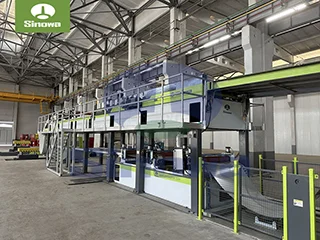
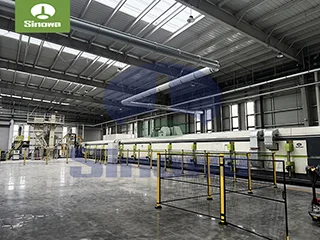
sandwich panel line
The operational logic of the insulated sandwich panel production line is built on the perfect coordination of mechanical transmission, physical pressing and chemical bonding, with each processing link precisely matched in speed and process parameters to avoid structural defects and performance inconsistencies caused by disjointed procedures. The entire production process starts with the feeding and pretreatment of base materials, covering metal surface materials and thermal insulation core materials that constitute the main body of the partition panel. The surface materials are usually metal coil sheets with good toughness and weather resistance, which need to undergo uncoiling, leveling and surface purification treatments before formal processing. The uncoiling unit stably releases the coiled metal materials at a constant speed, eliminating the bending and curling internal stress generated during coil storage. The subsequent leveling mechanism uses multi-group roller sets to perform fine calibration on the metal sheet surface, ensuring the flatness of the base material and avoiding panel warping and deformation in the subsequent compounding and curing stages. Meanwhile, the surface purification process removes floating dust, oil stains and oxide layers on the material surface, creating a clean bonding interface for the subsequent adhesive coating and composite molding, which is crucial for enhancing the bonding fastness between the surface layer and the core material.
Following the base material pretreatment, the sandwich panel production line enters the core surface forming process, where the flat metal sheet is processed into a specific structural profile through a continuous rolling forming system. The rolling unit is equipped with precision profiled rollers arranged in an orderly sequence, which gradually extrude and bend the metal sheet to form longitudinal grooves, trapezoidal textures or special assembly structures on the panel surface. These molded structures not only enhance the overall structural rigidity and compression resistance of the partition panel, but also provide convenient assembly interfaces for the on-site splicing and installation of subsequent panels. During the forming process, the system maintains a stable rolling pressure and transmission speed, ensuring consistent groove depth, spacing and edge radian of each panel, so that the finished products have high interchangeability and assembly accuracy. The edge forming module integrated in the rolling system can flexibly adjust the processing mode to produce diversified edge structures such as flat edges, overlapping edges and buckle edges, adapting to different wall splicing and sealing requirements of building partition projects.
The composite bonding stage is the core link of the entire insulated partition sandwich panel line, which determines the overall structural stability and thermal insulation performance of the finished panel. After the surface metal sheet is formed, it is accurately transported to the gluing and composite station through the synchronous transmission system. The automatic gluing unit evenly sprays or coats high-performance adhesive materials on the inner surface of the metal sheet, realizing full coverage and uniform distribution of the adhesive layer without local accumulation or missing coating. This uniform gluing mode ensures that the core material and the surface material can form an integral bonding structure without gaps, preventing hollowing and peeling problems in long-term use. After the gluing operation is completed, the thermal insulation core materials including foam materials and mineral fiber materials are accurately laid between the upper and lower metal surface layers through the automatic feeding device. The core material feeding system can precisely control the feeding thickness and spacing according to the preset panel specification parameters, ensuring that the core material filling is full and uniform, and maintaining the consistency of the thermal insulation thickness of each batch of panels.
After the preliminary assembly of surface materials and core materials, the semi-finished panels enter the double-belt composite pressing system for integrated molding. The upper and lower synchronous conveyor belts of the system form a stable pressing cavity, and the gap between the belts can be adaptively adjusted according to the thickness specifications of different panels. During the conveying process, the system applies continuous and uniform static pressure to the composite panel, which can effectively eliminate tiny gaps between the adhesive layer, the core material and the surface material, and make the overall structure of the panel more compact. At the same time, the composite pressing area is equipped with a graded heating system, which provides a stable temperature environment for the curing reaction of the adhesive and the foaming and shaping of the core material. The low-temperature preheating stage accelerates the activation of the adhesive, the medium-temperature constant pressure stage promotes the full combination of all structural layers, and the high-temperature curing stage completes the final shaping and structural stabilization of the panel. This segmented temperature control mode avoids the quality problems of core material aging, adhesive failure and panel deformation caused by excessive local temperature or uneven heating.
The curing and cooling process after composite molding is an indispensable part to stabilize the performance of insulated partition panels. The initially molded panels with high temperature are continuously transported to the constant-temperature curing tunnel, where the residual chemical reaction of the adhesive is fully completed under a stable temperature and humidity environment, and the bonding strength between all layers is further improved. After curing, the panels enter the natural cooling and forced cooling zone in sequence, and the internal and external temperature of the panels is gradually balanced through air cooling and contact heat dissipation. Slow and uniform cooling can effectively eliminate the internal thermal stress generated in the high-temperature processing stage, prevent the finished panels from warping, shrinking or cracking after leaving the sandwich panel machine, and ensure the long-term dimensional stability of the panels in different temperature and humidity environments.
After the completion of cooling and shaping, the continuous long-strip panel enters the finishing and cutting stage of the sandwich panel production equipment. The automatic trimming device first performs fine trimming on both sides of the panel to remove the irregular edge materials generated in the composite process, making the overall width of the panel uniform and the edges neat and smooth. Then, the fixed-length cutting system accurately cuts the continuous panel into standard-size finished products according to the preset length parameters. The cutting unit adopts high-precision servo control technology, which can realize stable and fast cutting while ensuring flat and burr-free cutting sections, avoiding secondary processing of the finished panels. In addition, the sandwich panel manufacturing line is equipped with a real-time detection and correction module in the cutting and finishing link, which can automatically identify the dimensional deviation and surface defects of the panels, and complete fine adjustment in real time, effectively reducing the defective rate of products.
The final stage of the production process includes finished product conveying, stacking and preliminary sorting. The qualified finished panels are stably transported to the finished product area through the flexible conveyor system, and the automatic stacking device neatly stacks the panels according to uniform specifications, which is convenient for subsequent transportation and storage. The whole production process from raw material feeding to finished product output is completed in a fully automated sandwich panel assembly line mode, with all process parameters uniformly controlled by the central control system. The integrated operational mode greatly reduces manual intervention, avoids product quality fluctuations caused by human operation errors, and significantly improves production efficiency and product consistency.
The technical advantages of the insulated partition panel production line are fully reflected in its high integration, high precision and strong adaptability. In terms of production integration, the equipment organically combines multiple processes such as uncoiling, forming, gluing, composite pressing, curing, cooling and cutting, realizing one-stop continuous production, which greatly shortens the production cycle compared with the traditional segmented production mode. In terms of processing precision, all transmission, pressing and cutting links adopt precise transmission and control structures, which can accurately control the key parameters such as panel thickness, width, length and bonding uniformity, ensuring that the structural precision of finished products meets the requirements of high-standard construction projects. In terms of adaptability, the sandwich panel making machine can adjust process parameters and processing modules according to different core material types and panel specifications, realizing flexible production of multiple series of insulated partition panels, and meeting the differentiated needs of different application scenarios for panel thickness, thermal insulation performance and structural strength.
In practical industrial production applications, the insulated partition board manufacturing line not only improves production efficiency and product quality, but also brings significant optimization effects in terms of production cost control and resource utilization. The automated continuous production mode reduces the labor demand in the production process, lowers the labor management cost and operation error rate. At the same time, the precise gluing and fixed-length cutting technology effectively reduces the waste of adhesive raw materials and panel leftover materials, improves the utilization rate of production raw materials, and realizes energy-saving and efficient production. In addition, the standardized production process makes the physical properties of the finished panels stable and consistent, with excellent thermal insulation, sound insulation, compression resistance and weather resistance. The partition panels produced by this line can effectively isolate indoor and outdoor temperature difference, reduce building energy consumption, and also have good sound absorption and noise reduction effects, creating a comfortable and safe indoor space environment.
With the continuous upgrading of modern building industrialization and green building standards, the market demand for high-performance insulated partition panels is constantly increasing, which also promotes the continuous technological iteration and functional optimization of insulated partition panel lines. Modern insulation sandwich panel machine is gradually developing towards higher automation intelligence, more flexible parameter adjustment and more stable operational performance. The introduction of intelligent sensing and real-time monitoring technology enables the equipment to automatically perceive the operational state of each processing link, realize real-time early warning and automatic adjustment of abnormal parameters, and further improve the stability and reliability of the production process. At the same time, the optimized structural design of the production line reduces the energy consumption of equipment operation, reduces the generation of production waste, and conforms to the development trend of green and low-carbon manufacturing in the construction industry.
In the field of building partition engineering, the insulated partition panels produced by professional production lines have irreplaceable application advantages compared with traditional brick walls and ordinary color steel plates. The lightweight structural feature of the panels reduces the overall load of the building, which is conducive to building structural safety and foundation cost control. The integrated thermal insulation and structural integration design enables the panels to complete partition construction and thermal insulation decoration in one step, simplifying the on-site construction process, shortening the construction cycle, and reducing the comprehensive construction cost. In addition, the standardized and modular production characteristics of the insulated partition sandwich panel machinery make the product assembly and disassembly more convenient, which is suitable for temporary building partition, industrial workshop space adjustment, commercial interior renovation and other scenarios that require flexible space layout adjustment, and has high practical value and market adaptability.
In conclusion, the insulated partition panel production line is a key core equipment supporting the industrialized production of modern building thermal insulation partition materials. Through scientific and reasonable process layout, precise mechanical control and efficient integrated operation, it realizes standardized, high-efficiency and high-quality mass production of insulated partition panels. Its stable operational performance and flexible production capacity not only meet the diversified application needs of the construction industry for thermal insulation partition materials, but also provide strong technical support for the greenization, lightweight and industrialization development of modern building engineering. With the continuous progress of manufacturing technology and the continuous improvement of building energy-saving requirements, the performance of insulated partition sandwich panel production machinery will be further optimized, and the produced high-performance partition panels will be more widely used in various new construction and renovation projects, injecting continuous power into the high-quality development of the construction industry.
https://www.cnsinowa.com/sandwich-panel-machines/insulated-partition-panel-line.html