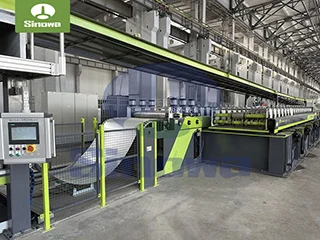
sandwich panel machine
The overall structural design of the PIR insulated sandwich panel production line follows the principles of mechanical stability, chemical reaction adaptability and operational intelligence, with each functional unit precisely matched to the physical and chemical characteristics of PIR foam materials and metal surface materials. The entire production line is composed of raw material unwinding and leveling unit, surface pretreatment and preheating unit, high-pressure foam mixing and injection unit, double-belt composite pressing and curing unit, servo-driven fixed-length cutting unit, conveying and shaping unit, and automatic stacking and finishing unit. All units are connected by precision transmission mechanisms and coordinated by an integrated control system, ensuring synchronous operation of each process link and avoiding quality fluctuations caused by mismatched operating speeds or uncoordinated process parameters. The mechanical framework adopts high-strength structural design to bear long-term continuous operation load, effectively reducing equipment vibration and structural deformation during high-speed production, which lays a solid foundation for the flatness, dimensional accuracy and structural stability of finished panels.
The initial stage of the production process focuses on raw material pretreatment and feeding, which is the basic guarantee for high-quality panel composite molding. Metal coiled materials used as panel surface layers are transported to the unwinding mechanism through auxiliary feeding equipment, and the automatic unwinding device releases coiled materials at a constant speed to avoid tensile deformation and wrinkling of surface materials. After unwinding, the metal sheets pass through multi-group leveling roller sets, which eliminate internal stress and surface unevenness generated during coiling and storage, ensuring the flatness of the base material before composite processing. Subsequently, the surface pretreatment module conducts thorough cleaning of the material surface to remove dust, oil stains and subtle oxide layers that may exist on the surface. These impurities, if not removed completely, will hinder the bonding interface between the surface layer and PIR foam core, leading to insufficient bonding strength, hollowing or delamination of finished panels in subsequent use. The cleaned surface materials will then enter the constant-temperature preheating area for uniform heating treatment. PIR foam polymerization and bonding reactions require a stable temperature environment, and moderate preheating can optimize the surface activity of metal materials, accelerate the subsequent foam curing reaction, and improve the compactness and adhesion uniformity of the composite interface.
The foam mixing and injection system is the core functional component of the entire PIR sandwich panel machine, determining the insulation performance, structural compactness and dimensional stability of the finished panel core layer. Different from ordinary polyurethane foaming equipment, this professional foaming unit is specially optimized for the polymerization characteristics of PIR materials, adopting high-pressure dynamic mixing technology to fully blend polyether polyol, isocyanate and various functional additives in accurate proportions. The internal mixing structure of the system can realize micro-level uniform mixing of raw materials, avoiding local uneven material ratio, insufficient reaction or excessive foaming problems. After full mixing, the liquid foam raw materials are quantitatively and evenly injected between the upper and lower surface layers through precision injection ports. The equipment is designed with multi-point uniform injection structure, which can distribute the foam raw materials evenly in the width direction of the panel, ensuring consistent foam density in all parts of the core layer and avoiding quality defects such as local hollowing, uneven thickness and inconsistent thermal insulation effect. The foaming process is dynamically adjusted according to production speed and panel specification changes, maintaining the best foaming expansion ratio and reaction state to form a fine and closed cell structure inside the PIR core layer, which endows the panel with excellent thermal insulation and pressure resistance.
Following the foam injection process, the semi-finished composite panel enters the double-belt pressing and curing module, which is the key link to realize composite molding and complete chemical curing of PIR foam. This module consists of upper and lower parallel circulating heat-conducting belts and a constant-temperature temperature control system, which can provide continuous and uniform pressure and temperature conditions for the foaming and curing process. After the liquid foam is injected, it begins to expand rapidly and fill the gap between the upper and lower surface layers. The double-belt structure can limit the free expansion of the foam in the vertical direction, ensuring that the overall thickness of the panel is uniform and consistent, and forming a flat and smooth surface. At the same time, the precision temperature control system maintains a constant curing temperature in the entire molding cavity, which can effectively promote the complete polymerization and cross-linking reaction of PIR foam molecules. In the staged curing process, the foam completes gelation, shaping and deep curing in sequence, gradually forming a high-strength closed-cell structure with stable physical properties. The long-distance circulating pressing design ensures that the foam has sufficient reaction time to complete curing, avoiding incomplete internal reaction and unstable performance of the core layer caused by insufficient curing time. The uniform pressure covering the entire panel width eliminates internal gaps between the foam core and the surface layer, realizing integrated composite molding of the panel.
After completing curing and shaping, the continuous long-strip panel is transported to the fixed-length cutting unit through the synchronous conveying system. This unit adopts high-precision servo control technology to realize dynamic following and cutting in the running state of the panel, which effectively avoids the production efficiency loss caused by static cutting and positioning. The control system can preset cutting length parameters according to different production requirements, and automatically adjust the cutting stroke and speed to ensure the dimensional accuracy of each finished panel. The flying saw cutting structure maintains vertical and flat cutting sections, without burrs, deformation or edge warping, ensuring the assembly precision of the panel in subsequent construction and installation. The cutting process is highly coordinated with the front-end molding and conveying speed, realizing seamless connection of continuous production and greatly improving the continuity and automation level of the PIR sandwich panel production line. After cutting, the finished panels are transported through the sorting conveyor mechanism, and unqualified products with dimensional deviation or surface defects are screened out through real-time monitoring, while qualified products enter the finishing and stacking link.
The final stage of production is automatic sorting, turnover and stacking of finished panels. The equipment is equipped with a flexible turnover device, which can adjust the placement state of panels according to production requirements, facilitate subsequent packaging and storage, and avoid surface scratches and extrusion damage caused by direct stacking of panels. The automatic stacking system can realize fixed-quantity and fixed-height stacking according to set parameters, with neat stacking and stable placement, which is convenient for subsequent handling, transportation and warehouse management. The whole process from raw material feeding to finished product stacking basically realizes unmanned automatic operation, reducing manual intervention links, effectively lowering the error rate caused by manual operation, and stabilizing the consistency of batch product quality. The auxiliary finishing unit can also complete simple surface cleaning and edge trimming of finished panels to further optimize the appearance quality of products.
The outstanding advantages of the PIR sandwich panel line are mainly reflected in production stability, product performance optimization and production flexibility. In terms of production stability, the integrated linkage design of all functional modules of the equipment realizes synchronous matching of process parameters, and the intelligent control system can monitor and adjust key parameters such as foaming ratio, curing temperature, pressing pressure and conveying speed in real time during the production process. Once slight parameter deviation is detected, the system will automatically perform fine adjustment to ensure that the production process is always in the optimal state, avoiding batch quality problems. In terms of product performance, the professional foaming and curing process of the equipment enables the PIR core layer to form a uniform closed-cell structure, which gives the finished panel low thermal conductivity, excellent thermal insulation performance, good fire resistance and structural stability. The tight composite interface formed by high-pressure pressing and constant-temperature curing makes the panel have high overall bonding strength, not easy to delaminate and deform during long-term use, and strong durability.
In terms of production flexibility, the equipment can adapt to the production of panels with different thicknesses, widths and surface material specifications by adjusting process parameters and replacing simple auxiliary molds. It can meet the diversified production needs of flat panels and slightly profiled panels, covering the product specification requirements of most building insulation, industrial workshop enclosure, cold storage insulation and purification engineering scenarios. The PIR sandwich panel equipment has strong compatibility with raw materials, and can adapt to different types of metal surface materials and environmentally friendly foaming auxiliary materials, conforming to the current development trend of green and energy-saving building materials. In addition, the optimized mechanical structure design reduces the friction loss and energy consumption during equipment operation, and the efficient foaming reaction process improves the utilization rate of raw materials, reducing the generation of waste materials in the production process, realizing energy saving and consumption reduction in the production link.
In practical industrial application, the PIR insulated sandwich panel machinery has become the core equipment for the standardized production of high-end insulation composite panels. The continuous and automated production mode greatly shortens the production cycle of single-panel products and improves the output capacity of production lines, which can well meet the large-scale procurement demand of engineering projects. The stable product quality produced by the equipment ensures that the panels maintain stable thermal insulation, wind pressure resistance and structural stability in complex building environments, effectively reducing the energy consumption of building operation and improving the safety and durability of building enclosure structures. With the continuous improvement of global building energy-saving standards and the rapid development of prefabricated building industry, the market demand for high-performance PIR insulated sandwich panels is constantly increasing, and this professional production equipment, as the key support for product upgrading and capacity expansion, is playing an increasingly important role in the building energy-saving material manufacturing industry.
The later maintenance and operational optimization of the equipment also determine its long-term service efficiency and service life. The modular structural design facilitates daily inspection, maintenance and partial replacement of worn parts, avoiding the overall shutdown and production halt caused by local component failure. The key transmission and processing parts are designed with wear resistance and high temperature resistance, adapting to the long-term continuous high-load operation state of the sandwich panel production line. The intelligent data recording function of the equipment can record the parameter data of each production process, which is convenient for production personnel to track production status, optimize process parameters, and summarize production experience, so as to continuously improve product quality and production efficiency. Through standardized operation and regular maintenance, the equipment can maintain long-term stable operation state, create continuous and stable production benefits for production enterprises, and provide reliable equipment support for the standardized and large-scale development of the PIR sandwich panel industry.
https://www.cnsinowa.com/sandwich-panel-machines/pir-insulated-sandwich-panel-machine.html