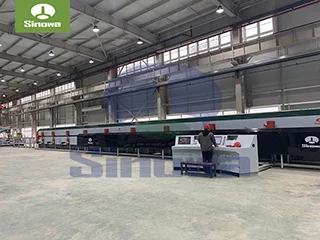
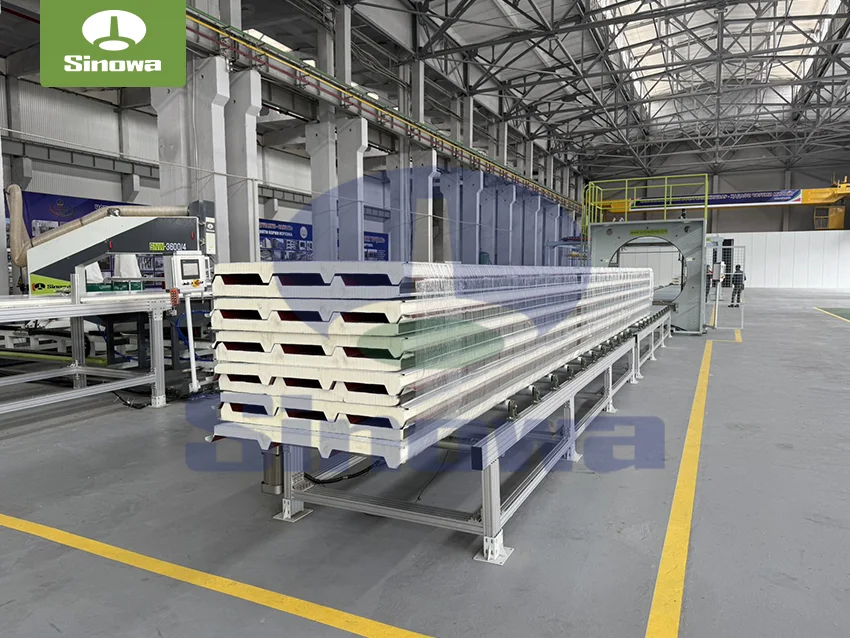
 sandwich panel machine
The overall design and operational logic of the PU sandwich panel production line fully adapt to the structural characteristics and performance requirements of prefabricated building panels. Different from ordinary composite panel production equipment, this machine is specially optimized for the thickness range, bonding strength, thermal insulation uniformity, and weather resistance standards required by prefabricated house wall and roof panels. The entire production line adopts a modular integrated structure, with multiple functional units operating in synchronous linkage to realize fully automated continuous production from raw material feeding to finished panel stacking. Each functional module is precisely matched in operating speed, pressure parameters, and temperature control standards, avoiding the quality fluctuations and production stagnation caused by mismatched operation of a single unit, and ensuring the continuity and stability of the entire production process.
The front-end part of the polyurethane sandwich panel production line is mainly composed of substrate feeding and preprocessing units, which undertake the basic preparation work for panel molding. Common substrate materials for prefabricated house PU sandwich panels include metal sheets and other lightweight structural decorative materials, all of which are supplied in coiled materials. The automatic uncoiling device stably releases coiled substrates at a constant speed, while the leveling unit eliminates tiny wrinkles, bending deformations, and surface unevenness generated during coiling and transportation. This preprocessing link is crucial for the subsequent composite molding process, as flat and smooth substrates can ensure uniform bonding contact with the PU foam core layer, avoid local gaps and delamination, and guarantee the flatness and overall structural uniformity of the final finished panel. After leveling, the substrates enter the roll forming unit, which shapes the flat plates into standardized structural profiles matching the installation requirements of prefabricated houses through multi-stage rolling and pressure shaping. The gradual molding design of the roll forming structure avoids structural damage and internal stress concentration of the substrates, maintaining the mechanical strength and surface integrity of the materials.
As the core functional unit of the polyurethane sandwich panel line, the PU foaming and injection system directly determines the thermal insulation performance, structural compactness, and dimensional stability of the sandwich panel core layer. This system is equipped with high-precision raw material storage and metering devices to store and quantitatively transport the two basic liquid raw materials for polyurethane foaming, as well as auxiliary materials including catalysts, flame retardants, and environmentally friendly blowing agents. The precision metering structure strictly controls the proportion of each raw material, which is the key to ensuring uniform foaming and stable performance of the PU core layer. Deviations in raw material ratios will directly lead to problems such as uneven foam density, poor curing effect, and reduced thermal insulation performance, affecting the overall quality of prefabricated house panels. After accurate proportioning, the raw materials are sent to the high-speed mixing head for full stirring and blending, and the uniformly mixed liquid materials are evenly sprayed on the surface of the lower substrate through the precise distribution mechanism. The whole injection process realizes linear and uniform distribution along the length and width of the substrate, avoiding local accumulation or shortage of foaming materials, so that the subsequent foaming molding can form a compact and consistent core layer structure.
Following the injection of PU foaming materials, the substrates with foaming materials enter the laminating and pressing curing unit, which is the key link to realize the composite integration of upper and lower substrates and PU foam core layer. The double-belt laminating structure adopted by the equipment can provide continuous and uniform pressing force, and the adjustable pressure system can adapt to panel molding requirements of different thickness specifications. In the pressing process, the liquid PU materials gradually expand, foam, and cure under constant pressure and appropriate temperature conditions, forming a micro-porous closed-cell structure with excellent thermal insulation and pressure resistance. The constant temperature control system of the laminating unit maintains a stable curing environment, effectively avoiding quality defects such as incomplete foaming, insufficient curing, and inconsistent core density caused by temperature fluctuations. At the same time, the synchronous operating speed of the upper and lower conveyor belts ensures that there is no relative displacement between the substrates and the foam core layer during the continuous production process, fundamentally preventing panel delamination and dislocation, and greatly improving the overall bonding strength and structural integrity of the sandwich panels. The closed-cell structure formed by scientific foaming and curing also endows the panels with low water absorption and high air tightness, which is essential for prefabricated houses to resist humid environments and maintain long-term thermal insulation effects.
After the completion of lamination and curing molding, the continuous integral panel enters the cooling and shaping stage. The high-temperature panels just out of the laminating unit have slight internal stress and unstable structural state, and the automatic cooling system realizes uniform and slow heat dissipation through circulating air cooling, which can effectively release internal structural stress and fix the overall shape of the panels. This cooling and shaping process prevents the finished panels from bending, deforming or shrinking after cutting and use, and ensures the dimensional accuracy and flatness of the panels. After cooling and shaping, the panels enter the fixed-length cutting unit, and the intelligent induction system automatically identifies the panel travel length and triggers the cutting device to perform precise fixed-length cutting. The high-speed cutting structure adopts a stable cutting mode to ensure flat and burr-free cutting sections, without damaging the edge structure of the panel and the internal foam core layer, which facilitates the subsequent assembly and splicing of prefabricated house panels. The polyurethane sandwich panel machine supports flexible adjustment of cutting length to meet the personalized size requirements of different prefabricated house designs, realizing diversified production of products on a single production line.
The final stage of the production process includes finished product inspection, conveying and automatic stacking. The PU sandwich panel line is equipped with real-time monitoring devices, which can continuously detect the thickness uniformity, surface flatness, and bonding compactness of the panels during the production process, and automatically alarm and adjust parameters once abnormal quality is found, realizing real-time quality control. The qualified finished panels are stably conveyed to the stacking area through the conveying system, and the automatic stacking device neatly stacks the panels according to the set specifications, reducing manual handling links, improving production efficiency, and avoiding panel surface scratches and structural damage caused by manual operation. The whole process from raw material feeding to finished product output realizes automated assembly line operation, with high production synchronization and low manual intervention, which greatly reduces the labor cost and human error rate in the production process.
The technological advantages of the prefabricated house PU sandwich panel machine are highly matched with the development needs of the prefabricated construction industry, bringing multiple value improvements to panel production and building application. First of all, the equipment achieves extremely high production consistency. Through precise mechanical transmission and intelligent parameter control, the density, thickness, bonding strength, and thermal insulation performance of each batch of panels remain stable, solving the problem of uneven quality of traditional handmade or semi-mechanized products. For prefabricated houses, standardized and consistent panel quality is the basis for ensuring on-site assembly accuracy and overall building performance, which can effectively avoid assembly gaps, poor sealing, and reduced thermal insulation effect caused by panel quality differences.
Secondly, the equipment has excellent production efficiency and resource utilization advantages. The continuous uninterrupted production mode greatly improves the output efficiency of sandwich panels, meeting the large-scale and centralized procurement needs of prefabricated construction projects. At the same time, the precise metering and distribution system of the PU foaming unit can maximize the utilization rate of raw materials, reduce the waste of chemical raw materials and substrates in the production process, and realize energy-saving and environmentally friendly production. The closed-cell foam structure formed by professional foaming technology also enables the panels to have ultra-low thermal conductivity, which can effectively reduce the heat transfer efficiency of prefabricated houses, reduce the energy consumption of building heating and cooling, and realize the energy-saving and low-carbon development goals of modern buildings.
In terms of product performance adaptation, the sandwich panel equipment can flexibly adjust production parameters to produce panels suitable for different application scenarios of prefabricated houses. By adjusting foaming density, pressing thickness, and raw material ratio, it can produce lightweight panels suitable for temporary prefabricated buildings and high-strength thick panels suitable for long-term residential and commercial prefabricated houses. The produced PU sandwich panels integrate thermal insulation, heat preservation, sound insulation, waterproof, and structural decoration functions, which can directly serve as wall panels, roof panels, and partition panels of prefabricated houses. The one-time composite molding process eliminates the need for secondary thermal insulation and decoration construction of traditional building wall materials, greatly simplifying the on-site construction process of prefabricated houses, shortening the construction cycle, and reducing the overall construction cost of the project.
In terms of operational stability and intelligent level, modern PU sandwich panel making machine adopts a centralized intelligent control system, which integrates all parameter adjustment and equipment operation monitoring functions on the control terminal. Operators can uniformly adjust the operating speed, foaming parameters, pressing pressure, cutting size and other core parameters of each unit through the terminal, and the system can automatically store production parameters to facilitate batch repeated production. The real-time fault monitoring function can automatically identify abnormal operation of equipment components, realize early warning and automatic shutdown protection, reduce equipment failure rate and maintenance cost, and ensure the long-term stable operation of the production line. In addition, the modular structural design of the equipment facilitates daily maintenance and later functional upgrading, and can adapt to the continuous upgrading of prefabricated building standards and panel performance requirements.
With the global construction industry accelerating the transformation to energy conservation, environmental protection and high efficiency, prefabricated buildings have become the mainstream development direction of the construction industry, and the market demand for high-performance PU sandwich panels continues to grow, which also puts forward higher requirements for the performance and technological level of supporting production equipment. Modern PU sandwich panel machine is gradually developing toward higher intelligence, higher precision, lower energy consumption and stronger customization. The upgraded intelligent monitoring system can realize more refined control of foaming uniformity and panel thickness, further improving product precision and quality stability. The optimized mechanical structure reduces the operating energy consumption and noise of the equipment, and the improved raw material mixing and foaming technology is more in line with the environmental protection production standards of the industry.
In the field of prefabricated house manufacturing, the popularization and application of professional PU sandwich panel production machinery has completely changed the backward production mode of traditional building insulation materials, promoted the standardized, industrialized and large-scale development of prefabricated building supporting materials. The high-quality PU sandwich panels produced by the equipment not only improve the construction efficiency and economic benefits of prefabricated houses, but also effectively improve the thermal comfort, environmental protection performance and service life of modular buildings. In the future, with the continuous innovation of mechanical manufacturing technology and building material technology, PU sandwich panel manufacturing machine will continue to iterate and upgrade, providing more efficient, environmentally friendly and flexible production solutions for the prefabricated construction industry, and injecting continuous power into the high-quality development of the global modular building field.
https://www.cnsinowa.com/sandwich-panel-machines/prefabricated-house-pu-sandwich-panel-machine.html