sandwich panel line
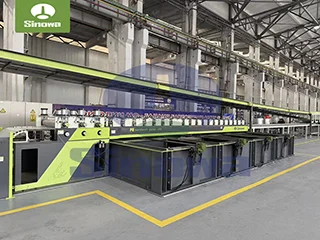
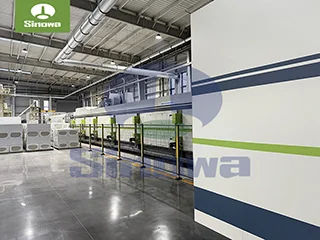
The structural composition of a continuous insulation board production line is a modular system where each component works in synergy to complete the production process. The entire line can be divided into several functional sections, including unwinding and preprocessing, mixing and metering, foaming and lamination, curing and shaping, cutting and finishing, as well as stacking and packaging. The unwinding and preprocessing section is responsible for handling facing materials, which can be flexible substrates such as aluminum foil, non-woven fabrics, kraft paper, cement-based cloth or rigid materials like color-coated steel plates. This section is equipped with unwinding units, web control accumulators and preheating devices. The unwinding units ensure stable unrolling of the facing materials, while the accumulators maintain consistent tension to prevent material deformation. Preheating devices raise the facing materials to an optimal temperature, which promotes better adhesion with the core material and improves the overall bonding strength of the finished board.
The mixing and metering section is the core of the production line, as it directly affects the chemical reaction and physical properties of the insulation core. This section typically includes raw material storage tanks, metering pumps, mixers and additive feeding systems. Raw materials for the core, such as polyol, isocyanate, phenolic resin and blowing agents, are stored in dedicated tanks and delivered to the mixers via precision metering pumps. The metering pumps ensure accurate ratio control of each component, with deviations kept to a minimum to maintain consistent foam density and insulation performance. Mixers employ high-speed stirring or static mixing technology to achieve homogeneous blending of reactive components and additives, including catalysts, flame retardants and curing agents. Advanced systems often adopt multi-component mixing technology, allowing for flexible adjustment of formulas to produce core materials with different properties. For example, pentane-based blowing agents can be incorporated to enhance environmental friendliness and reduce thermal conductivity, while flame retardants improve the fire resistance of the final product.
The foaming and lamination section is where the core material is formed and bonded with the facing materials. In this section, the mixed raw materials are continuously sprayed or extruded between the upper and lower facing materials, which are moving synchronously on a conveyor system. The reactive mixture undergoes foaming expansion under controlled temperature conditions, filling the entire space between the facing materials. Lamination devices apply uniform pressure to ensure tight bonding between the core and facing materials, eliminating air gaps that could compromise insulation performance. Some production lines are equipped with double-belt lamination systems, where the sandwich structure is pressed between two parallel belts to maintain flatness and thickness uniformity. The speed of the conveyor system and the foaming time are precisely coordinated to ensure that the core material completes the initial curing process before entering the next section.
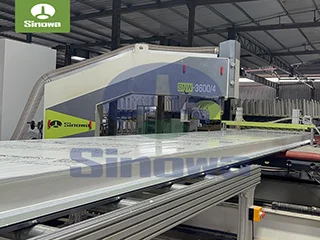
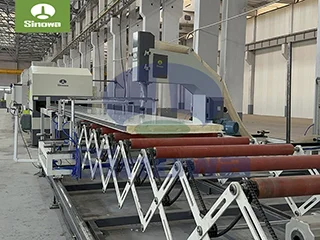
Curing and shaping sections are designed to stabilize the structure of the insulation board by promoting full curing of the core material. Depending on the type of core material, curing can be achieved through thermal conduction, convection or radiation heating. For polyurethane and polyisocyanurate cores, the curing process is exothermic, but additional heating may be required to accelerate curing and ensure dimensional stability. The curing section often features temperature-controlled chambers or roller heating systems, where the boards are subjected to a gradual temperature gradient to prevent warping or cracking. After curing, the boards pass through shaping devices to trim the edges and adjust the thickness, ensuring compliance with dimensional specifications. The cutting and finishing section uses precision cutting tools, such as band saws or water jet cutters, to cut the continuous board into fixed lengths. Water jet cutting is particularly suitable for fragile core materials, as it minimizes dust generation and material damage. Finishing processes may include surface polishing, dust removal and quality inspection to remove defects and ensure the final product meets performance standards.
The stacking and packaging section completes the production process by automatically stacking the cut boards and applying protective packaging. Automated stacking systems use robotic arms or conveyor belts to arrange the boards in neat piles, adjusting the stacking height and layer spacing to prevent deformation. Packaging materials, such as plastic film or waterproof paper, are wrapped around the stacks to protect the boards from moisture, dust and mechanical damage during storage and transportation. Some advanced production lines integrate quality control systems throughout the process, using sensors and cameras to monitor parameters such as board thickness, density, bonding strength and surface flatness. Real-time data feedback allows for immediate adjustments to production parameters, ensuring consistent product quality and reducing waste.
The performance of a continuous insulation board production line is evaluated based on several key indicators, including production efficiency, energy efficiency, product uniformity, flexibility and operational stability. Production efficiency is typically measured by the output volume per hour, which varies depending on the board thickness, width and core material type. Advanced lines can achieve outputs of up to several thousand square meters per hour for boards with a thickness of 50mm, with production speeds ranging from 30 to 60 meters per minute. This high efficiency is attributed to the automated and continuous operation, which eliminates the downtime associated with batch production. Energy efficiency is another critical performance metric, as insulation board production involves heating, mixing and conveyor operations that consume significant energy. Modern production lines adopt various energy-saving measures, such as insulating the bodies of laminating conveyors to reduce heat loss, using high-efficiency motors and optimizing power distribution. Some lines achieve energy consumption levels that are 40% lower than conventional models, with motor power for lamination conveyors reduced to half of the industry average.
Product uniformity is a hallmark of high-performance continuous production lines, as it directly impacts the insulation effect and structural reliability of the boards. These lines minimize human interference through automated control systems, ensuring consistent density, thickness and bonding strength across the entire board surface. For example, the closed-cell rate of foam cores can be stabilized above 90%, ensuring excellent thermal insulation and water resistance. Dimensional stability is also closely controlled, with thickness deviations kept within ±2% and length/width tolerances within a few millimeters. Flexibility refers to the line's ability to adapt to different raw materials, board specifications and production requirements. Modular design is a key feature that enhances flexibility, allowing for easy replacement of components to produce different types of insulation boards. For instance, a single line can be reconfigured to produce polyurethane, polyisocyanurate or phenolic foam boards with varying facing materials and thicknesses, meeting the diverse needs of different applications.
Operational stability is ensured by robust mechanical design and advanced control systems. Critical components are precision-machined using CNC equipment, and modular connections (such as bolted joints instead of welding) facilitate maintenance and reduce the risk of mechanical failure. Integrated control systems use computerized interfaces to monitor and adjust all production parameters, including temperature, pressure, mixing ratio and conveyor speed. These systems provide user-friendly operation and real-time fault diagnosis, minimizing downtime and maintenance costs. Additionally, safety design is incorporated to handle hazardous materials such as reactive chemicals and blowing agents, ensuring compliance with industrial safety standards and protecting personnel and equipment.
Continuous insulation board production lines can be classified based on the type of core material they produce, the facing material used and the production capacity. By core material type, the most common lines are those for polyurethane (PU), polyisocyanurate (PIR) and phenolic foam (PF) boards. PU insulation board production lines are widely used due to the excellent thermal insulation, lightweight and flexible properties of PU foam. These lines are suitable for producing boards with a wide range of densities and thicknesses, and can incorporate various blowing agents to optimize performance. PIR production lines are similar to PU lines but produce cores with higher temperature resistance and closed-cell rates, making them ideal for high-temperature applications. Phenolic foam production lines specialize in manufacturing boards with superior fire resistance and low smoke emission, as phenolic foam is inherently flame-retardant and does not release toxic gases when burned.
By facing material, production lines can be categorized into those for flexible-faced and rigid-faced insulation boards. Flexible-faced lines use substrates such as aluminum foil, non-woven fabrics and kraft paper, producing boards that are lightweight and easy to install. These boards are commonly used for pipe insulation, ductwork and temporary construction. Rigid-faced lines use color-coated steel plates, cement-based boards or glass fiber facers, producing structural insulation boards with high mechanical strength. These boards are suitable for building envelopes, roofing and wall cladding. Production lines can also be classified by capacity, ranging from small-scale lines with an output of a few hundred square meters per hour to large-scale lines capable of producing several thousand square meters per hour. Small-scale lines are suitable for regional manufacturers or specialized applications, while large-scale lines are used by industrial producers to meet mass market demand.
The applications of continuous insulation board production lines are diverse, spanning the construction, industrial, transportation and aerospace sectors, driven by the growing demand for energy efficiency and environmental protection. In the construction industry, insulation boards produced by these lines are widely used in building envelopes, including external walls, roofs, floors and ceilings. They help reduce thermal bridging, minimize heat loss in winter and heat gain in summer, thereby improving building energy efficiency and reducing heating and cooling costs. Rigid-faced insulation boards are often used as part of curtain wall systems or prefabricated building components, providing both insulation and structural support. Flexible-faced boards are used for internal insulation and pipe wrapping in residential, commercial and industrial buildings.
In industrial settings, insulation boards are essential for thermal insulation of equipment, pipelines and storage tanks. They help maintain stable operating temperatures, improve process efficiency and reduce energy consumption. For example, in petrochemical plants, insulation boards are used to insulate pipelines carrying high-temperature or low-temperature fluids, preventing heat loss and ensuring operational safety. In food processing facilities, they help maintain refrigeration temperatures and prevent condensation. Phenolic foam boards, with their excellent fire resistance, are commonly used in industrial buildings with strict fire safety requirements, such as power plants and factories.
The transportation sector also benefits from insulation boards produced by continuous lines. In the automotive industry, lightweight insulation boards are used for sound and thermal insulation in vehicle interiors, improving passenger comfort. In the aerospace sector, high-performance insulation boards, such as vacuum insulation panels (VIPs) produced by specialized continuous lines, are used to insulate spacecraft and aircraft. These boards offer ultra-low thermal conductivity and minimal weight, making them suitable for the extreme environmental conditions of space and high-altitude flight. Additionally, insulation boards are used in refrigerated trucks and containers to maintain temperature stability during the transportation of perishable goods.
Other applications include subway construction, where insulation boards are used for tunnel lining and station insulation to prevent moisture accumulation and heat transfer. In the renewable energy sector, insulation boards are used in solar thermal systems and wind turbine nacelles to protect equipment and improve energy efficiency. The versatility of continuous insulation board production lines allows for the customization of boards to meet the specific requirements of each application, such as enhanced fire resistance, water resistance, mechanical strength or thermal insulation performance.
The future development of continuous insulation board production lines is focused on improving energy efficiency, reducing environmental impact and enhancing intelligence. Manufacturers are investing in research and development to develop more eco-friendly raw materials, such as bio-based polyols and non-ozone-depleting blowing agents, to align with global sustainability goals. Advances in control technology, such as the integration of artificial intelligence and Internet of Things (IoT) devices, will enable real-time monitoring and optimization of production processes, further improving product quality and reducing waste. Additionally, the development of multi-functional production lines capable of producing composite insulation boards with integrated properties, such as thermal insulation, sound absorption and fire resistance, will expand their application scope.
In conclusion, continuous insulation board production lines are critical equipment in the modern insulation material industry, offering high efficiency, consistent product quality and flexibility. Their modular structure, advanced performance characteristics and ability to produce a wide range of insulation boards make them indispensable in various sectors, from construction and industrial to transportation and aerospace. As the demand for energy-efficient and sustainable building materials continues to grow, continuous insulation board production lines will play an increasingly important role in promoting environmental protection and energy conservation. Ongoing technological innovations will further enhance their performance and expand their applications, making them a key driver of the global insulation material market.
https://www.cnsinowa.com/sandwich-panel-machines/continuous-insulation-board-production-line.html