 sandwich panel line
The foundation of high-quality fire-resistant PU sandwich panels lies in the careful selection and preparation of raw materials, a stage that sets the tone for the entire production process. The outer facings, commonly made of metal sheets such as galvanized steel or aluminum, serve as both structural supports and protective layers for the foam core. These sheets must undergo thorough surface treatment to enhance adhesion with the PU foam, prevent corrosion, and ensure uniform coating if decorative or protective finishes are applied. The thickness of the outer facings is tailored to the intended application, with thicker sheets used for high-load-bearing walls and thinner options for lighter-duty scenarios. The key to the panel’s fire resistance, however, resides in the PU foam core and its flame-retardant modifications. Standard PU foam is inherently flammable, so it must be formulated with non-toxic mineral additives or chemical flame retardants to achieve a high level of fire performance. These additives work by either suppressing the combustion reaction, forming a protective char layer on the foam surface, or diluting flammable gases released during decomposition. Common mineral additives include soda, feldspar, and boehmite, which not only improve fire resistance but also enhance the foam’s mechanical strength and moisture resistance. The polyol and isocyanate components used to produce the PU foam must also be carefully selected to ensure compatibility with the flame retardants, as well as to achieve the desired foam density, which typically ranges around 42 kg/m³ for optimal structural integrity and fire performance.
The raw material preparation stage also involves rigorous quality checks to eliminate contaminants and ensure consistency. Metal coils for the outer facings are inspected for surface defects, thickness variations, and coating adhesion before being fed into the production line. Any coils with imperfections are rejected or processed to correct the issues, as surface irregularities can lead to poor foam adhesion and weak points in the panel structure. The PU foam components, including polyols, isocyanates, and flame retardants, are tested for chemical composition, viscosity, and reactivity to ensure they meet the required specifications. Mixing ratios of these components are critical—even slight deviations can result in foam with inconsistent density, reduced fire resistance, or poor bonding with the outer facings. To maintain precision, raw materials are stored in temperature-controlled tanks and transported to the mixing unit via closed pipelines, minimizing exposure to environmental factors such as humidity and temperature fluctuations that could alter their properties.
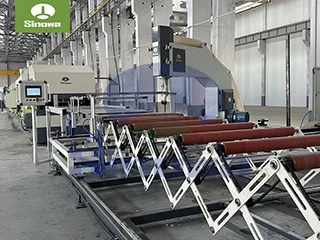
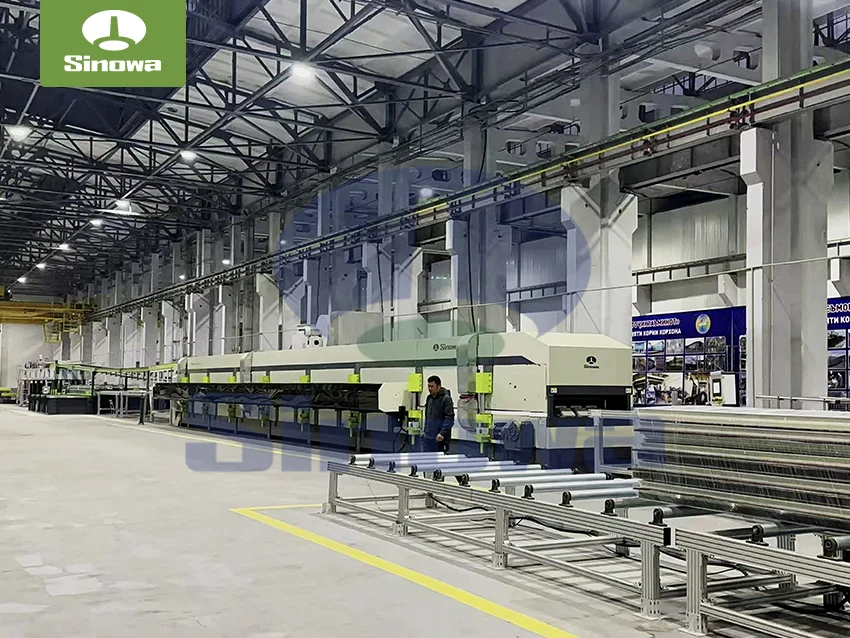
The core of the manufacturing line is the integrated production system, which combines uncoiling, roll forming, foam injection, laminating, and cutting processes into a continuous, automated workflow. The process begins with the uncoiling of metal sheets, where large coils are fed into an uncoiler machine that unwinds them smoothly and feeds them into a roll forming unit. The roll forming machine shapes the metal sheets into the desired profile, such as corrugated or flat surfaces, using a series of precision rollers. This shaping not only enhances the panel’s structural rigidity but also facilitates inter-panel connection during installation, ensuring tight joints that prevent fire from spreading through gaps. The formed metal sheets are then cut to the approximate length required for the final panels, with some lines featuring flying cutters that allow for continuous production without stopping the line.
Once the outer facings are prepared, they are conveyed to the foam injection station, where the PU foam mixture is precisely dispensed between the two sheets. The injection process is highly automated, with computer-controlled systems regulating the flow rate, pressure, and distribution of the foam to ensure uniform filling. The foam expands rapidly upon injection, filling every gap between the outer facings and adhering tightly to their surfaces. The use of a closed injection system minimizes waste and ensures that the foam core has a consistent density throughout the panel. For fire-resistant panels, the injection process must be calibrated to ensure that the flame retardants are evenly distributed in the foam, as localized concentrations can create weak points in fire performance. The panels then move to the laminating system, where they are pressed under controlled pressure and temperature to promote proper bonding between the foam core and outer facings, as well as to ensure the foam cures uniformly. The curing process is critical—insufficient curing can result in a soft core with reduced strength and fire resistance, while over-curing can cause brittleness and cracking. The laminating unit maintains a stable temperature environment to accelerate curing without compromising the foam’s properties, typically allowing the panels to reach sufficient hardness before moving to the next stage.
After laminating and initial curing, the panels are transported to the cutting station, where they are trimmed to their final dimensions with high-precision cutting tools. The cutting process must be accurate to ensure that the panels fit together seamlessly during installation, as ill-fitting panels can create gaps that undermine fire resistance. Some advanced manufacturing lines feature CNC cutting systems that allow for custom lengths and shapes, catering to diverse construction needs. Following cutting, the panel edges are often sealed with a PU-based sealant to enhance fire resistance and prevent moisture infiltration. This edge sealing process is particularly important for fire performance, as it eliminates potential pathways for flame and smoke to penetrate the panel core. The sealed edges also improve the panel’s overall durability by protecting the foam core from environmental moisture, which can degrade its insulation properties and structural integrity over time.
Quality control is an integral part of every stage of the manufacturing process, ensuring that each panel meets the required fire resistance and performance standards. Continuous monitoring systems are installed throughout the production line to track key parameters such as foam density, panel flatness, coating adhesion, and edge sealing quality. During the foam injection stage, sensors measure the foam expansion rate and density, adjusting the injection parameters in real time to correct any deviations. After curing, random samples from each production batch are subjected to rigorous testing to evaluate fire performance, mechanical strength, thermal conductivity, and moisture resistance. Fire performance tests assess metrics such as flame spread rate, smoke emission, and fire resistance duration, ensuring that the panels can inhibit fire propagation for the required period. Mechanical tests include compression strength, bending strength, and shear strength evaluations, as the panel must maintain structural integrity even when exposed to elevated temperatures. Thermal conductivity tests verify the panel’s insulation efficiency, a key advantage of PU sandwich panels that complements their fire resistance. Any panels that fail these tests are rejected, and the production process is reviewed to identify and address the root cause of the issue.
The finished fire-resistant PU sandwich panels offer a range of advantages that make them suitable for diverse construction applications. Their integrated design combines fire resistance with excellent thermal insulation, reducing energy consumption for heating and cooling while enhancing building safety. The panels’ lightweight nature compared to traditional building materials simplifies transportation and installation, reducing construction time and labor costs. Unlike conventional construction methods that require separate insulation, fire protection, and structural layers, PU sandwich panels are factory-made as a single component, ensuring consistent quality and minimizing on-site work. This prefabricated approach also reduces the risk of installation errors that can compromise fire safety, as the panels are designed with interlocking features that facilitate proper assembly. The panels’ durability and weather resistance make them suitable for both interior and exterior walls in industrial buildings, warehouses, clean rooms, logistics centers, and other commercial structures. They can also be used in temperature-controlled environments such as cold storage facilities, where their insulation properties and fire resistance are equally important.
In addition to their performance benefits, fire-resistant PU sandwich panels contribute to sustainable construction practices. The high thermal insulation efficiency of the PU foam core reduces energy consumption, lowering the building’s carbon footprint over its lifespan. The use of non-toxic flame retardants minimizes environmental impact, while the panels’ long service life reduces the need for frequent replacement. Many manufacturing lines also incorporate waste reduction measures, such as recycling excess foam and metal scraps, further enhancing the sustainability of the production process. The lightweight design of the panels also reduces the load on the building’s foundation, allowing for more efficient structural design and reducing the overall material usage in the construction project.
The operation and maintenance of the manufacturing line are crucial for ensuring consistent production quality and extending the equipment’s lifespan. Regular maintenance schedules are implemented to inspect and service key components such as uncoilers, roll forming machines, foam injection systems, and cutting tools. Lubrication, calibration, and part replacement are performed to prevent equipment breakdowns and maintain precision. The production line operators receive specialized training to monitor the process, adjust parameters as needed, and identify potential issues before they escalate. Automated monitoring systems provide real-time data on equipment performance, allowing for predictive maintenance that minimizes downtime. Proper maintenance not only ensures that the panels meet the required fire resistance and quality standards but also optimizes production efficiency, reducing waste and lowering production costs.
Advancements in manufacturing technology continue to enhance the performance and efficiency of fire-resistant PU sandwich panel production lines. New flame-retardant formulations are being developed to improve fire performance without compromising the foam’s insulation properties or mechanical strength, allowing for panels that meet even stricter fire safety requirements. Automation and robotics are being integrated into more stages of the production process, increasing precision, reducing human error, and boosting production capacity. Digital twin technology, which creates a virtual replica of the production line, is also being adopted to simulate processes, optimize parameters, and predict potential issues before they occur. These technological innovations are driving the evolution of fire-resistant PU sandwich panels, making them an even more reliable and versatile solution for modern construction.
In conclusion, the manufacturing line for fire-resistant PU sandwich panels is a complex, integrated system that requires precision, expertise, and strict quality control to produce panels that balance fire safety, structural performance, and insulation efficiency. From raw material selection and preparation to automated production, curing, and testing, each stage of the process plays a critical role in ensuring the final product meets the demands of modern construction. As fire safety regulations become increasingly stringent and sustainability becomes a top priority, the production of fire-resistant PU sandwich panels will continue to evolve, leveraging new materials and technologies to deliver safer, more efficient, and environmentally friendly building solutions. These panels have already established themselves as a preferred choice for a wide range of applications, and their importance in constructing safe, energy-efficient buildings is only set to grow in the years to come.
https://www.cnsinowa.com/sandwich-panel-machines/pu-sandwich-panel-manufacturing-line-for-fire-resistant-wall.html