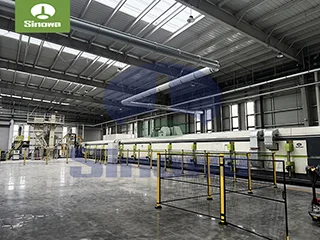
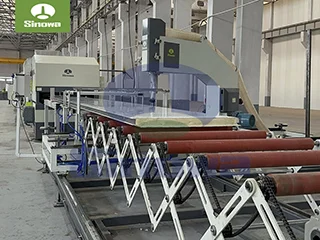
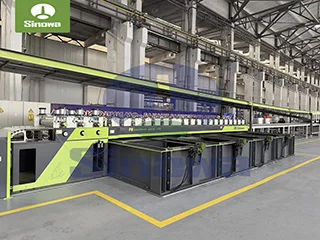
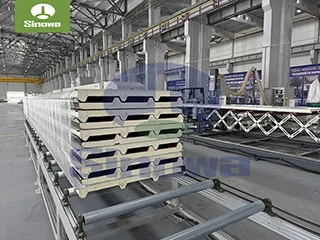
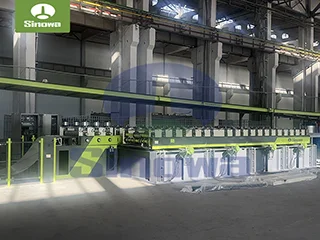
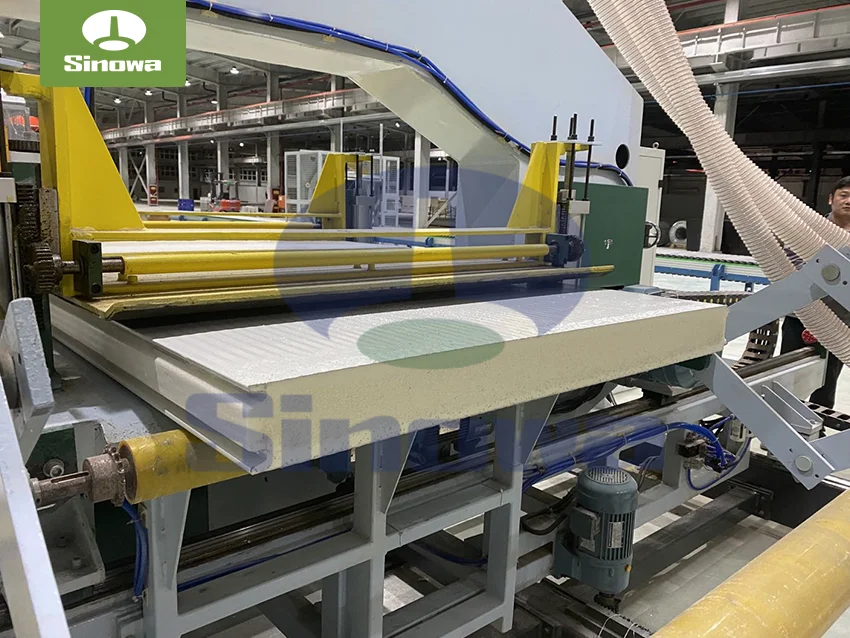
 sandwich panel machine
The entire working process of the PU sandwich panel production line starts from the raw material feeding and preprocessing stage of color steel sheets. The coiled color steel raw materials are fixed on the unwinding mechanism of the production line, and the hydraulic unwinding structure provides stable and continuous material supply power for the subsequent process. During the unwinding process, the automatic correction device runs synchronously to dynamically adjust the conveying deviation of the color steel sheet, ensuring that the steel sheet maintains a straight and stable conveying state in the horizontal direction, which lays a foundation for the consistent size and flatness of the final finished plate. After unwinding, the color steel sheet enters the cleaning and drying unit to remove surface dust, oil stains and moisture impurities. These tiny impurities will affect the bonding tightness between the steel sheet and the PU foam layer, and even cause delamination and hollowing of the plate in subsequent use. Therefore, the multi-stage cleaning and hot air drying process is an indispensable preprocessing link, which ensures that the inner surface of the color steel sheet keeps clean and dry, and optimizes the interface condition for subsequent composite bonding.
After completing surface preprocessing, the upper and lower color steel sheets respectively enter the roll forming system for profile molding. The roll forming mechanism is composed of multiple groups of precision roller sets arranged in an orderly manner. Through progressive rolling and bending, the flat color steel sheet is pressed into the required three-dimensional profile structure. The gap and pressure of each group of rollers are precisely matched, which can realize gradual deformation of the steel sheet, avoid structural damage and stress concentration caused by one-time excessive bending, and ensure the uniform thickness and regular shape of the formed steel sheet. The forming speed of the roller system is synchronized with the overall operating speed of the production line, realizing continuous and uninterrupted sheet metal forming, and effectively improving the continuity and efficiency of the entire production process. At the same time, the preheating device installed behind the roll forming unit heats the formed color steel sheet moderately. Appropriate preheating can activate the molecular activity on the inner surface of the steel sheet, reduce the temperature difference between the steel sheet and the PU raw material solution, and create a stable temperature environment for the subsequent foaming and bonding reaction.
The PU raw material metering and mixing system is the core functional unit that determines the foaming quality of the sandwich panel core layer. The polyurethane foaming raw materials are composed of two different liquid components, which are stored in independent storage tanks respectively. Driven by high-precision metering pumps, the two components are quantitatively transported to the mixing head according to the fixed proportion required for the foaming reaction. The metering system can realize accurate control of raw material delivery volume, effectively avoiding product quality problems such as uneven foam density, insufficient foaming or excessive expansion caused by unreasonable proportion of raw materials. In the high-pressure mixing head, the two liquid materials are subjected to high-speed impact and turbulent mixing to form a uniform and stable composite solution. The high-pressure mixing mode can fully fuse the raw material components, eliminate local material segregation and uneven mixing, and ensure that the subsequent foaming reaction can proceed stably and uniformly in all areas.
The uniformly mixed PU composite solution is continuously and evenly poured on the surface of the lower formed color steel sheet through the automatic pouring system. The pouring position and flow rate are kept stable under the intelligent control system, so that the liquid raw material can be evenly spread on the surface of the steel sheet without accumulation or missing pouring. Immediately after pouring, the lower steel sheet carrying the PU solution and the upper formed color steel sheet enter the double-belt laminating conveying mechanism together. The double-belt conveyor has stable clamping and conveying performance, which can clamp the upper and lower steel sheets at a constant pressure and drive the whole plate body to move forward at a uniform speed. In the closed space of the laminating mechanism, the PU liquid begins to undergo chemical foaming and polymerization reaction under the action of internal catalysts and ambient temperature.
The foaming and curing process is the key link to determine the physical properties of the sandwich panel. The PU sandwich panel line adopts a gradient temperature control mode to create a staged reaction environment for PU foam molding. In the initial stage of foaming, the moderate temperature environment promotes the rapid nucleation of the PU solution, forming a large number of uniform tiny bubble structures; in the middle stage, the temperature is appropriately increased to accelerate the molecular polymerization and foam expansion reaction, so that the foam can fully fill the gap between the upper and lower steel sheets; in the later stage, the constant temperature state is maintained to stabilize the foam structure and complete solidification and molding. This staged temperature regulation mode can effectively avoid the defects of large bubble holes, uneven density and insufficient solidification caused by too fast or too slow reaction speed. During the foaming process, the stable clamping pressure of the double-belt mechanism limits the free expansion of the foam, so that the foam can only expand in the fixed space between the two steel sheets, ensuring the consistent thickness of the plate and the tight fit between the foam core layer and the steel sheet.
With the continuous operation of the conveyor mechanism, the initially cured sandwich panel enters the constant-temperature curing area for deep structural stabilization. The internal circulating air heating system of the curing area forms a uniform and stable temperature field inside the closed space, which promotes the complete polymerization of the PU foam molecules and further enhances the bonding force between the foam core layer and the color steel sheet. After long-term constant-temperature curing, the foam forms a dense closed-cell structure, which endows the sandwich panel with excellent thermal insulation, sound insulation and compression resistance. At the same time, the interface between the steel sheet and the foam realizes molecular-level bonding, which effectively solves the common problems of delamination and peeling in traditional composite plates, and greatly improves the structural stability and service durability of the products.
After completing curing and molding, the continuous integral plate body enters the trimming and fixed-length cutting process. The edge trimming mechanism first trims the irregular edges on both sides of the plate body to ensure that the overall width of the plate is consistent and the edge structure is flat and neat. Subsequently, the automatic tracking and cutting system performs precise fixed-length cutting according to the preset dimensional parameters. The cutting mechanism adopts synchronous tracking cutting technology, which can complete the cutting operation in the moving state of the plate body without stopping the production line, ensuring the continuity and high efficiency of production. The cutting tool has high precision and sharpness, which can realize flat and smooth cutting sections without burrs, cracks and plate deformation, ensuring the dimensional accuracy and appearance quality of finished plates.
The cut single finished plates are transported to the cooling and shaping area through the conveying mechanism. After high-temperature curing, the plate body has a certain residual temperature. The natural air cooling mode is adopted to gradually reduce the temperature of the plate body to room temperature, so that the internal molecular structure of the foam can be further stabilized, eliminating the internal stress generated during high-temperature molding, and avoiding plate deformation, warping and other quality problems after placement. After cooling and shaping, the plates are automatically sorted and stacked by the mechanical stacking device, and the stacked finished products are neatly arranged to facilitate subsequent centralized packaging, transportation and storage.
The whole operation process of the color steel PU sandwich panel machine is uniformly scheduled and controlled by the intelligent electrical control system, which realizes the synchronous linkage of unwinding, forming, mixing, pouring, foaming, curing, cutting and stacking processes. The system can automatically adjust the operating speed, temperature parameters, raw material proportion and clamping pressure according to different production demands, realizing flexible production of plates with different specifications. The hydraulic and pneumatic auxiliary systems provide stable power support for the mechanical movement of each component, ensuring the stability and accuracy of equipment operation. In addition, the equipment is equipped with a real-time monitoring function for operating parameters, which can dynamically feed back the operating state of each link, realize automatic adjustment and fault early warning, effectively reduce manual intervention, and improve the stability and consistency of product quality.
The inherent working principle of the color steel PU sandwich panel production machine determines the excellent performance of the produced color steel PU sandwich panels. The continuous composite molding technology avoids the quality differences of intermittent production, and the precise foaming and curing control makes the foam core layer have uniform density and stable structure. The integrated composite structure formed by tight bonding between the color steel layer and the PU foam layer enables the product to have good mechanical strength, thermal insulation performance and weather resistance. Reasonable mechanical structure design and process principle layout make the equipment have high production efficiency and stable operating performance, which can meet the large-scale and standardized production demands of sandwich panels, and provide reliable technical support for the application of color steel PU sandwich panels in various industrial and construction fields.
https://www.cnsinowa.com/sandwich-panel-machines/principle-of-color-steel-pu-sandwich-panel-machine.html