 sandwich panel line
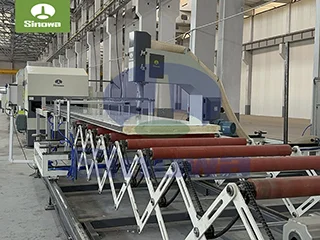
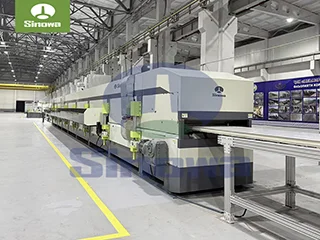
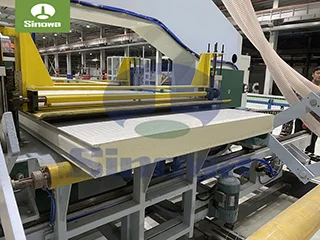
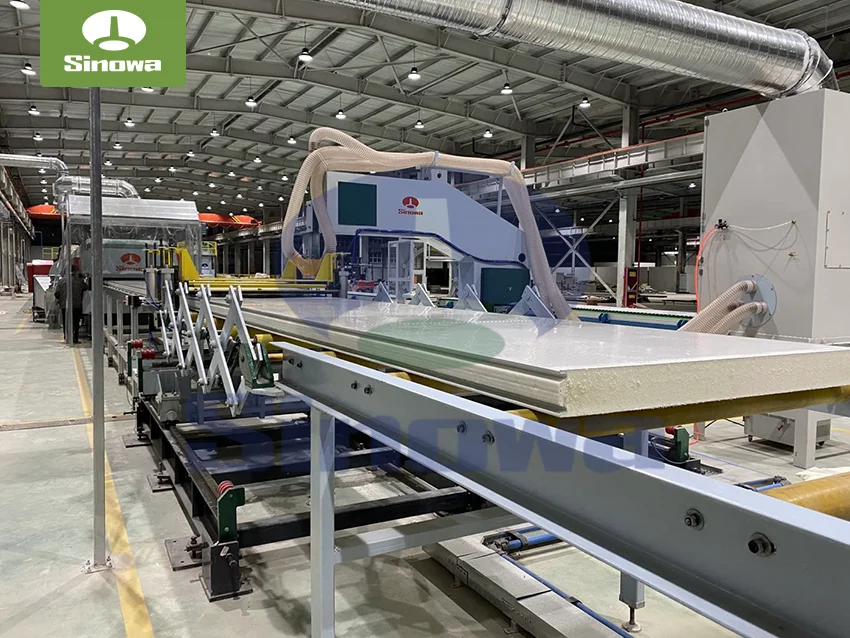
The entire production system operates as a fully continuous and highly synchronized automated workflow, integrating raw material feeding, surface material forming, precise chemical mixing, in-line foaming, composite lamination, constant-temperature curing, fixed-length cutting, surface protection, and automatic stacking into one seamless operational process. This integrated design eliminates the inefficiencies and precision errors of fragmented manual or semi-automatic production modes, realizing uninterrupted mass production while maintaining consistent product quality across all finished panels. Every functional module of the production line is mutually coordinated through precise mechanical transmission and intelligent parameter control, forming a closed-loop production system that balances production efficiency, product uniformity, and structural stability of finished panels.
The front-end operation of the cold storage sandwich panel production line starts with the surface material feeding and forming module, which serves as the foundation for shaping the outer protective structure of PU sandwich panels. Coiled metal raw materials are steadily released through automatic unwinding equipment, with built-in leveling devices eliminating irregular wrinkles, bending, and tension differences on the surface of the coiled materials. This pre-leveling treatment ensures the flatness and dimensional accuracy of subsequent formed panels, laying a solid foundation for tight composite bonding with the PU core layer. After leveling, the metal sheets enter the roll forming system, where multiple groups of precision roll shafts perform gradual cold bending and profiling. The profiling process is adjustable according to different cold storage construction needs, capable of processing flat or slightly corrugated surface structures to enhance the mechanical strength and surface impact resistance of the panels. During this stage, the production line also supports automatic surface film lamination, attaching a protective film to the outer layer of the metal sheet to prevent surface scratches, oxidation, and corrosion during subsequent production, transportation, and installation, effectively extending the service life of finished panels.
Following the surface material forming process, the PU sandwich panel production line enters the core functional stage of PU raw material mixing and continuous foaming, which directly determines the thermal insulation performance and structural stability of cold storage panels. The system adopts a high-precision proportional metering and high-pressure mixing mode for the two-component polyurethane raw materials. The independent metering units accurately control the delivery volume of different raw material components, ensuring strict proportional matching during mixing to avoid performance defects caused by uneven material ratios. After fully mixed through the high-speed oscillating mixing head, the liquid polyurethane material is evenly and continuously sprayed onto the surface of the pre-formed lower metal panel. The oscillating spraying design ensures full coverage of the panel width without blank areas or material accumulation, enabling the subsequent foamed core layer to present a uniform and dense pore structure.
The foaming reaction process is carried out in a fully enclosed and temperature-controlled composite cavity, creating stable reaction conditions for polyurethane expansion and molding. The mixed liquid material undergoes rapid chemical reaction once sprayed, gradually expanding and filling the gap between the upper and lower metal panels. The PU sandwich panel line is equipped with a constant-pressure double-belt pressing system, which maintains stable and uniform pressure on the composite panels during the foaming and expansion process. This pressure control mode effectively avoids core layer hollowing, local bulging, or inconsistent thickness caused by uneven expansion, ensuring the overall flatness and compact structure of the composite panels. The foaming process adopts environmentally friendly foaming components, which do not produce harmful substances during the reaction and molding process, and the formed foam core layer has no peculiar smell, meeting the environmental and safety requirements for cold storage facilities used for food and low-temperature medical material storage.
After the completion of foaming and preliminary composite molding, the semi-finished panels are transported to the long-distance gradient curing tunnel for structural stabilization treatment, a key step to determine the long-term performance of cold storage PU panels. The curing system adopts a staged temperature control mode, gradually cooling the panels from the molding temperature to room temperature through gradient temperature adjustment. This slow curing process allows the molecular structure of the polyurethane foam core layer to fully stabilize, completing the solidification and bonding reaction between the core material and the metal surface layer. Sufficient curing treatment can significantly enhance the bonding strength between the core layer and the surface material, effectively preventing delamination, cracking, or peeling of the panel structure during long-term use in low-temperature environments. Meanwhile, the internal pore structure of the foam is further optimized during the curing process, reducing residual stress inside the material, improving the overall compression resistance and dimensional stability of the panel, and enabling the panel to maintain stable thermal insulation performance under long-term cold storage temperature fluctuations.
After curing and shaping, the continuous long-strip composite panels enter the post-processing module for fine processing and sizing. The automatic tracking and cutting system performs precise fixed-length cutting according to preset dimensional parameters, with high cutting accuracy ensuring consistent length and neat end faces of each finished panel. The cutting equipment operates synchronously with the production line transportation speed, realizing dynamic cutting without stopping the line, which greatly improves continuous production efficiency. After cutting, the panels go through edge trimming and sealing treatment to smooth the rough cutting edges and seal the tiny gaps at the panel ends. This edge sealing process is particularly critical for cold storage panels, as it effectively blocks external humid air from penetrating into the core layer, prevents the foam core from absorbing moisture and deteriorating, and avoids the decline of thermal insulation performance caused by water vapor penetration, ensuring the airtightness and thermal insulation integrity of the panels after installation.
Subsequent processing links include surface inspection, auxiliary finishing, and automatic stacking and collection. The PU sandwich panel machine is equipped with online visual detection and manual auxiliary inspection mechanisms to screen out individual products with surface defects, uneven core layers, or insufficient bonding. Unqualified products are separately collected and reprocessed to ensure that all delivered finished panels meet uniform quality standards. After inspection, the qualified panels are automatically transported to the stacking area, where the mechanical stacking device neatly stacks the panels according to specifications, realizing orderly collection of finished products and facilitating subsequent packaging, transportation, and warehouse storage. The entire post-processing stage minimizes manual intervention, reducing human-induced quality differences and improving the tidiness and consistency of finished product packaging.
The technological advantages of the cold storage polyurethane sandwich panel production line are highly targeted to the actual application scenarios of cold storage engineering. Compared with ordinary building insulation panel production line, it optimizes the foam formula control and curing process, making the produced panels have extremely low thermal conductivity, which can effectively reduce the cold loss of cold storage facilities and reduce the long-term energy consumption of cold storage refrigeration systems. The dense closed-cell structure of the PU core layer formed by precise foaming control gives the panels excellent moisture-proof and waterproof performance, adapting to the high-humidity internal environment of cold storage for a long time without moisture accumulation or mildew growth. In addition, the composite structure formed by high-pressure lamination and sufficient curing has strong overall rigidity and impact resistance, enabling the panels to withstand external pressure and minor collisions during cold storage use and maintenance, maintaining structural integrity for a long time.
In terms of production flexibility, this automated polyurethane sandwich panel line supports adjustable production parameters to meet the diverse construction needs of different cold storage projects. It can produce panels of different thicknesses, widths, and lengths, adapting to low-temperature cold storage, ultra-low temperature cold storage, and constant-temperature fresh-keeping cold storage of different scales. The adjustable foaming density and structural strength parameters also enable the panels to adapt to different installation environments such as cold storage walls, roofs, and partition walls, realizing multi-scene application of a single production line. The highly automated control system simplifies equipment operation procedures, with all core production parameters adjustable and viewable in real time, facilitating operators to monitor the production status and adjust process parameters according to production requirements, ensuring efficient and stable operation of the production line.
From the perspective of production efficiency and industrial value, the continuous operation mode of the cold storage polyurethane sandwich panel machine completely changes the limitations of traditional intermittent production. It achieves uninterrupted continuous molding from raw material input to finished product output, greatly improving single-line output capacity and shortening the production cycle of customized panels. The standardized production process eliminates the performance differences of hand-made or semi-mechanized products, making the thermal insulation effect, structural strength, and dimensional accuracy of each batch of panels highly consistent, which is of great significance for ensuring the overall construction quality of cold storage projects. High-consistency panel products can realize precise docking and assembly during on-site installation, improving the installation efficiency of cold storage engineering and reducing the construction cycle and comprehensive engineering cost.
In terms of long-term equipment operation stability, the continuous PU sandwich panel production line adopts integrated mechanical structure design and durable transmission components, with stable operation performance and low failure rate during long-term continuous production. The modular functional design facilitates daily maintenance and component replacement, reducing equipment maintenance costs and downtime loss. Meanwhile, the intelligent parameter memory function can store the process parameters of different specification panels, enabling rapid parameter switching during batch production of different products and further improving production flexibility and operational efficiency. The environmentally friendly production process of the entire line avoids waste gas and waste residue pollution during the production process, meeting the green production requirements of modern manufacturing industries and conforming to the sustainable development concept of the cold chain logistics industry.
With the continuous upgrading of cold storage construction standards and the rapid development of the global cold chain economy, the market requirements for cold storage insulation panels are becoming increasingly stringent in terms of thermal insulation performance, structural durability, energy-saving effect, and product consistency. As special equipment for professional cold storage panel manufacturing, the PU sandwich panel continuous production line continuously optimizes its process flow and structural design according to industry development needs. Its efficient automated production mode, precise process control capability, and targeted product performance advantages make it the core equipment for modern cold storage insulation panel manufacturing. It not only improves the industrialization and standardization level of cold storage supporting materials but also provides reliable high-quality material support for the safe operation, energy saving and consumption reduction, and long-term stable use of various cold storage facilities, promoting the high-quality development of the entire cold storage construction and cold chain logistics industry.
https://www.cnsinowa.com/sandwich-panel-machines/cold-storage-pu-sandwich-panel-line.html