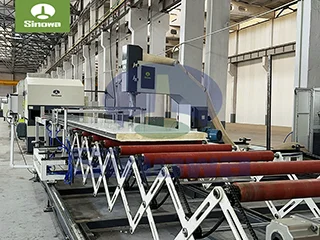
sandwich panel line
The normal and efficient operation of the entire continuous PU sandwich panel production line first depends on the scientific and standardized pretreatment and continuous conveying of upper and lower surface raw materials, which is the primary basic link to ensure the flatness and appearance quality of the final finished sandwich panels. The surface materials used for PU sandwich panels are mostly metal sheet materials with good surface flatness, certain mechanical hardness and strong weather resistance, and these coiled raw materials need to be installed on the automatic unwinding mechanism at the front end of the production line in advance. The unwinding device is designed with a stable tension control system, which can precisely adjust the unwinding speed and tension according to the overall production line operating speed, effectively avoiding the problems of sheet deviation, wrinkling, stretching and deformation during the unwinding process. After the coiled surface materials are unwound, they first enter the surface leveling and trimming processing area, where professional leveling rollers and edge trimming mechanisms carry out multi-point pressure leveling and fixed-size edge trimming on the metal sheets. The leveling process eliminates the internal stress generated during the coiling and storage of the metal sheets, ensuring that the surface materials remain flat and straight without any uneven bending or local bulging in the subsequent composite processing stage; the edge trimming operation uniformly cuts off the irregular edges and excess burrs on both sides of the sheets, ensuring that the width dimensions of the upper and lower surface materials are completely consistent, and avoiding the problem of inconsistent edge specifications of the finished sandwich panels after subsequent composite pressing. After the completion of leveling and trimming, the surface materials will enter the surface pre-treatment and preheating link along the automatic conveying track. The pre-treatment process mainly removes surface dust, oil stains and residual impurities generated during sheet processing, ensuring that the surface of the metal sheets is clean and dry, which is a key prerequisite for enhancing the bonding fastness between the surface materials and the middle PU foam core layer; the preheating link appropriately raises the temperature of the surface materials to the optimal process temperature required for PU foam bonding, effectively preventing the problem of insufficient initial bonding strength caused by the temperature difference between the cold surface materials and the freshly foamed PU materials, and further optimizing the composite bonding effect between the core layer and the surface layers throughout the follow-up process.
After the pretreatment of the upper and lower surface materials is completed and they are stably conveyed to the composite forming station, the production line enters the core processing stage of continuous PU foam raw material mixing, metering and pouring, which directly determines the thermal insulation performance, structural compactness and overall quality stability of the sandwich panel core layer. The PU foam core layer is formed by the chemical reaction and foaming polymerization of two main raw materials, and the accurate proportioning and uniform mixing of the raw materials are the core technical points of the entire production process. The continuous production line is equipped with a high-precision automatic metering and feeding system, which can stably and continuously transport the two raw materials to the professional mixing device according to the optimal process ratio set in advance. The metering system has real-time flow monitoring and automatic fine adjustment functions, which can automatically correct the feeding flow deviation caused by changes in raw material viscosity, ambient temperature and equipment operating status during the production process, always maintaining the accurate proportion of the two raw materials and avoiding product quality problems such as insufficient foaming reaction, uneven foam pore structure and reduced core layer strength caused by unreasonable ratio. After precise metering, the two raw materials enter the high-speed dynamic mixing chamber for full and uniform mixing. The high-speed stirring mechanism inside the mixing chamber can instantly blend the two raw materials evenly in a very short time, triggering the initial chemical reaction of PU foaming, and the mixed raw materials are quickly and evenly poured between the upper and lower surface materials that are continuously moving forward synchronously through the automatic pouring head. The pouring head adopts a multi-point uniform pouring design, which can distribute the mixed foaming raw materials evenly along the width and length direction of the surface materials, ensuring that the thickness of the subsequent foamed core layer is uniform everywhere, and there will be no quality defects such as local material shortage, excessive accumulation and uneven thickness of the core layer. The whole mixing and pouring process is carried out in a fully closed and continuous state, which not only ensures the stability of the foaming reaction environment, but also effectively reduces the volatilization of raw materials and material waste, realizing efficient and environmentally friendly production operation.
After the PU foaming raw materials are poured between the upper and lower surface materials, the semi-finished composite panels immediately enter the continuous laminating pressing and primary foaming shaping area, which is a key process link to realize the composite bonding of the upper and lower surface materials and the core foam and complete the preliminary shaping of the sandwich panel structure. The laminating pressing part of the production line is composed of multiple groups of upper and lower synchronous pressing rollers and a closed shaping mold cavity structure, and the pressing gap between the upper and lower rollers can be precisely adjusted according to the preset thickness specifications of the sandwich panels. When the semi-finished panels pass through the pressing area, the upper and lower pressing rollers apply uniform and stable continuous pressure on the composite materials, so that the upper and lower surface materials are closely attached to the freshly poured PU foaming materials, and the preliminary bonding and shaping are completed in the initial stage of the PU foaming reaction. At the same time, the closed shaping mold cavity can limit the free expansion range of the PU foam during the foaming and rising process, ensuring that the foam expands and foams according to the preset thickness and structural space, avoiding the problem of uneven overall thickness and irregular surface radian of the sandwich panels caused by unrestricted foaming. In the laminating pressing process, the production line maintains a synchronous matching between the pressing speed and the conveying speed of the front-end surface materials and the pouring speed of the foaming raw materials, realizing the integration of continuous feeding, continuous pouring and continuous pressing without any intermittent pause in the whole process. This synchronous operation mode ensures that the foaming reaction of the PU core layer proceeds steadily under continuous pressure and constant speed conditions, the internal foam pore structure formed after foaming is fine and uniform, without large pores, hollow areas or local collapse defects, and the bonding interface between the core layer and the surface materials forms a tight and integrated composite structure, effectively improving the overall structural strength and peeling resistance of the sandwich panels. After primary pressing and preliminary shaping, the semi-finished panels initially complete the composite forming of the surface layers and the core layer, and the overall structural outline of the sandwich panels is basically finalized, and then they are continuously conveyed to the subsequent constant temperature curing area for deep foaming and curing treatment.
The constant temperature continuous curing area is an indispensable post-processing link for the continuous PU sandwich panel line to ensure the complete foaming reaction and stable performance forming of the PU core layer, and it plays a decisive role in the final comprehensive performance and long-term service stability of the finished sandwich panels. After preliminary pressing and shaping, the semi-finished sandwich panels have completed the initial foaming and bonding, but the internal chemical reaction of the PU foam has not been fully completed, and the core layer has not reached the final stable structural strength and thermal insulation performance. The curing area adopts a fully enclosed constant temperature and thermal insulation structural design, which can maintain a stable temperature and humidity environment inside the area according to the optimal curing process parameters required for PU foam reaction. The semi-finished panels move forward slowly and continuously along the special conveying track inside the curing area, and during the continuous advancing process, the PU foam core layer completes the subsequent foaming expansion, molecular polymerization reaction and structural strength stabilization under constant temperature and stable environmental conditions. The continuous curing mode avoids the quality difference of different batches of products caused by uneven curing temperature and inconsistent curing time in the traditional intermittent curing process. The long-term stable constant temperature environment enables the chemical reaction of the PU foam to be fully and thoroughly carried out, the internal foam structure to be fully solidified and shaped, the bonding force between the core layer and the upper and lower surface materials to be further enhanced and stabilized, and the overall hardness, compression resistance, thermal insulation and dimensional stability of the sandwich panels to reach the preset standard requirements. The length and internal temperature of the curing area are designed according to different production speeds and different sandwich panel thickness specifications. Thicker sandwich panels and higher production speeds require a longer curing distance and more stable constant temperature conditions to ensure that the core layer inside the thick panels can also complete the curing reaction thoroughly from the inside to the outside without incomplete internal curing or excessive surface curing. After continuous curing, the internal structure of the sandwich panels is completely stable, the dimensional deformation rate is controlled within a very small range, and all basic physical and mechanical properties are fully formed, meeting the basic conditions for subsequent fixed-length cutting and finished product processing.
After the continuous curing process is completed, the fully formed continuous long-strip sandwich panels enter the fixed-length automatic cutting and edge finishing processing area, which is the final forming processing link to turn continuous semi-finished products into standard finished PU sandwich panels. The production line is equipped with a high-precision automatic tracking and cutting system, which can automatically measure and position the length of the long-strip sandwich panels in real time according to the finished product length specifications set by the production system in advance. The cutting mechanism adopts a high-speed stable cutting mode, which can complete the fixed-length cutting operation quickly and accurately without stopping the continuous conveying of the production line, realizing non-stop continuous cutting and ensuring the continuity and efficiency of the whole production process. The cutting tool is made of high-strength wear-resistant materials, which can ensure that the cutting section of the sandwich panels is flat and smooth without burrs, edge collapses or core layer shedding, maintaining the flatness and regularity of the end face of the finished panels. After fixed-length cutting, the finished sandwich panels will pass through the edge finishing and corner trimming mechanism to carry out fine processing on the four sides of the panels, trimming tiny burrs and irregular edges generated during cutting and previous processing, further optimizing the overall appearance quality and dimensional accuracy of the products. For sandwich panels used in special engineering scenarios, the production line can also complete simple grooving, edge sealing and other fine processing operations on the edges of the panels according to the set process requirements in this link, meeting the special installation and matching needs of different engineering projects. The whole cutting and finishing process is fully automated and intelligently controlled, with no need for manual intervention in the whole process, effectively avoiding dimensional errors and appearance quality problems caused by manual cutting and trimming, ensuring that each finished sandwich panel has accurate dimensional specifications and consistent appearance quality.
The final link of the entire continuous PU sandwich panel production line is automatic finished product conveying, quality preliminary inspection and automatic stacking and storage, which realizes the automatic output and standardized stacking of finished products and lays a foundation for subsequent finished product storage, transportation and factory delivery. After cutting and finishing, the qualified finished sandwich panels are automatically conveyed to the preliminary quality inspection station along the conveying track. The preliminary inspection work mainly relies on the production line's own online detection device and simple manual sampling inspection to check the key indicators of the finished panels, including overall flatness, dimensional accuracy, cutting section quality, surface bonding integrity and apparent appearance quality. Unqualified products with defective appearance, unqualified dimensions or poor bonding quality will be automatically identified and separately conveyed to the unqualified product collection area by the system, avoiding the mixing of unqualified products into the finished product stacking area. Qualified finished sandwich panels are continuously transported to the automatic stacking mechanism, which automatically completes the orderly stacking and arrangement of the finished panels according to the set stacking height and stacking mode. The stacking mechanism has stable lifting and positioning functions, which can ensure that the stacked sandwich panels are placed neatly and stably without tilting, collision or surface scratch damage during the stacking process. After the stacking of a single stack of finished panels is completed, the automatic conveying device will transport the stacked finished products to the finished product storage area for centralized storage, waiting for subsequent packaging, loading and delivery. The whole finished product processing and stacking link realizes full automation from conveying, inspection to stacking, which not only greatly reduces the labor demand for finished product post-processing, reduces the labor intensity of operators, but also effectively improves the stacking neatness and storage management efficiency of finished products, avoiding product damage and quality problems caused by manual stacking and handling.
The core advantages of the continuous PU sandwich panel production line in actual industrial production operation are reflected in many aspects such as production efficiency stability, product quality consistency, production cost optimization and production operation safety and environmental protection, which make it the preferred production equipment for large-scale standardized production of PU sandwich panels. In terms of production efficiency, compared with the traditional intermittent production equipment that needs repeated mold closing, feeding, foaming, curing and mold opening and unloading, the continuous production line realizes uninterrupted continuous operation from raw material feeding to finished product output, with no idle time and repeated debugging links in the production process. The production speed can be adjusted steplessly according to market demand and production plan, and it can efficiently complete large-scale production tasks in a short time, effectively shortening the production cycle of products and improving the market supply capacity of enterprises. In terms of product quality control, the whole production process of the continuous production line adopts integrated automatic control, and all key process parameters such as raw material ratio, conveying speed, pressing pressure, curing temperature and cutting size are precisely controlled by the system with fixed parameter values, avoiding product quality fluctuations caused by manual operation experience differences and human misoperation. The produced PU sandwich panels have uniform thickness, stable foam density, firm bonding interface and consistent overall performance, which can meet the long-term and stable use requirements of various engineering projects. In terms of production cost control, the continuous production mode reduces manual operation links, reduces labor input costs, and the precise metering and closed feeding design effectively reduces raw material waste and material loss in the production process. At the same time, the stable operation of the equipment reduces the failure rate and maintenance cost of the production line, and the comprehensive production operation cost of unit products is effectively optimized and reduced.
With the continuous upgrading of construction industry standards and the increasing market demand for energy-saving, low-carbon and high-performance building materials, the continuous PU sandwich panel production line is also constantly developing and evolving in the direction of intelligent operation, energy-saving production and diversified product adaptation. In the actual production and operation process, the daily maintenance and scientific operation management of the production line are also crucial to maintaining long-term stable production efficiency and product quality stability. Operators need to carry out regular inspection and maintenance on key components such as the raw material metering system, mixing and pouring device, pressing and shaping mechanism, curing temperature control system and cutting and stacking equipment, regularly clean the production line conveying track and processing components, check the operating status of the transmission system and control system, and timely replace worn parts and repair potential equipment faults. Good daily maintenance can effectively extend the service life of the production line, reduce equipment failure shutdown time, ensure the continuity and stability of production work, and further give full play to the efficient production advantages of the continuous production line. At the same time, according to the changes of market application needs and building energy-saving requirements, production enterprises can adjust the production process parameters of the continuous production line, produce PU sandwich panels with different thickness specifications, different surface material types and different thermal insulation performance levels, meet the personalized and differentiated material needs of different construction projects, and continuously expand the application scope and market development space of PU sandwich panel products. Relying on the efficient, stable and intelligent production characteristics of the continuous PU sandwich panel production line, PU sandwich panels will continue to play an irreplaceable important role in the field of modern construction and industrial supporting facilities, and promote the high-quality development of the prefabricated construction and energy-saving building material industry.
https://www.cnsinowa.com/sandwich-panel-machines/continuous-pu-sandwich-panel-production-line.html