 sandwich panel line
The core design concept of the energy-saving continuous sandwich panel manufacturing line focuses on balancing high production efficiency with low energy consumption, optimizing every link of the traditional production process from raw material input to finished product output. Traditional sandwich panel production equipment mostly adopts intermittent operation modes, requiring repeated equipment start-stop, manual parameter adjustment, and intermediate material transfer in the production process. This operation mode not only leads to huge invalid energy consumption caused by frequent equipment start and stop but also causes unstable product quality due to human operation errors and discontinuous production rhythms. In contrast, the energy-saving continuous production line adopts an integrated continuous operation structure, realizing seamless connection of raw material feeding, core material foaming and curing, upper and lower panel composite pressing, constant-temperature shaping, and fixed-length cutting stacking. The whole production process maintains a stable operating state, eliminating energy loss caused by equipment restart and parameter repeated debugging, and fundamentally improving energy utilization efficiency in the production process.
The overall structural design of the continuous sandwich panel production line follows the principles of modular integration and energy-efficient optimization, with each functional unit closely matched in operating speed and process parameters to form a highly coordinated closed-loop production system. The entire equipment is mainly composed of a panel unwinding and pretreatment unit, a core material raw material automatic metering and mixing unit, a continuous foaming and filling unit, a constant-temperature composite pressing unit, a curing and shaping unit, an intelligent fixed-length cutting unit, and an automatic finished product stacking unit. Each unit is equipped with independent energy regulation and operation monitoring modules, which can realize independent energy consumption optimization and linkage coordination according to production load changes, avoiding the long-term high-load operation of a single unit under low production demand, which greatly reduces ineffective energy consumption in the production process. Compared with traditional production lines, this modular linkage design can effectively reduce overall equipment energy consumption while maintaining continuous and stable production capacity, forming a production model of high output and low energy consumption.
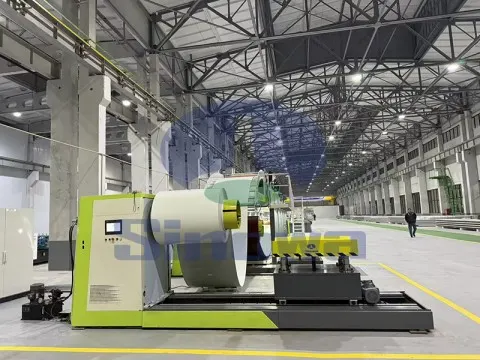
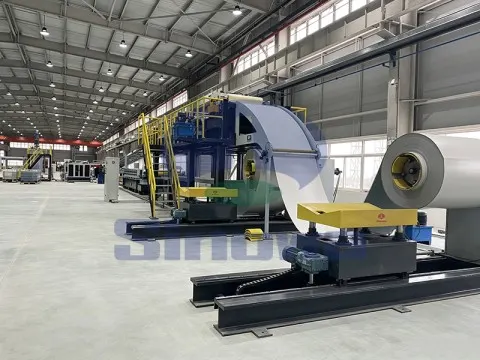
The panel unwinding and pretreatment unit is the starting link of the entire production process and also an important part of ensuring product flatness and composite stability. This unit is responsible for the continuous unwinding of upper and lower metal or non-metal panels, and completes surface dust removal, tension adjustment, and flatness correction of the panels through automatic mechanical structures. Traditional production equipment usually uses fixed-tension unwinding structures, which are prone to panel deviation and uneven tension during high-speed operation, requiring frequent shutdown adjustments and resulting in energy waste and material loss. The energy-saving continuous production line adopts a dynamic tension self-adjustment structure, which can real-time monitor the panel operating state through sensing components and automatically adjust the unwinding speed and tension parameters according to production speed changes. This real-time adjustment mechanism ensures that the panels maintain a stable and flat feeding state during continuous operation, avoids material wrinkling and deviation defects caused by unstable tension, and eliminates energy consumption losses caused by shutdown maintenance and defective product rework. At the same time, the pretreatment unit adopts low-power high-efficiency dust removal and leveling components, which can complete panel surface pretreatment with minimal energy input, laying a good foundation for subsequent composite processing.
The core material raw material metering and mixing unit is the key functional module to realize energy saving and product performance stability, and it is also the core technological upgrade of the continuous production line compared with traditional equipment. Sandwich panel core materials mainly include polyurethane foam, rock wool, glass wool, and other lightweight thermal insulation materials, and the uniformity of raw material ratio and mixing state directly determines the thermal insulation performance, structural strength, and dimensional stability of finished panels. Traditional intermittent production equipment mostly adopts manual or semi-automatic fixed-ratio feeding, with large errors in raw material metering and uneven mixing of multi-component raw materials, which not only affects product quality but also easily causes raw material waste and increases production energy consumption indirectly. The energy-saving continuous production line is equipped with a fully automatic precision metering and continuous mixing system, which can realize real-time dynamic metering and proportional feeding of various core material raw materials according to preset process parameters.
This advanced mixing system adopts high-efficiency forced mixing structures with optimized blade operation tracks and rotating speeds, which can complete uniform mixing of multi-component raw materials in a short time, avoiding local uneven density and inconsistent foaming ratio of core materials caused by insufficient mixing. The entire metering and mixing process operates continuously and stably without intermittent pause and repeated mixing, which greatly reduces the invalid operation time of mixing equipment and effectively cuts down the electric energy consumption of the mixing link. In addition, the system is equipped with a raw material residual monitoring and self-cleaning function, which can automatically clean residual raw materials inside the equipment after production is completed, avoiding raw material solidification and blockage caused by long-term residue. This self-cleaning design prevents equipment failure and energy consumption increase caused by blockage, reduces manual maintenance frequency, and further optimizes the overall energy-saving effect of the production line.
The continuous foaming and filling unit undertakes the core molding work of the sandwich panel core material, and its energy-saving design is mainly reflected in precise temperature control and quantitative foaming control. After the fully mixed core material raw materials are transported to the filling area, the equipment realizes uniform and continuous filling between the upper and lower panels through quantitative feeding structures. Traditional production equipment usually adopts open foaming and fixed-temperature heating modes, with large temperature fluctuation ranges in the foaming area. Excessively high temperature will cause unnecessary heat energy waste, while excessively low temperature will lead to insufficient core material foaming, reduced product performance, and increased defective rate. The energy-saving continuous production line adopts a closed constant-temperature foaming bin structure, which forms a relatively sealed thermal environment for core material foaming and effectively reduces heat dissipation loss in the foaming process.
Equipped with multi-point distributed temperature sensing modules inside the foaming bin, the equipment can real-time monitor the temperature changes of different areas in the foaming zone and feed data back to the intelligent control system. The system automatically adjusts the heating power and heat supply range according to the real-time temperature data, realizing constant-temperature and precise heating within the optimal foaming temperature range. This intelligent temperature regulation mode avoids long-term full-power operation of heating equipment and heat energy waste caused by excessive temperature, ensuring that the core material completes uniform and stable foaming and filling with the lowest heat energy consumption. At the same time, the continuous quantitative filling structure ensures that the core material filling amount per unit length is consistent, avoiding product thickness deviation and performance differences caused by uneven filling, reducing the generation of defective products, and realizing energy saving and consumption reduction from the perspective of reducing waste.
The constant-temperature composite pressing unit is an important link to determine the bonding strength and overall flatness of sandwich panels, and its energy-saving optimization is reflected in pressure stability control and efficient heat energy utilization. After the core material is filled and initially foamed, the upper and lower panels and the intermediate core material enter the composite pressing area together, and complete bonding and preliminary shaping under stable temperature and pressure conditions. Traditional pressing equipment has unstable pressure output during operation, with frequent pressure fluctuations, requiring repeated pressure supplementation and long-term high-pressure operation, resulting in serious electric energy waste. Moreover, the traditional open pressing structure has poor thermal insulation performance, large heat loss during hot pressing, and low heat energy utilization efficiency.
The energy-saving continuous composite pressing unit adopts a fully enclosed thermal insulation pressing chamber and a servo constant-pressure control system. The closed thermal insulation structure effectively locks the heat inside the pressing area, reduces heat exchange and loss with the external environment, and improves the utilization rate of heating heat energy. The servo constant-pressure system can output stable and precise pressing pressure according to different panel thicknesses and core material types, maintaining constant pressure during the continuous composite process. It avoids energy consumption waste caused by frequent pressure adjustment and excessive pressure output, and ensures that the panels and core materials are closely bonded without gaps or delamination. The whole pressing process operates continuously and stably, with no need for repeated pressure adjustment and heating compensation, which significantly reduces the comprehensive energy consumption of the composite molding link and improves the bonding firmness and overall flatness of finished products.
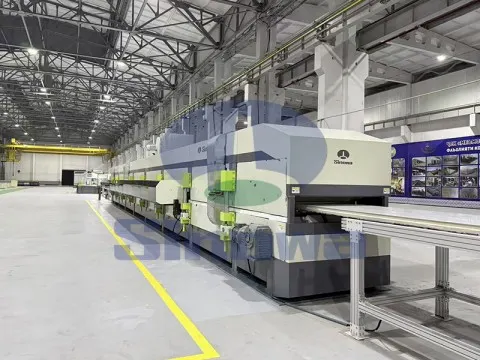
The curing and shaping unit undertakes the follow-up solidification and stress relief work of composite panels, which is crucial to improving the dimensional stability and service life of finished sandwich panels. After composite pressing, the internal structure of the panel has not been completely solidified, and there is residual internal stress. Continuous constant-temperature curing treatment is required to make the core material structure fully stable and the bonding interface completely firm. Traditional production lines usually adopt segmented open curing areas, with discontinuous temperature control and large temperature differences in different curing stages, resulting in insufficient curing or excessive curing of panels. Insufficient curing will lead to unqualified product performance, while excessive curing will cause a great waste of heat energy.
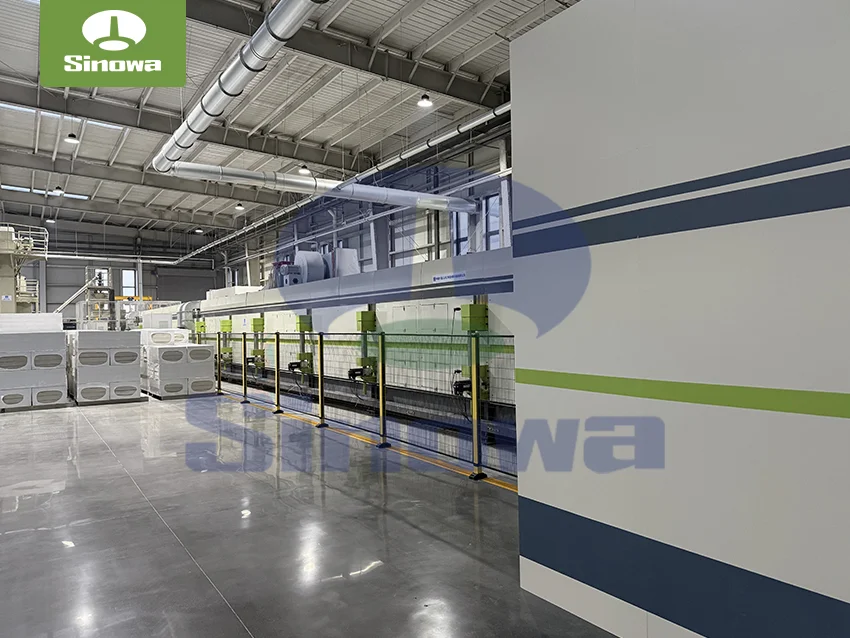
The energy-saving continuous curing and shaping unit adopts an integrated gradient constant-temperature curing channel, which divides the curing area into multiple temperature gradient zones according to the curing process requirements of sandwich panels. The panel passes through low-temperature preliminary curing, medium-temperature stable curing, and high-temperature final shaping in sequence, realizing gradual and complete solidification of the core material and bonding interface. The intelligent temperature control system independently adjusts the temperature and heating power of each gradient zone, ensuring that each stage maintains the most suitable curing temperature, avoiding invalid heat energy consumption caused by single high-temperature heating throughout the whole process. At the same time, the closed curing channel structure reduces heat dissipation, and the residual heat generated in the curing process can be recycled and reused for preheating the raw material feeding area through the internal heat circulation system, realizing secondary utilization of heat energy and further improving the overall energy-saving level of the production line. After gradient curing, the panel structure is more stable, with no deformation or shrinkage in the later stage, effectively reducing product scrap rate and indirect energy consumption caused by rework.
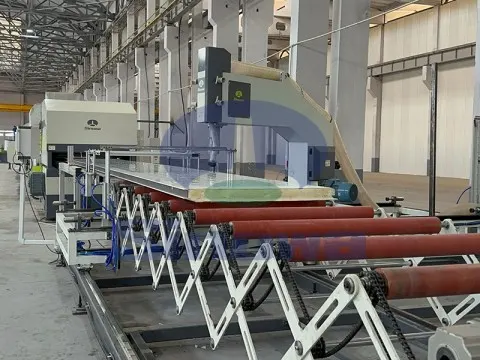
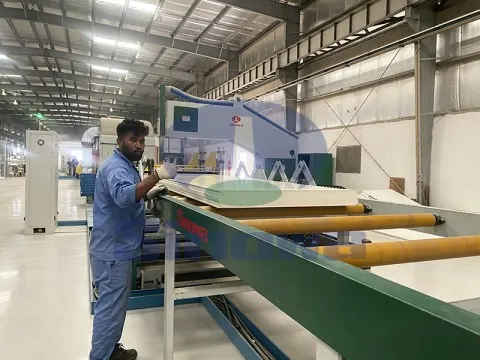
The intelligent fixed-length cutting and finished product processing unit realizes precise sizing and automatic finishing of continuous molded panels. Traditional cutting equipment adopts intermittent cutting mode, requiring equipment deceleration, positioning, and acceleration repeatedly, with large mechanical vibration and high invalid energy consumption. At the same time, manual measurement and positioning are easy to produce errors, resulting in inconsistent panel sizes and material waste. The energy-saving continuous production line is equipped with a high-speed synchronous fixed-length cutting system, which can track the panel operating speed in real time and realize synchronous dynamic cutting without stopping the machine. The whole cutting process is completed in continuous operation state, eliminating energy loss caused by frequent equipment start-stop and speed regulation.
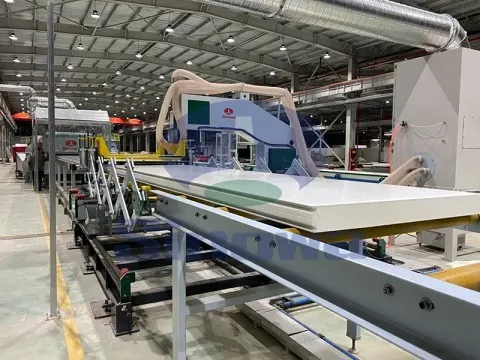
This cutting system adopts servo precision driving structure, with high cutting positioning accuracy and stable operation, which can ensure that the dimensional error of each finished panel is controlled within a tiny range, realizing standardized and consistent product sizing. The automatic edge trimming and deburring function matched with the cutting unit can complete fine processing of panel edges at one time, avoiding secondary processing procedures and reducing additional energy consumption and labor cost input. The cut finished panels are automatically transported to the stacking area through the conveying system, and the automatic stacking unit adopts optimized mechanical transmission structure, which can complete orderly stacking of finished products with low power consumption. Compared with manual stacking and traditional mechanical stacking equipment, it reduces equipment operation energy consumption, improves stacking efficiency and neatness of finished products, and facilitates subsequent packaging and storage.
In terms of overall operation and energy consumption management, the energy-saving continuous sandwich panel line is equipped with a centralized intelligent control system, which realizes integrated monitoring and optimized regulation of all functional units of the equipment. The control system can real-time collect operating data such as equipment operating speed, power consumption, temperature parameters, and material feeding volume, form dynamic energy consumption data analysis, and automatically adjust the operating parameters of each unit according to production load changes. When the production load is reduced, the system automatically reduces the operating power of idle units and adjusts the heating and operating parameters of the main unit to avoid long-term high-load operation of the equipment, realizing on-demand energy supply and maximum energy saving.
In addition, the intelligent control system has an automatic energy-saving standby function. When there is no raw material input or temporary production suspension, the equipment automatically enters the low-energy standby state, closes unnecessary heating and operating units, maintains the basic operating state of the core system, and avoids continuous high energy consumption caused by equipment idle operation. The system also has fault self-diagnosis and early warning functions, which can timely find abnormal energy consumption and equipment operation faults, remind operators of maintenance and adjustment, avoid long-term abnormal operation of equipment leading to increased energy consumption and equipment loss, and ensure that the production line maintains a high-efficiency and low-energy consumption operating state for a long time.
Compared with the traditional intermittent sandwich panel production line, the energy-saving continuous production line has comprehensive advantages in energy consumption control, production efficiency, product quality stability, and production cost control. In terms of energy consumption, the integrated continuous operation mode eliminates invalid energy consumption caused by frequent start-stop and parameter debugging of traditional equipment, and the intelligent precise temperature control and pressure regulation system reduces heat energy and electric energy waste in the production process. The residual heat circulation recycling structure further improves energy utilization efficiency, and the comprehensive energy consumption per unit of finished product is significantly reduced. In terms of production efficiency, the full-process continuous seamless production mode avoids production pause and waiting time in the intermittent production process, greatly improves the continuous production capacity of the equipment, and can realize long-term stable high-speed production.
In terms of product quality, the fully automatic precision metering, uniform mixing, constant-temperature composite, and gradient curing process ensures that the core material density, bonding strength, dimensional accuracy, and surface flatness of each batch of finished sandwich panels are highly consistent, avoiding product performance differences caused by human operation errors and discontinuous processes. The stable product quality greatly reduces the defective rate and rework rate in the production process, reduces raw material waste and additional energy consumption generated by rework, and realizes dual improvement of economic benefits and energy-saving benefits. In terms of operation cost, the high degree of automation of the production line reduces manual operation links, reduces labor input, and the intelligent energy-saving regulation system reduces daily operation energy consumption and equipment maintenance cost, effectively lowering the comprehensive production cost of enterprises.
With the continuous promotion of global green building policies and the continuous improvement of industrial energy-saving and emission reduction standards, the market demand for low-energy consumption and high-efficiency sandwich panel production equipment is constantly rising. Traditional high-energy consumption and low-efficiency intermittent production equipment can no longer adapt to the large-scale, standardized, and green development trend of the sandwich panel industry. The energy-saving continuous sandwich panel manufacturing line, with its advanced continuous production technology and perfect energy-saving optimization design, has become the mainstream development direction of the panel manufacturing equipment industry.
In practical industrial production applications, this type of sandwich panel line can adapt to the production needs of different types of sandwich panels, including metal surface thermal insulation panels, non-metal composite panels, fire-resistant thermal insulation panels, and other diversified products. By adjusting the process parameters of raw material ratio, foaming temperature, composite pressure, and curing time, the equipment can flexibly switch production modes to meet the differentiated product needs of different construction scenarios and industrial fields. Its strong production flexibility and stable energy-saving performance enable production enterprises to effectively respond to market demand changes while reducing production energy consumption, improving market competitiveness, and realizing sustainable production and operation.
In terms of equipment service life and later operation stability, the energy-saving continuous production line adopts optimized mechanical structure design and high-precision matching parts, reducing mechanical friction loss and equipment failure rate in the continuous operation process. The intelligent energy-saving operation mode avoids long-term overload operation of equipment, reduces the aging speed of equipment components, and effectively prolongs the overall service life of the equipment. The modular unit design facilitates daily maintenance and later upgrading of the equipment. Enterprises can carry out local optimization and upgrading of functional units according to production needs and technological progress, avoiding overall equipment elimination caused by technological iteration, reducing equipment renewal cost, and further improving the long-term economic and energy-saving benefits of production.
In conclusion, the energy-saving continuous sandwich panel manufacturing line represents the advanced manufacturing level of the modern sandwich panel industry, integrating continuous production technology, intelligent control technology, and energy-saving optimization technology. It completely optimizes the defects of high energy consumption, low efficiency, unstable quality, and high cost of traditional production equipment, realizes organic unity of high-efficiency production and low-energy consumption operation, and provides reliable equipment support for the green and high-quality development of the building thermal insulation composite material industry. With the continuous advancement of manufacturing technology and the continuous improvement of energy-saving requirements, the energy-saving continuous sandwich panel production equipment will further develop in the direction of higher intelligence, lower energy consumption, and stronger flexibility, continuously empowering the upgrading and sustainable development of the modern construction material manufacturing industry.
Sinowa is a professional manufacturer of sandwich panel machine in china, we provide diversified and high-performance sandwich panel production lines, including fully automatic continuous PU sandwich panel line and customized special lines to meet mass production and personalized order demands. These sandwich panel lines support processing multiple foam core materials, such as PU, PIR, mineral wool, rock wool and glass wool, covering different insulation and fireproof standards.
Featuring stable operation, high efficiency, energy saving and easy maintenance, our PU sandwich panel line deliver sandwich panels with excellent thermal insulation, fire resistance, sound insulation and lightweight durability. The finished panels are widely applied in industrial workshops, warehouse roofing and wall cladding, cold storage insulation, serving global construction and industrial insulation markets.
https://www.cnsinowa.com/sandwich-panel-machines/energy-saving-continuous-sandwich-panel-manufacturing-line.html