 sandwich panel machine
The overall structural design of heavy duty continuous sandwich panel production machine follows the principles of mechanical stability, operational continuity, and functional integration. The main frame of the entire production line is constructed with thickened high-strength steel profiles and integrated welding technology, which enhances overall rigidity and torsional resistance. This structural configuration effectively offsets mechanical vibration and operational displacement generated during long-term high-speed operation, avoiding dimensional deviation and surface defects of panels caused by equipment jitter. All load-bearing components and transmission parts are designed with enhanced wear resistance and fatigue resistance, allowing the equipment to maintain stable operating performance under continuous working conditions for thousands of hours, which is the fundamental guarantee for high-efficiency and high-quality continuous production.
The complete production workflow of the machinery covers raw material unwinding, surface material leveling, core material pretreatment, precise material mixing, continuous composite molding, constant temperature curing, fixed-size cutting, edge trimming, and automatic stacking, forming a closed-loop and fully automated production process. Each functional link is equipped with independent driving and regulating systems, and all links achieve synchronous linkage through intelligent program control, eliminating production gaps and process interruptions that are common in traditional batch production equipment. This seamless production mode not only greatly improves production efficiency but also ensures the uniformity of panel thickness, bonding strength, and overall flatness of each finished product, realizing standardized mass production of sandwich panels.
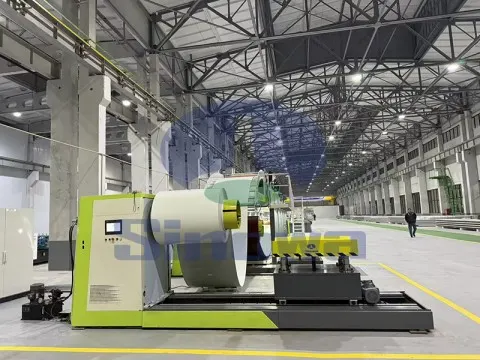
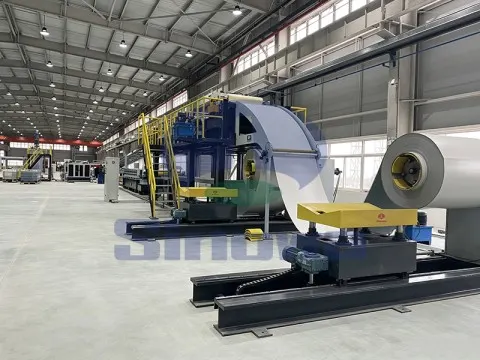
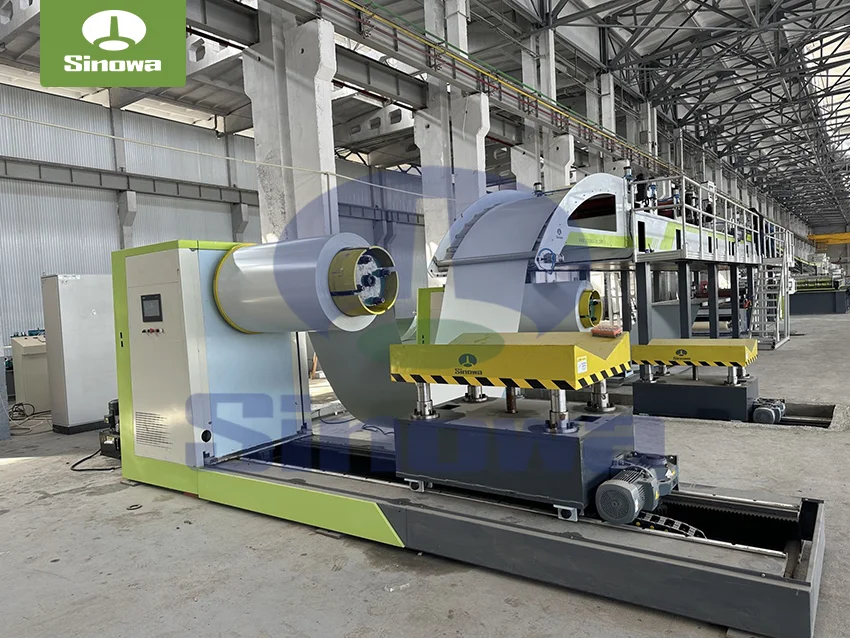
The front-end feeding and pretreatment system constitutes the initial core link of the continuous sandwich panel line, responsible for the stable supply and standardized pretreatment of upper and lower surface materials and intermediate core materials. For metal surface materials commonly used in sandwich panels, the system is equipped with automatic unwinding devices with tension self-adjusting functions. The tension control module can dynamically adjust the unwinding speed and tension according to the operating speed of the subsequent production line, effectively preventing surface material deviation, wrinkling, and stretching deformation during high-speed transmission. After unwinding, the surface material will pass through a multi-group leveling and correction mechanism, which eliminates the internal stress and surface unevenness of the coiled material, ensuring that the surface material maintains a flat and straight state in the subsequent composite process and lays a foundation for the smooth surface of finished panels.
In terms of core material processing, the equipment supports the continuous molding and filling of various lightweight core materials, including foam polymer materials and inorganic lightweight thermal insulation materials. The core material pretreatment unit is equipped with precision metering and conveying devices, which can stably and quantitatively transport core material raw materials to the composite molding area. For foaming core materials, the system realizes automatic proportioning and uniform mixing of multiple raw material components through closed-loop metering control. The fully mixed raw materials are evenly sprayed and laid on the flat lower surface material in a continuous linear state, with the laying thickness and density accurately adjustable according to production requirements. The whole process avoids manual intervention, ensuring the consistency of core material filling amount and distribution state of each panel section, and fundamentally improving the overall structural uniformity of sandwich panels.
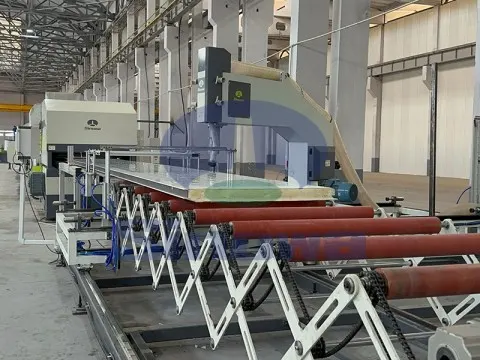
The continuous composite molding system is the key functional unit that determines the bonding quality and structural strength of sandwich panels. This unit adopts horizontal continuous composite molding technology, and the upper and lower surface materials are accurately closed and bonded with the intermediate core material under the action of synchronous transmission rollers. Different from the static pressing molding of traditional intermittent equipment, the continuous composite structure realizes dynamic synchronous molding in the running state of materials. The multi-group pressing roller sets are arranged in a gradient manner, which can apply uniform and stable pressure to the composite material layer by layer. The pressure value can be precisely adjusted according to the thickness and material characteristics of the panel, ensuring that the core material and surface material are closely bonded without gaps, delamination, or excessive compression deformation.
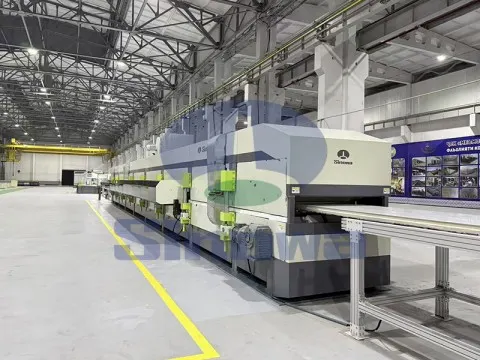
Equipped with a circulating constant temperature heating and curing system, the machinery provides a stable thermal environment for the rapid solidification and bonding of composite layers. The heating area adopts segmented temperature control design, and different temperature parameters can be set in different sections according to the curing characteristics of different core materials. The uniform heat conduction structure ensures that the temperature distribution in the curing area is balanced, avoiding local overheating or insufficient curing. In the continuous forward movement of the composite plate blank, the material completes foaming expansion, structural shaping, and adhesive curing in the heating area in sequence, realizing integrated molding of the whole plate structure. The scientific temperature gradient setting effectively shortens the curing cycle while ensuring the full molding of the core material structure, balancing production efficiency and product structural stability.
The precision traction and transmission system is an indispensable part to ensure the continuity and dimensional accuracy of production. The equipment adopts multi-point synchronous traction technology, and the traction rollers arranged at key positions of the production line are driven by independent servo power units. The intelligent control system uniformly coordinates the operating speed of all traction units, realizing fully synchronous transmission of materials in each production link. The high-precision positioning and speed control capability ensure that the plate blank does not shift or stretch during high-speed operation, and the linear transmission accuracy is maintained within a stable range. This synchronous transmission mode not only ensures the consistency of plate thickness and length but also avoids product quality problems such as uneven core material distribution and inconsistent bonding strength caused by asynchronous material transmission.
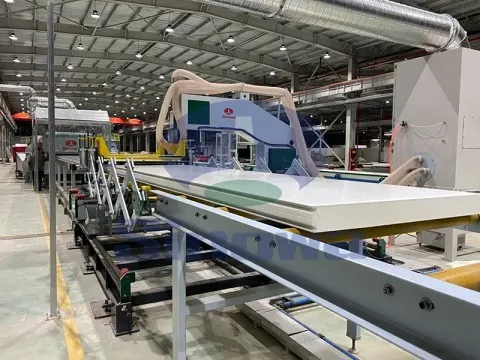
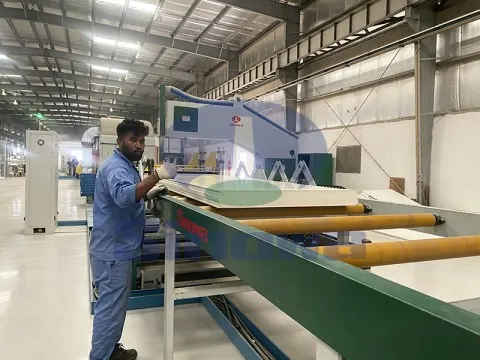
The post-processing system of the production line integrates fixed-length cutting, edge trimming, and surface finishing functions, realizing one-time forming of finished products. The automatic cutting unit adopts high-speed precision cutting tools and intelligent length positioning modules, which can complete fixed-length cutting according to preset parameter values. The cutting action is fast and stable, with neat and smooth cutting sections without burrs or deformation. The edge trimming mechanism can automatically trim the excess edge materials on both sides of the plate to ensure the consistency of the overall width of the finished plate. For plates that need surface finishing, the integrated finishing unit can complete fine polishing and surface correction, further improving the flatness and appearance quality of the plate surface. All post-processing procedures are completed online in a continuous state, without stopping the line for processing, which maximizes the continuity of production.
The automatic stacking and discharging system at the tail of the continuous sandwich panel production line realizes unmanned collection and arrangement of finished plates. After the finished plates pass the post-processing inspection, the automatic conveying device transports the plates to the stacking platform, and the intelligent stacking mechanism performs orderly stacking according to the set number and arrangement mode. The system has the functions of automatic counting and fault alarm, which can timely feed back abnormal stacking conditions to the control terminal. The automatic stacking function not only reduces manual labor input and avoids quality risks such as plate scratching and deformation caused by manual handling but also improves the tidiness and standardization of finished product storage, facilitating subsequent packaging, transportation, and storage management.
In terms of intelligent control, heavy duty continuous sandwich panel machine adopts a modular programmable control system, which integrates parameter setting, operation monitoring, fault diagnosis, and data statistics functions. Operators can complete the setting of production parameters such as plate thickness, plate length, operating speed, and curing temperature through the centralized control terminal. The system has a built-in data real-time collection and analysis module, which can monitor the operating state of each functional unit of the production line in real time, including equipment operating speed, temperature, pressure, and material consumption data. Once abnormal parameters or equipment faults occur, the system will automatically trigger alarm prompts and display fault location and cause information, providing accurate basis for equipment maintenance and troubleshooting.
The equipment is designed with a humanized operation logic and protection mechanism, with simple and intuitive operation procedures. It supports one-key start and stop of the whole line and segmented independent debugging, which is convenient for personnel to complete equipment commissioning, parameter adjustment, and daily maintenance. The multi-level safety protection system covers mechanical limit protection, overload protection, over-temperature protection, and emergency stop protection, which can effectively avoid equipment damage and safety accidents caused by misoperation or abnormal working conditions. The intelligent control system also has a parameter memory function, which can store the production parameters of different types of panels, realizing rapid switching of production formulas and greatly improving the flexibility of production line operation.
The heavy-duty performance advantage of the equipment is fully reflected in its long-term stable operation capability and high-load production adaptability. The key transmission parts and wearing parts are made of high-hardness and wear-resistant materials, and经过 precision processing and heat treatment technology, which greatly extends the service life of vulnerable parts and reduces the frequency of equipment failure and parts replacement. The optimized mechanical transmission structure reduces mechanical friction and energy loss during operation, making the equipment maintain low energy consumption and low failure rate during long-hour continuous operation. It can adapt to 24-hour uninterrupted industrial production modes, effectively meeting the high-intensity production needs of large-scale panel manufacturing enterprises.
In terms of product adaptability, the continuous production line has strong production flexibility and can produce multiple specifications of sandwich panels by adjusting equipment parameters. It can adapt to different types of surface materials including metal color-coated plates, galvanized plates, and non-metal composite plates, and match with various core materials such as polyurethane foam, rock wool, glass wool, and polystyrene foam. By adjusting the laying thickness of core materials, pressing pressure, and curing temperature, the equipment can produce sandwich panels with different thicknesses, thermal insulation performances, and structural strengths, covering the production needs of building enclosure panels, cold storage thermal insulation panels, purification workshop panels, and industrial equipment insulation panels. The diversified production capability enables a single production line to meet the multi-scenario application needs of the market, greatly improving the utilization rate and economic benefit of the equipment.
Compared with traditional intermittent sandwich panel production equipment, heavy duty continuous production machinery has obvious advantages in production efficiency and product quality stability. The intermittent production mode needs repeated material loading, pressing, curing, and unloading, with long single-cycle production time and low output efficiency, and the manual intervention link leads to large differences in product quality between batches. In contrast, the continuous production mode realizes uninterrupted material operation and one-time composite forming, with unit time output several times that of traditional equipment. The whole production process is controlled by unified program parameters, eliminating human factors interference, making the thickness, bonding strength, flatness, and dimensional accuracy of finished panels highly consistent, and effectively improving the overall qualification rate of products.
In terms of production cost control, the continuous production line realizes precise quantitative control of raw materials through intelligent metering and feeding systems, avoiding raw material waste caused by excessive feeding or uneven distribution in traditional production processes. The high degree of automation reduces the number of on-site operators, realizing centralized control and unmanned operation of the production line, greatly reducing labor costs. The stable and efficient operating performance of the equipment shortens the production cycle of single products and improves the production capacity per unit time, which effectively reduces the comprehensive production cost of products and enhances the market competitiveness of enterprise products.
The equipment also has excellent environmental protection and energy-saving performance, which conforms to the development trend of modern green industrial manufacturing. The closed raw material conveying and mixing system avoids the volatilization and leakage of raw materials, reducing the generation of production waste and environmental pollution. The segmented circulating heating system optimizes the heat energy utilization mode, reduces invalid heat loss, and improves thermal energy utilization efficiency. The low-friction transmission structure and optimized power matching design reduce mechanical energy consumption, realizing low energy consumption and low emission in the production process. In addition, the neat and centralized production process reduces the generation of leftover materials, and the generated edge materials and waste materials can be recycled and reused, further improving the resource utilization rate of production.
In terms of equipment maintenance and later operation, the modular structural design brings great convenience to daily maintenance and fault repair. The whole production line is divided into multiple independent functional modules, and each module has a standardized disassembly and assembly structure. When local parts fail or need regular maintenance, personnel can independently disassemble, inspect and replace the corresponding modules without affecting the overall structure and operating state of the equipment. The key parts of the equipment are equipped with dust-proof, anti-corrosion and wear-resistant protective structures, which adapt to complex industrial production environments such as high dust and high humidity, reduce the corrosion and wear of equipment parts, and extend the overall service life of the production line. The simple and efficient maintenance mode reduces the later operation and maintenance cost of the equipment and improves the continuous operation efficiency of the production line.
With the continuous upgrading of the construction industry and industrial manufacturing standards, the market has put forward higher requirements for the performance, quality and production efficiency of sandwich panel products. Traditional backward batch production equipment can no longer meet the needs of large-scale, standardized and high-quality production. Heavy duty continuous sandwich panel production machinery, with its high automation, high efficiency, high stability and strong adaptability, has become the mainstream equipment for modern sandwich panel production. It not only solves the pain points of low efficiency, unstable quality and high cost in traditional production processes but also promotes the standardized and intelligent development of the sandwich panel manufacturing industry.
In practical industrial application scenarios, this continuous sandwich panel machinery can perfectly adapt to the large-scale production needs of panel manufacturing factories. Whether it is the mass production of conventional building thermal insulation panels or the customized production of special specification panels for special engineering, the equipment can complete efficient and stable production through parameter adjustment and process optimization. The finished sandwich panels produced by the equipment have excellent structural integrity, stable bonding performance, good thermal insulation and fire resistance, and uniform overall quality, which can fully meet the stringent application requirements of modern construction engineering, cold chain facilities, purification engineering and industrial enclosure facilities.
In the future development of the composite panel manufacturing industry, intelligent upgrading and green production will become the core development direction. Heavy duty continuous sandwich panel production machinery will also be continuously optimized and upgraded in combination with modern industrial technology. The further integration of intelligent sensing technology, remote monitoring technology and automatic debugging technology will realize more refined and intelligent production control. The optimization of energy-saving structures and environmental protection processes will further reduce production energy consumption and environmental impact, and the upgrading of mechanical structures will improve the equipment's adaptability to new materials and new processes. As a key core equipment in the composite material manufacturing industry, heavy duty continuous sandwich panel production machinery will continue to play an important role in promoting the high-quality development of the modern building material industry and industrial manufacturing field.
Sinowa is a professional manufacturer of sandwich panel machine in china, we provide diversified and high-performance sandwich panel production lines, including fully automatic continuous PU sandwich panel line and customized special lines to meet mass production and personalized order demands. These sandwich panel lines support processing multiple foam core materials, such as PU, PIR, mineral wool, rock wool and glass wool, covering different insulation and fireproof standards.
Featuring stable operation, high efficiency, energy saving and easy maintenance, our PU sandwich panel line deliver sandwich panels with excellent thermal insulation, fire resistance, sound insulation and lightweight durability. The finished panels are widely applied in industrial workshops, warehouse roofing and wall cladding, cold storage insulation, serving global construction and industrial insulation markets.
https://www.cnsinowa.com/sandwich-panel-machines/heavy-duty-continuous-sandwich-panel-production-machinery.html