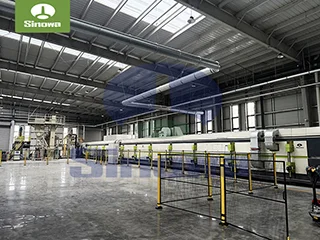
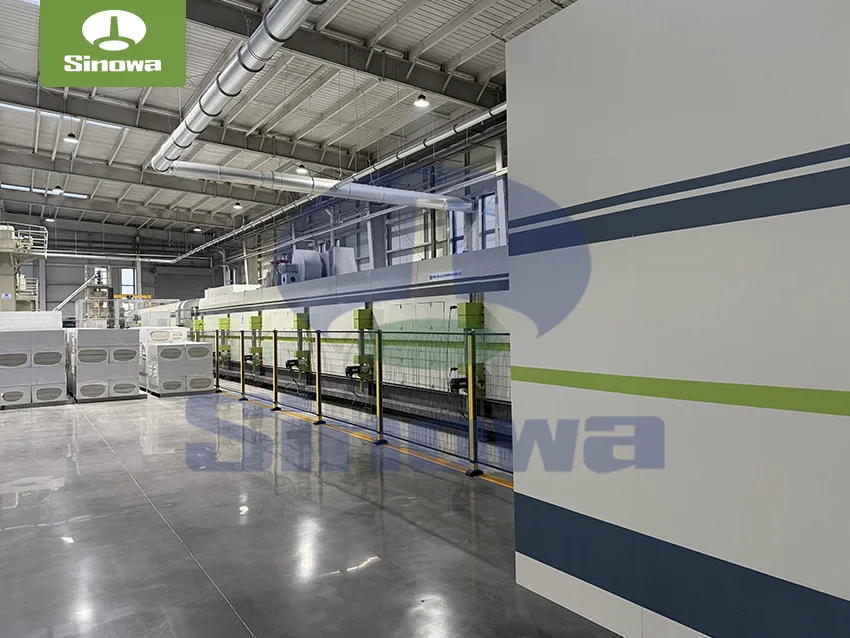
 sandwich panel line
To understand the core value of the temperature control system in PU sandwich panel production, it is essential to analyze the inherent characteristics of polyurethane material forming. Polyurethane foam is formed by the cross-linking reaction of polyol and isocyanate materials, and the reaction rate, foaming expansion degree, cell structure formation, and final curing strength are all directly determined by ambient and material temperature. In traditional production environments without precise temperature regulation, thermal conditions are easily affected by seasonal changes, workshop ventilation, and continuous equipment operation heat accumulation. Too low a temperature will slow down the chemical reaction, leading to insufficient foaming, incomplete core material curing, uneven density distribution, and weak bonding between the core layer and metal skins. On the contrary, excessively high temperature will cause the foaming reaction to proceed too rapidly, generating irregular and coarse foam cells, local over-expansion and shrinkage, and even residual internal stress inside the panel, which will lead to panel deformation, surface warping, and reduced thermal insulation performance after long-term use. The professional temperature control system completely avoids these defects by locking in the optimal thermal range required for material reaction, creating a stable and consistent thermal environment for every batch of panels in continuous production.
The complete temperature control system of the PU sandwich panel line covers multiple functional modules with differentiated thermal management logic, realizing segmented precision temperature control according to the process requirements of each production link. In the raw material pretreatment stage, the system maintains a constant preheating temperature for polyurethane raw materials and auxiliary materials. Appropriate preheating can reduce the viscosity of liquid raw materials, improve the uniformity of material mixing, and ensure that the mixed slurry has consistent fluidity and reaction activity each time it is output. This step eliminates the material component stratification and uneven reaction caused by inconsistent raw material temperatures, which is the primary guarantee for the uniformity of the panel core material. Different from the fixed-temperature preheating mode, the system can fine-tune the preheating temperature according to the ambient temperature of the workshop and the material characteristics of different formulas, ensuring that the raw materials always maintain the best reaction activity state in variable production environments.
The foaming and laminating curing stage is the most critical link for temperature control, and also the core functional area of the entire temperature regulation system. After the uniformly mixed polyurethane slurry is evenly distributed between the upper and lower surface materials, the panel enters the closed laminating and curing tunnel. The temperature control system arranges high-precision temperature sensing units and heat regulation components in different areas of the tunnel, realizing zoned temperature control for the front foaming area, middle curing area, and final shaping area. In the initial foaming area, the system maintains a moderate temperature to control the foaming expansion speed of polyurethane, ensuring that the foam fills the entire interlayer space uniformly and slowly without generating voids or local accumulation. In the middle curing area, the temperature is stably maintained within the optimal curing range to promote sufficient cross-linking and solidification of polyurethane molecular structures, forming a dense and uniform closed-cell structure. In the final shaping area, the temperature is slightly adjusted to stabilize the structural state of the cured core material, eliminate internal micro-stress, and ensure the flatness and structural stability of the panel surface. This segmented variable temperature control mode fully adapts to the dynamic changes of polyurethane chemical reactions, making the foaming and curing process more scientific and efficient than single-temperature production modes.
In addition to the heating and constant temperature control in the curing stage, the complete temperature control system also includes a matched constant-speed cooling regulation module, which forms a complete thermal cycle management from heating curing to cooling shaping. After the high-temperature curing process is completed, the panel has a certain residual temperature, and rapid cooling or natural cooling will cause inconsistent shrinkage of the core material and surface materials, resulting in dimensional deviation and bonding hidden dangers. The intelligent cooling system adopts graded cooling treatment, which gradually reduces the panel temperature according to the set temperature drop curve, ensuring that the internal and external temperature of the panel decreases synchronously, and the shrinkage rate of each structural layer remains consistent. This gradual cooling mode effectively avoids panel warping, cracking, and interlayer delamination caused by thermal expansion and cold contraction stress, and further solidifies the bonding strength between the polyurethane core layer and the surface materials. The cooling temperature and cooling speed can be intelligently adjusted according to the panel thickness, core material formula, and production speed, realizing adaptive matching of cooling parameters and production conditions.
The intelligent closed-loop regulation mechanism is the key to the efficient operation of the temperature control system. The system is equipped with distributed high-sensitivity temperature sensors, which collect real-time temperature data of each production area, material surface, and equipment operating environment all day long. The collected temperature data is transmitted to the central control unit for real-time analysis and comparison with the preset standard temperature parameters. Once subtle temperature deviation is detected, the system will automatically trigger dynamic adjustment instructions, accurately correcting the heating power, heat supply frequency, and cooling air volume of each functional module without manual intervention. This real-time monitoring and instant adjustment response mechanism ensures that the temperature error of each production link is controlled within a very small range, completely eliminating product quality fluctuations caused by thermal parameter drift. In the long-term continuous production process, the system can also record and analyze temperature data of different production cycles, automatically optimize temperature parameters according to production environment changes and equipment operation status, and realize self-adaptive intelligent regulation of thermal conditions.
The application of the precision temperature control system has brought comprehensive improvements to the production quality and performance of PU sandwich panels. In terms of structural performance, stable temperature control enables the polyurethane core material to form a uniform and regular closed-cell structure, with consistent cell size and density distribution in all parts of the panel. This uniform structural state makes the panel have stable mechanical strength, uniform pressure resistance, and strong structural toughness, avoiding local softness or insufficient compression resistance caused by uneven foaming. In terms of bonding performance, the constant thermal environment ensures that the chemical bonding reaction between the polyurethane core material and the surface material is fully completed, forming a firm and integrated composite structure. The interlayer bonding strength of the panel is significantly improved, and the problem of interlayer peeling and degumming in long-term use is effectively avoided.
In terms of thermal insulation performance, which is the core advantage of PU sandwich panels, the optimization effect of the temperature control system is particularly prominent. Uniform and complete foaming curing ensures that the core material has a high closed-cell rate, which greatly reduces air convection and heat transfer inside the core layer, enabling the panel to maintain stable and excellent thermal insulation performance in various temperature environments. Panels produced under precise temperature control conditions have more stable thermal conductivity, without performance attenuation caused by incomplete local curing or defective cell structure. At the same time, the standardized thermal forming process also improves the waterproof and sound insulation performance of the panel. The dense closed-cell structure can effectively block moisture penetration and reduce sound wave transmission, making the comprehensive performance of the finished panel more stable and reliable.
In terms of production efficiency and production stability, the temperature control system also solves many pain points of traditional production. Traditional PU panel production is easily restricted by ambient temperature, and production parameters need to be adjusted frequently with seasonal changes, resulting in discontinuous production and inconsistent product quality. The intelligent temperature control system completely isolates the interference of external ambient temperature, realizing standardized and consistent production throughout the year. Whether in high-temperature summer environments or low-temperature winter workshops, the equipment can maintain a stable production state, ensuring that the product quality of each batch is consistent. In addition, precise temperature regulation avoids material waste caused by unqualified products due to temperature deviation, reduces the rate of defective products in the production process, and effectively improves the utilization rate of polyurethane raw materials. The optimized thermal reaction process also shortens the curing cycle appropriately, matching the continuous operation speed of the PU sandwich panel production line, and realizing the dual improvement of production qualification rate and production efficiency.
The energy-saving advantage brought by the refined temperature control system is also an important part of its industrial value. Traditional heating equipment usually adopts continuous full-power operation, which causes a large amount of heat energy waste due to excessive heating and repeated heating. The intelligent temperature control system adopts intermittent and variable-power heating operation mode, automatically adjusting heat supply according to the real-time temperature demand of the production process. When the production area reaches the standard temperature, the system automatically reduces heating power or maintains constant temperature with low power; when temperature fluctuation occurs, it performs precise supplementary heating, avoiding invalid energy consumption. At the same time, the system is equipped with heat preservation and heat recovery structures in key heating areas, which reduce heat loss in the production process and further improve energy utilization efficiency. This intelligent energy regulation mode not only reduces the overall energy consumption of production but also reduces the operating cost of long-term industrial production, meeting the development needs of energy-saving and low-carbon industrial production.
In actual industrial production scenarios, the PU sandwich panel machine with a complete temperature control system shows strong adaptability to diversified production needs. It can meet the production requirements of sandwich panels with different thicknesses, different core material formulas, and different surface material types. For thin panels with fast curing speed and thick panels with long curing cycle, the system can match the optimal temperature curve and heat preservation time respectively, ensuring that panels of different specifications can achieve the best forming effect. For panels used in different application scenarios such as building thermal insulation, cold storage enclosure, and industrial workshop partition, the system can adjust the foaming and curing temperature parameters according to the performance requirements of the product, targeted optimizing the thermal insulation, mechanical strength, and weather resistance of the panel, making the product more adaptable to complex application environments.
The long-term operation stability of the temperature control system also ensures the sustainable and stable output of the polyurethane sandwich panel production line. The system is designed with over-temperature protection, temperature deviation alarm, and fault self-checking functions. Once abnormal temperature changes or system operation faults occur, it will automatically send out prompt information and start safety protection measures to avoid equipment failure and product quality problems caused by abnormal thermal conditions. The modular design of the temperature control unit facilitates daily maintenance and later debugging, ensuring that the system can maintain high-precision operation state for a long time in high-intensity continuous production. Compared with traditional polyurethane sandwich panel line that require frequent manual debugging and parameter calibration, the intelligent temperature control system greatly reduces manual operation intervention, reduces the technical threshold of production operation, and improves the overall automation level of the production line.
With the continuous upgrading of the composite panel manufacturing industry, the market has put forward higher requirements for the consistency, stability, and comprehensive performance of PU sandwich panel products. The temperature control system, as the core supporting technology of modern polyurethane sandwich panel machine, has become an indispensable key part of high-end panel production equipment. It fundamentally changes the extensive production mode relying on manual experience and environmental conditions in the past, and realizes the precise, standardized, and intelligent production of PU sandwich panels. Through full-process and multi-dimensional thermal management, the system optimizes every chemical reaction and physical forming link of the panel, making the structural stability, thermal insulation performance, and dimensional accuracy of finished panels reach a more excellent level. In the future development of the building insulation and industrial composite material industry, the temperature control technology of continuous PU sandwich panel line will continue to be optimized and upgraded, further promoting the high-quality and efficient development of the entire industry and providing more reliable composite panel products for construction, cold chain, industrial manufacturing, and other fields.
https://www.cnsinowa.com/sandwich-panel-machines/pu-sandwich-panel-line-with-temperature-control-system.html