sandwich panel machine
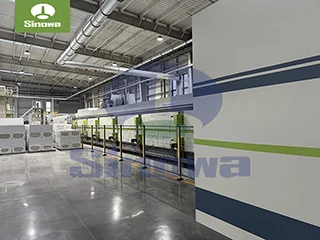
The overall structural design of polyurethane sandwich panel production line follows the principles of modular integration and collaborative operation, with every functional unit precisely matched in operating speed, processing accuracy, and working rhythm to avoid production discontinuity or product defects caused by asynchronous operation. The entire production system can be divided into several core functional sections that operate in a coordinated cycle, including the substrate feeding and forming section, polyurethane raw material metering and mixing section, automatic foam pouring and laying section, constant-pressure laminating and curing section, fixed-length cutting and finishing section, and intelligent control and adjustment section. Each section is composed of specialized mechanical components and auxiliary devices, forming a closed-loop production process from raw material input to finished product output, and the whole operation realizes highly automated production with minimal manual intervention throughout the process.
The front-end substrate processing module serves as the foundation for panel forming, undertaking the pretreatment and shaping of upper and lower facing materials for sandwich panels. This module is mainly responsible for uncoiling continuous sheet raw materials, correcting material deviation, and conducting continuous roll forming to shape flat sheets into standardized structural profiles. Equipped with high-strength alloy roller sets and precision transmission structures, the equipment can adapt to facing materials of different thicknesses and texture specifications, ensuring that the surface flatness, edge straightness, and overall dimensional uniformity of the formed sheets remain consistent. During operation, the sheet materials are steadily transported forward through the conveyor system, and the multi-stage rolling process gradually adjusts the sheet structure to form the required groove and edge structures, which lays a solid foundation for the subsequent compounding with polyurethane foam cores and ensures the overall structural tightness and mechanical stability of finished panels. The deviation correction device embedded in this module can dynamically monitor the material conveying state in real time, automatically fine-tuning the material running track to prevent lateral deviation and effectively eliminate product quality problems such as uneven edge sealing and inconsistent panel thickness caused by material displacement.
As the core functional unit that determines the thermal insulation, bonding, and physical properties of finished panels, the polyurethane raw material processing and foaming module dominates the core quality of sandwich panel products. Polyurethane foam is formed by the precise chemical reaction and foaming expansion of two main liquid raw materials, supplemented by functional additives. This foam core sandwich panel line module adopts high-precision metering and dynamic mixing structures to strictly control the proportion, temperature, and pressure of raw material delivery. The raw material conveying system stably transports the pre-treated polyol and isocyanate components to the high-pressure mixing head, where the materials undergo intense instantaneous mixing to form a uniform and stable reaction mixture. The entire mixing process is completed in an airtight environment, avoiding the mixing of air impurities and ensuring the uniformity of the subsequent foaming reaction. Meanwhile, the equipment is equipped with an independent temperature regulation system to maintain the optimal reaction temperature range of raw materials, avoiding abnormal changes in foaming speed, foam density, and pore structure caused by temperature fluctuations. After mixing, the liquid polyurethane mixture is evenly poured onto the surface of the lower facing sheet through an automatic pouring device, forming a uniform liquid material layer that will expand and fill the gap between the upper and lower sheets in the subsequent process.
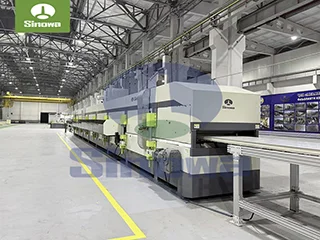
The intermediate laminating and curing module is a key link to realize the composite forming and structural stabilization of sandwich panels, undertaking the foaming expansion, bonding compounding, and solidification molding of polyurethane foam cores. After the liquid polyurethane material is poured on the lower sheet, the upper formed facing sheet is accurately closed through the automatic conveying and positioning mechanism, forming a closed sandwich structure. The semi-finished panel then enters the double-track laminating conveyor system, which provides continuous and uniform static pressure to the panel through high-precision chain plate pressing structures. This constant-pressure pressing state can effectively control the expansion range and thickness of polyurethane foam, ensuring that the foam core is evenly filled between the upper and lower sheets without hollow gaps or local bulges. Inside the laminating equipment, a constant-temperature curing environment is maintained to match the chemical reaction cycle of polyurethane foaming. With the progress of thermal reaction, the liquid polyurethane mixture gradually expands, foams, and solidifies, forming a fine and uniform closed-cell structure, and tightly bonds with the inner surfaces of the upper and lower facing sheets to form an integrated composite structure. The collaborative operation of constant pressure and constant temperature enables the foam core to complete structural shaping and performance stabilization in the shortest cycle, effectively improving production efficiency while ensuring the bonding strength and overall flatness of the panel.
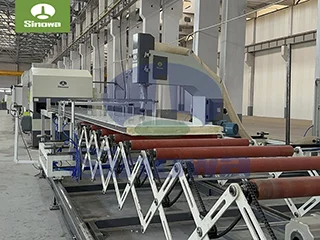
The back-end cutting and finishing module realizes the standardized sizing and quality finishing of cured sandwich panels. After completing foaming, curing, and composite forming, the continuous long-strip panel is stably conveyed to the fixed-length cutting device. The PU sandwich panel production line adopts automatic induction and positioning technology to accurately identify the preset panel length specifications, driving the high-speed cutting tool to complete flat and neat cutting operations. The cutting mechanism is designed with shock absorption and stabilization structures to avoid panel vibration and section deformation during cutting, ensuring that the cutting section is smooth, flat, and free of burrs, cracks, and indentations. After cutting, the equipment completes simple edge trimming and surface finishing of the panels to remove residual foam scraps and tiny burrs generated during processing, further optimizing the appearance quality and structural tightness of finished products. The entire cutting and finishing process operates synchronously with the front-end production rhythm, realizing uninterrupted continuous production and effectively improving the overall production continuity and yield of the assembly line.
The intelligent control system runs through the entire operation process of polyurethane sandwich panel machine, serving as the core brain to coordinate the synchronous operation of all functional modules. The system integrates data monitoring, parameter adjustment, fault diagnosis, and operation linkage functions, realizing full-process automatic control from raw material metering, conveying, foaming, and pressing to cutting and finishing. Operators can set production parameters such as panel thickness, length, foaming density, and conveying speed through the centralized control interface. The system will automatically adjust the operating status of each module in real time according to the set parameters, maintaining the consistency and stability of the production process. In the production process, the control system can dynamically monitor key operating data including raw material pressure, reaction temperature, conveying speed, and pressing pressure. Once abnormal parameter fluctuations are detected, the system will automatically trigger early warning prompts and perform adaptive adjustment, effectively avoiding batch product quality defects and equipment operation failures. In addition, the system has a memory function for production parameters, which can quickly call up matching parameter schemes according to different panel production specifications, greatly improving production flexibility and switching efficiency for diversified products.
The mechanical performance and structural design of PU sandwich panel machine endow it with outstanding production adaptability and operational stability. The main frame of the equipment adopts high-rigidity structural design and thickened reinforced materials, which can withstand long-term continuous operating load and mechanical vibration, effectively avoiding structural deformation and operating accuracy attenuation caused by long-time operation. All transmission components are processed with high-precision technology and equipped with wear-resistant and anti-corrosion treatments, reducing equipment wear and failure rates during high-frequency operation and extending the overall service life of the equipment. In terms of production adaptability, the equipment can realize flexible adjustment of multiple production indicators, adapting to the production of sandwich panels with different thickness specifications, different surface materials, and different foam density requirements. Whether it is lightweight thin panels for building exterior decoration or thick high-insulation panels for cold storage and industrial insulation, the equipment can complete standardized and high-quality production through simple parameter adjustment and mechanical positioning calibration.
In terms of production quality control, the systematic and integrated design of polyurethane sandwich panel line effectively solves many quality pain points in traditional manual and semi-automatic production modes. The precise raw material metering system ensures the accurate proportion of polyurethane reaction components, avoiding unstable foam performance caused by raw material ratio deviation, such as insufficient foaming, excessive porosity, or reduced thermal insulation performance. The constant-pressure and constant-temperature laminating curing system ensures that each position of the panel is subjected to consistent pressure and temperature conditions, making the foam core structure uniform and dense, with stable bonding strength between the foam core and the surface layer. The fully automated continuous production mode eliminates product differences caused by manual operation errors, realizing consistent dimensional accuracy, surface flatness, and internal structural performance of each batch of panels, greatly improving the overall qualification rate and product stability of production.
In terms of production efficiency and energy consumption control, modern PU sandwich panel line has achieved significant optimization and upgrading compared with traditional equipment. The integrated continuous production process eliminates intermediate handling, waiting, and repeated positioning links between multiple independent processes, greatly shortening the single-panel production cycle and improving the overall production capacity of the assembly line. The optimized foaming reaction process and temperature and pressure control system can accurately match the energy required for the polyurethane foaming reaction, avoiding energy waste caused by excessive temperature and pressure supply. At the same time, the intelligent energy-saving control system can automatically adjust the operating power of each module according to the production load, realizing low-energy operation during standby and stable energy supply during peak production, effectively reducing the unit energy consumption of product production. In addition, the closed foaming and production environment reduces the volatilization and waste of raw materials, improves the utilization rate of polyurethane chemical raw materials and sheet substrates, and realizes efficient and economical production.
Daily maintenance and standardized operation are crucial to maintaining the long-term stable operation of polyurethane foam sandwich panel manufacturing line and ensuring continuous production quality. Conventional maintenance work includes regular cleaning of the mixing head and pouring pipeline to prevent residual polyurethane materials from solidifying and blocking the pipeline and affecting the accuracy of subsequent material mixing and pouring. Regular inspection and lubrication of transmission parts such as conveyor rollers, chains, and gears can reduce operating friction and wear and maintain stable transmission accuracy. The temperature and pressure sensing components of the control system need regular calibration to ensure real-time and accurate monitoring data, avoiding parameter control deviations. In addition, the sealing performance of the foaming and laminating workshop environment should be checked regularly to maintain stable environmental temperature and humidity conditions required for the polyurethane foaming reaction, which helps to stabilize the foaming effect and product performance. Standardized operation and refined maintenance can effectively reduce equipment failure rates, extend equipment service life, and ensure long-term stable and efficient operation of the production line.
With the continuous upgrading of composite material manufacturing technology, polyurethane foam sandwich panel mechanical equipment is evolving towards higher automation, smarter control, stronger adaptability, and more environmentally friendly production. The continuous optimization of mechanical structure and control technology enables the sandwich panel equipment to produce sandwich panels with higher structural strength, better thermal insulation performance, and more stable durability, which can better meet the increasingly stringent application requirements in modern construction, industrial insulation, cold chain transportation, and other fields. As a key equipment for the production of energy-saving and environmentally friendly composite materials, it not only improves the industrial production level of polyurethane sandwich panels but also provides reliable technical and equipment support for the popularization and application of high-efficiency thermal insulation and energy-saving building materials, playing an important role in promoting the high-quality development of the composite material manufacturing industry and the green upgrading of the construction industry.
https://www.cnsinowa.com/sandwich-panel-machines/polyurethane-foam-sandwich-panel-mechanical-equipment.html