sandwich panel machine
The basic working logic of the foam sandwich panel machine originates from the organic combination of precision mechanical transmission, physical and chemical molding principles, and automatic material control systems. The overall production logic follows a progressive composite molding idea, taking lightweight foam materials as the inner core and rigid flat materials as the upper and lower surface layers, and achieving tight integration and stable bonding between different materials through mechanical pressure and constant-temperature curing. The entire production process is carried out in a closed and continuous operating system, which avoids the quality fluctuations caused by external environmental interference and manual operation errors in scattered production links. The equipment is designed with a modular functional structure, and each functional unit corresponds to an independent production link, realizing seamless connection between processes from raw material input to finished product output, and forming a complete closed-loop production system.
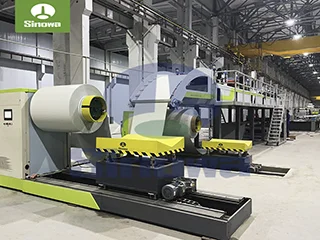
The complete production process of the foam sandwich panel production line starts with raw material preparation and feeding, which is the foundation for ensuring the uniformity and stability of finished products. The surface layer raw materials, usually coiled sheet materials with flat and smooth surfaces and good structural toughness, are sent to the pretreatment unit through an automatic unwinding structure. During this stage, the equipment completes automatic leveling, surface cleaning, and tension adjustment of the coiled materials. The tension control system plays a key role here, as it can maintain a consistent feeding speed and flat state of the sheet materials, effectively preventing sheet deviation, wrinkling, and uneven tension during subsequent composite processing. At the same time, the foam core material raw materials are transported to the internal mixing and foaming unit through a quantitative feeding device. The core material raw materials are proportioned according to the preset process parameters, and the internal stirring structure of the equipment realizes full and uniform mixing of different components, laying a foundation for the consistent density and uniform structure of the subsequent foam core layer.
After the raw material pretreatment is completed, the foam core sandwich panel line enters the core foaming and material compounding stage, which is the most critical link determining the structural performance of the sandwich board. The uniformly mixed foam raw materials are transported to the closed foaming cavity through a high-pressure conveying system. Under the dual action of precise temperature control and pressure adjustment inside the cavity, the raw materials undergo rapid physical expansion and chemical reaction molding. The equipment’s temperature control system can maintain a constant working temperature within a precise range, ensuring that the foaming multiple, pore uniformity, and density of the foam core layer remain stable without local over-foaming or insufficient foaming. After the foam core layer is initially formed, the equipment automatically sprays uniform adhesive on the inner surfaces of the upper and lower surface sheets, and then accurately fits the surface sheets with the foam core layer through a positioning and guiding structure. This synchronous fitting operation ensures that there is no offset or gap between the core layer and the surface layers, avoiding hollowing and delamination defects of the finished board.
The composite pressing and constant-temperature curing process follows the material fitting operation, which is the key to enhancing the bonding strength and structural stability of the sandwich board. The sandwich panel production equipment is equipped with a multi-group roller pressing structure, which applies uniform and continuous static pressure to the composite board blank. The pressure value is stably controlled by the internal hydraulic and pneumatic linkage system, ensuring that the pressure acting on each position of the board surface is consistent, so that the adhesive can fully infiltrate the contact interface between the foam core and the surface materials. While maintaining pressure, the constant-temperature curing system works continuously to promote the complete curing reaction of the adhesive and the further stabilization of the foam core structure. Through integrated pressure maintenance and temperature maintenance, the molecular bonding degree between different materials is greatly improved, enabling the finished sandwich board to have excellent overall structural integrity, and effectively avoiding delamination, cracking, and poor bonding in long-term use.
After the curing process is completed, the equipment enters the finishing and shaping stage of finished products, including fixed-length cutting, edge trimming, and surface finishing. The high-precision cutting system of the sandwich panel equipment can automatically identify the processing length according to the preset parameters, and complete flat and neat cutting of the board through a stable cutting execution structure. Compared with traditional post-processing manual cutting, the integrated cutting function of the equipment ensures consistent dimensional accuracy of each finished board, with no burrs or irregular edges on the cutting surface. The edge trimming unit further polishes and shapes the edges of the board to eliminate residual materials and irregular structures generated in the composite process, making the overall appearance and dimensional standard of the product more uniform. After all finishing procedures are completed, the finished boards are automatically output through the conveying platform, realizing continuous cyclic production without shutdown interruption.
The core advantages of the foam sandwich panel line in industrial production are mainly reflected in production efficiency, product quality stability, and production cost control. In terms of production efficiency, the fully continuous automated production mode eliminates the intermediate handling and waiting links of traditional segmented production. From raw material feeding to finished product output, all links are connected synchronously, and the production speed can be adjusted according to production demands, realizing large-scale batch production. The highly automated operation mode greatly reduces the demand for manual operation, and only a small number of operators are required to complete parameter setting, equipment monitoring, and routine maintenance work, effectively reducing labor input and human resource costs in the production process.
In terms of product quality control, the foam sandwich board machine relies on a full-process automatic parameter control system to realize precise control of all core production indicators. Key parameters such as foaming density, composite pressure, curing temperature, and feeding speed are uniformly controlled by the equipment system, avoiding product quality differences caused by subjective manual operation experience and operating errors. The products produced by the equipment have consistent thickness, uniform internal foam pore structure, stable bonding performance, and excellent overall flatness, which can meet the unified quality standard requirements of large-scale engineering applications and industrial supporting use. In addition, the closed production environment of the equipment reduces the contact between raw materials and the external environment, avoids the impact of dust, temperature and humidity changes on material performance, and further improves the qualification rate and stability of finished products.
In terms of product performance diversity and production flexibility, the foam sandwich panel machinery has strong adjustable performance. By adjusting the internal process parameters and replacing simple auxiliary structures, the equipment can produce sandwich boards with different thicknesses, core material densities, and surface layer specifications. This adjustable feature enables the equipment to adapt to the diverse product demands of different application scenarios. For lightweight thermal insulation boards used in building enclosure structures, the equipment can adjust the foaming parameters to reduce the core material density and enhance the thermal insulation effect; for structural support boards used in equipment packaging and temporary facilities, the equipment can increase the composite pressure and core material density to improve the structural strength and compression resistance of the boards. This flexible production capability makes the equipment widely adaptable to multi-scenario and multi-specification production demands.
With the continuous progress of industrial manufacturing technology, the structural design and functional performance of foam sandwich panel manufacturing line is also undergoing continuous optimization and upgrading. Modern optimized equipment pays more attention to energy conservation and environmental protection in the production process. The upgraded heating and foaming system can effectively reduce energy consumption while maintaining stable temperature control, and the closed raw material conveying and processing structure avoids the volatilization and waste of raw materials, improving the utilization rate of production materials. At the same time, the intelligent monitoring system of the equipment is gradually improved, which can realize real-time monitoring of equipment operating status, production parameter changes, and material processing effects. Once abnormal parameters or equipment failures are detected, the system will automatically trigger early warning and protection mechanisms, reducing the probability of defective products and equipment failure losses, and improving the safety and stability of long-term continuous operation of the equipment.
The application scope of products produced by foam sandwich panel making machine covers multiple industrial fields, showing strong market adaptability and application value. In the construction industry, such sandwich boards are widely used in the enclosure structures of prefabricated buildings, temporary construction facilities, and building thermal insulation and energy-saving renovation projects. Relying on the lightweight, thermal insulation, sound insulation, and weather-resistant characteristics of foam core materials, the boards can reduce the self-weight of building structures while improving the thermal insulation and sound absorption performance of buildings, helping to realize energy-saving and lightweight building construction. In the cold chain and refrigeration industry, the high-efficiency thermal insulation performance of foam sandwich boards makes them ideal materials for refrigeration warehouse partitions, cold storage enclosure structures, and refrigerated transportation carriage interiors, which can effectively reduce cold air loss and improve the operational energy-saving effect of refrigeration equipment.
In the industrial packaging and equipment protection field, the lightweight and high-strength composite structure of foam sandwich boards can provide good buffer protection and structural support for large-scale equipment and precision instruments. The boards can resist external extrusion and impact, avoid damage to equipment during transportation and storage, and their lightweight characteristics can also reduce transportation costs. In addition, such boards are also applied in the field of municipal facilities and temporary engineering, such as temporary isolation facilities, outdoor simple housing structures, and municipal engineering enclosure facilities, relying on their convenient processing, fast installation, and durable performance.
In the context of the current industrial upgrading and green manufacturing development trend, the foam sandwich panel manufacturing machine, as an efficient and energy-saving composite material production equipment, is playing an increasingly important role in promoting the upgrading of the building materials industry and the development of lightweight composite materials. The equipment’s integrated and automated production mode conforms to the development direction of industrial intelligent manufacturing, and the green production process with low energy consumption and low material loss meets the industry’s requirements for energy conservation and environmental protection. With the continuous expansion of the market demand for lightweight, thermal insulation, and energy-saving composite boards, the technological innovation and market application of foam sandwich board machines will be further promoted, driving the composite board manufacturing industry to develop in a more standardized, efficient, and intelligent direction.
In practical industrial application, the stable operation of the foam sandwich panel production machinery is closely related to daily maintenance and standardized operation. Scientific and reasonable daily maintenance can effectively extend the service life of the equipment, maintain stable production accuracy, and reduce the failure rate of long-term operation. Routine maintenance work mainly includes regular cleaning of the material conveying and foaming cavity structure to avoid residual raw material accumulation affecting subsequent processing effects, regular inspection and lubrication of the transmission and pressing components to ensure flexible and stable mechanical operation, and real-time calibration of the temperature control, pressure control, and cutting systems to ensure that all production parameters are within the standard range. Standardized operation procedures can avoid equipment abnormalities and product quality problems caused by misoperation, ensuring the continuity and stability of batch production.
Looking at the overall development of the composite board manufacturing industry, the foam sandwich board machine has broken through the limitations of traditional handicraft and semi-mechanized production, realized the standardized and large-scale production of foam composite sandwich boards, and provided reliable equipment support for the popularization and application of lightweight thermal insulation composite materials. In the future, with the continuous integration of intelligent control technology, energy-saving technology and mechanical manufacturing technology, the foam sandwich board machine will develop towards higher intelligence, lower energy consumption, stronger production flexibility and higher processing accuracy, further meeting the increasingly diverse and high-standard market application demands, and injecting continuous power into the high-quality development of the modern building materials and composite material industries.
https://www.cnsinowa.com/sandwich-panel-machines/foam-sandwich-board-machine.html