sandwich panel line
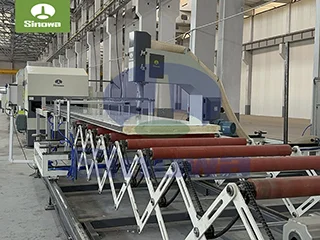
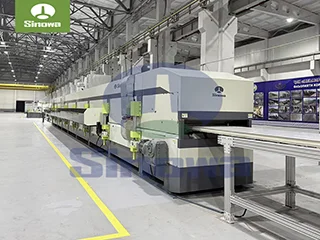
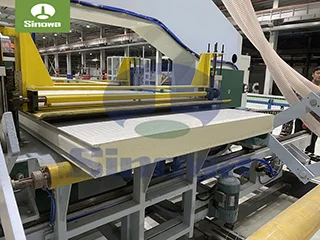
The overall structural design of the fully automatic color steel sandwich panel line follows the logic of streamlined industrial production, with all functional modules closely connected and synchronously operated to form a closed-loop production system without redundant processes. The entire equipment set is scientifically divided into multiple collaborative functional units, including raw material unwinding and pretreatment unit, precision roll forming unit, core material automatic conveying and positioning unit, high-precision composite bonding unit, constant-temperature pressure curing unit, fixed-length cutting and shaping unit, as well as finished product automatic stacking and output unit. All units are uniformly scheduled and regulated by a central intelligent control system, which can automatically adjust operating parameters according to different production specifications, ensuring the synchronization of material transmission, processing speed and molding accuracy throughout the production process. This integrated structural design eliminates the disconnection and error interference between independent processing equipment in traditional production lines, greatly improving the overall operational stability and production continuity of the equipment.
The raw material pretreatment stage is the primary link that determines the surface quality and composite performance of finished sandwich panels, undertaking the core task of standardizing the processing of color steel coil raw materials. The color steel coils used for panel surface layers are loaded on the hydraulic automatic unwinding mechanism, which adopts a stable tension control structure to avoid tension fluctuation, material deviation and coil loosening during the unwinding process. Different from simple manual unwinding equipment, the automatic unwinding unit can adapt to color steel coils of different inner diameters and widths, realizing stepless speed regulation and continuous and uniform material feeding. After unwinding, the color steel sheets will pass through a multi-group leveling roller set, which can effectively eliminate the surface warping, bending and micro-deformation generated during coil winding and transportation. The precision leveling process ensures the flatness of the metal surface, laying a solid foundation for subsequent roll forming and composite bonding. Meanwhile, the supporting surface cleaning and drying system automatically removes floating dust, oil stains and residual impurities on the surface of color steel sheets. These tiny pollutants are key factors leading to insufficient bonding strength and delamination of panels in later stage, and the full-automatic closed cleaning process completely removes surface impurities, optimizing the bonding interface between metal plates and core materials.
Following the pretreatment process is the roll forming process, which shapes flat color steel sheets into standardized profile structures matching the design requirements of sandwich panels. The roll forming unit consists of dozens of groups of precision forming rollers arranged in an orderly gradient manner, and each group of rollers corresponds to a specific bending and pressing process. Through gradual cold pressing and molding, the flat steel sheets are processed into various edge structures such as plug-in type, buckle type and flat mouth type, meeting the assembly and connection requirements of different building scenarios. The entire forming process is completed at a constant speed and pressure, avoiding structural damage and surface scratch problems caused by sudden pressure changes. The central control system can store multiple sets of molding parameter programs, and workers can switch panel profile specifications in a short time through parameter adjustment, realizing flexible production of diversified panel types without replacing a large number of molds. In addition, the roll forming unit is equipped with a real-time deviation correction sensing system. When the steel sheet deviates from the standard transmission track during operation, the system will automatically trigger the fine-tuning mechanism to correct the position in real time, ensuring the consistency of the overall dimension and profile accuracy of each batch of panels.
The core material conveying and positioning system is a key functional module to ensure the uniformity and structural stability of sandwich panel interlayer. Common core materials for color steel sandwich panels include lightweight thermal insulation and fireproof materials such as polyurethane foam, rock wool and glass wool, which undertake the core functions of building thermal insulation, heat preservation and sound insulation. The fully automatic production line is equipped with a special core material automatic cutting and conveying mechanism, which can cut the coiled or block core materials into standard sizes matching the steel plates according to the preset panel thickness specifications. The conveying system adopts synchronous transmission with the steel plate forming unit, ensuring that the core materials are accurately paved between the upper and lower color steel sheets at a fixed position and fixed speed. The automatic positioning device can fine-tune the left and right positions of the core materials in real time to avoid deviation, dislocation and uneven laying thickness, so that the core material distribution of each panel is uniform and consistent, ensuring that the thermal insulation, sound insulation and mechanical properties of all finished products maintain stable and unified standards.
The composite bonding and high-pressure molding stage is the core process of sandwich panel production, which directly determines the structural firmness and service life of finished panels. The automatic sandwich panel production line is equipped with a high-precision automatic glue spraying system, which can evenly coat the adhesive on the bonding surface between color steel sheets and core materials according to the set dosage. The intelligent glue spraying control ensures uniform glue distribution and moderate dosage, avoiding quality problems such as insufficient bonding caused by too little glue and surface glue overflow caused by too much glue. After the completion of glue spraying, the upper and lower color steel sheets and the middle core material enter the pressure composite unit synchronously. The unit adopts multi-group pressure roller groups with balanced pressure distribution, which can apply stable and uniform pressure to the composite plates. Under the action of constant pressure, the three-layer structure is closely bonded to form an integrated composite whole, effectively eliminating gaps and hollow layers inside the panels. This integral composite molding process greatly improves the overall structural strength of the panels, making the panels have stronger compression resistance and bending resistance compared with manually bonded products, and avoiding delamination and cracking during long-term use.
The constant-temperature curing system is an essential post-composite processing link to stabilize the bonding structure and enhance the interface durability of sandwich panels. After pressure compounding, the initially molded panels enter the closed constant-temperature curing channel for continuous thermal curing treatment. The internal temperature of the curing channel is accurately controlled in a stable range, which can accelerate the curing reaction of the adhesive, promote the full integration of the adhesive layer with the metal plate and core material, and significantly improve the bonding strength and aging resistance of the composite interface. The fully enclosed curing environment avoids the influence of external temperature and humidity changes on the curing effect, ensuring that each batch of panels completes the curing reaction under consistent environmental conditions. After curing, the internal structure of the panels tends to be stable, the bonding interface no longer has the risk of virtual bonding, and the overall dimensional stability and structural durability of the products are greatly improved, which can adapt to complex outdoor and harsh building environments for long-term use.
The fixed-length cutting and finishing process realizes the final sizing and shaping of finished sandwich panels. The continuous sandwich panel production line adopts automatic tracking and cutting technology, and the central control system can preset the production length of panels according to customer demand. When the cured composite panels are transmitted to the cutting station, the high-precision sensing device automatically identifies the conveying position and triggers the cutting mechanism to complete fixed-length cutting instantly. The cutting mechanism adopts flat and smooth cutting tools, which can realize neat and burr-free cutting of metal plates and core materials at one time, without secondary trimming and polishing. After cutting, the edge finishing unit automatically processes the panel edges to remove tiny burrs and uneven gaps generated during cutting, ensuring that the panel edges are flat and smooth, which is convenient for on-site assembly and installation of subsequent building construction. The entire cutting and finishing process is fully automated, with fast response speed and high sizing accuracy, effectively avoiding dimensional errors caused by manual cutting and improving the qualification rate of finished products.
The final finished product automatic stacking and output system realizes the automatic collection and arrangement of finished panels, completing the whole closed-loop production process. The cut and finished standard panels are automatically transmitted to the stacking station through the conveyor belt. The intelligent stacking mechanism can automatically adjust the stacking height and arrangement mode according to the panel specifications, neatly stacking the finished panels on the material rack in order. The whole process does not require manual handling and arrangement, which not only greatly reduces the labor intensity of workers, but also avoids surface scratches, deformation and pollution of panels caused by manual contact. The stacked finished products are neat in appearance and stable in structure, convenient for subsequent packaging, transportation and storage, and can be directly applied to building construction after simple packaging, realizing seamless connection between production and application.
The core advantage of the fully automatic color steel sandwich panel machine lies in its highly intelligent and unmanned continuous production capability, which subverts the traditional discrete production mode. The whole production process from raw material feeding to finished product stacking is completed by equipment linkage, with minimal manual intervention. Workers only need to set production parameters, monitor equipment operation status and conduct daily maintenance during the production process, which greatly reduces the dependence on skilled workers and effectively reduces human error in the production process. The central control system has real-time monitoring and self-diagnosis functions, which can track the operating status, transmission speed, processing parameters and product quality data of each functional unit in real time. Once abnormal conditions such as equipment jitter, parameter deviation and material blockage occur, the system will automatically send prompt information and perform self-adjustment and protection, ensuring the safety and stability of long-term continuous operation of the equipment.
In terms of production efficiency, the streamlined integrated design enables the continuous sandwich panel line to realize 24-hour uninterrupted cyclic production, with far higher single-line output than semi-automatic and manual production modes. The synchronous operation of each functional module eliminates waiting and idle time between processes, realizing continuous and efficient output of products. At the same time, the unified parameterized production standard makes the dimensional accuracy, structural performance and surface quality of each batch of panels highly consistent, effectively solving the problems of uneven product quality, large performance difference and low qualification rate in traditional production. The standardized and automated production mode not only improves production efficiency, but also optimizes product performance stability, making the finished panels have excellent thermal insulation, sound insulation, wind resistance and structural stability.
In terms of production flexibility and applicability, the fully automatic sandwich panel production machinery has strong diversified production capacity, which can adapt to the production of sandwich panels with different thicknesses, different core materials and different profile structures. By adjusting the operating parameters of the control system and matching simple functional adjustments, the equipment can switch between multiple panel production specifications, meeting the differentiated needs of different building scenarios such as industrial workshops, cold storage buildings, public stadiums and temporary modular buildings. The equipment is designed with humanized operation logic, with simple and intuitive parameter setting and operation interface, convenient for staff to quickly master and operate, and suitable for large-scale batch production and small-batch customized production, with extremely high production flexibility and market adaptability.
In terms of production cost and resource utilization, the fully automatic operation mode effectively controls the waste of raw materials. The precise glue spraying, fixed-length cutting and quantitative core material laying technologies minimize the residual waste of steel plates, core materials and adhesives in the production process, improving the utilization rate of raw materials. The efficient continuous production reduces unit energy consumption and labor cost per square meter of panels, realizing energy-saving and cost-reducing production. In addition, the integrated equipment structure has stable operation, low failure rate and long service life, reducing the frequency of equipment maintenance and parts replacement, and further optimizing the overall production and operation cost of enterprises.
With the continuous development of the modern construction industry towards energy saving, environmental protection and modularization, color steel sandwich panels, as high-efficiency energy-saving building enclosure materials, are widely used in various new building projects. The fully automatic color steel sandwich panel manufacturing line as the core equipment for standardized production of such materials, provides reliable equipment support for the large-scale promotion and application of energy-saving building materials. Its automated, efficient and standardized production characteristics not only meet the market demand for high-quality and high-consistency building panels, but also conform to the development trend of industrialized and intelligent construction industry. In the future, with the continuous upgrading of automation and intelligent technology, such production lines will further realize more refined parameter control, more diversified product adaptation and more intelligent operation and maintenance management, continuously empowering the high-quality development of the modern building materials industry.
https://www.cnsinowa.com/sandwich-panel-machines/fully-automatic-color-steel-sandwich-panel-production-line.html