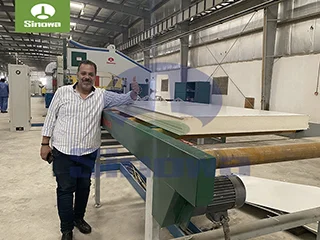
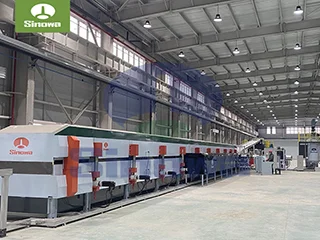
sandwich panel machine
The overall structural design of the clean room sandwich panel machine follows streamlined production logic, combining multiple independent functional units into an integrated production line to realize automated uninterrupted processing from raw material input to finished product output. The entire production system mainly includes raw material unwinding units, surface material pretreatment mechanisms, automatic gluing systems, core material laying devices, composite pressing modules, constant temperature curing structures, precision cutting components, and finished product conveying platforms. Each functional unit is connected through intelligent transmission structures, realizing synchronous operation and parameter linkage. In the mechanical layout design, manufacturers prioritize compact spatial arrangement to reduce floor occupation while reserving reasonable heat dissipation and maintenance space for key operating components, effectively improving the utilization rate of factory production space. The main frame of the machine adopts high-strength metal structural parts processed by integral casting and precision cutting, which effectively resist vibration displacement during high-speed operation, maintain long-term structural stability, and lay a solid foundation for consistent product dimensional accuracy.
Raw material pretreatment constitutes the initial and critical processing stage in the entire production workflow. Metal coiled materials commonly used as panel surface layers are installed on the unwinding mechanism, which is equipped with adjustable tension control devices to ensure uniform release of coiled materials without wrinkles or tensile deformation. Before formal molding, the surface pretreatment unit carries out impurity removal and surface modification on the inner side of the metal panel. This process eliminates oil stains, floating dust, and moisture attached to the material surface, and changes the physical flatness of the material surface through micro-treatment technology, enhancing the adhesion between the surface material and the intermediate core layer. For non-metal surface materials such as magnesium oxide plates used in special clean environments, the pretreatment mechanism completes surface polishing and edge trimming to remove burrs and uneven structures, ensuring the flatness and regularity of subsequent composite assembly. The entire pretreatment process adopts non-destructive processing methods to avoid damaging the protective coating on the outer surface of the panel, thereby maintaining the corrosion resistance and aesthetic performance of the finished panel.
Gluing technology is one of the core technologies of the clean room sandwich panel machine, directly affecting the bonding firmness and service life of composite panels. The automated gluing system is equipped with high-precision glue supply pumps and evenly arranged glue spraying ports, which can quantitatively and uniformly apply environmentally friendly adhesives to the bonding surfaces of surface materials and core materials. The machine can automatically adjust glue application amount and coating density according to different material textures and panel thickness specifications, avoiding quality defects such as glue accumulation, missing coating, and uneven bonding. In order to adapt to the low-carbon and environmental protection production requirements of modern clean materials, the gluing module supports the use of low-volatile and non-toxic adhesive raw materials. During the gluing process, the system maintains constant temperature and humidity in the gluing area to ensure the chemical activity of the adhesive, accelerate the initial bonding reaction between materials, and prevent degumming and layering of panels caused by insufficient glue curing in the later stage. Meanwhile, the closed gluing structure effectively reduces the volatilization of adhesive components, improving the safety of the production operating environment.
The core material laying and composite pressing processes determine the internal structural uniformity and overall mechanical properties of clean room panels. Common core materials for clean room panels include rock wool, aluminum honeycomb, and glass magnesium materials, all of which require even and gap-free laying inside the panels. The core material laying device of the machine adopts distributed feeding and leveling structures, which scatter and arrange bulk core materials in an orderly manner, eliminating hollow areas and stacking defects inside the core layer. After the completion of core material laying, the upper and lower surface materials and the intermediate core layer enter the pressing module together. The pressing unit is composed of multi-group parallel pressure rollers, with adjustable pressure values and roller spacing. It applies uniform vertical pressure to the composite materials to realize tight fitting between layers. The gradual pressing mode is adopted in the pressing process to avoid internal structural damage caused by instantaneous excessive pressure on fragile core materials. In addition, the pressure roller surface is treated with anti-sticking and wear-resistant processing to prevent adhesive residue from affecting subsequent pressing accuracy and ensure the smoothness of the outer surface of the panel.
Constant temperature curing is an essential link to stabilize the bonding performance of composite panels. The curing system of the clean room sandwich panel line builds an enclosed constant temperature space, which adjusts the internal temperature and humidity according to the curing characteristics of different adhesives and core materials. In the curing stage, the composite semi-finished panels move at a constant speed with the conveying structure, completing molecular stabilization reactions of adhesives in a mild temperature environment. Reasonable temperature control can accelerate the solidification of the adhesive, enhance the bonding strength between layers, and avoid panel deformation caused by rapid temperature changes. For panels with special fireproof and thermal insulation requirements, the curing time and temperature parameters will be appropriately optimized to improve the structural compactness of the core layer and enhance the overall fire resistance and heat preservation performance of the panels. The internal circulating air design of the curing chamber ensures uniform temperature distribution in all areas, eliminating inconsistent curing quality caused by local temperature differences.
The precision cutting system undertakes the final shaping processing of finished panels. After curing and shaping, the continuous composite plates are transported to the cutting area, and the intelligent control system automatically completes fixed-length cutting according to preset size parameters. The cutting components adopt high-speed rotating cutting tools made of wear-resistant alloy materials, which realize smooth cutting of metal and composite mixed structures. During the cutting process, the equipment is equipped with dust removal and debris collection devices to reduce particle splashing, keeping the production environment clean and meeting the basic production standards of clean material processing. In addition to fixed-length cutting, the cutting module can also complete edge trimming and groove opening treatments on panel edges according to usage requirements. The processed panel edges have flat sections without burrs, which facilitates seamless assembly and installation in the later clean room construction process. The cutting system has high dimensional control accuracy, effectively controlling the length error of finished products within a tiny range to meet the high-precision assembly requirements of clean space engineering.
In terms of intelligent control, modern clean room sandwich panel production line adopts integrated digital control systems. The operating parameters of each functional module are uniformly controlled by the central control panel, realizing one-click setting of production specifications such as panel thickness, length, and gluing amount. The system has real-time monitoring functions for operating data, which can track the operating status of key components such as motors, pressure rollers, and glue pumps in real time. Once abnormal parameters such as excessive vibration and uneven glue discharge occur, the system will automatically trigger prompt feedback and perform intelligent adjustment. The human-computer interaction interface is designed with simple and intuitive operation logic, which reduces the difficulty of equipment operation and shortens the training cycle for operators. Meanwhile, the control system supports parameter storage and one-key recall, enabling rapid switching between different production specifications and improving the flexible production capacity of the equipment for diversified panel products.
Compared with traditional manual and semi-automatic panel production equipment, clean room sandwich panel machines have prominent advantages in production efficiency and product quality consistency. The continuous assembly line production mode eliminates intermediate handling and waiting links between processes, greatly shortening the single-panel forming cycle. The fully enclosed production structure reduces external environmental interference on materials, avoiding quality fluctuations caused by manual operation errors. The panels produced by this type of machine have uniform surface flatness, consistent internal density, and stable bonding performance. Moreover, the panel has good airtightness after assembly, which can effectively block the penetration of external dust and bacteria, perfectly adapting to the strict environmental purification standards of clean rooms. In terms of production loss, the precise feeding and cutting design of the equipment reduces the waste of raw materials, improving the comprehensive utilization rate of production materials.
Clean room sandwich panels produced by professional machines are widely used in multiple high-standard purification industries. In the pharmaceutical production industry, such panels are used to build sterile production workshops, relying on their smooth non-dusting surface and antibacterial properties to ensure the purity of pharmaceutical production environments. In the electronic manufacturing industry, the anti-static and dust-proof characteristics of the panels meet the production requirements of precision electronic components, avoiding product damage caused by particle contamination. In addition, biological laboratories, food processing workshops, and medical and health institutions also use these composite panels in large quantities to build safe and controllable clean spaces. With the iterative upgrading of industrial construction modes, the assembled clean room construction method has gradually become mainstream. The standardized panels produced by automated machines can realize rapid on-site assembly, shortening the construction cycle of clean rooms and reducing on-site construction pollution, which is in line with the development trend of green industrial construction.
Daily maintenance and scientific operation are crucial to prolonging the service life of clean room sandwich panel machines. In daily production, operators need to regularly clean residual adhesives and material debris on the surface of pressure rollers, cutting tools, and conveying structures to prevent hard attachments from affecting processing accuracy. The transmission parts such as gears and bearings should be regularly supplemented with lubricating oil to reduce mechanical wear and operating noise. The sealing components of the curing chamber and gluing system need regular inspection and replacement to maintain the stability of internal temperature and glue supply pressure. In addition, the electrical control system should be regularly dust-proof and moisture-proof maintained to avoid circuit failures caused by humid environment and dust accumulation. Reasonable maintenance plans can not only keep the equipment in an efficient operating state for a long time but also reduce the failure rate and maintenance cost in the later stage of the equipment.
From the perspective of industrial development trends, the clean room sandwich panel machinery industry is constantly evolving towards intelligence, energy saving, and diversification. With the improvement of industrial environmental protection standards, the equipment will further optimize the gluing system and heating structure, adopting lower energy consumption and more environmentally friendly processing technologies to reduce production energy consumption and pollutant emissions. In terms of functional expansion, future equipment will strengthen the customized production capacity of special-shaped panels, realizing integrated processing of curved panels and special-sized structural panels to meet the personalized construction needs of complex clean space engineering. The intelligent linkage technology between multiple devices will also be further optimized to build a fully automated unmanned production workshop, realizing intelligent management of the entire process from raw material warehousing to finished product storage. Driven by technological innovation, clean room sandwich panel machines will continuously improve production sophistication and product adaptability, providing more reliable material processing guarantees for the upgrading of the global clean room engineering industry.
In conclusion, the clean room sandwich panel machine, as special composite material processing equipment integrating multiple advanced technologies, plays an irreplaceable core role in the clean room construction industry. Through scientific mechanical structure design, precise process control, and efficient production logic, this equipment stably outputs high-performance composite panels that meet purification standards. It not only optimizes the production mode of clean room building materials and improves the comprehensive quality of panels but also promotes the standardized and assembled development of clean space construction engineering. With the continuous growth of market demand for high-standard clean environments in various industries, the technological innovation and application promotion of clean room sandwich panel machines will further accelerate, continuously inject new impetus into the upgrading of the industrial manufacturing level, and create a safer, cleaner, and more stable production and experimental space for all walks of life.
https://www.cnsinowa.com/sandwich-panel-machines/clean-room-sandwich-panel-machine.html