 sandwich panel line
Raw material preparation and surface pretreatment constitute the initial and foundational stage of the entire production workflow, directly determining the surface quality and structural durability of finished cleanroom panels. The primary raw materials involved include metal facing sheets with smooth and non-dusting properties and two-component polyurethane foam raw materials, along with a series of auxiliary additives that regulate foaming density and structural stability. Before formal production, all raw materials undergo strict pre-production inspection and environmental adaptation treatment. Metal coiled materials, as the outer protective layer of sandwich panels, require multi-stage surface pretreatment processes to remove oil stains, oxide layers, and residual particles generated during rolling and transportation. Degreasing, passivation, and high-pressure cleaning procedures are implemented sequentially, followed by constant-temperature drying treatment to ensure the surface is completely dry and free of any residual contaminants. This rigorous pretreatment is indispensable for cleanroom applications, as any tiny residual particles or chemical residues on the panel surface may become potential pollution sources, triggering particle accumulation or microbial growth in the sealed and highly clean controlled environment. Meanwhile, polyurethane raw materials are stored in constant-temperature sealed storage tanks to maintain stable chemical activity, avoiding performance fluctuations caused by temperature and humidity changes that could affect foaming uniformity and bonding strength.
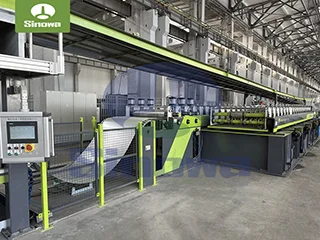
The unwinding and tension control system serves as the starting point of automated continuous production, achieving stable and orderly feeding of upper and lower metal facing materials. Equipped with dual-station unwinding structures, the system supports uninterrupted material switching during continuous production, effectively avoiding production shutdowns caused by raw material replacement and improving overall production continuity. The core advantage of this unit lies in its high-precision tension control and automatic correction functions. In the high-speed continuous feeding process, inconsistent tension can easily lead to material wrinkling, deviation, or uneven stress, resulting in defective panel surfaces and inconsistent overall dimensions. The real-time tension monitoring and adjustment mechanism maintains a constant feeding state of the metal sheet, while the automatic deviation correction device precisely calibrates the material feeding trajectory, ensuring that the upper and lower facing materials remain completely aligned in the horizontal direction throughout the operation process. This stable feeding foundation lays a reliable prerequisite for subsequent foaming, compounding, and forming processes, guaranteeing the flatness and dimensional accuracy of the final composite panels.
Roll forming and surface fine treatment processes shape the flat metal sheets into standardized structural profiles suitable for cleanroom assembly. Cleanroom sandwich panels require precise edge structures and flat surface characteristics to achieve tight splicing and seamless assembly in on-site construction, preventing air leakage and dust accumulation at splicing gaps. The roll forming unit is composed of multiple groups of precision forming stations, which gradually shape the metal sheet through orderly rolling without damaging the surface coating and substrate structure. The step-by-step forming mode avoids structural stress concentration caused by one-time stamping, effectively enhancing the flatness and structural stability of the panel surface. After forming, the panels undergo secondary surface fine cleaning and smoothing treatment to remove tiny burrs and floating particles generated during rolling, further optimizing the surface finish. The overall forming process is highly adaptable, capable of adjusting forming specifications according to different cleanroom design requirements to produce panels with varying thicknesses and edge structures, meeting the diverse assembly needs of wall panels, ceiling panels, and partition panels in different cleanroom grades.
Polyurethane high-precision mixing and pouring is the core process that determines the thermal insulation performance and structural firmness of sandwich panels. Polyurethane foam, as the core filling material of cleanroom panels, undertakes key functions such as heat insulation, sound absorption, and structural support. Its foaming uniformity, density consistency, and bonding strength with metal sheets directly affect the comprehensive performance of finished panels. The polyurethane sandwich panel production line adopts a fully automatic proportional mixing system to precisely control the mixing ratio of polyol, isocyanate, and functional additives. Different from ordinary civil insulation panels, cleanroom-specific polyurethane foam requires finer and more uniform foam pores, lower water absorption, and higher structural compactness to prevent moisture penetration and microbial breeding in long-term sealed use. The high-pressure mixing equipment achieves instantaneous and uniform mixing of multi-component raw materials through high-speed stirring, eliminating local uneven mixing and material agglomeration. The mixed foam raw materials are evenly poured onto the surface of the lower metal sheet through a precision pouring nozzle, with the pouring range and flow rate automatically adjusted according to panel width and thickness specifications, ensuring full coverage of the composite area without overflow or missing filling.
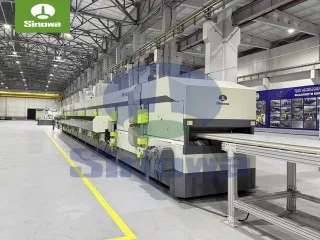
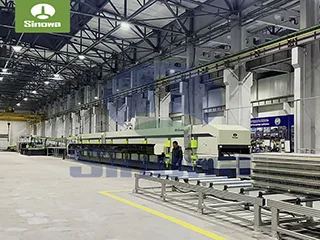
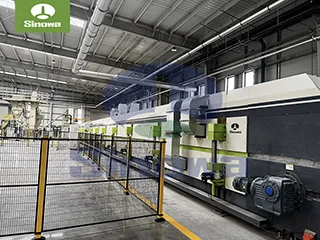
Laminating, pressure forming and constant-temperature curing processes realize the integral composite molding of metal facing and polyurethane foam core. After the foam raw materials are poured, the upper and lower formed metal sheets enter the double-belt laminating unit synchronously, and the foam layer is wrapped and pressed between the two layers of metal sheets. The laminating unit maintains stable and uniform pressure throughout the operation process, avoiding local excessive pressure leading to foam compression deformation or insufficient pressure causing poor bonding and hollow core problems. The closed double-belt conveying structure ensures that the panel remains flat and stress-balanced during the composite forming process. Subsequently, the semi-finished panels enter the gradient constant-temperature curing zone to complete foam foaming, curing and molecular structure stabilization. The curing process adopts staged temperature control, starting from a moderate temperature to promote full foaming of the polyurethane material, then gradually cooling to room temperature to realize stable shaping. This gradient curing mode effectively releases internal stress generated during foaming and compounding, preventing panel deformation, warping and cracking in subsequent use. After complete curing, the foam core forms a compact and uniform porous structure, achieving tight integration with the metal sheet, forming an integral composite structure with high bonding strength and overall rigidity.
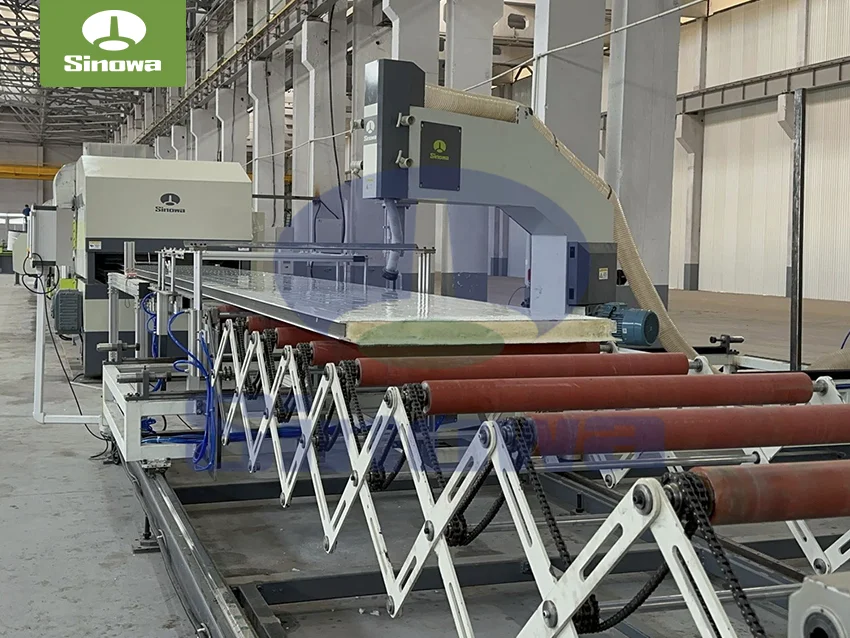
Fixed-length cutting and edge finishing processes complete the dimensional shaping and appearance optimization of finished panels. The PU sandwich panel production line is equipped with a high-precision flying saw cutting system, which supports dynamic cutting during continuous panel operation without stopping the production line. The servo control system precisely controls the cutting length and angle, ensuring the squareness and dimensional tolerance of each panel meet the strict standards of cleanroom engineering. Cleanroom panels have extremely high requirements for edge flatness and precision, as tiny dimensional deviations may lead to gaps in on-site assembly, affecting the airtightness and dust-proof effect of the cleanroom. After cutting, the panels enter the edge finishing unit to remove cutting burrs, smooth sharp edges, and conduct fine sealing treatment on the section. The edge sealing treatment can effectively block the tiny pores on the section of the polyurethane core layer, preventing moisture, dust and bacteria from entering the core layer, avoiding core layer dampness, mildew and structural aging, and greatly extending the service life of the panels in long-term sterile and humid environments.
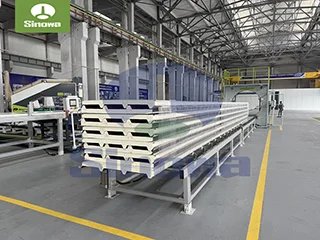
Surface protection, quality inspection and automatic stacking are the final links of the entire production process, ensuring the delivery quality and transportation safety of finished products. After finishing, the surface of the panel is covered with a protective film to prevent surface scratches, dust adhesion and coating damage during transportation and handling. The online quality inspection system conducts comprehensive detection of panel surface flatness, bonding integrity, dimensional accuracy and surface cleanliness, automatically screening out unqualified products and isolating defective materials to prevent unqualified products from entering the finished product link. Qualified finished panels are transported to the automatic stacking unit, which realizes automatic alignment, turnover and stacking according to set specifications. The intelligent stacking mode ensures neat placement of panels, uniform spacing between layers, no extrusion deformation, and facilitates subsequent packaging, transportation and warehouse management. The entire post-processing process is highly automated, reducing manual contact with the panel surface, effectively avoiding secondary pollution and surface damage caused by manual operation, and maintaining the high cleanliness state of cleanroom panels.
The overall structural design and operational characteristics of the cleanroom PU sandwich panel line endow it with outstanding advantages in the production of high-standard cleanroom special materials. The fully automated integrated production mode realizes seamless connection of all processes from raw material feeding to finished product warehousing, greatly improving production efficiency while maintaining stable and consistent product quality. The precise process control system can accurately adjust key parameters such as foaming density, composite pressure, curing temperature and production speed according to different usage scenarios, realizing flexible production of multi-specification panels. Compared with intermittent production equipment, the continuous production line has higher production uniformity, and the physical properties such as thermal insulation coefficient, structural strength and surface flatness of each batch of panels are highly consistent, which is crucial for the overall construction quality control of large-scale cleanroom projects.
In terms of product performance control, the polyurethane sandwich panel line focuses on the core needs of cleanroom environments for anti-dust, anti-bacterial, heat insulation and airtightness. The optimized polyurethane foaming process makes the core layer structure more compact, with excellent thermal insulation and moisture resistance, which can effectively reduce the energy consumption of cleanroom constant-temperature and constant-humidity equipment. The smooth and seamless panel surface formed by precision rolling and finishing treatment has no dust dead corners, is easy to clean and disinfect daily, and can resist the adhesion and growth of microorganisms, adapting to the long-term sterile and dust-free operation requirements of pharmaceutical, medical, electronic and biochemical industries. At the same time, the integral composite structure formed by high-strength bonding has good wind resistance, pressure resistance and structural stability, which can adapt to the positive and negative pressure environment of cleanrooms and avoid structural deformation and air leakage caused by environmental pressure changes.
In practical industrial applications, the cleanroom PU sandwich panel machine has become the core equipment for supporting the construction of modern high-standard clean spaces. With the continuous upgrading of industrial manufacturing standards and the increasingly strict environmental control requirements of biological and medical fields, the performance requirements for cleanroom panels are constantly improving. This professional production line can continuously optimize production processes and product performance through parameter adjustment and process upgrading, meeting the iterative upgrading needs of cleanroom engineering. The panels produced by the line are widely used in various closed controlled environment spaces, providing stable and reliable basic building materials for ensuring product production purity, experimental environment accuracy and medical operation safety.
The systematic and standardized production mode of the polyurethane sandwich panel machine also provides strong support for the standardized construction of cleanroom engineering. Traditional manual or semi-automatic panel production methods have problems such as unstable product quality, inconsistent specifications and low production efficiency, which are difficult to meet the batch and high-quality construction needs of large cleanroom projects. The integrated automatic production line realizes standardized and batch production of cleanroom panels, with stable product performance, unified specifications and high surface finish, which can effectively improve the assembly efficiency and overall construction quality of cleanroom projects. In addition, the low-pollution production process of the entire line avoids the generation of dust and harmful residues during production, and the finished panels have no volatile harmful substances, meeting the environmental protection and sterile use requirements of high-end clean environments.
In summary, the cleanroom PU sandwich panel continuous production line is a highly integrated and intelligent professional manufacturing system integrating precision mechanical transmission, automatic parameter control, material science and process optimization. Through standardized and precise control of every link from raw material pretreatment to finished product warehousing, it ensures that the produced sandwich panels have excellent surface cleanliness, stable structural performance, superior thermal insulation and good assembly adaptability. As an indispensable core equipment in the field of cleanroom supporting manufacturing, it not only improves the industrial production efficiency of cleanroom special panels, but also provides a solid quality guarantee for the safe, stable and long-term operation of various high-standard controlled environment spaces, and plays an important supporting role in the standardized development and quality upgrading of modern cleanroom engineering construction.
https://www.cnsinowa.com/sandwich-panel-machines/cleanroom-pu-sandwich-panel-line.html