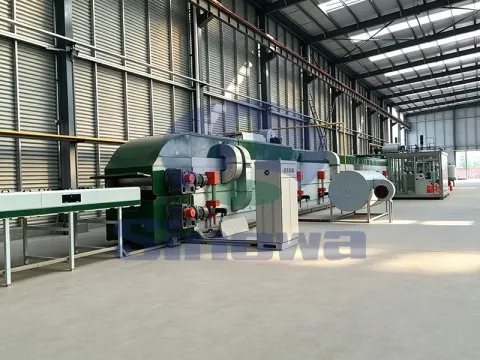
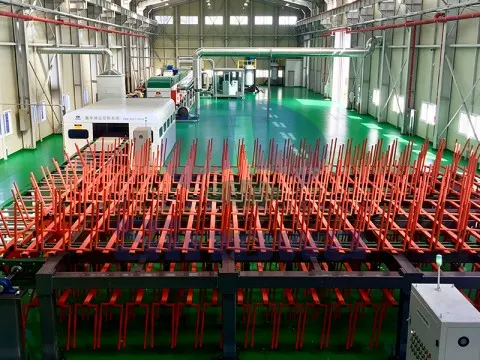
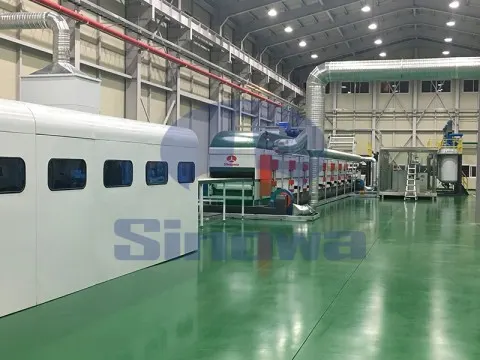
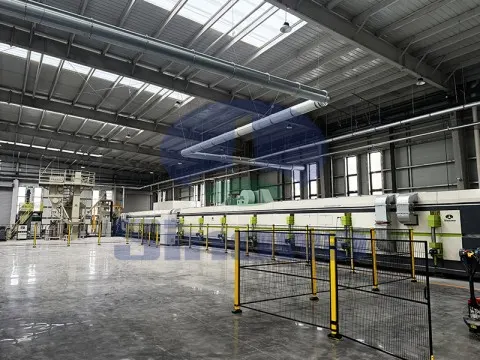
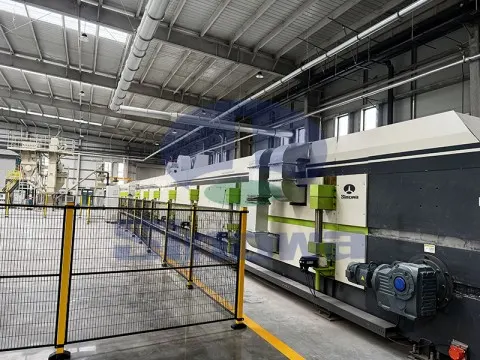
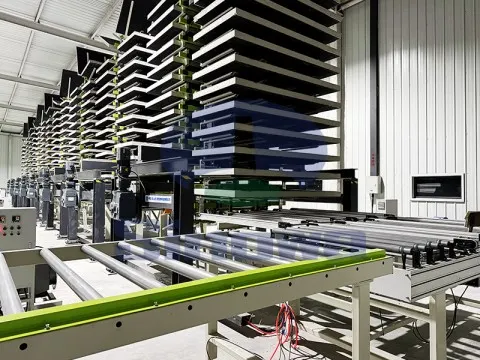
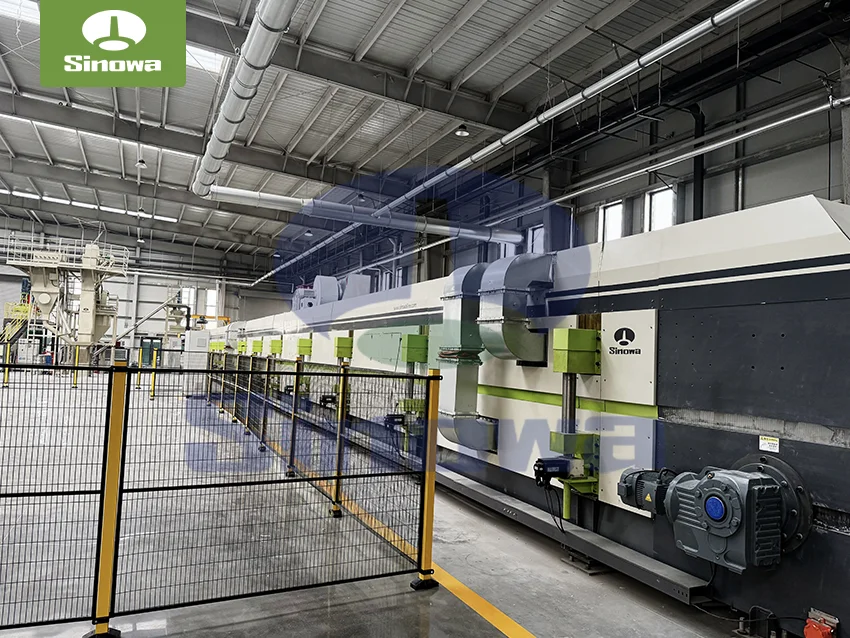
 sandwich panel line
The structural performance of insulation boards produced by professional production lines is the fundamental core that distinguishes high-quality building thermal insulation materials from ordinary low-performance insulation products, and all structural performance indicators are closely related to the mechanical design and process parameter setting of each station in the production line. The first core structural performance is overall compressive bearing capacity, which is a key indicator to ensure that insulation boards will not be deformed, crushed or structurally damaged under long-term static load and occasional dynamic load after being installed in building structures such as building roofs, floor foundations and wall bottoms. The production line realizes the uniform distribution of internal cell structure and stable bonding density of raw materials through precise foaming control, layered compaction treatment and continuous pressure maintaining forming process. For insulation boards used in building foundation and ground bearing parts, the production line will appropriately adjust the compaction pressure and material curing time in the forming process, so that the finished boards can maintain stable structural shape under long-term soil pressure, building dead weight and pedestrian and equipment rolling pressure, avoiding structural collapse or local depression that affects the overall stability of the building base. The second important structural performance is bending resistance and impact resistance, which is mainly reflected in the structural stability of insulation boards in exterior wall laying, facade insulation and building edge protection parts that are easily affected by external natural forces and construction collision extrusion. The production line can add built-in flexible reinforcing structures or carry out integral laminated reinforcement treatment in the board forming stage, effectively dispersing external bending stress and impact force borne by the boards, preventing cracking, fracture and surface damage of insulation boards during construction installation and long-term external wind and rain erosion, and maintaining the integrity of thermal insulation structure and building exterior decoration effect for a long time.
Interlayer bonding firmness is another indispensable key structural performance of construction insulation boards, and it is also a core technical advantage realized by fine process control of modern insulation board production lines. Most composite insulation boards are composed of internal thermal insulation core material and external protective surface material, and the bonding strength between different material layers directly determines the long-term service life and structural safety of the boards. Traditional simple processing equipment often leads to insufficient interlayer bonding tightness due to uneven glue coating and inconsistent pressing time, resulting in delamination, peeling and hollowing of insulation boards after long-term use, which not only reduces the thermal insulation effect, but also brings hidden dangers to building structural safety. The advanced construction insulation board production line adopts automatic uniform gluing technology and integrated hot pressing composite forming process, which makes the core material and surface material form a tight integrated bonding structure at the molecular level in the production process, effectively resisting the influence of external temperature difference change, humidity erosion and structural slight vibration on the interlayer bonding state. This stable interlayer structural performance ensures that the insulation board will not produce relative displacement and separation between layers in the face of seasonal temperature alternation and building structural slight settlement deformation, always maintaining the overall structural integrity and continuous and stable thermal insulation function, and greatly reducing the later maintenance and replacement frequency of building insulation engineering.
Structural dimensional stability and deformation resistance under temperature and humidity changes are also important structural performances carefully controlled in the production and forming process of construction insulation board production lines. Buildings are always in a natural environment with alternating high and low temperatures and changing air humidity throughout the year, and ordinary insulation materials are prone to thermal expansion and cold contraction shrinkage and moisture absorption expansion deformation, leading to structural warping, edge curling and splicing gap enlargement of insulation boards, which seriously affects the overall thermal insulation sealing effect and building exterior wall decoration flatness. The professional production line optimizes the raw material ratio and constant temperature curing process in the production link, so that the internal structural stress of the finished insulation board is fully released in the production stage, and the internal organizational structure tends to be stable and balanced. The finished boards produced by this process have extremely low thermal and cold shrinkage deformation coefficient and low moisture absorption expansion rate, can maintain stable geometric size and flat structural shape in both high-temperature summer and low-temperature winter environments, will not produce obvious structural deformation due to environmental changes, ensure the tight splicing and seamless fitting between boards in construction installation, avoid thermal bridge generation and heat loss caused by splicing gaps, and maintain the long-term stability of building energy-saving insulation effect.
According to different raw material formulas, internal structural forming modes and production process configurations on the production line, construction insulation boards can be divided into several core structural types with distinct performance characteristics and targeted application directions, each of which is produced by special customized production line process flow and structural forming system to meet the differentiated structural stress and thermal insulation needs of different construction scenarios. The first major category is foamed closed-cell structural insulation boards, which are formed by continuous mixing, high-pressure foaming, integral extrusion forming and fixed-size cutting through the production line, with a continuous and dense closed-cell internal porous structure inside the boards. In the production process of this type of insulation board, the production line strictly controls the foaming ratio and cell uniformity, so that the internal closed-cell structure is evenly distributed without gaps and through holes, endowing the boards with excellent low thermal conductivity, good waterproof and moisture-proof performance and high compressive structural strength. The closed-cell structural design makes this kind of insulation board not affected by humid environment and groundwater moisture erosion, and the internal porous structure can effectively lock static air to block heat conduction and heat convection, achieving efficient thermal insulation and heat preservation effect. At the same time, the integral extrusion forming structure makes the board have good overall structural integrity, not easy to break and deform, suitable for building parts with high requirements for moisture resistance, compression resistance and thermal insulation efficiency, and is one of the most widely used insulation board types in modern building energy-saving engineering.
The second main type is fiber reinforced loose composite structural insulation boards, which take natural mineral fiber or inorganic fiber as the main internal thermal insulation core raw material, and complete fiber melting, fiberization paving, layered needling reinforcement and integral pressing forming through the production line to form a fiber interwoven loose porous internal structure. The production line of this kind of insulation board focuses on the uniform paving and internal reinforcement treatment of fiber materials, forming a three-dimensional interwoven fiber network structure inside the board, which gives the board excellent high-temperature resistance performance and flame retardant structural characteristics, and will not burn or deform rapidly in case of open fire and high temperature baking. The fiber interwoven loose structure also makes the board have good sound absorption and noise reduction structural performance, which can effectively isolate external noise transmission and improve the indoor acoustic environment of buildings. Although the compressive strength of fiber reinforced composite insulation boards is slightly lower than that of closed-cell foamed boards, their high-temperature structural stability and non-combustible characteristics are irreplaceable, so they are mainly used in building parts with high fire protection requirements and high-temperature thermal insulation needs, providing dual protection for building fire safety and thermal insulation energy saving.
The third category is sandwich composite reinforced structural insulation boards, which adopt a three-layer composite structural design of upper and lower protective surface layers and middle thermal insulation core layer, and complete automatic surface layer fitting, core material filling, integral hot pressing bonding and edge sealing reinforcement through the special composite lamination process of the production line. In the production process, the production line precisely aligns the surface layer and core material, and carries out integral reinforcement treatment on the edge and overall structure of the board, so that the surface layer and core material are tightly combined to form an integrated force-bearing and thermal insulation structure. The surface layer of the sandwich composite board has high hardness and wear resistance structural characteristics, which can resist external impact, scratch and weathering erosion, while the middle core layer undertakes the main thermal insulation and heat preservation function, and the overall composite structure has both high mechanical structural strength and excellent thermal insulation performance. This kind of insulation board has balanced comprehensive structural performance, not only meeting the building thermal insulation needs, but also having good external protection and structural collision resistance, and can be directly used as thermal insulation and decoration integrated structural board for building exterior walls, simplifying the subsequent construction process and improving the overall construction efficiency of building insulation engineering.
The fourth type is thin-layer lightweight structural insulation boards, which are produced by the production line through low-density raw material ratio, micro-foaming forming and thin-layer rapid curing process, with thin board thickness and light overall weight, and the internal structure is fine and uniform lightweight porous structure. The production line of this kind of insulation board focuses on lightweight forming and thin-layer dimensional precision control, ensuring that the board has low overall density while maintaining basic structural strength, and will not bring excessive dead weight load to the building main structure after installation. The thin-layer lightweight structural design makes this kind of insulation board easy to cut, transport and construct and install, with low requirements for building bearing capacity, suitable for light-weight building structures, interior partition walls and indoor local thermal insulation parts. Although the compressive bearing capacity and thermal insulation thickness of thin-layer lightweight insulation boards are limited, their flexible construction adaptability and light structural advantages make them play an important role in indoor fine thermal insulation and old building energy-saving renovation projects.
Different types of insulation boards produced by construction insulation board production lines have clear and targeted practical application ranges in modern construction engineering, municipal infrastructure construction and industrial supporting engineering, and the matching between board structural performance and engineering application scenarios is the core principle to ensure the long-term stable operation of building thermal insulation systems. Closed-cell foamed structural insulation boards with high compression resistance and moisture resistance are widely used in building foundation insulation, floor heating base insulation, roof waterproof and thermal insulation integrated layers and underground municipal pipeline insulation protection projects. In building foundation engineering, this kind of insulation board can isolate the temperature exchange between the ground soil and the building interior, prevent the building foundation from being damaged by frost heave and temperature difference deformation, and stabilize the structural stress state of the building base. In floor heating projects, its high compressive structural performance can bear the pressure of floor pavement and indoor furniture and personnel activities, without deformation and damage while ensuring the upward uniform heat transfer of floor heating, improving the utilization efficiency of heating energy. In roof and underground pipeline engineering, excellent waterproof and moisture-proof structural performance can avoid the decline of thermal insulation performance caused by moisture absorption and water inflow, and maintain long-term stable thermal insulation and structural protection effects in humid and underground harsh environments.
Fiber reinforced loose composite structural insulation boards with high-temperature resistance and flame retardant structural performance are mainly applied to high-rise building exterior wall fireproof thermal insulation layers, public building crowded space partition thermal insulation, industrial high-temperature equipment surrounding thermal insulation and building chimney and ventilation pipeline high-temperature thermal insulation protection parts. High-rise buildings and public crowded buildings have extremely high requirements for building fire safety, and the non-combustible structural characteristics of fiber insulation boards can effectively block the spread of fire in case of fire, avoid the rapid spread of flame along the building thermal insulation layer, and gain valuable escape time for personnel. For industrial high-temperature production workshops and high-temperature equipment thermal insulation projects, the high-temperature structural stability of fiber insulation boards can long-term resist the erosion of high-temperature heat radiation and hot air flow, without structural aging, deformation and failure due to long-term high-temperature action, and continuously maintain the thermal isolation effect between high-temperature equipment and the external environment, reduce industrial heat energy loss, and improve the safety of industrial production operation. At the same time, the sound absorption and noise reduction structure of fiber insulation boards can also reduce the noise pollution generated by industrial equipment operation and building internal and external noise interference, and improve the comfort of building and industrial operation environment.
Sandwich composite reinforced structural insulation boards with comprehensive balanced structural performance are mostly used in modern prefabricated building exterior wall enclosure structures, commercial building facade thermal insulation and decoration integration projects, cold storage and constant temperature warehouse enclosure thermal insulation structures and bridge and tunnel engineering internal thermal insulation protection. Prefabricated buildings have high requirements for building component integration and on-site rapid construction, and the sandwich composite insulation board integrates thermal insulation, decoration and structural protection functions, which can be directly installed as the exterior wall enclosure component of prefabricated buildings, reducing the on-site construction procedures of thermal insulation and decoration, shortening the overall construction cycle of the project. In cold storage and constant temperature warehouse engineering, the integrated composite structure can effectively block the internal and external temperature exchange of the warehouse, maintain the stable low-temperature or constant temperature environment inside the warehouse, reduce the operation energy consumption of refrigeration and constant temperature equipment, and improve the operation efficiency of cold chain logistics and storage engineering. In bridge and tunnel engineering, the high structural strength and weather resistance of sandwich composite boards can resist the erosion of natural wind, rain, frost and snow and long-term traffic vibration, protect the internal structure of bridges and tunnels from temperature deformation and structural aging, and extend the service life of municipal transportation infrastructure.
Thin-layer lightweight structural insulation boards are mainly used for interior wall partition thermal insulation of residential and commercial buildings, old building energy-saving renovation and thermal insulation upgrading, indoor ceiling local thermal insulation and small space independent thermal insulation decoration projects. Old building energy-saving renovation projects have strict restrictions on building structural load and construction space, and the lightweight structural characteristics of thin-layer insulation boards will not increase the extra load of the old building main structure, and the thin thickness will not occupy the indoor usable space, which is convenient for rapid construction and renovation. Indoor partition and ceiling thermal insulation only need basic thermal insulation and temperature adjustment functions, and the flexible cutting and convenient installation characteristics of thin-layer lightweight insulation boards can meet the thermal insulation needs of different indoor local spaces, improve the indoor living and office comfort, and realize the low-cost and high-efficiency energy-saving thermal insulation transformation of buildings. With the continuous development of green building concepts and building energy-saving policies, thin-layer lightweight insulation boards are also increasingly used in low-rise residential buildings and rural building thermal insulation renovation projects, promoting the comprehensive popularization of building energy-saving thermal insulation technology.
In the overall development of modern construction industry, the technological progress of construction insulation board production line always promotes the continuous optimization and upgrading of insulation board structural performance and structural types, and the diversified structural design and performance differentiation of insulation boards also expand the broader application space for building energy-saving and structural protection engineering. The production line realizes the precise control of the internal structure and external performance of insulation boards through the optimization of production technology and mechanical structure configuration, making each type of insulation board form unique structural advantages matching the application scenario, not only meeting the basic building thermal insulation and energy-saving needs, but also providing reliable structural safety and long-term durability protection for different types of construction and infrastructure projects. In the future, with the continuous improvement of building energy-saving standards and the continuous innovation of green building materials technology, construction insulation board production lines will further develop towards high efficiency, environmental protection and intelligent precision production, and the structural performance of produced insulation boards will be more optimized, the structural types will be more abundant, and the application fields will be more extensive, constantly providing solid basic support for the high-quality development of the construction industry and the realization of green and low-carbon building development goals.
Sinowa is a professional manufacturer of sandwich panel machine in china, we provide diversified and high-performance sandwich panel production lines, including fully automatic continuous PU sandwich panel line and customized special lines to meet mass production and personalized order demands. These sandwich panel lines support processing multiple foam core materials, such as PU, PIR, mineral wool, rock wool and glass wool, covering different insulation and fireproof standards.
Featuring stable operation, high efficiency, energy saving and easy maintenance, our PU sandwich panel line deliver sandwich panels with excellent thermal insulation, fire resistance, sound insulation and lightweight durability. The finished panels are widely applied in industrial workshops, warehouse roofing and wall cladding, cold storage insulation, serving global construction and industrial insulation markets.
https://www.cnsinowa.com/sandwich-panel-machines/construction-insulation-board-production-line.html