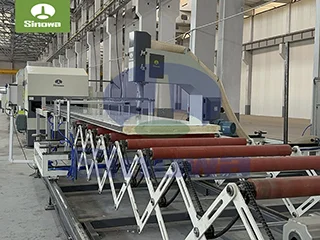
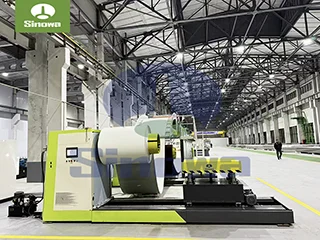
sandwich panel line
The structure of the PU sandwich panel making line with edge sealing machine is designed based on the principle of continuous composite processing, integrating multiple functional modules that cooperate with each other to complete the whole production process of PU sandwich panels. The core structure can be divided into several key parts, including the feeding system, core material foaming system, composite forming system, edge sealing system, cutting system, and auxiliary systems. The feeding system is responsible for the stable supply of surface materials and core material raw materials, and its design needs to adapt to different types of surface materials, such as metal sheets, FRP, CFRP, aluminum plates, plywood and stainless steel. The feeding mechanism usually adopts unwinding devices with tension control function to ensure that the surface materials are flat and free of wrinkles during the conveying process, which lays a foundation for the subsequent composite quality. For metal surface materials, the feeding system is often equipped with a leveling device to correct the deformation caused by storage or transportation, and a rib pressing device can be added according to needs to enhance the structural strength of the surface materials.
The core material foaming system is the key to determining the performance of PU sandwich panels, and it is mainly composed of material storage tanks, mixing devices, and foaming nozzles. The raw materials of PU foam, mainly polyether polyol and isocyanate, are transported to the mixing device through precise metering pumps, and are fully mixed with additives such as foaming agents, catalysts, foam stabilizers and flame retardants in a short time. The selection and proportion of additives directly affect the foaming effect and the final performance of the core material; for example, water can be used as a foaming agent, and composite catalysts composed of 2-ethyl-4-methylimidazole, 2,4,6-tris(dimethylaminomethyl)phenol and triethylenediamine can accelerate the foaming and curing speed. The foaming nozzles uniformly spray the mixed raw materials between the two layers of surface materials, and the raw materials undergo rapid chemical reaction and foaming to form a dense PU foam core. In order to improve the bonding firmness between the core material and the surface materials, some production lines will pre-treat the surface materials, such as corona treatment, to increase the surface roughness and surface energy.
The composite forming system is responsible for bonding the surface materials and the foamed core material into an integrated structure, which is usually composed of composite rollers and heating devices. The composite rollers apply uniform pressure to the surface materials and the core material to ensure that the two are closely bonded without gaps, while the heating devices control the temperature of the composite process within a reasonable range to promote the curing of the PU foam and improve the bonding strength. The pressure and temperature parameters of the composite forming system need to be adjusted according to the type of surface materials and the thickness of the core material to avoid problems such as insufficient bonding or surface material deformation. The edge sealing system is a unique and important part of this production line, which is used to seal the edges of the formed PU sandwich panels to solve the problems of easy moisture absorption, poor air tightness and insufficient structural stability of the panel edges. The edge sealing machine usually adopts the method of online continuous edge sealing, and the edge sealing material is usually PU-based adhesive, which has good compatibility with the PU core material and can form a tight seal with the surface materials. The edge sealing process includes edge trimming, adhesive coating, shaping and curing. First, the excess material on the edge of the panel is trimmed to ensure the flatness of the edge; then the PU-based adhesive is evenly coated on the edge; finally, the edge is shaped and cured to form a smooth and tight edge sealing layer. Some advanced edge sealing systems can also realize the integrated edge sealing of the panel's top, bottom and sides, further improving the overall sealing performance of the panel.
The cutting system is used to cut the continuous composite panels into finished products of specified length, which is composed of cutting tools, positioning devices and control systems. The cutting tools are usually circular saws or band saws, which can be selected according to the hardness of the surface materials and the thickness of the panels; the positioning devices ensure the accuracy of the cutting length, and the error is usually controlled within a small range to meet the requirements of engineering installation. The auxiliary systems include dust removal devices, waste recycling devices, and control systems. The dust removal devices collect the dust and waste generated during the cutting and edge trimming processes to ensure the cleanliness of the production environment and the health of operators; the waste recycling devices collect the excess surface materials and core material waste for secondary processing and utilization, which saves raw materials and reduces production costs; the control system is the "brain" of the entire production line, usually adopting PLC control, which can realize the automatic control of the entire production process, including parameter setting, operation monitoring, and fault alarm. The integrated control system centralizes all control points in the main control console, realizing parameter linkage and fault self-diagnosis, which improves the automation level of the production line and reduces the number of operators.
The performance of the PU sandwich panel making line with edge sealing machine directly determines the quality of the finished panels and the efficiency of production, and its core performance is reflected in automation, production stability, processing accuracy, and adaptability. Automation performance is an important advantage of modern production lines. Through the integrated control of each module, the production line can realize continuous operation from raw material feeding to finished product stacking, reducing manual intervention and improving production efficiency. The automatic control system can not only set and adjust production parameters according to needs but also monitor the operation status of each part in real time. Once a fault occurs, it can issue an alarm in time and stop the machine if necessary to avoid the production of a large number of unqualified products. The production stability is reflected in the consistency of the finished products. The precise metering of raw materials, the stable control of the foaming process, and the uniform pressure and temperature of the composite forming ensure that the thickness, density, bonding strength and edge sealing effect of each batch of panels are consistent, which meets the requirements of large-scale engineering applications.
Processing accuracy is another key performance indicator, which mainly includes the accuracy of the thickness and length of the panels, the flatness of the surface, and the tightness of the edge sealing. The thickness accuracy is controlled by the gap of the composite rollers and the metering accuracy of the foaming raw materials, and the error is usually within ±0.5mm; the length accuracy is guaranteed by the positioning device of the cutting system, which can meet the precise requirements of engineering installation; the surface flatness is ensured by the leveling device of the feeding system and the uniform pressure of the composite rollers, avoiding wrinkles and unevenness; the edge sealing tightness is determined by the edge sealing process and the performance of the edge sealing adhesive, which can effectively prevent moisture and air from entering the panel, ensuring the long-term use performance of the panel. The adaptability of the production line refers to its ability to produce different types, specifications and performance of PU sandwich panels. By adjusting the production parameters, replacing the feeding devices and cutting tools, the production line can produce panels with different surface materials, core material densities, thicknesses and lengths. For example, it can produce panels with core material density ranging from 28 to 50 kg/m³, thickness ranging from 10 to 150 mm, and width up to 3.2 m, which meets the needs of different application scenarios. In addition, some production lines can also produce PU sandwich panels and PU edge-sealed rock wool sandwich panels by replacing the core material feeding system, realizing the multi-purpose of one line.
The types of PU sandwich panel making lines with edge sealing machines can be divided according to different classification standards, and the common classification methods include classification by production capacity, classification by automation level, and classification by product type. According to the production capacity, it can be divided into small, medium and large production lines. Small production lines are suitable for small and medium-sized enterprises with small production demand, with a daily output of usually less than 500 square meters. They have the advantages of small floor area, low investment cost and flexible operation, but the automation level is relatively low, and manual intervention is required in some links. Medium-sized production lines have a daily output of 500 to 1500 square meters, with moderate automation level and production efficiency, which can meet the production demand of most enterprises and is the most widely used type in the market. Large production lines have a daily output of more than 1500 square meters, with high automation level, adopting full automatic control and intelligent monitoring, which can realize 24-hour continuous operation. They are suitable for large enterprises with large-scale production demand, and have the advantages of high production efficiency, stable product quality and low labor cost, but the investment cost and floor area are relatively large.
According to the automation level, it can be divided into semi-automatic and full-automatic production lines. Semi-automatic production lines need manual operation in some links, such as raw material feeding, finished product stacking and partial parameter adjustment. They have low investment cost and are suitable for enterprises with limited funds or small production scale. Full-automatic production lines realize the automatic operation of the whole process, from raw material unwinding, foaming, composite, edge sealing, cutting to finished product stacking and packaging, which is controlled by the computer system. They have high production efficiency, stable product quality and low labor intensity, but the investment cost is relatively high, and the requirements for operators' professional skills are higher. According to the type of products produced, it can be divided into special production lines for PU sandwich panels and multi-purpose production lines. Special production lines for PU sandwich panels are specially designed for the production of PU core sandwich panels, with high production efficiency and good product specificity. Multi-purpose production lines can not only produce PU sandwich panels but also produce sandwich panels with other core materials, such as rock wool and glass wool, by replacing the core material foaming system and adjusting the production parameters. They have strong adaptability and can meet the diversified production needs of enterprises. In addition, according to the structure of the edge sealing machine, it can also be divided into linear edge sealing production lines and multi-angle edge sealing production lines, which are suitable for the production of panels with different edge shapes.
The wide application of the PU sandwich panel making line with edge sealing machine is closely related to the excellent performance of the PU sandwich panels produced, and these panels are widely used in construction, cold chain logistics, industrial workshops, vehicle manufacturing and other fields. In the construction field, PU sandwich panels produced by this production line are widely used in external walls, internal partitions, roofs and other parts of buildings. Due to their excellent thermal insulation performance, light weight and high strength, they can reduce the energy consumption of buildings and improve the structural stability of buildings. The edge sealing treatment makes the panels have good waterproof and moisture-proof performance, which can adapt to different climate environments. For example, in the construction of residential buildings and commercial buildings, PU sandwich panels are used as external wall insulation materials, which can effectively reduce the energy consumption of air conditioning and heating, and meet the requirements of green and energy-saving buildings. In large public buildings such as airports, railway stations and stadiums, PU edge-sealed rock wool sandwich panels are often used, which have A-level fire resistance and good thermal insulation performance, meeting the strict fire safety requirements of public buildings.
In the field of cold chain logistics, PU sandwich panels are important materials for the construction of cold storage, walk-in freezers and refrigerated trucks. The PU foam core has extremely low thermal conductivity (only 0.022-0.033 W/(m·K)), which has excellent thermal insulation performance, and the edge sealing treatment further enhances the air tightness and waterproof performance of the panels, effectively reducing the energy consumption of refrigeration equipment and ensuring the stability of the internal temperature of the cold storage or refrigerated truck. The panels used in cold storage usually have thicker core materials and tighter edge sealing to meet the requirements of low-temperature storage. In addition, PU sandwich panels are also used in the construction of constant temperature and humidity workshops in food processing and pharmaceutical production, ensuring the stability of the production environment and meeting the hygiene and safety requirements of the industry.
In the field of industrial workshops, PU sandwich panels are widely used in the construction of workshop walls and roofs due to their light weight, high strength, corrosion resistance and sound insulation performance. For some workshops with special requirements, such as chemical workshops and automobile spraying workshops, panels with excellent corrosion resistance and fire resistance can be produced by selecting appropriate surface materials and core material additives, which adapt to the harsh production environment. The light weight of the panels can reduce the load of the workshop structure, and the quick installation feature can shorten the construction period of the workshop. In addition, the sound insulation performance of PU sandwich panels can also reduce the spread of noise in the workshop, improving the working environment of operators. In the field of vehicle manufacturing, PU sandwich panels are used in the production of vehicle bodies of RVs, buses and special vehicles. The light weight of the panels can reduce the fuel consumption of the vehicle, and the excellent shock absorption and sound insulation performance can improve the comfort of the vehicle. The edge sealing treatment ensures that the panels have good waterproof performance, adapting to the outdoor working environment of the vehicle.
In addition to the above fields, PU sandwich panels produced by the PU sandwich panel making line with edge sealing machine also have applications in some special fields, such as the construction of prefabricated buildings, temporary buildings and clean rooms. Prefabricated buildings have the advantages of quick installation, energy saving and environmental protection, and PU sandwich panels are important prefabricated components, which can realize the modular production and assembly of buildings. Temporary buildings such as construction site offices and dormitories often use PU sandwich panels due to their quick installation and disassembly, and good thermal insulation performance. Clean rooms require high air tightness and cleanliness of the building materials, and PU sandwich panels with smooth surfaces and tight edge sealing can meet the requirements, being widely used in the electronics, semiconductor and medical device industries.
With the continuous development of the construction industry and industrial manufacturing industry, the demand for energy-saving, environmental protection and high-performance building materials is increasing, which promotes the continuous upgrading and improvement of the PU sandwich panel making line with edge sealing machine. In the future, the production line will develop in the direction of higher automation, intelligence, energy saving and environmental protection. The intelligent control system will be more perfect, realizing the intelligent adjustment of production parameters and the predictive maintenance of equipment, further improving production efficiency and reducing maintenance costs. The optimization of the foaming process and the development of new additives will make the performance of PU sandwich panels more excellent, such as better fire resistance, lower thermal conductivity and longer service life. At the same time, the production line will pay more attention to energy saving and environmental protection, adopting more environmentally friendly foaming agents and production processes, reducing energy consumption and pollutant emissions, and meeting the requirements of green production. The improvement of the adaptability of the production line will also enable it to produce more types of composite panels, expanding the application scope of PU sandwich panels.
In conclusion, the PU sandwich panel making line with edge sealing machine is an integrated production equipment with reasonable structure, excellent performance and diverse types, which provides strong support for the mass production of high-performance PU sandwich panels. Its structure covers multiple functional modules, ensuring the continuity and stability of the production process; its excellent automation, production stability and processing accuracy ensure the quality of finished products; its diverse types can meet the production needs of different enterprises; and the wide application of the produced panels promotes the development of various fields such as construction, cold chain logistics and industrial manufacturing. With the continuous progress of technology, the PU sandwich panel making line with edge sealing machine will play a more important role in the future, contributing to the development of energy-saving and environmental protection industries.
https://www.cnsinowa.com/sandwich-panel-machines/pu-sandwich-panel-making-line-with-edge-sealing-machine.html