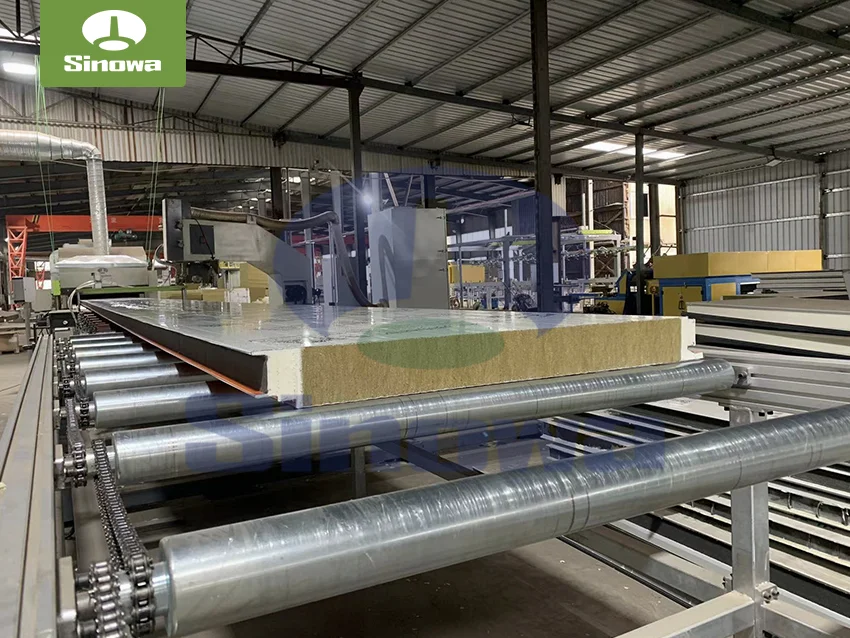
 sandwich panel line
The structure of a rockwool sandwich panel production line with a pre-heating device is designed to achieve seamless coordination between various functional modules, forming a continuous workflow that minimizes manual intervention and maximizes production stability. The entire line typically consists of several core components, each responsible for a specific stage of the manufacturing process. At the initial stage, the uncoiling system is used to feed the surface layer materials—usually metal coils such as galvanized steel or color-coated steel—into the production line smoothly. This system is equipped with tension control mechanisms to prevent material deformation during uncoiling, ensuring the flatness of the surface layers that directly affect the appearance and structural integrity of the final panels. Following the uncoiling system is the roll forming module, which shapes the surface layer materials into the desired profiles through a series of precision rollers. The profiles can be customized into corrugated, flat, or tiled structures based on application requirements, with the roll forming process designed to maintain consistent dimensions and shape accuracy.
The pre-heating device is positioned between the roll forming module and the bonding section, serving as a critical pre-treatment unit for the surface layers. Unlike traditional production lines that directly bond surface layers with the rockwool core, the addition of a pre-heating device ensures that the surface layers reach an optimal temperature before the bonding process. The pre-heating device usually adopts a combination of radiation and convection heating methods, with heating elements evenly distributed to achieve uniform temperature control. The structure of the pre-heating device includes an insulated chamber made of high-density thermal insulation materials to minimize heat loss, ensuring energy efficiency while maintaining stable heating performance. Temperature sensors and microprocessor-based control systems are integrated into the device to monitor and adjust the heating temperature in real time, allowing for precise control within a range typically between 30°C and 300°C depending on the material properties of the surface layers and the type of adhesive used. This precise temperature regulation prevents overheating or insufficient heating, both of which can compromise the bonding quality.
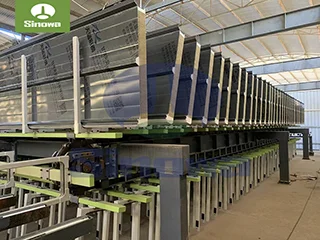
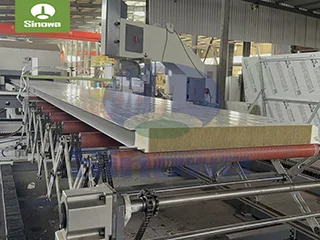
After pre-heating, the surface layers are conveyed to the bonding section, where the rockwool core is combined with the upper and lower surface layers. The rockwool feeding system ensures uniform distribution of the rockwool core material, with adjustable thickness settings to meet different insulation requirements. Adhesive spraying systems are installed above and below the rockwool core, applying a uniform layer of adhesive to ensure strong bonding between the core and surface layers. The pre-heated surface layers enhance the wettability and curing speed of the adhesive, promoting better adhesion and reducing the risk of delamination over time. Following the bonding process, the composite panel enters the double-belt pressing and heating system, which applies consistent pressure and maintains a stable temperature to facilitate full curing of the adhesive. This system uses heat-resistant belts to convey the panel while applying uniform pressure, ensuring that the panel maintains its shape and thickness throughout the curing process.
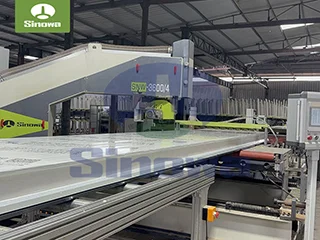
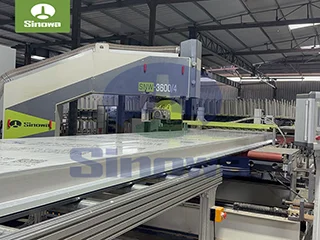
Subsequent to curing, the panel is transferred to the cutting module, which uses precision cutting tools such as band saws or milling cutters to trim the panel to the required length and width. The cutting process is synchronized with the production line speed to ensure smooth and accurate cuts, minimizing material waste. After cutting, the finished panels are conveyed to the stacking and packaging system, where they are automatically stacked in an orderly manner and packaged to protect them from damage during storage and transportation. The entire production line is controlled by a centralized electrical system, often utilizing programmable logic controllers (PLC) to coordinate the operation of all modules. This centralized control enables parameter linkage, fault self-diagnosis, and remote monitoring capabilities, significantly improving operational efficiency and reducing maintenance costs.
The performance of a rockwool sandwich panel production line with a pre-heating device is characterized by its efficiency, stability, precision, and energy-saving capabilities, all of which directly contribute to the quality of the finished panels. One of the key performance advantages is the improved bonding quality achieved through the pre-heating device. By pre-heating the surface layers, the adhesive can spread more evenly and cure faster, resulting in a stronger bond between the rockwool core and surface layers. This not only enhances the structural stability of the panels but also improves their resistance to moisture, temperature changes, and mechanical stress, extending the service life of the products. Additionally, the pre-heating process reduces the curing time required in the subsequent pressing stage, allowing for higher production line speeds—typically ranging from 2 to 6 meters per minute, with adjustable settings to accommodate different product specifications.
Precision control is another critical performance feature of this production line. The centralized PLC control system ensures that all modules operate in synchronization, maintaining consistent parameters such as temperature, pressure, and speed throughout the production process. This precision translates into uniform panel thickness, accurate dimensions, and consistent surface quality, reducing product defects and material waste. The modular design of the line also enhances its reliability and maintainability, as individual components can be inspected, maintained, or replaced without disrupting the entire production process. This modularity also allows for easy expansion or modification of the line to meet changing production needs, such as adding new profiles or increasing production capacity.
Energy efficiency is an increasingly important performance criterion in modern manufacturing, and the rockwool sandwich panel production line with a pre-heating device is designed to minimize energy consumption. The pre-heating device uses high-efficiency insulation materials to reduce heat loss, while the temperature control system ensures that only the required amount of heat is supplied. Additionally, the continuous production process eliminates the need for repeated heating and cooling cycles, further reducing energy waste. Many production lines also incorporate energy recovery systems, which capture and reuse waste heat from the pre-heating and curing stages, improving overall energy efficiency. This not only reduces operational costs but also aligns with global sustainability goals by minimizing carbon emissions.
The adaptability of the production line is another notable performance attribute. It can accommodate a wide range of raw material specifications, including different thicknesses of surface layer metals (typically 0.5 to 0.7 mm) and various types of rockwool cores. The line can also produce panels with different thicknesses (usually 30 to 50 mm) and widths, depending on customer requirements. This flexibility allows manufacturers to produce a diverse range of products for different applications without the need for extensive reconfiguration of the equipment. Furthermore, the line can be adapted to produce panels with different surface finishes, such as color-coated, galvanized, or aluminum foil surfaces, expanding its applicability across various industries.
Rockwool sandwich panel production lines with pre-heating devices can be categorized into different types based on several criteria, including production capacity, automation level, and product specialization. Based on production capacity, the lines are typically divided into small-scale, medium-scale, and large-scale models. Small-scale lines are suitable for manufacturers with low production requirements, often featuring semi-automatic operation and lower production speeds, making them ideal for small businesses or specialized production. Medium-scale lines balance production capacity and flexibility, offering fully automatic operation with moderate speeds, suitable for most medium-sized manufacturing enterprises. Large-scale lines are designed for high-volume production, with advanced automation systems, high-speed operation, and integrated quality control modules, catering to large-scale industrial manufacturers serving global markets.
Another classification criterion is the level of automation, which ranges from semi-automatic to fully automatic. Semi-automatic lines require some manual intervention, such as loading raw materials or adjusting parameters, while fully automatic lines integrate advanced robotics and intelligent control systems to realize unmanned operation from raw material feeding to finished product packaging. Fully automatic lines offer higher production efficiency, better product consistency, and reduced labor costs, making them the preferred choice for large-scale production. However, semi-automatic lines are more cost-effective for small-scale manufacturers or those with variable production requirements.
Product specialization is also a key factor in categorizing these production lines. Some lines are designed specifically for producing wall panels, featuring roll forming modules that create flat or corrugated profiles suitable for wall applications. Others are specialized in roof panels, with modules that produce tiled or multi-wave profiles to enhance water resistance and structural strength. There are also multi-purpose lines that can produce both wall and roof panels through simple configuration adjustments, offering greater flexibility for manufacturers. Additionally, some specialized lines are designed to produce fire-rated panels, incorporating advanced rockwool core materials and bonding technologies to meet strict fire safety standards.
The applications of rockwool sandwich panels produced by these lines are diverse, spanning the construction, industrial, and commercial sectors, driven by the panels’ excellent performance and the production line’s ability to deliver consistent quality. In the construction industry, rockwool sandwich panels are widely used for external walls, internal partitions, and roofs of industrial buildings, commercial complexes, residential buildings, and public facilities. For industrial buildings such as factories and warehouses, the panels’ thermal insulation and fire resistance properties help maintain stable internal temperatures and improve safety, while their quick installation reduces construction time and costs. Commercial buildings, such as shopping malls and office towers, benefit from the panels’ sound absorption capabilities, creating a more comfortable indoor environment, as well as their aesthetic flexibility, which allows for customizable surface finishes.
The cold storage and refrigeration industry is another major application area for rockwool sandwich panels produced by these lines. The panels’ excellent thermal insulation performance helps minimize heat transfer, reducing energy consumption for cooling systems and maintaining stable low temperatures required for storing food, pharmaceuticals, and other perishable goods. The pre-heating device ensures strong bonding between the surface layers and the rockwool core, preventing moisture penetration that could compromise insulation performance and lead to mold growth. Additionally, the panels’ structural strength makes them suitable for the heavy-duty requirements of cold storage facilities.
Industrial applications extend beyond cold storage to include power plants, chemical plants, and metallurgical facilities, where rockwool sandwich panels are used for thermal insulation and fire protection of equipment and structures. The panels’ resistance to high temperatures and chemical corrosion makes them suitable for harsh industrial environments, helping to protect equipment and ensure operational safety. In the transportation sector, the panels are used for the interior and exterior of mobile buildings, such as prefabricated cabins, container houses, and mobile clinics, due to their lightweight, durability, and quick installation.
Public facilities, such as schools, hospitals, and stadiums, also utilize rockwool sandwich panels for their fire safety and sound insulation properties. In schools and hospitals, where safety is a top priority, the panels’ fire resistance helps prevent the spread of fire, while their sound absorption reduces noise pollution, creating a more conducive environment for learning and healing. Stadiums and other large venues benefit from the panels’ lightweight design, which reduces the load on the building structure, as well as their thermal insulation, which helps maintain comfortable indoor temperatures for spectators.
The renewable energy sector is an emerging application area, with rockwool sandwich panels used in the construction of solar energy facilities and wind power plants. The panels’ durability and resistance to harsh weather conditions make them suitable for outdoor use, while their thermal insulation helps protect equipment and improve energy efficiency. Additionally, prefabricated housing, which is gaining popularity due to its sustainability and quick construction, relies heavily on rockwool sandwich panels produced by these lines, as they can be manufactured in standard sizes and quickly assembled on-site.
As global demand for energy-efficient, fire-safe, and sustainable building materials continues to grow, the importance of rockwool sandwich panel production lines with pre-heating devices will only increase. Manufacturers are constantly innovating to improve the performance and efficiency of these lines, incorporating advanced technologies such as artificial intelligence for predictive maintenance and intelligent parameter adjustment. The modular design and flexibility of these lines allow them to adapt to evolving market needs, while their energy-saving features align with global sustainability initiatives. Whether for large-scale industrial production or small-scale specialized manufacturing, these production lines play a crucial role in delivering high-quality rockwool sandwich panels that meet the diverse needs of modern industries. By integrating pre-heating technology into the production process, manufacturers can ensure that their products offer superior performance, durability, and reliability, making them a preferred choice for a wide range of applications.
https://www.cnsinowa.com/sandwich-panel-machines/rockwool-sandwich-panel-production-line-with-pre-heating-device.html