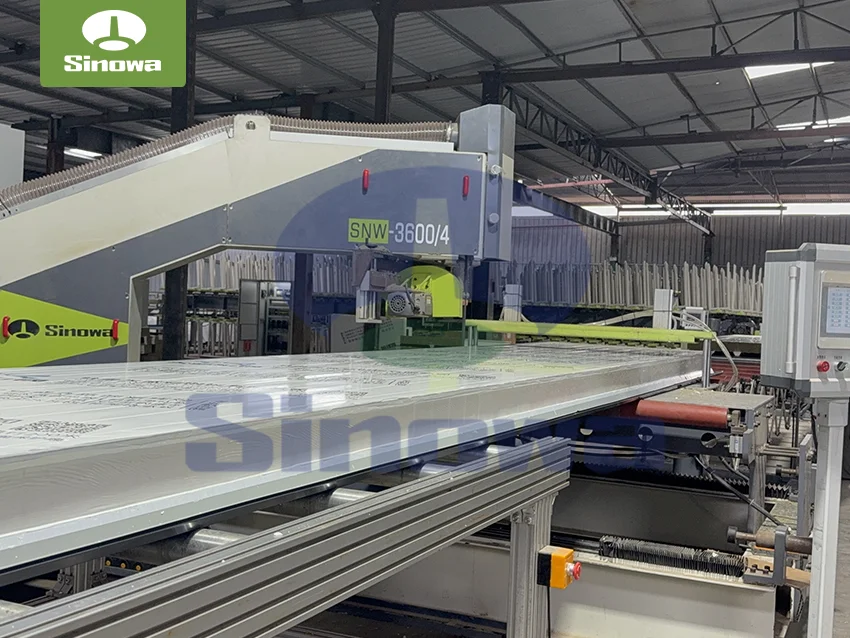
 sandwich panel line
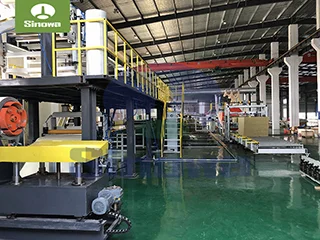
The overall design of the exterior wall rock wool sandwich panel production line follows the principles of continuous operation, precise processing and stable molding, covering the entire manufacturing process from raw material pretreatment to finished product stacking. Different from ordinary interior partition panel production equipment, this production line adjusts the structural parameters and process flow in a targeted manner, focusing on enhancing the bonding firmness, overall flatness and structural strength of exterior wall panels, so as to cope with external environmental factors such as wind pressure, temperature difference change and outdoor humidity erosion. The whole production process realizes automated assembly line operation, with coordinated operation of each functional unit, which effectively reduces manual operation errors, improves production consistency, and maintains stable product quality in mass production.
Raw material pretreatment is the initial and foundational link of the entire production process, which directly determines the basic performance of finished panels. The rock wool sandwich panel line is equipped with a full set of feeding and leveling units for surface metal sheets and rock wool core materials. For the outer metal face sheets used for exterior walls, the equipment completes automatic unwinding, continuous leveling and surface finishing through precision roller sets. The multi-stage leveling mechanism eliminates the internal stress of the metal coil, removes surface wrinkles and uneven deformation, and ensures that the surface flatness of the face sheets meets the requirements of exterior wall decoration and assembly. Meanwhile, the trimming device on the production line performs fine cutting on both sides of the metal sheet to ensure consistent width of the plate body, laying a foundation for subsequent accurate composite molding.
In terms of rock wool core material processing, the rockwool sandwich panel production line is equipped with a professional core material conveying and shaping system suitable for exterior wall panels. The rock wool raw materials are transported stably through the automatic feeding device, and the fiber steering and sorting mechanism adjusts the arrangement direction of internal rock wool fibers, making the fibers perpendicular to the panel surface. This structural adjustment significantly improves the compressive resistance and overall structural stability of the rock wool core layer, enabling the finished exterior wall panels to bear greater external pressure and avoid deformation during long-term outdoor use. In addition, the supporting dust collection device is arranged around the core material processing area to collect scattered fine fibers generated in the feeding and shaping process, which not only keeps the production environment clean and tidy, but also prevents fiber impurities from adhering to the bonding surface and affecting the composite quality of the panel.
Gluing treatment is a key process that determines the bonding strength between the metal surface layer and the rock wool core layer, and the rock wool sandwich panel machine adopts an automatic precision gluing system optimized for exterior wall panel manufacturing. The system uses high-performance environmental protection polymer adhesive with fast curing speed and strong adhesion, which can form a stable bonding layer between metal and rock wool materials. The intelligent gluing control unit can accurately adjust the adhesive dosage and spraying uniformity according to the set process parameters, realizing uniform glue distribution on the entire bonding surface with tiny dosage deviation. This precise gluing mode avoids quality problems such as degumming and hollowing caused by uneven glue application, effectively enhances the overall integration of the sandwich panel, and ensures that the panel will not suffer layer separation under long-term outdoor temperature and humidity changes.
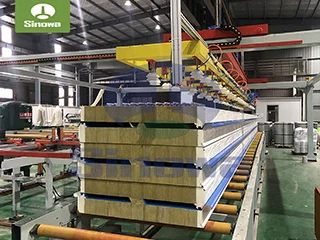
After the completion of gluing and pre-composite positioning, the semi-finished products enter the core composite pressing and heating curing stage, which is the core link to finalize the panel structure and performance. The rock wool board production line is equipped with a dual-belt constant-pressure composite pressing device, which can provide stable and uniform pressing force for the composite panel. The constant pressure control mode ensures that the rock wool core layer and the metal surface layer are closely fitted without local extrusion deformation, maintaining the uniform thickness and flatness of the whole panel. Matching with the pressing process, the constant-temperature heating system keeps the composite environment in a stable temperature range, which accelerates the curing reaction of the adhesive and promotes the full integration of each structural layer. The integrated process of pressing and heating enables the adhesive to form high-strength bonding in a short time, greatly improving production efficiency while ensuring the structural firmness of the exterior wall panels.
The continuous sandwich panel production line is embedded with real-time online detection and parameter adjustment functions during the continuous production process, realizing intelligent monitoring of panel quality. The high-precision thickness detection device conducts real-time scanning and measurement on the running semi-finished panels, automatically feeding back thickness data to the central control system. Once slight thickness deviation is detected, the system will automatically fine-tune the operating parameters of the pressing and conveying units to ensure that the thickness of each section of the panel is consistent. At the same time, the intelligent system monitors the operating speed, pressing pressure and heating temperature of each equipment module in real time, realizing linkage adjustment of the whole line. This intelligent control mode effectively avoids product quality fluctuations caused by equipment parameter changes, ensuring that each batch of exterior wall panels maintains unified structural performance and dimensional accuracy.
After curing and molding, the panels enter the precise cutting and finishing process. The automatic cutting unit of the sandwich panel machinery can complete fixed-length cutting according to customized size requirements, realizing non-stop continuous cutting in the production process and effectively improving production continuity. The cutting tool adopts high-precision wear-resistant structure, which ensures smooth and neat cutting sections without burrs or deformation, meeting the assembly precision requirements of exterior wall construction. In addition, the edge trimming and shaping device performs fine finishing on the edges of the panels, optimizing the edge structure of the sandwich panels. The optimized edge structure can effectively prevent rainwater penetration and fiber leakage in outdoor use, further improving the weather resistance and sealing performance of exterior wall panels.
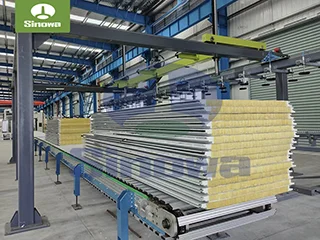
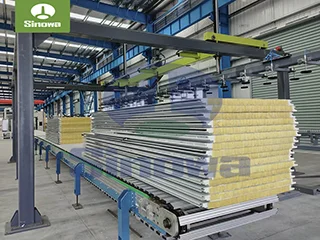
The final stage of the production process includes surface cleaning, automatic stacking and finished product output. The online cleaning device removes residual adhesive and tiny impurities on the panel surface, ensuring the flat and clean appearance of the finished panels. The automatic stacking system orderly arranges the processed finished panels according to the set spacing and quantity, realizing standardized stacking and facilitating subsequent transportation and storage. The whole process from raw material feeding to finished product stacking is completed by automated equipment, with minimal manual intervention, which not only reduces labor cost investment, but also avoids quality risks caused by manual operation.
In terms of production performance advantages, this professional production line for exterior wall rock wool sandwich panels has significant improvements in production efficiency and product quality compared with ordinary panel production equipment. The continuous assembly line operation mode realizes uninterrupted mass production, with stable production rhythm and high product yield. The standardized process design makes the fire resistance, thermal insulation performance and structural strength of finished panels more stable, fully adapting to the harsh outdoor environment of building exterior walls. The rock wool core layer processed by professional fiber adjustment and uniform pressing technology has uniform density distribution, which gives the panel excellent thermal insulation and sound insulation effects, while maintaining good fireproof and flame-retardant properties, meeting the core performance requirements of building exterior wall energy conservation and safety.
In terms of equipment operation and maintenance, the automatic sandwich panel production line adopts modular structural design, with each functional unit independent and interconnected. This design facilitates daily inspection, maintenance and partial replacement of equipment components, reducing equipment failure rate and maintenance cost. The centralized control operation interface is simple and intuitive, and operators can complete parameter setting, equipment start-stop control and production data monitoring through simple operations. The equipment is also equipped with perfect safety protection and fault early warning functions, which can timely detect abnormal operating conditions and trigger protection measures, ensuring the safety and stability of the production process.
With the continuous development of green building concepts and building energy conservation policies, the market demand for high-performance exterior wall thermal insulation and fireproof panels is increasing year by year. The professional rock wool sandwich panel production machine for exterior walls, as key equipment for green building material production, can stably produce high-quality building panels that meet the requirements of energy conservation, environmental protection and safety. The panels produced by this line have wide adaptability, suitable for exterior wall enclosure and thermal insulation projects of various industrial plants, office buildings, shopping malls, residential supporting buildings and other buildings. Its stable product performance and efficient production capacity make it an important support for the standardized and large-scale development of the modern building exterior wall material industry.
In the future, with the continuous upgrading of building engineering standards and intelligent manufacturing technology, the exterior wall rockwool sandwich panel production line will further develop towards higher automation, more precise control and more energy-saving operation. The continuous optimization of process technology and equipment structure will further improve the comprehensive performance of finished panels, reduce production energy consumption, and better adapt to the diversified and high-standard application needs of modern architectural exterior wall projects, providing more reliable material support for the construction of high-quality green buildings.
https://www.cnsinowa.com/sandwich-panel-machines/rock-wool-sandwich-panel-production-line-for-exterior-wall.html