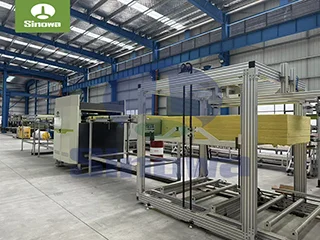
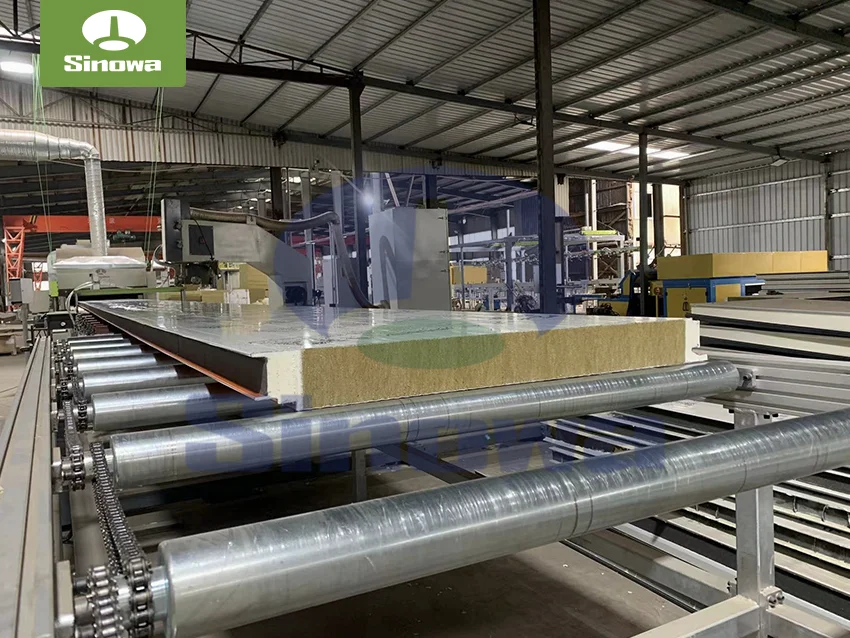
 sandwich panel line
Raw material preparation and pretreatment constitute the initial and foundational stage of the entire production workflow, directly determining the surface quality, structural stability and overall performance of finished panels. The surface materials adopted for production are usually metal coil sheets with good flatness, ductility and weather resistance, which are stored in coil form to facilitate continuous feeding. The automatic uncoiling unit stably unfolds the coiled surface materials at a constant speed, avoiding material deformation, wrinkling and tension deviation caused by uneven feeding speed. During the uncoiling process, the system is equipped with automatic deviation correction structures to ensure the linear conveying of surface materials, laying a foundation for subsequent precise forming and composite processing. Meanwhile, the protective film covering device operates synchronously to attach a uniform protective layer on the surface of the metal sheet, which effectively prevents surface scratches, oxidation and dust adhesion during subsequent processing, transportation and installation, and maintains the long-term aesthetic and anti-corrosion performance of the panel surface.
The core material pretreatment process is the key link that distinguishes the foam rock wool sandwich panel production line from ordinary single-material sandwich panel production equipment. The production line adopts a dual-core composite structure design, with foam material providing excellent thermal insulation performance and rock wool core material endowing the panel with outstanding fire resistance, sound insulation and structural stability. The rock wool core material, made of high-quality mineral fiber raw materials through high-temperature melting and centrifugal fiber forming, is transported to the special core material processing station in the form of fixed-size board blanks. The processing unit carries out fine trimming, thickness calibration and fiber arrangement optimization on rock wool blanks to remove irregular edges and thickness deviations generated in the preliminary blank making process, ensuring that each rock wool core material has consistent dimensional accuracy and flatness. In particular, the professional fiber orientation adjustment mechanism can optimize the vertical arrangement of rock wool fibers, significantly enhancing the overall compression resistance, tensile strength and shear resistance of the composite panel, and avoiding structural loosening and performance attenuation caused by disordered fiber distribution.
Synchronized with rock wool core material processing, the foam material undergoes independent pretreatment and molding treatment. The foam raw materials are processed through professional molding equipment to form uniform and dense foam layers with stable thickness and uniform pore structure. The closed-cell structure of the foam layer endows the panel with ultra-low thermal conductivity, effectively blocking the transmission of external temperature and realizing efficient heat preservation and heat insulation effects. In the pretreatment stage, the surface of foam materials is specially polished and roughened to increase the bonding contact area with adhesive and rock wool core materials, greatly improving the composite bonding strength between different material layers. All core material pretreatment processes are completed through automated sandwich panel assembly line, which not only eliminates the errors and instability caused by manual operation, but also greatly improves the continuity and consistency of core material quality.
Glue coating and composite assembly are the core processes to realize the integrated molding of sandwich panels. The rock wool board production line is equipped with a full-automatic circulating glue coating system, which can evenly spray high-performance adhesive on the upper and lower surfaces of rock wool core materials and foam layers according to set parameters. The glue coating amount and coating uniformity are precisely controlled by the system to avoid excessive glue overflow or local glue shortage. A uniform and continuous adhesive layer can form a stable bonding interface between metal surface sheet, foam layer and rock wool core layer, ensuring that each material layer can be closely combined without gaps or delamination. The adhesive materials selected are characterized by high bonding strength, aging resistance and environmental friendliness, which can maintain stable bonding performance in long-term complex temperature and humidity environments, and will not produce brittle fracture or peeling phenomenon due to temperature changes and external vibration.
After the completion of glue coating, each processed material layer is accurately positioned and assembled through the automatic conveying and positioning system. The upper and lower metal surface sheets, intermediate foam insulation layer and rock wool functional core layer are stacked in a fixed structural order, and the overall flatness and dimensional symmetry of the assembled plate blank are calibrated in real time. The assembled plate blank is continuously transported to the double-belt pressing and curing unit, which is the key equipment for realizing integral composite molding of panels. The double-belt pressing system provides stable and uniform pressure and constant temperature curing environment, enabling the adhesive to fully infiltrate and solidify, and promoting the tight combination between different material layers. The constant-temperature curing process makes the foam structure fully shaped and the rock wool fiber and adhesive form an integrated stress structure, effectively improving the overall rigidity and structural stability of the panel. The pressing speed, curing temperature and pressing pressure can be adjusted intelligently according to different material specifications and panel thickness requirements, realizing flexible production of multiple product specifications on one line.
Precision cutting and edge finishing processes determine the dimensional accuracy and installation adaptability of finished sandwich panels. After continuous pressing and curing, the integrated long-strip composite plate is formed into a continuous whole without internal gaps and delamination. The automatic tracking cutting device follows the production pace in real time and performs fixed-length cutting according to the preset dimensional parameters. The cutting tool adopts high-precision structural design, which can realize smooth and burr-free cutting of metal surface layers and internal composite core materials, avoiding material edge deformation and fiber scattering. After cutting, the edge finishing unit carries out fine trimming and sealing treatment on the panel end faces, which seals the exposed fiber and foam sections, effectively preventing water vapor penetration, dust accumulation and fiber falling, and further improving the weather resistance and service life of the panel.
The post-processing and finished product sorting system realizes the automatic collection and standardized stacking of finished panels. The cut single panels are stably transported to the stacking area through the roller conveying system, and the automatic suction cup stacking device accurately absorbs and stacks the panels according to the set sequence and height. The intelligent stacking mode can avoid surface friction and collision damage between panels, maintain the integrity of the protective film and the flatness of the plate surface. At the same time, the system is equipped with a preliminary quality detection function, which automatically screens out products with unqualified dimensional accuracy, surface defects and poor bonding effects, ensuring that all stacked finished products meet uniform quality standards. The stacked finished panels can be directly transported to the packaging link for subsequent sealed packaging and storage, which is convenient for subsequent transportation and on-site installation.
The structural design and operational characteristics of the foam rock wool sandwich panel line endow it with irreplaceable technical advantages in the field of building material manufacturing. Firstly, the integrated continuous production mode realizes the seamless connection of all processes from raw material feeding to finished product output, greatly shortening the production cycle and effectively improving production efficiency compared with traditional segmented and intermittent production equipment. The whole production process realizes mechanical automation and intelligent control, reducing manual intervention links, not only reducing labor cost and operational error rate, but also improving the stability and consistency of product quality. Secondly, the dual-core composite structure production technology perfectly combines the thermal insulation advantages of foam materials and the fireproof and sound insulation advantages of rock wool materials, making the finished panels have comprehensive performance advantages that single-material panels cannot match.
In terms of product performance control, the precise parameter adjustment function of the rock wool sandwich panel machine enables the produced panels to have stable thickness uniformity, flatness and bonding strength. The optimized fiber arrangement and composite pressing process make the panels have good compression resistance and bending resistance, which can adapt to different structural installation environments and bear certain external loads. The sealed composite structure can effectively block the propagation of sound waves and reduce noise transmission, providing good sound insulation effect for building spaces. At the same time, the rock wool core material has excellent high-temperature resistance and non-combustible characteristics, which can effectively prevent the spread of flames in case of fire, improving the overall fire safety of buildings, while the foam layer maintains efficient thermal insulation performance, reducing building energy consumption and realizing energy-saving and environmental protection building needs.
In terms of production flexibility, the foam rockwool sandwich panel making machine has strong product adaptability. By adjusting the feeding thickness of core materials, pressing parameters and cutting dimensions, it can produce sandwich panels with different thicknesses, widths and structural proportions, meeting the personalized production needs of different application scenarios. Whether it is thin decorative insulation panels or thick load-bearing fireproof insulation panels, the production line can complete efficient and standardized production. In addition, the production line adopts modular structural design, which is convenient for daily maintenance, equipment debugging and functional upgrading. Each processing unit operates independently and cooperates synchronously, and the failure of a single unit will not affect the overall operation of the equipment to the greatest extent, ensuring the continuity and stability of production work.
With the continuous upgrading of the construction industry's requirements for building energy conservation, fire safety and environmental protection performance, the market demand for high-performance composite sandwich panels is increasing year by year, which also promotes the continuous technological innovation and functional optimization of foam rockwool sandwich panel production line. Modern production lines are gradually moving towards higher intelligence, energy conservation and environmental protection. The optimized power control system reduces energy consumption in the production process, and the closed-loop processing design avoids material waste and dust pollution in the production process, realizing green and low-carbon production. The intelligent monitoring system can monitor the operating parameters of each link in real time, automatically alarm and adjust abnormal conditions, further improving production safety and product qualification rate.
The foam rock wool sandwich panels produced by this production line are widely used in various industrial buildings, civil buildings and special functional spaces. They are commonly applied to the enclosure walls, roof systems, partition structures of factory buildings, warehouses and cold storage spaces, as well as the interior decoration and functional enclosure of public buildings. In cold storage and constant-temperature workshops, the excellent thermal insulation performance of the panels can effectively maintain indoor temperature stability and reduce equipment operation energy consumption. In industrial factory buildings and public facilities, the good fire resistance and sound insulation performance of the panels can improve building safety and indoor environmental comfort. At the same time, the lightweight characteristic of the sandwich panel reduces the overall load of the building structure, simplifies the installation process, shortens the construction cycle, and reduces the comprehensive construction cost, so it has high practical value and market promotion value.
In conclusion, the foam rock wool sandwich panel manufacturing line is an efficient, stable and versatile professional manufacturing equipment in the field of modern building material production. Through scientific and reasonable process layout and advanced composite molding technology, it realizes the efficient production of high-performance composite sandwich panels with dual functions of thermal insulation and fire prevention. Its automated production mode, flexible product adjustment capability and stable product quality provide reliable technical support for the standardized and large-scale production of high-quality building insulation and fireproof materials. With the continuous development of the construction industry towards high efficiency, energy conservation and safety, this rockwool sandwich panel machinery will continue to play an important role in the building material manufacturing field, and constantly drive the upgrading and innovation of composite building panel technology, meeting the increasingly stringent application requirements of modern buildings.
https://www.cnsinowa.com/sandwich-panel-machines/foam-rock-wool-sandwich-panel-line.html