 sandwich panel machine
The operation of rock wool board production line starts with the raw material pretreatment and batching module, which serves as the initial guarantee for stable product quality. Natural volcanic rocks and auxiliary mineral materials, the primary raw materials for rock wool production, require professional processing before entering the high-temperature production link. This equipment unit is mainly responsible for crushing, screening, impurity removal, and precise proportioning of raw materials. Bulk raw materials are transported into the crushing device through automated conveying structures, where large-size ore blocks are processed into uniform granular materials with consistent particle size. Subsequent screening mechanisms remove fine impurities and unqualified particles that may affect fiber forming quality, ensuring the purity and uniformity of raw materials. The fully automatic batching system equipped in this module adjusts the mixing ratio of different raw materials through precise metering control according to production process requirements. This intelligent proportioning method avoids the instability of manual batching, effectively balancing the physical properties of subsequent fibers and enabling the finished rock wool boards to maintain stable thermal insulation, sound absorption, and fire resistance performance. Processed raw materials are stored in sealed silo structures and steadily conveyed to the next production link through quantitative feeding devices, realizing uninterrupted feeding for continuous production.
High-temperature melting equipment is the core thermal processing unit of the entire rock wool sandwich panel production line, determining the fundamental structural characteristics of rock wool fibers. The equipment adopts closed high-temperature heating structures that can create a stable extreme temperature environment ranging from 1400℃ to 1600℃. After entering the melting equipment, the proportioned mixed raw materials undergo continuous high-temperature heating until they are completely melted into homogeneous liquid magma. The closed structural design of the melting equipment effectively reduces heat loss, improves thermal energy utilization efficiency, and avoids external interference during the melting process. Advanced temperature regulation systems are embedded in the equipment to realize real-time monitoring and dynamic adjustment of internal temperature, ensuring that raw materials achieve the optimal melting state without excessive high-temperature decomposition or insufficient melting. Sufficient high-temperature melting thoroughly changes the original physical structure of natural ores, eliminating internal stress and heterogeneous structures of raw materials, and laying a structural foundation for the formation of fine, uniform, and high-toughness inorganic fibers. The molten liquid magma flows out stably through specially designed flow channels, providing qualified raw materials for the subsequent fiber forming process.
Fiber forming equipment is the key functional module that converts liquid magma into rock wool fibers, adopting mature high-speed centrifugal fibrillation technology as the core working principle. The rock wool sandwich panel machine is equipped with high-speed rotating centrifugal structures that can maintain a stable high rotating speed during operation. When the high-temperature liquid magma contacts the rotating centrifugal components, it is rapidly thrown outward under the action of powerful centrifugal force and stretched into ultra-fine inorganic fibers with uniform diameter. The mechanical structure of the centrifugal fibrillation device is precisely optimized, which can effectively control the fiber diameter within a stable range and avoid the generation of coarse fibers or fiber fragments. During the fiber forming process, the equipment is matched with a uniform atomizing and spraying structure, which evenly sprays quantitative adhesive additives on the surface of newly formed fibers. These additives can bond scattered single fibers into a continuous fiber network structure while enhancing the overall toughness and structural stability of the fiber layer. The whole fiber forming process is completed in a closed negative pressure environment, which not only ensures the orderly collection of fibers but also prevents fiber drift and material loss, realizing clean and efficient production. The fibers formed by this equipment have slender and uniform morphology, soft texture, and stable spatial structure, which endow rock wool boards with excellent porous structure characteristics.
Cotton collection and laying equipment undertakes the task of gathering scattered fibers and forming preliminary fiber blankets, serving as the transitional link between fiber forming and board molding. Under the action of negative pressure air suction system, the dispersed rock wool fibers with adhesives are evenly adsorbed on the surface of the mesh conveyor belt of the cotton collection equipment, forming a loose and uniform primary fiber felt layer. The negative pressure control system of the equipment can adjust the air suction intensity according to production specifications, precisely controlling the thickness and density of the primary fiber layer to ensure consistent material accumulation in each production section. The subsequent pendulum laying structure further optimizes the fiber arrangement state, realizing multi-layer staggered laying of fibers through reciprocating swing motion. This mechanical laying mode changes the single directional arrangement of traditional fibers, forms a three-dimensional cross network structure inside the fiber blanket, and greatly improves the overall structural strength, compression resistance, and dimensional stability of the preliminary blank. The fiber blanket after pendulum laying has uniform thickness, fluffy texture, and internal gap uniformity, which effectively avoids quality problems such as local density difference and uneven thermal insulation performance of finished products. At the same time, the equipment is equipped with a preliminary pressing structure, which carries out gentle compression shaping on the loose fiber blanket to discharge excess air inside the fiber layer, compact the primary structure, and facilitate subsequent curing and molding processing.
Curing and molding equipment is the core unit for finalizing the structural shape and physical properties of rock wool boards, completing the curing and hardening of the fiber blanket through constant temperature and fixed-time thermal treatment. The curing equipment adopts a closed tunnel-type structural design, with a stable internal temperature field and uniform heat distribution. When the preliminarily pressed fiber blanket enters the curing equipment with the conveyor system, it undergoes continuous constant temperature heating treatment. Under the action of appropriate temperature and heat, the adhesives attached to the fiber surface undergo stable chemical curing reactions, enabling the cross-bonding between fibers to form a firm and integrated whole structure. The internal temperature and running speed of the curing equipment can be adjusted intelligently according to the thickness, density, and production speed of rock wool boards, ensuring that the adhesive is fully cured without thermal damage to the inorganic fiber structure. The whole curing process is stable and controllable, which can effectively eliminate internal structural gaps and unstable bonding states of the fiber layer, so that the rock wool board blank obtains stable mechanical strength and structural rigidity. After curing treatment, the loose fiber blanket is transformed into a hard, flat, and uniformly structured board blank, with all physical properties initially finalized, achieving the transformation from loose fiber materials to fixed-shape board products.
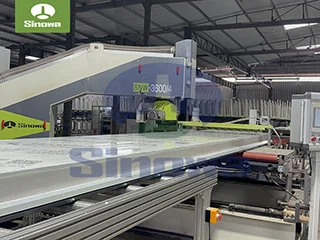
Cooling and cutting equipment is the final processing module of the rock wool sandwich panel line, responsible for finishing and shaping cured rock wool board blanks to meet standardized product specifications. The high-temperature board blanks discharged from the curing equipment first enter the automatic cooling system, which adopts circulating air cooling technology to realize uniform and gradual cooling of the board surface and interior. The gradual cooling mode avoids product deformation, cracking, and internal structural damage caused by rapid temperature change, effectively ensuring the flatness and dimensional stability of finished rock wool boards. After cooling to normal temperature, the board blanks are transported to the precision cutting equipment through the conveyor system. The cutting equipment adopts automated positioning and high-speed cutting structures, which can accurately cut continuous long board blanks into finished products of different sizes according to preset production parameters. The precision mechanical cutting structure ensures smooth and neat cutting sections without burrs, fractures, or fiber looseness. In addition, the equipment is equipped with an automatic trimming and waste recycling device, which can trim the irregular edges of the board body and collect the generated waste materials in a centralized manner. The recycled waste materials can be reprocessed and reused after crushing, realizing resource recycling and reducing production waste.
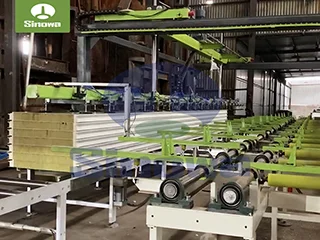
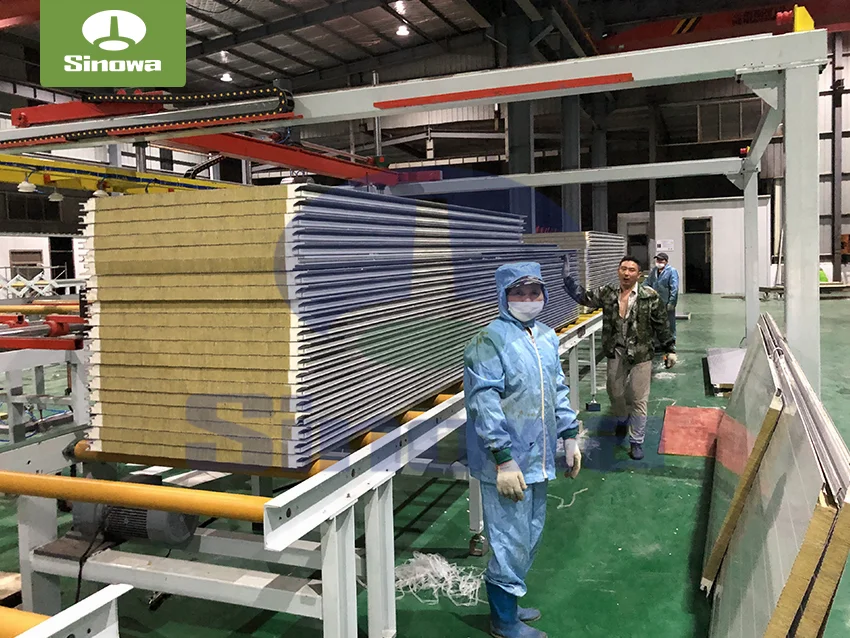
The overall structural design and operating performance of modern rockwool board production equipment highlight the advantages of automation, integration, and high efficiency. The entire production line adopts a fully connected mechanical transmission and electrical control system, realizing automatic docking and coordinated operation of all links from raw material feeding to finished product output. The centralized control system can monitor the operating state, process parameters, and production quality of each equipment module in real time, and automatically adjust operating parameters according to production changes, effectively reducing manual intervention and human error. The integrated structural design simplifies the production layout, reduces the occupied space of production equipment, and improves the continuity and efficiency of the production process. Compared with traditional decentralized production equipment, the integrated production line has more stable operation, lower failure rate, and more consistent product quality. In terms of energy consumption control, the equipment optimizes the heat preservation structure of high-temperature components and the operating logic of power components, effectively reducing invalid energy consumption and improving overall production energy efficiency.
The mechanical performance and process optimization of rockwool board production line directly determine the core quality indicators of rock wool board products. The precise batching and uniform melting functions of the equipment ensure the stability of fiber raw material composition, laying the foundation for the fire resistance and high-temperature resistance of finished products. The high-speed centrifugal fiber forming technology can produce fine and uniform fibers, forming a large number of tiny closed pores inside the rock wool board. This porous structure gives the product excellent thermal insulation and sound absorption performance, effectively isolating heat transfer and reducing noise transmission. The three-dimensional fiber network structure formed by the pendulum laying and curing process significantly improves the mechanical strength and structural durability of rock wool boards, enabling the products to maintain stable performance under long-term use, external compression, and temperature change environments. At the same time, the standardized production process realized by the equipment ensures the consistency of product thickness, density, and structural uniformity, making the comprehensive performance of each batch of products stable and reliable.
With the continuous upgrading of industrial production requirements and building energy-saving standards, rock wool board production machinery is constantly evolving towards intelligence, environmental protection, and high precision. Modern equipment has added more intelligent monitoring and self-diagnosis functions, which can real-time monitor the operating status of mechanical components, temperature changes, material flow, and product quality indicators, and automatically alarm and adjust abnormal conditions, greatly improving production stability and safety. In terms of environmental protection, the optimized equipment structure effectively collects and processes fine fiber dust and waste gas generated during production, realizing clean production and reducing the impact of production processes on the surrounding environment. The continuous optimized mechanical structure and process parameters further improve the utilization rate of raw materials and product yield, reducing production costs while improving resource utilization efficiency. As the key equipment for producing high-performance inorganic insulation materials, rock wool sandwich panel production equipment will continue to play an important role in the field of building energy conservation, industrial thermal insulation, and fire safety protection, providing reliable technical and equipment support for the popularization and application of high-quality rock wool board products.
https://www.cnsinowa.com/sandwich-panel-machines/rock-wool-equipment.html