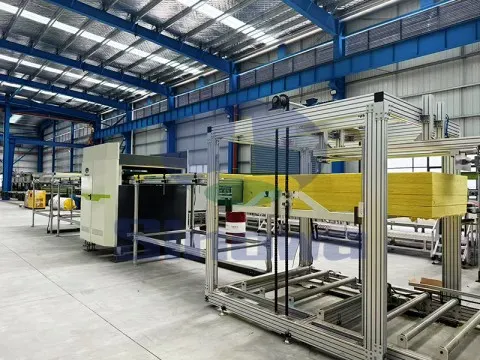
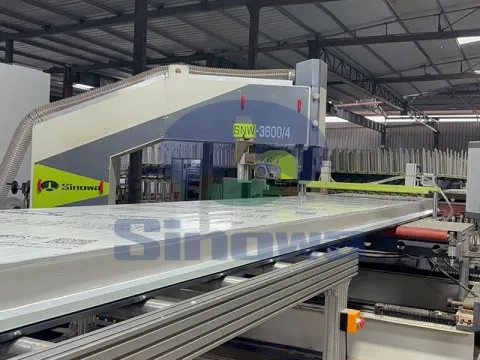
sandwich panel machine
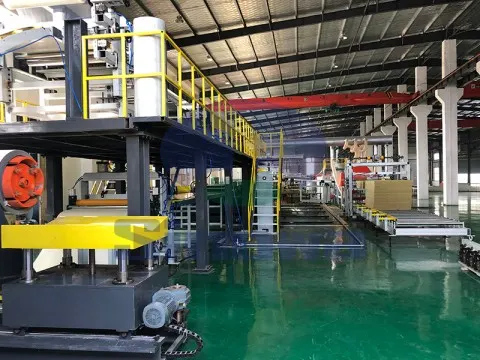
The overall structural design of the mineral wool sandwich panel machine follows the principles of mechanical rationality, production efficiency, and operational stability. The entire production line consists of multiple interconnected functional modules, each undertaking independent production tasks while maintaining precise coordination with other modules to ensure the continuity of the production process. The main structural parts include a raw material feeding system, surface material rolling and forming unit, core material processing and laying mechanism, adhesive coating device, composite pressing system, fixed-length cutting mechanism, automatic stacking unit, and an integrated intelligent control system. Every structural component is carefully optimized in terms of mechanical structure and operating logic to adapt to the physical characteristics of mineral wool raw materials and metal surface materials, avoiding material damage, bonding defects, and dimensional errors during the production process.
The raw material feeding system is the starting link of the entire mineral wool sandwich panel production line, which is divided into two independent feeding modules for metal surface plates and mineral wool core materials respectively. For metal surface materials, the feeding structure adopts a horizontal unwinding design, which can stably place coiled metal raw materials and achieve continuous and uniform material output during equipment operation. The internal tension adjustment structure of the feeding device can dynamically control the stretching degree of the metal coil, effectively preventing the metal plate from deformation, wrinkling, and uneven stress caused by excessive tension or loose conveying in the conveying process. In terms of mineral wool core material feeding, the equipment is equipped with a special material sorting and conveying structure. Bulk mineral wool raw materials are transported to the processing area through conveyor equipment, and the internal raking and sorting components can disperse agglomerated mineral wool to ensure the uniformity of core material density in subsequent laying links. This feeding mode eliminates the uneven internal structure of finished panels caused by raw material accumulation, laying a solid foundation for the stable physical performance of composite panels.
After the raw material feeding is completed, the metal surface material will enter the rolling and forming unit for surface shaping treatment. The rolling unit is composed of multiple groups of precision arranged rolling rollers, and the surface of each roller is treated with wear-resistant and anti-corrosion processes to prolong the service life of mechanical components. According to the preset panel shape requirements, the rolling rollers carry out continuous cold rolling processing on the flat metal plate, gradually pressing the flat plate into a specific groove and contour structure. This forming process enables the metal surface plate to have higher structural strength and surface flatness, and the shaped contour can also enhance the occlusion tightness between adjacent panels during on-site installation. The rolling speed and pressing gap of the rolling unit can be adjusted in real time through the control system, which can adapt to metal plates of different thicknesses and hardness, realizing flexible production of diversified panel specifications. In the whole rolling process, the mechanical vibration amplitude is strictly controlled, so as to avoid surface scratches and structural damage to the metal plate.
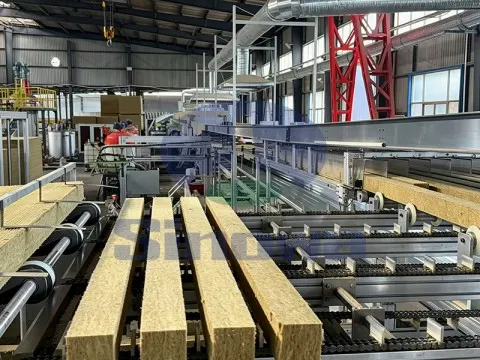
The core material processing and laying link is one of the core working procedures of the mineral wool core sandwich panel machine, which directly determines the thermal insulation and mechanical stability of the finished panel. Mineral wool belongs to inorganic fiber material with porous internal structure, and its fiber arrangement mode has a crucial impact on the overall performance of the composite panel. The professional laying mechanism inside the equipment can adjust the placement direction of mineral wool strips, so that the internal fibers of the mineral wool are vertically distributed between the upper and lower metal plates. This vertical fiber arrangement mode can effectively improve the compression resistance and structural stability of the core material, prevent the core material from collapsing and deforming under long-term external pressure, and meanwhile give full play to the heat insulation and sound insulation advantages of mineral wool fiber gaps. Before laying, the equipment will complete the sorting and cutting of mineral wool raw materials to ensure that the size of mineral wool strips matches the width of metal surface plates. The automatic alignment device is equipped in the laying process to correct the laying position in real time, avoiding the lateral deviation of the core material and ensuring that the core material is completely and evenly filled in the middle of the metal plates without empty gaps.
The adhesive coating process is a key step to realize the composite bonding of metal plates and mineral wool core materials. The equipment is equipped with an intelligent gluing system, which can quantitatively and uniformly coat high-strength adhesive on the inner surfaces of the upper and lower metal plates. The gluing device adopts a multi-point spraying structure, and the glue output can be accurately controlled according to the production speed and panel specifications. This quantitative gluing mode not only ensures that the adhesive can fully cover the bonding contact surface to form a stable bonding layer, but also avoids excessive glue accumulation leading to material waste and panel surface bulging. Before gluing, the surface of the metal plate will be simply cleaned by the equipment to remove dust and oil stains generated in the rolling process, improving the adhesion between the adhesive and the metal plate. After gluing, the preliminary bonding between the mineral wool core material and the metal plate is completed instantly, and the primary composite blank of the sandwich panel is formed.
The composite pressing system undertakes the task of solidifying the bonding structure and shaping the overall panel. The pressing unit is composed of upper and lower pressing roller sets with adjustable spacing, and the internal hydraulic transmission structure provides stable and balanced pressing force. When the preliminarily bonded composite blank passes through the pressing area, the pressing rollers apply uniform vertical pressure to the panel to eliminate tiny gaps between the core material and the metal plate, so that the adhesive can fully penetrate into the fiber gaps of mineral wool and enhance the integration degree of the composite structure. The pressing pressure and running speed are matched with each other, and the pressure value will be moderately adjusted according to the thickness of different panels to prevent excessive pressure from crushing the mineral wool core material or insufficient pressure leading to loose bonding. In the pressing process, the equipment maintains a constant operating temperature to accelerate the initial curing speed of the adhesive, shorten the molding cycle of the panel, and improve the overall production efficiency.
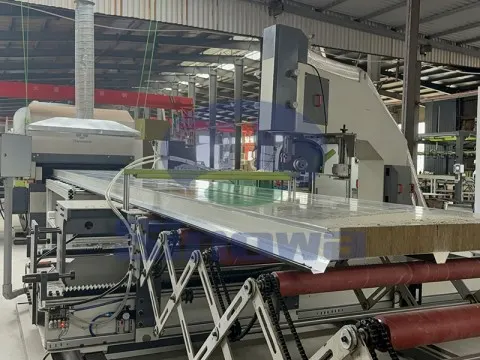
After the composite pressing is completed, the continuous long-strip composite panel will enter the fixed-length cutting mechanism for sizing processing. The cutting unit adopts high-precision servo driving technology, and the system can preset the cutting length according to customer production requirements. During operation, the measuring sensor monitors the conveying distance of the panel in real time, and feeds the data back to the control system. When the panel reaches the preset size, the cutting tool completes the instantaneous cutting action. The cutting tool is made of high-hardness alloy materials, which can keep the cutting edge sharp for a long time, ensuring that the cutting section of the panel is flat and smooth without burrs, cracks and edge warping. The cutting speed is synchronized with the production rhythm of the front-end process, which will not cause production stagnation due to cutting delay, realizing uninterrupted continuous production. In addition, the cutting mechanism is equipped with a dust collection structure, which can collect fine debris generated during cutting to keep the equipment operating environment clean.
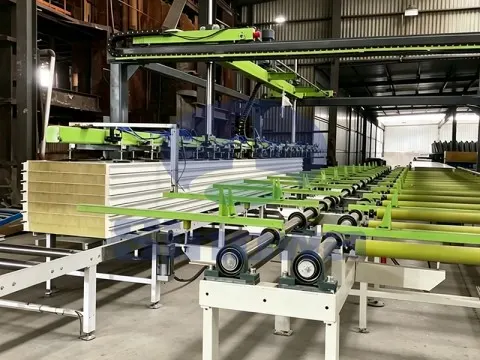
The automatic stacking unit is the final processing link of the production line, responsible for orderly collecting and stacking the cut finished panels. This unit is equipped with a servo positioning system and a flexible grabbing structure. After the panels are transported to the stacking area, the grabbing component stably picks up the panels and places them in the designated stacking position. The intelligent alignment device can dynamically correct the placement angle of each panel to ensure that the stacked panels are neatly arranged with consistent gaps. Compared with manual stacking, the automatic stacking structure effectively reduces the surface scratch and collision damage of panels caused by human operation, and improves the stacking regularity of finished products. The stacked panels can be directly transported to the packaging link, which simplifies the subsequent packaging process and reduces the labor input in the production link.
The intelligent control system runs through all functional units of the mineral wool core sandwich panel machine, which is the core brain to ensure the coordinated operation of the entire production line. The system adopts programmable logic controller and human-computer interaction touch screen design. Operators can complete parameter setting, equipment debugging, production mode switching and data monitoring through a simple touch operation. The control system integrates multiple sensing components, which can monitor the operating temperature, conveying speed, mechanical pressure, material consumption and other data of each module in real time. Once abnormal conditions such as material blockage, pressure overload and component failure occur during the production process, the system will automatically trigger an early warning mechanism and perform emergency shutdown protection to avoid equipment damage and production safety hazards. In addition, the control system has a memory function, which can store the production parameters of common panel specifications, realizing one-click calling during repeated production and greatly improving the debugging efficiency of the equipment.
In actual industrial production applications, the mineral wool core sandwich panel machine has prominent operational advantages. First of all, the equipment has a high degree of automation, realizing unmanned continuous operation from raw material feeding to finished product stacking. The whole production line only needs a small number of operators to complete parameter monitoring and daily maintenance work, which effectively reduces labor costs for manufacturers. Secondly, the equipment has strong production flexibility. By adjusting the operating parameters of each module, it can produce sandwich panels with different thicknesses, widths and surface shapes. The switching speed of production specifications is fast, which can meet the personalized customization needs of different construction projects. In terms of production efficiency, the stable mechanical transmission structure enables the production line to maintain a continuous and efficient operating state, with smooth production rhythm and low intermediate failure rate.
In terms of production quality control, the standardized mechanical processing mode of the equipment effectively avoids the quality fluctuations caused by manual operation. The mineral wool core material is evenly laid, the adhesive is quantitatively coated, and the pressing force is balanced, so that the produced composite panels have consistent density, stable bonding performance and uniform dimensional accuracy. The finished panels have excellent fire resistance, because the inorganic fiber characteristics of mineral wool will not burn, and the compact composite structure can block the spread of flames. At the same time, the porous internal structure of mineral wool gives the panel good sound absorption and heat insulation performance, which can reduce external noise interference and slow down indoor and outdoor heat exchange. These excellent performance characteristics make the panels widely used in high-demand places such as industrial fireproof workshops, constant-temperature cold storage and sound insulation buildings.
Daily maintenance and scientific maintenance are essential to extend the service life of the mineral wool sandwich panel making machine and maintain stable production efficiency. In daily production, operators need to regularly clean the dust and raw material residues attached to the surface of mechanical components, especially the rolling rollers, cutting tools and conveying tracks, to prevent hard residues from wearing the equipment and scratching the panel surface. The transmission parts such as gears and bearings need to be regularly coated with lubricating oil to reduce mechanical friction loss and avoid abnormal noise and jamming during operation. It is necessary to regularly check the tightness of the connecting parts of each module and the sensitivity of the sensing components, and replace the aging and damaged parts in a timely manner. In addition, the operating environment of the equipment should be kept dry and ventilated to prevent the internal circuit and metal components from being corroded by humid air. Scientific maintenance can not only reduce the failure rate of the equipment, but also keep the production accuracy of the equipment for a long time.
With the continuous development of the global construction industry and the continuous improvement of energy-saving and environmental protection construction standards, the market demand for high-performance composite building materials is steadily increasing, which also promotes the continuous technological upgrading of mineral wool core sandwich panel machines. At present, the development direction of such equipment is gradually moving towards intelligent integration, energy conservation and environmental protection, and high-precision production. The optimized mechanical structure reduces the energy consumption of equipment operation, and the improved dust removal and noise reduction structures reduce the environmental pollution caused by the production process. The upgraded intelligent control system can realize remote data monitoring and production parameter optimization, helping manufacturers realize refined production management. In the future, with the continuous innovation of mechanical manufacturing technology and material processing technology, the comprehensive performance of mineral wool core sandwich panel machines will be further improved, and the application scope will be more extensive, providing more reliable equipment support for the high-quality development of the construction composite material industry.
In conclusion, the mineral wool core sandwich panel machine is a kind of efficient and intelligent composite material production equipment with reasonable structural design and complete functional modules. It completes the automated manufacturing of mineral wool core sandwich panels through the coordinated operation of multiple functional units. The equipment not only has the advantages of high production efficiency, flexible adjustment and stable operation, but also can produce composite panels with excellent physical properties to meet the diversified application needs of the construction industry. With the continuous progress of industrial manufacturing technology, this type of equipment will continue to iterate and upgrade, constantly adapt to the changing market demand, and play an increasingly important role in the field of modern building material production, contributing to the standardized and high-quality development of the global construction industry.
Sinowa is a professional manufacturer of sandwich panel machine in china, we provide diversified and high-performance sandwich panel production lines, including fully automatic continuous PU sandwich panel line and customized special lines to meet mass production and personalized order demands. These sandwich panel lines support processing multiple foam core materials, such as PU, PIR, mineral wool, rock wool and glass wool, covering different insulation and fireproof standards.
Featuring stable operation, high efficiency, energy saving and easy maintenance, our PU sandwich panel line deliver sandwich panels with excellent thermal insulation, fire resistance, sound insulation and lightweight durability. The finished panels are widely applied in industrial workshops, warehouse roofing and wall cladding, cold storage insulation, serving global construction and industrial insulation markets.
https://www.cnsinowa.com/sandwich-panel-machines/mineral-wool-core-sandwich-panel-machine.html