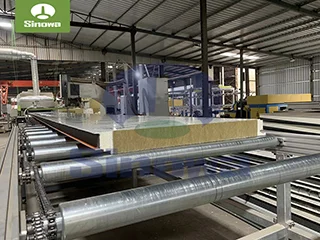
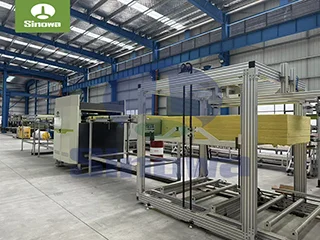
sandwich panel line
The production of rock wool thermal insulating sandwich panels begins with the preparation of raw materials, which include the outer facing materials, the rock wool core, and adhesive substances. The outer facings are typically made of thin metal sheets, often processed with protective coatings to enhance weather resistance and durability. These metal coils are stored in designated areas before being fed into the production line through uncoiling systems. The uncoiling process is a critical starting point, as it ensures the smooth and continuous supply of metal sheets without interrupting the production flow. Modern uncoiling systems are equipped with automatic strip connection machines, allowing for coil changes without stopping the entire line—this feature significantly boosts production efficiency by minimizing downtime. Additionally, the uncoiling units incorporate edge control systems and pressing rollers to maintain the flatness and alignment of the metal sheets, preventing defects that could affect the final product’s structural integrity.
Once the metal sheets are uncoiled, they proceed to the roll forming stage, where they are shaped into the desired profiles. Roll forming technology uses a series of consecutive rollers to gradually bend the metal sheets into specific cross-sectional shapes, such as trapezoidal or corrugated designs, which are commonly used for roof and wall panels. The precision of the roll forming process is crucial, as it determines the dimensional accuracy and structural stability of the final panels. Advanced production lines employ digital servo technology and frequency conversion vector control to adjust the rollers’ speed and pressure in real time, ensuring consistent shaping across the entire length of the metal sheets. This level of control also allows for quick adjustments between different panel profiles, enabling manufacturers to switch between wall and roof panel production with minimal setup time. After forming, the metal sheets pass through a preheating station, where they are heated to a specific temperature to optimize the adhesion of the adhesive and ensure a strong bond with the rock wool core.
Parallel to the processing of the outer facings is the preparation of the rock wool core, the heart of the sandwich panel’s thermal and acoustic performance. Rock wool is produced by melting volcanic rocks, such as basalt or diabase, at extremely high temperatures—typically above 1,400 degrees Celsius. The molten rock is then spun into fine fibers using centrifugal force, creating a lightweight material with a high surface area-to-volume ratio. These fibers are bonded together using a thermosetting resin, which cures to form a rigid, porous structure that exhibits excellent thermal insulation and sound absorption properties. The rock wool is processed into slabs or rolls of specific thicknesses and densities, depending on the intended application of the sandwich panels. Before being integrated into the production line, the rock wool is cut into precise strips using automatic cutting equipment, ensuring that it fits perfectly between the upper and lower metal facings. For roof panels, additional trapezoidal filler strips are cut and inserted to fill the ribs, enhancing the panel’s insulation efficiency and structural strength.
The assembly stage is where the outer metal facings and rock wool core are combined to form the sandwich panel. This process begins with the application of adhesive to the inner surfaces of the preheated metal sheets. The adhesive is applied using an oscillating coating gantry, which ensures even distribution across the entire surface—this uniformity is essential for creating a strong, consistent bond between the metal and rock wool. Some production lines also incorporate a two-component adhesive system, which mixes the adhesive components on-site to optimize curing time and bond strength. After the adhesive is applied, the rock wool core is automatically fed between the upper and lower metal facings. The entire assembly then enters a double belt laminating machine, which acts as a continuously moving mold. The double belt system applies uniform pressure and heat to the assembly, facilitating the curing of the adhesive and ensuring that the rock wool core is firmly bonded to the metal facings. The length of the double belt conveyor is carefully calibrated to provide sufficient time for the adhesive to cure completely, typically ranging from 20 to 30 meters to accommodate production speeds.
For enhanced performance, many production lines include a side-sealing process using foam. This step involves injecting a foam material, often polyurethane-based, along the edges of the sandwich panel to seal gaps and prevent moisture infiltration. The side-sealing foam also improves the panel’s thermal insulation by eliminating thermal bridges and enhances its structural rigidity. The foam is applied using high-pressure metering machines, which accurately dose the foam components to ensure consistent density and curing. After side sealing, the continuous sandwich ribbon moves to the cross-cutting station, where it is cut into individual panels of the desired length. The cutting process uses a band saw or circular saw equipped with digital length measurement systems, allowing for precise cuts without stopping the production line. This non-stop cutting capability is a key feature of modern production lines, enabling them to maintain high production speeds while ensuring dimensional accuracy.
Following cutting, the finished panels are conveyed to a cooling station to allow the adhesive and foam to fully cure and stabilize. The cooling process is critical for preventing warping or deformation of the panels, as it ensures that the materials set uniformly. Cooling conveyors use forced air or water-based cooling systems to reduce the panel temperature to ambient levels efficiently. Once cooled, the panels are transferred to an automatic stacking system, which arranges them onto pallets in a neat, stable configuration. The stacking system is equipped with sensors to detect panel dimensions and adjust the stacking pattern accordingly, minimizing the risk of damage during handling. After stacking, the pallets of panels are moved to the packaging station, where they are wrapped in moisture-proof and damage-resistant materials, such as PVC foil. This packaging protects the panels during storage and transportation, preventing moisture absorption, scratches, and impacts that could compromise their performance.
The efficiency and performance of a rock wool thermal insulating sandwich panel production line are largely determined by its level of automation and control systems. Modern lines are equipped with full computer integration control systems that monitor and regulate every stage of the production process. These systems use human-machine interface (HMI) technology, allowing operators to input production parameters, monitor real-time data, and make adjustments as needed. The centralized control system collects data on production speed, temperature, pressure, and material consumption, enabling manufacturers to optimize processes for maximum efficiency and minimal waste. Additionally, the control system incorporates safety features, such as emergency stop mechanisms and fault detection alarms, to ensure the safety of operators and prevent equipment damage. With this high level of automation, a typical production line requires only 5 to 8 operators to manage the entire process, significantly reducing labor costs compared to semi-automatic or manual production methods.
Production speed and capacity are key performance indicators of these lines, with modern systems capable of operating at speeds ranging from 3 to 8 meters per minute, depending on the panel thickness and profile complexity. This translates to an annual production capacity of up to 1 million square meters, based on standard working hours and days. The ability to adjust production speed allows manufacturers to balance efficiency with quality, slowing down for more complex profiles or thicker panels to ensure precision. The continuous production design eliminates the need for batch processing, further enhancing efficiency and reducing production time. This high capacity makes the production line suitable for large-scale construction projects, such as industrial warehouses, logistics centers, and commercial buildings, where large volumes of panels are required within tight deadlines.
Quality control is an integral part of the production process, ensuring that every panel meets the required performance and dimensional standards. Quality checks begin with the inspection of raw materials, including the metal coils, rock wool, and adhesive. The metal sheets are checked for thickness uniformity, coating quality, and flatness, while the rock wool is tested for density, fiber distribution, and thermal conductivity. During production, in-line sensors monitor the panel thickness, adhesive application, and bonding strength, providing real-time feedback to the control system to make immediate adjustments. After cutting and cooling, random samples of finished panels are subjected to rigorous testing, including dimensional accuracy checks, flatness measurements, and bond strength tests. Additional tests may be conducted to verify thermal insulation performance, sound absorption, and fire resistance, ensuring that the panels meet the specific requirements of different applications. Any panels that fail to meet the quality standards are removed from the production line and recycled or discarded, preventing defective products from reaching customers.
The rock wool thermal insulating sandwich panels produced by these lines offer a range of performance benefits that make them ideal for various construction applications. Their primary advantage is excellent thermal insulation, thanks to the rock wool core’s low thermal conductivity. This property helps reduce energy consumption in buildings by minimizing heat transfer through walls and roofs, leading to lower heating and cooling costs. Additionally, rock wool is a non-combustible material, providing superior fire resistance compared to other insulation materials. This fire resilience enhances building safety by slowing the spread of flames and reducing the release of toxic fumes. The porous structure of rock wool also delivers effective sound absorption, making the panels suitable for buildings located in noisy environments, such as near airports or highways, or for spaces requiring acoustic insulation, such as offices, schools, and hospitals.
The durability and versatility of these panels further expand their application scope. The metal facings provide resistance to weathering, corrosion, and physical impact, ensuring a long service life even in harsh environments. The panels can be customized with different coatings and finishes to meet aesthetic requirements, making them suitable for both interior and exterior applications. Common uses include industrial warehouses, factory buildings, cold storage facilities, shopping malls, and residential buildings. They are also widely used in modular construction, where speed and efficiency are paramount, as the prefabricated panels can be quickly installed on-site, reducing construction time and labor costs. In addition to building applications, the panels are used in industrial settings for equipment insulation, noise barriers, and fire partitions, demonstrating their adaptability to diverse needs.
Sustainability is an increasingly important consideration in modern manufacturing, and rock wool thermal insulating sandwich panel production lines are designed with environmental efficiency in mind. Rock wool itself is a sustainable material, as it can be produced from recycled slag and volcanic rocks, which are abundant natural resources. The production process also minimizes waste, with scrap materials from cutting and trimming being recycled back into the production cycle. Additionally, the high thermal insulation performance of the panels contributes to energy efficiency in buildings, reducing carbon emissions associated with heating and cooling. Many production lines incorporate energy-saving technologies, such as frequency conversion motors and efficient heating systems, to reduce their own energy consumption. By optimizing material usage and energy efficiency, these production lines support the construction of greener, more sustainable buildings.
The operation and maintenance of a rock wool thermal insulating sandwich panel production line require specialized knowledge, but modern systems are designed to be user-friendly and reliable. Regular maintenance includes inspecting and lubricating moving parts, checking the accuracy of sensors and control systems, and cleaning adhesive application equipment to prevent clogs. The centralized control system provides diagnostic tools that help identify potential issues before they escalate into major problems, reducing downtime and maintenance costs. Operators receive training on system operation, parameter adjustment, and basic troubleshooting, ensuring that the line runs smoothly and efficiently. With proper maintenance, a well-designed production line can operate continuously for many years, delivering consistent quality and high productivity.
In conclusion, the rock wool thermal insulating sandwich panel production line represents a harmonious integration of advanced technologies, precision engineering, and quality control. From the uncoiling of metal sheets to the final packaging of finished panels, every stage is designed to maximize efficiency, ensure product consistency, and meet the evolving demands of the construction industry. The high level of automation, coupled with the superior performance of the resulting panels, makes these production lines a valuable asset for manufacturers seeking to deliver high-quality, sustainable building materials. As the construction industry continues to prioritize energy efficiency, fire safety, and sustainability, the role of rock wool thermal insulating sandwich panel production lines will only grow in importance. These lines not only enable the mass production of panels that meet strict performance standards but also contribute to the development of greener, safer, and more efficient buildings worldwide. Whether for industrial, commercial, or residential applications, the panels produced by these lines offer a reliable, durable solution that balances functionality, performance, and environmental responsibility.
https://www.cnsinowa.com/sandwich-panel-machines/rock-wool-thermal-insulating-sandwich-panel-production-line.html