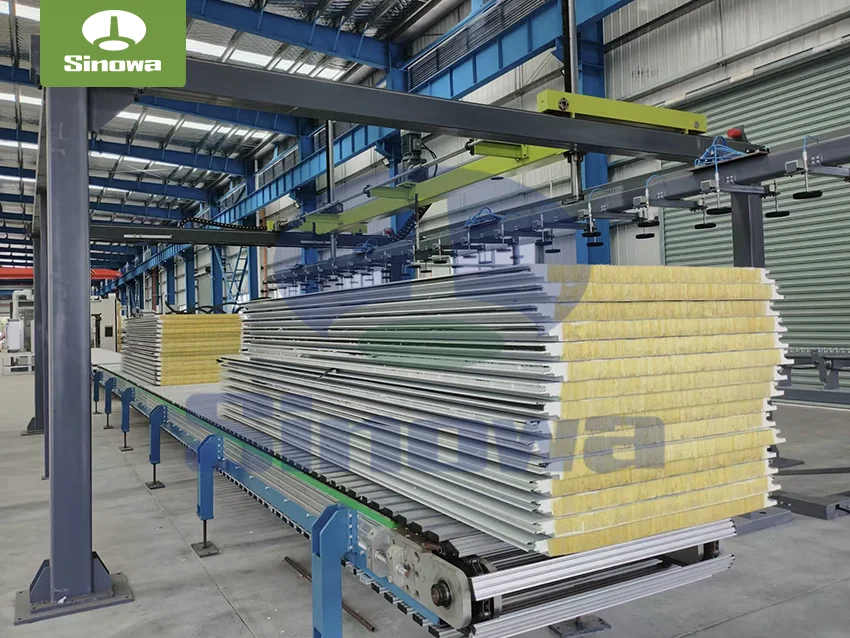
 sandwich panel machine
The core function of a rock wool sandwich panel production machine is to realize the precise compounding of rock wool core material with surface layers such as color steel sheets, aluminum sheets, or stainless steel sheets through a series of continuous and automated processes. Unlike traditional manual or semi-automatic production methods, modern production machines achieve full-process integration from raw material feeding to finished product packaging, significantly improving production efficiency while ensuring consistent product quality. The working process of the machine follows a strict logical sequence, with each link closely cooperating to form a seamless production chain that meets the large-scale demand of commercial building projects.
The production process starts with the feeding and forming of surface materials. The coil material used for the surface layer is first loaded into the decoiler, which unrolls the coil smoothly under the control of a frequency conversion system to avoid material deformation caused by uneven tension. The unrolled sheet is then conveyed to the roll forming system, where it undergoes step-by-step cold forming through a set of precision rollers. This cold forming process ensures that the surface layer obtains the required shape and structural strength without damaging the material's surface coating or mechanical properties. The forming parameters can be adjusted according to the design requirements of commercial buildings, such as the shape of the panel edge, surface texture, and thickness of the surface layer, to adapt to different application scenarios like exterior walls, roofs, and partitions.
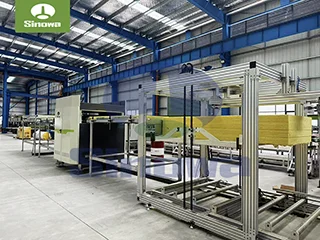
While the surface layer is being formed, the rock wool core material undergoes a series of processing procedures to meet the compounding requirements. The original rock wool slabs, usually with standard sizes, are first transported to the slitting device by a lifting system. The slitting device cuts the slabs into strips of specified thickness according to the design requirements of the sandwich panel, with adjustable thickness ranges typically covering 50mm to 250mm to meet the thermal insulation and structural needs of different commercial buildings. After slitting, the rock wool strips are conveyed to the turning system, which adjusts the fiber direction of the rock wool to be upright. This vertical fiber arrangement significantly enhances the compressive strength and thermal insulation performance of the final sandwich panel, making it more suitable for the load-bearing and energy-saving requirements of commercial buildings.
The next critical step is the compounding of the surface layer and the rock wool core material, which relies on precise adhesive spraying and lamination technology. The upper and lower surface layers that have completed roll forming are preheated to an appropriate temperature by a hot air circulation preheating system. This preheating process improves the adhesion between the adhesive and the surface layer, ensuring a firm bond. Meanwhile, the adhesive spraying system uniformly sprays polyurethane adhesive on both the upper and lower surfaces of the rock wool core material. The adhesive dosage is precisely controlled by a servo system, generally ranging from 180g to 250g per square meter, to balance bonding strength and material cost. The rock wool core material with adhesive is then accurately laminated with the upper and lower surface layers, and the composite structure is conveyed to the double belt pressing system.
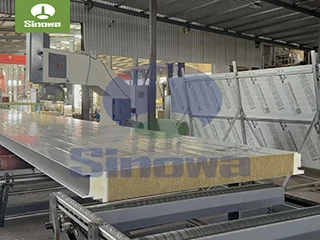
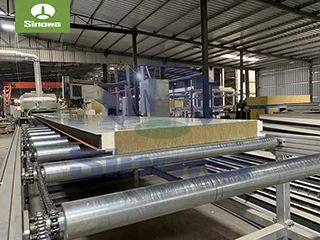
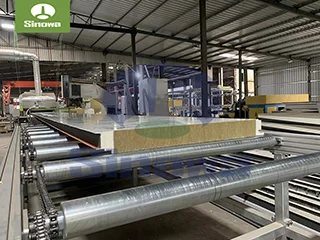
The double belt pressing system plays a key role in shaping the final product and ensuring bonding quality. This system consists of two parallel pressure belts that apply uniform pressure to the composite panel from top to bottom while maintaining a stable temperature. The combination of pressure and temperature promotes the curing of the polyurethane adhesive, ensuring that the surface layer and the rock wool core material are tightly bonded without gaps. During the pressing process, the side sealing device sprays polyurethane foam on the edges of the panel to seal the rock wool core material, preventing moisture intrusion and improving the waterproof and corrosion-resistant performance of the panel. This side sealing technology effectively overcomes the drawback of traditional rock wool panels being prone to water absorption and deliquescence, extending the service life of the panels in commercial building environments.
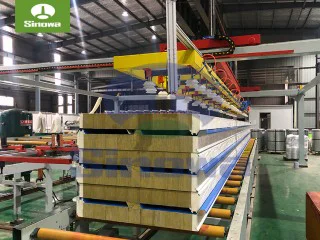
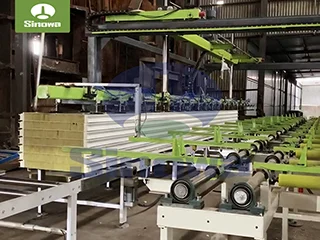
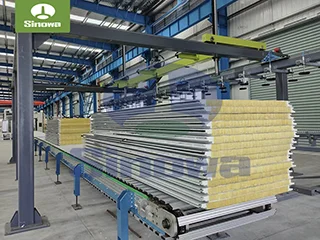
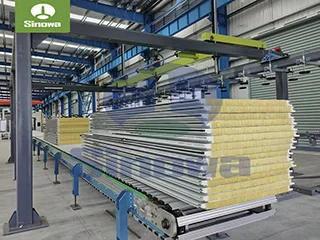
After pressing and curing, the continuous composite panel is conveyed to the cutting system for length cutting. The cutting system adopts a non-stop cutting design, which allows the machine to cut the panel to the required length while maintaining production continuity, avoiding efficiency losses caused by machine shutdowns. The cutting precision is controlled by a digital servo system, ensuring that the length error of the panel is within a small range, which facilitates the on-site installation of commercial buildings. After cutting, the finished panels are conveyed to the automatic stacking system, which arranges the panels neatly according to the set quantity and specifications. The stacking system can adjust the stacking height and mode according to the packaging and transportation requirements, reducing manual handling and improving the efficiency of subsequent packaging and transportation.
Modern rock wool sandwich panel production machines are characterized by high automation, which is mainly reflected in the integration of computer control systems and intelligent detection technologies. The entire production line is controlled by a centralized control system with a man-machine interface, allowing operators to set production parameters such as panel thickness, length, and production speed through the interface. The system automatically adjusts each component to ensure that the production process is carried out in accordance with the set parameters. At the same time, intelligent detection devices are installed at key positions of the production line to monitor parameters such as the thickness of the rock wool core material, the uniformity of adhesive spraying, and the flatness of the panel in real time. If an abnormality is detected, the system will issue an alarm and adjust automatically or stop production to avoid the production of defective products.
High production efficiency is another important advantage of modern rock wool sandwich panel production machines. The production speed of continuous production lines can be adjusted between 3 meters per minute and 8 meters per minute according to the product specifications and forming requirements. Based on 250 working days a year and 10 working hours a day, the annual production capacity can reach 800,000 to 1 million square meters, which is far higher than that of traditional production methods. This high efficiency is particularly important for large-scale commercial building projects that require a large number of sandwich panels, as it can ensure the timely supply of materials and shorten the construction period. In addition, the high degree of automation reduces the number of operators required for the production line, usually only 5 to 8 people are needed to complete the entire production process, which significantly reduces labor costs and management costs.
The adaptability and flexibility of rock wool sandwich panel production machines are also constantly improving to meet the diverse needs of commercial buildings. Commercial buildings have different requirements for sandwich panels due to differences in design styles, functional positioning, and environmental conditions. For example, shopping malls may require panels with better sound absorption performance to create a comfortable shopping environment, while high-rise office buildings may prioritize fire resistance and structural stability. Production machines can adapt to these diverse needs by adjusting parameters such as rock wool density, panel thickness, surface layer material, and edge structure. The rock wool density can be adjusted between 80kg/m³ and 120kg/m³ to balance thermal insulation, sound absorption, and structural performance. The surface layer can be replaced with different materials such as color steel sheets, stainless steel sheets, or aluminum sheets to meet the requirements of corrosion resistance, aesthetics, and durability in different commercial environments.
The performance of the panels produced by the machine directly determines their application effect in commercial buildings. Rock wool sandwich panels produced by advanced production machines have excellent fire resistance, reaching the non-combustible grade with a melting point of approximately 1000°C. The fire resistance time can reach 1 hour for 50mm thick panels and up to 4 hours for 100mm thick panels, and no toxic gases are released at high temperatures, providing a reliable safety guarantee for commercial buildings with dense personnel. In terms of thermal insulation, the thermal conductivity of the rock wool core material is as low as 0.043W/(m·K), which is more than 5 times that of concrete panels. This excellent thermal insulation performance can significantly reduce the energy consumption of commercial buildings, reducing heating costs in cold areas and air conditioning loads in hot areas.
Sound absorption and noise reduction are also important performance advantages of rock wool sandwich panels produced by these machines. The porous structure of rock wool allows it to effectively absorb sound waves, and the vertical fiber arrangement further enhances this performance. Tests show that panels using rock wool with a density of 120kg/m³ have a sound insulation capacity of 29-30dB and a sound absorption performance of DELTA LA=15.7dB(A), which is very suitable for commercial buildings such as shopping malls, hotels, and office buildings that require a quiet environment. In addition, the panels are lightweight and high-strength, with a weight only 1/19 of that of clay bricks, which can reduce the overall load of the building. The modular design of the panels also facilitates on-site installation, with an average daily installation area of 600-800 square meters, significantly shortening the construction period of commercial buildings.
In the context of global attention to energy conservation and environmental protection, rock wool sandwich panel production machines are also developing towards more energy-saving and environmentally friendly directions. Traditional production equipment may have problems such as high energy consumption and dust pollution. Modern machines adopt energy-saving technologies such as frequency conversion motors and heat recovery systems, reducing energy consumption by 40% compared with traditional equipment. The dust collection device installed in the rock wool processing section can effectively collect dust generated during slitting and conveying, avoiding environmental pollution and protecting the health of operators. In addition, the adhesive and auxiliary materials used in the production process are also developing towards environmental protection, with low volatile organic compounds (VOCs) content, in line with the environmental protection requirements of modern commercial buildings.
The application of rock wool sandwich panel production machines in commercial building projects has brought significant economic and social benefits. For construction enterprises, the high-quality panels produced by the machines can improve the construction quality and reduce the maintenance cost of the building in the later period. The efficient production capacity ensures the timely supply of materials, avoiding project delays caused by material shortages. For commercial building owners, the excellent performance of the panels can improve the comfort, safety, and energy efficiency of the building, enhancing the value and competitiveness of the property. In terms of society, the popularization of these machines promotes the upgrading of the building materials industry, promotes the development of green buildings, and contributes to the achievement of energy conservation and emission reduction goals.
With the continuous development of commercial building technology, the requirements for rock wool sandwich panels are becoming higher and higher, which also drives the continuous innovation and upgrading of production machines. Future production machines will be more intelligent, integrating technologies such as the Internet of Things, big data, and artificial intelligence to realize real-time monitoring, remote control, and predictive maintenance of the production process. The precision of the machines will be further improved to meet the requirements of ultra-thin or ultra-thick panels and complex shapes. At the same time, the research and development of multi-functional production lines will be strengthened, enabling a single machine to produce multiple types of sandwich panels with different core materials and surface layers, further improving production efficiency and flexibility.
In addition, the integration of new materials and new processes will also promote the development of rock wool sandwich panel production machines. For example, the application of new environmentally friendly adhesives can further improve the bonding strength and environmental performance of panels. The development of composite core materials will expand the application scope of sandwich panels in commercial buildings. Production machines will need to adapt to these new materials and processes through structural optimization and technological innovation, providing strong support for the sustainable development of the commercial building industry.
In conclusion, rock wool sandwich panel production machines play a crucial role in the commercial building industry. Their advanced technology, high efficiency, and flexibility ensure the stable supply of high-performance rock wool sandwich panels, providing a solid material foundation for the safety, energy efficiency, and comfort of commercial buildings. As the commercial building industry continues to move towards green, intelligent, and high-quality development, rock wool sandwich panel production machines will continue to innovate and upgrade, constantly improving production capacity, product quality, and environmental performance. These machines will not only promote the development of the building materials industry but also make important contributions to the construction of more sustainable and livable commercial spaces.
https://www.cnsinowa.com/sandwich-panel-machines/rock-wool-sandwich-panel-production-machine-for-commercial-building.html