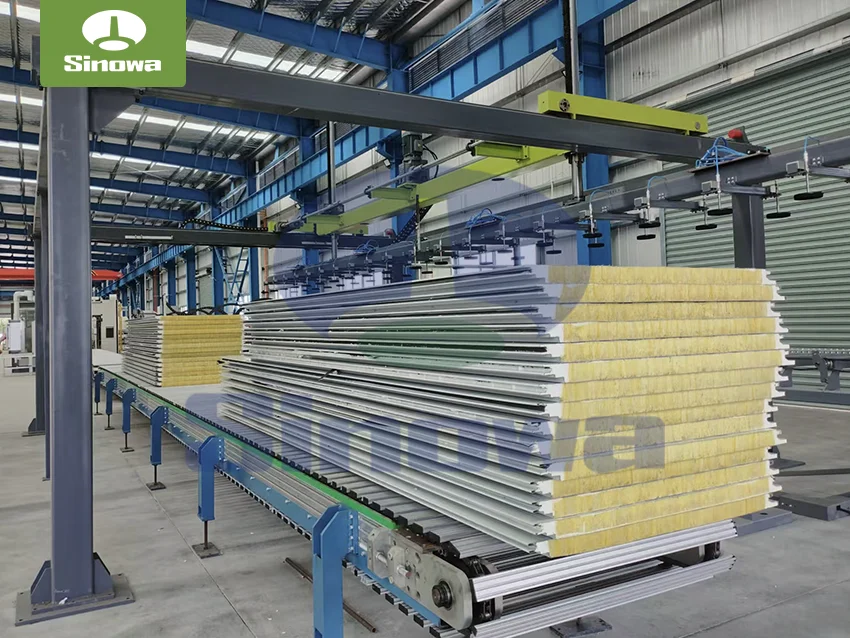
 sandwich panel machine
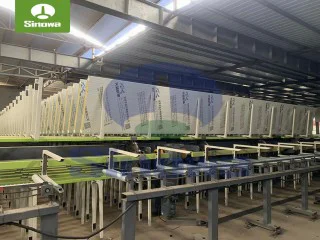
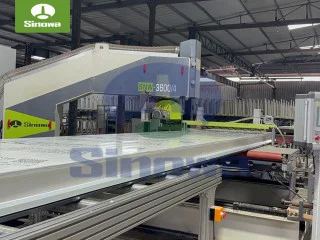
The polyurethane edge sealing rock wool sandwich panel machine is a fully automated continuous composite production line integrating metal plate cold bending forming, rock wool core material arrangement, high-pressure polyurethane foaming edge sealing, double-belt constant-pressure composite bonding, fixed-length servo cutting and automatic finished product stacking. Different from split-type intermittent production equipment for traditional sandwich panels, this machine realizes uninterrupted linear operation of all processing links from raw material input to finished panel output, eliminating manual intermediate handling and secondary processing procedures. The whole sandwich panel production line can be divided into six functional modules with cooperative linkage, including metal plate unwinding and leveling module, roller cold bending forming module, rock wool core material pretreatment and laying module, high-pressure polyurethane mixing and edge sealing pouring module, continuous double-belt pressing and curing module, as well as fixed-length cutting and automatic stacking module. Each module is connected through synchronous conveying rollers, and the operating speed, temperature parameters, material supply flow and pressing pressure of all units are uniformly adjusted by a centralized intelligent control system, ensuring consistent operating rhythm across the entire line and avoiding mismatched production speeds that lead to composite dislocation, incomplete edge foaming or uneven bonding between core materials and metal plates.
The front-end raw material processing section serves as the foundation for high-quality panel molding, starting with the metal plate unwinding and leveling unit. Coiled metal substrates are released stably through hydraulic unwinding devices, and multiple sets of precision leveling rollers eliminate internal stress and surface bending deformation generated during coil storage and transportation. Flat metal plates avoid local gaps in subsequent composite processes caused by surface warpage. After leveling, upper and lower metal plates enter the roller cold bending forming unit respectively. According to the structural design requirements of wall panels or roof panels, the continuous roller group carries out gradual edge pressing, groove bending and profiling processing on both sides of the metal plates. The profiling structure matches the edge size of rock wool core materials and reserved polyurethane sealing grooves, laying a structural foundation for seamless fitting between metal plates, rock wool cores and polyurethane edge sealing layers in the later stage. Unlike simple flat plate processing equipment, the roller forming system of this machine adopts segmented speed matching design, which can fine-tune the feeding speed of upper and lower plates independently according to different plate thicknesses, preventing tensile deformation of thin metal plates during high-speed continuous production.
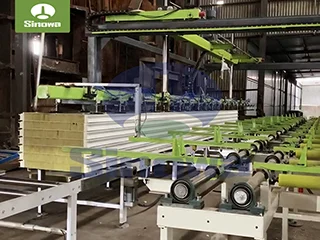
Following metal plate forming is the pretreatment and automatic laying process of rock wool core materials, a key link determining the fire resistance and overall rigidity of finished panels. Bulk rock wool raw materials contain disordered fiber structures, local fiber agglomeration and residual gaps, which will lead to uneven overall panel hardness and inconsistent fire resistance if directly laid. The rock wool sandwich panel machine is equipped with special rock wool carding and splitting equipment, which disperses compacted rock wool blocks through mechanical combing to form uniform and fluffy fiber layers with consistent density. Meanwhile, longitudinal and transverse cutting devices trim rock wool materials into fixed-width core strips matching metal plate profiles. During the laying process, servo-driven distribution equipment arranges rock wool core materials stably between the pre-formed lower metal plates, with automatic deviation correction functions installed on both sides of the conveying platform to prevent lateral offset of rock wool layers during high-speed transmission. Stable and uniform laying of rock wool cores ensures that the core layer maintains consistent fireproof performance and mechanical bearing capacity across the entire panel, avoiding potential safety hazards such as local fire penetration and insufficient compression resistance caused by uneven core material distribution.
The polyurethane high-pressure foaming and edge sealing pouring system is the core technological module that distinguishes this equipment from ordinary rock wool sandwich panel production line, and it solves the long-standing edge performance defects of conventional rock wool panels. Traditional production methods adopt manual gluing or post-edge filling processes, which cannot achieve fully enclosed seamless sealing on panel cross sections, resulting in moisture and water vapor easily penetrating into rock wool fiber gaps from panel edges. Moisture absorption will drastically reduce the thermal insulation performance of rock wool and accelerate fiber aging and panel delamination. The built-in high-pressure foaming unit of PU sandwich panel machine adopts dual-component polyurethane raw material independent metering and high-speed mixing technology. Isocyanate and polyether raw materials are transported to the mixing head through independent precision metering pumps, with real-time closed-loop control of material flow ratio to ensure the optimal foaming reaction ratio of polyurethane materials. After instantaneous high-pressure mixing inside the sealed mixing head, homogeneous polyurethane foam materials are evenly injected into the reserved edge grooves on both sides of rock wool core materials through linear automatic moving nozzles. The whole injection process runs synchronously with the linear conveying speed of the sandwich panel line, realizing continuous uninterrupted edge sealing foaming along the full length of panels.
The polyurethane foaming reaction process requires precise temperature and pressure control to guarantee edge sealing quality. The continuous sandwich panel production line is equipped with constant-temperature heating systems for material pipelines and mixing heads, maintaining a stable reaction temperature suitable for polyurethane foaming all year round and avoiding incomplete foaming in low-temperature environments or excessive foam shrinkage in high-temperature environments. After injection, polyurethane materials undergo rapid foaming, filling and curing within several seconds, closely wrapping the end faces of rock wool core materials to form fully closed waterproof and thermal insulation edge structures. The integrated edge sealing structure eliminates open fiber gaps on rock wool cross sections, completely blocks moisture penetration channels, and effectively eliminates thermal bridge effects at panel splicing joints during building installation. In addition to edge sealing, an appropriate amount of polyurethane bonding material can be sprayed on the upper and lower surfaces of rock wool cores according to production demands, enhancing the bonding force between rock wool layers and metal plates and avoiding interlayer delamination caused by long-term wind load and temperature alternating changes in building use scenarios.
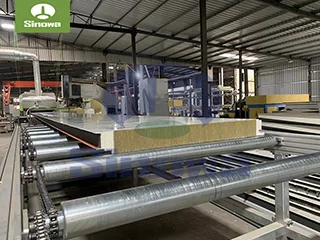
After completing core material laying and edge sealing injection, semi-finished panels enter the continuous double-belt pressing and curing module, which is responsible for overall composite shaping and stable curing of multi-layer structures. The upper and lower circulating steel belts clamp the metal plates, rock wool cores and polyurethane edge sealing layers synchronously, providing stable and uniform static pressure throughout the composite process. Compared with intermittent pressing equipment, continuous double-belt pressing will not produce periodic pressure changes, so there is no local dislocation or bubble generation inside composite panels. The internal heating circulation system of the pressing section accelerates the curing molding speed of polyurethane foam and adhesive components, shortening the production cycle while ensuring that the bonding strength between each layer meets long-term engineering use standards. The length of the pressing and curing section is matched with the linear operating speed of the continuous sandwich panel manufacturing line, ensuring that polyurethane materials complete sufficient curing reaction before panels exit the pressing unit, preventing structural deformation or edge collapse of panels in subsequent cutting and transportation processes.
The post-processing part of the continuous sandwich panel line includes high-precision fixed-length cutting and automatic finished product stacking. Servo-driven flying saw cutting equipment realizes dynamic following cutting without stopping the production line, which greatly improves overall production efficiency compared with static cutting that requires line shutdown. The cutting system supports free adjustment of panel cutting length according to different engineering construction requirements, with smooth and neat cutting sections without metal plate burrs or core material collapse. After cutting, finished panels are transmitted to the automatic stacking platform, where mechanical arms complete automatic arrangement, layer-by-layer stacking and position correction. The whole process cancels manual carrying and stacking, reduces labor costs in the production workshop, and avoids surface scratches and structural damage to panels caused by manual operation errors.
From the perspective of actual production and engineering application effects, panels manufactured by polyurethane edge sealing rockwool sandwich panel making machine has comprehensive performance improvements in multiple dimensions compared with ordinary rock wool sandwich panels. In terms of waterproof and moisture-proof performance, fully enclosed polyurethane edge sealing completely isolates rock wool fibers from external humid air, and the water absorption rate of panel edges is reduced by more than 90%, so the thermal insulation performance of panels can remain stable for more than 20 years in high-humidity environments such as coastal areas and cold chain warehouses. In terms of thermal insulation performance, the integral polyurethane edge structure with low thermal conductivity eliminates thermal bridges at panel splicing gaps, reducing the overall heat transfer coefficient of building enclosure systems and lowering long-term building operation energy consumption. In terms of structural stability, the integrated composite structure formed by synchronous pressing of polyurethane materials enhances the overall torsional resistance and bending resistance of panels. Panels can withstand larger wind pressure loads when used as exterior wall and roof enclosure materials for high-rise buildings and large-span industrial plants, reducing the risk of panel deformation and falling off under extreme weather conditions.
In terms of fire safety performance, the equipment retains the excellent fireproof advantage of inorganic rock wool core materials while adopting flame-retardant modified polyurethane raw materials for edge sealing parts. The composite panels maintain non-combustible fire protection grade consistent with pure rock wool panels, and the edge sealing structure will not produce molten droplets during high-temperature combustion, avoiding secondary fire hazards. This performance characteristic makes such panels widely applicable to building scenarios with strict fire protection requirements, including pharmaceutical clean workshops, electronic manufacturing workshops, large logistics warehouses and public transportation buildings. Meanwhile, the seamless edge structure also optimizes the sound insulation effect of panels. The closed edge avoids sound wave leakage from panel splicing gaps, improving the overall noise reduction performance of building enclosure structures and creating quieter indoor working and production environments.
In terms of production operation and cost control, the full-link integrated automatic design of polyurethane edge sealing rockwool sandwich panel production machine reduces manual intervention links to the greatest extent. One set of automatic sandwich panel production line only requires a small number of operators to complete parameter monitoring and daily equipment maintenance, effectively cutting labor input in panel manufacturing workshops. The synchronous matching design of all functional modules reduces material waste in the production process: the precision metering system of polyurethane materials avoids excessive raw material consumption, and the integrated forming process eliminates leftover materials generated by secondary edge trimming in traditional processes. Although the equipment integrates multiple sophisticated functional units, its daily maintenance logic is systematic and simple. The centralized control system has real-time fault self-diagnosis and abnormal alarm functions, which can quickly locate abnormal points such as blocked material pipelines, mismatched transmission speed and insufficient pressing pressure, helping maintenance personnel complete rapid troubleshooting and reduce production line downtime losses.
In the context of global dual-carbon goals and upgraded building energy-saving standards, the market demand for high-performance fireproof and thermal insulation composite panels continues to grow, which also puts forward higher requirements for the iterative upgrading of sandwich panel production equipment. The future optimization direction of polyurethane edge sealing rock wool sandwich panel manufacturing machine mainly focuses on three aspects: intelligent digital upgrading, energy-saving transformation of production links, and multi-functional flexible production adaptation. Firstly, the equipment will be further combined with digital twin technology to realize real-time simulation of the whole production process, remote parameter adjustment and unmanned full-line operation, reducing human operation errors and achieving refined intelligent production. Secondly, waste heat recovery devices will be added to the heating and pressing sections of the sandwich panel manufacturing line to recycle residual heat generated by polyurethane reaction and circulating heating, reducing overall power consumption of the equipment and improving the energy utilization rate of the production process. Thirdly, the equipment will enhance flexible switching capacity of panel specifications, realizing rapid switching production between wall panels, roof panels, special-shaped joint panels and other different types of panels without replacing roller molds, adapting to more personalized and customized building enclosure demands.
In conclusion, polyurethane edge sealing rock wool sandwich panel production machinery solve the core performance pain points of traditional rock wool sandwich panels through innovative integrated edge sealing technology and full-process automated composite production logic. This equipment perfectly combines the fire resistance advantage of inorganic rock wool materials and the waterproof, thermal insulation and structural stability advantages of organic polyurethane foam materials, achieving complementary performance strengths of two different composite materials. It not only improves the production efficiency and finished product qualification rate of sandwich panel manufacturing industry, but also provides high-quality, long-life and low-energy-consumption enclosure materials for modern modular buildings, energy-saving buildings and industrial construction projects. As global building energy-saving and fire safety regulations become increasingly rigorous, this type of automated composite sandwich panel equipment will gradually become standard configuration for medium and high-end sandwich panel production enterprises, continuously promoting the high-quality development of the global building composite material manufacturing industry and modular construction field.
https://www.cnsinowa.com/sandwich-panel-machines/polyurethane-edge-sealing-rock-wool-sandwich-panel-machine.html