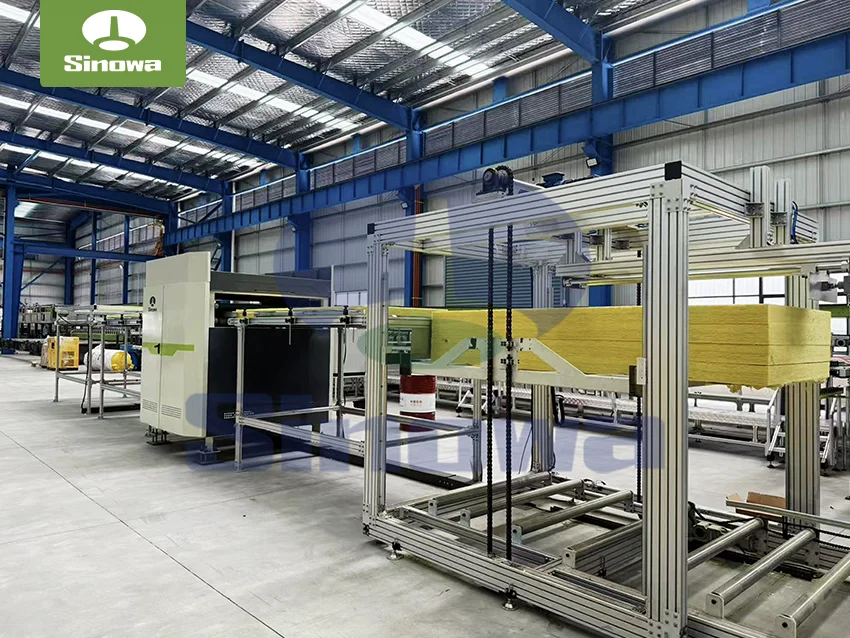
 sandwich panel line
The operational logic of the polyurethane sandwich panel production line is based on synchronous linkage and precision automated control, with every production procedure coordinated in a continuous and orderly manner to ensure consistent product quality and stable production efficiency. At the initial stage of production, the system completes the pretreatment of metal surface materials, which mainly includes uncoiling, leveling, trimming, and surface protection film lamination. The metal base material, usually pre-coated metal sheets with stable surface performance, is released from the coil rack at a constant speed, and the leveling unit eliminates the subtle deformation and internal stress generated during coil storage and transportation. The trimming device accurately calibrates the edge dimension of the metal sheet to ensure the flatness and uniformity of the subsequent composite fit, while the surface lamination process prevents surface scratches and pollution during high-temperature processing and mechanical extrusion, laying a foundation for the stable appearance and long-term service performance of finished panels.
Following the surface material pretreatment process, the production system enters the core material arrangement and laying stage, which determines the basic thermal insulation and fireproof performance of the final product. Rock wool core materials, processed into uniform strip structures with consistent density and fiber direction, are transported to the assembly station through an automatic conveying mechanism. The equipment is equipped with a precise material distribution structure that arranges rock wool strips in an orderly and closely fitted manner, effectively avoiding hollow gaps and uneven density inside the panel core. Uniform core material arrangement is critical to eliminating local thermal bridges and inconsistent fire resistance of the panel, ensuring that every section of the finished panel maintains stable thermal insulation, sound absorption, and fireproof capabilities. Different from manual auxiliary laying in traditional production modes, the automated laying structure of the production line realizes continuous and seamless core material arrangement, greatly improving the compactness and overall uniformity of the rock wool core layer.
Polyurethane edge sealing treatment is the most innovative and functional core link of the PU sandwich panel production line, distinguishing it from ordinary rock wool panel production equipment. In this process, the precise batching and feeding system stably conveys polyurethane raw materials through fully sealed pipelines, with an intelligent metering structure controlling the output and foaming ratio accurately to avoid material waste and uneven foaming caused by manual debugging. The polyurethane raw materials undergo uniform mixing and then are evenly poured and foamed on both side edges of the arranged rock wool core layer. Through controllable low-pressure foaming technology, the polyurethane material fully fills the edge gaps of the rock wool core layer and forms a dense and integrated sealing structure after rapid curing and forming. This edge sealing structure closely bonds with the rock wool core and the outer metal sheet, completely sealing the loose fiber gaps at the edge of traditional rock wool panels.
This unique edge sealing process brings multiple performance improvements to the panel. Firstly, it effectively blocks the penetration of moisture, humid air, and dust, solving the problem that traditional rock wool panels are prone to moisture absorption, mildew, and fiber shedding at the edges during long-term use, which leads to reduced thermal insulation performance and shortened service life. Secondly, the high-density polyurethane sealing layer significantly enhances the overall structural rigidity and impact resistance of the panel, improving the bending and compression resistance of the edge part that is most prone to structural damage during installation and use. In addition, the integrated sealing structure eliminates the air leakage gap at the panel splicing position, optimizes the overall air tightness of the building enclosure system, and further improves the energy-saving effect of the building by reducing convective heat loss.
After the completion of edge sealing foaming, the semi-finished panels enter the constant-temperature heating and composite pressing stage, which is a key procedure to realize the integrated bonding of metal surface layer, rock wool core layer, and polyurethane edge sealing layer. The polyurethane sandwich panel line adopts a segmented temperature control double-belt pressing structure, with independent temperature adjustment modules set in different pressing sections to match the curing requirements of polyurethane materials and the bonding characteristics of composite layers. The upper and lower pressing belts run synchronously at a constant speed, and the gap between the belts can be adaptively adjusted according to the preset panel thickness, ensuring uniform pressing force on the entire panel surface. Under the condition of constant temperature and constant pressure, the polyurethane material completes secondary curing and tight bonding, forming an integrated composite structure without gaps between layers. This continuous pressing and curing mode avoids the problems of uneven bonding, layer separation, and bubbling that are common in intermittent pressing production, and greatly improves the structural stability and overall flatness of finished panels.
The curing zone is designed with a reasonable length and constant-temperature environment, providing sufficient reaction time for the composite materials to ensure that the molecular bonding of polyurethane materials is fully completed and the bonding strength between composite layers reaches the optimal state. The stable temperature environment prevents residual stress inside the panel caused by uneven temperature changes, effectively avoiding panel deformation, warping, and edge cracking in the subsequent use process. After continuous curing and forming, the integrated composite panel has excellent overall consistency, with coordinated stress distribution inside the structure and strong resistance to external temperature changes and mechanical extrusion.
The fixed-length cutting and post-processing stage is the final shaping link of the rock wool sandwich panel line. The fully formed continuous composite panel is transported to the precision cutting unit through a synchronous conveying mechanism. The intelligent control system presets the cutting size according to production requirements, and the high-speed cutting equipment completes flat and smooth cutting without burrs and edge damage. Different from traditional cutting equipment that is prone to fiber scattering and edge cracking, the cutting structure of this production line is optimized for the composite characteristics of polyurethane and rock wool materials, which can keep the cutting section neat and the edge sealing structure intact, ensuring the dimensional accuracy and appearance quality of each finished panel. After cutting, the equipment automatically completes edge finishing and surface cleaning to remove residual materials generated during cutting, ensuring the cleanliness and flatness of the panel surface and edges.
The finished panel sorting and stacking system realizes automatic collection and arrangement of finished products. The sorted panels are neatly stacked through a mechanical stacking structure, which avoids surface friction damage and irregular stacking deformation caused by manual handling. The automated stacking mode also standardizes the specification of finished product storage, facilitating subsequent centralized transportation and on-site construction and installation. The entire production process from raw material input to finished product output is completed on a single continuous sandwich panel production line, realizing uninterrupted cyclic production and greatly improving production continuity and output efficiency.
The core advantages of the polyurethane edge sealing rock wool board production line are reflected in its high automation level, stable production performance, and excellent product quality control capability. The entire production process adopts a centralized linkage control system, which realizes one-key adjustment of production parameters such as panel thickness, production speed, and cutting size. The system can automatically monitor the operating status of each unit in real time, including raw material feeding volume, heating temperature, pressing pressure, and conveying speed, and perform real-time fine adjustment of parameters according to production conditions to ensure the stability of the production process. This intelligent control mode reduces human intervention in the production process, avoids product quality fluctuations caused by manual operation errors, and significantly improves the yield rate of finished products.
In terms of production adaptability, the rock wool sandwich panel machine has strong flexible production capacity. It can adapt to the production of composite panels with different thickness specifications by adjusting the gap of the pressing unit and the feeding parameters of raw materials, and can meet the diversified production needs of different architectural scenarios. The modular structural design of the equipment makes the production line compatible with multiple types of surface metal materials and rock wool core materials with different densities, realizing flexible switching of production specifications without major equipment transformation. This flexible production feature enables manufacturers to quickly respond to the differentiated market demand and improve the comprehensive utilization rate of production equipment.
The panels produced by this production line have comprehensive performance advantages compared with traditional building enclosure panels. The rock wool core material endows the panel with excellent fire resistance and high-temperature resistance, effectively blocking the spread of flame and heat flow in case of fire, and meeting the safety protection needs of high-standard building fire prevention. The internal fiber porous structure of rock wool also provides outstanding sound absorption and noise reduction performance, which can effectively isolate external noise and reduce indoor sound resonance, improving the comfort of the building space. The polyurethane edge sealing layer makes up for the structural defects of rock wool materials, realizing waterproof, moisture-proof, and dust-proof functions at the edge of the panel, and avoiding the attenuation of thermal insulation performance caused by the entry of humid air and dust into the core layer.
In terms of structural durability, the integrated composite structure formed by polyurethane bonding and edge sealing enables the panel to have strong overall structural stability. The close combination of metal sheet, rock wool core, and polyurethane sealing layer makes the panel have good wind resistance, pressure resistance, and structural deformation resistance, and can maintain stable performance in long-term outdoor complex environments such as temperature difference changes, humid weather, and wind and rain erosion. The service life of the panel is significantly extended compared with ordinary rock wool panels, reducing the frequency of building maintenance and replacement in the later stage.
From the perspective of construction and application, the finished panels produced by the PU sandwich panel machine have high dimensional accuracy and good splicing compatibility. The neat and regular edge structure enables seamless assembly between panels during on-site construction, avoiding the problems of poor splicing tightness and secondary filling treatment required by traditional panels. The lightweight integrated structural design reduces the overall self-weight of the building enclosure, reduces the load pressure on the building main structure, and simplifies the construction process. The panels do not need complex secondary processing on the construction site, which can greatly shorten the construction cycle, improve construction efficiency, and reduce comprehensive construction costs.
With the continuous upgrading of green building and energy-saving building standards in the construction industry, the market demand for high-performance thermal insulation and fireproof enclosure panels is constantly increasing, which further highlights the application value of polyurethane edge sealing rock wool panel production lines. As a green and efficient building material manufacturing equipment, it does not produce excessive waste and pollutant emissions during the production process. The precise raw material metering system avoids material waste, and the closed production process reduces dust and noise pollution in the production workshop, meeting the development requirements of modern green manufacturing.
In the field of industrial construction, the panels produced by this equipment are widely used in the enclosure structures of industrial workshops, logistics warehouses, and clean workshops, providing stable fire prevention, thermal insulation, and dust-proof effects for industrial production spaces. In the field of public buildings, they are suitable for large-span venues, commercial buildings, and office buildings, balancing building safety, energy saving and aesthetic performance. In high-standard energy-saving buildings, the excellent thermal insulation and air tightness of the panels can effectively reduce the heating and cooling energy consumption of buildings, realize efficient utilization of building energy, and conform to the development trend of low-carbon and energy-saving buildings.
In the future development of building material manufacturing, the polyurethane edge sealing rockwool sandwich panel production line will continue to evolve towards higher intelligence, higher efficiency, and more diversified adaptability. With the continuous progress of industrial automation technology, the equipment will realize more refined parameter control and intelligent fault diagnosis, further improving production stability and product consistency. At the same time, with the continuous innovation of new building materials and building structures, the production line will continuously expand its production adaptability, meet the manufacturing needs of more high-performance composite panels, and provide more reliable core equipment support for the high-quality development of the modern construction industry. As an important carrier of advanced building material manufacturing technology, this production line will continue to play an irreplaceable role in promoting the upgrading of building enclosure material performance and the standardized development of the building material industry.
https://www.cnsinowa.com/sandwich-panel-machines/polyurethane-edge-sealing-rock-wool-panel-line.html






