sinowa@sinowa.cn
+0086 151 0610 6366
Rock Wool Board Processing And Forming Equipment

Rock Wool Board Processing And Forming Equipment

Jul 14, 2026

Rock wool board processing and forming equipment constitutes the core industrial system for manufacturing high-performance inorganic thermal insulation and fireproof building materials. As global demand for energy-efficient construction, fire safety enhancement, and sustainable industrial insulation continues to rise, the technological maturity and operational stability of rock wool processing and forming equipment have become pivotal factors determining the quality, performance consistency, and production efficiency of rock wool board products. Different from traditional simple material processing machinery, modern rock wool board processing and forming equipment integrates multi-stage physical processing, intelligent temperature regulation, precision fiber forming, and automated molding curing technologies, achieving full-process continuous production from raw material pretreatment to finished product shaping. This systematic equipment solution not only realizes the standardized manufacturing of rock wool boards with stable density, uniform fiber structure, and reliable mechanical strength but also adapts to diverse production requirements for different application scenarios, laying a solid technical foundation for the wide promotion of rock wool insulation materials in construction, petrochemical, industrial manufacturing, and new energy fields.

Home > Sandwich Panel Machines > Rock Wool Board Processing And Forming Equipment

Rock Wool Board Processing And Forming Equipmentsandwich panel machine

The operational logic of rock wool board production line is based on the physical fiberization and thermosetting molding principle of inorganic mineral raw materials. The entire production and forming process abandons chemical synthesis pollution links, relying entirely on high-temperature melting, mechanical centrifugal fiber stretching, directional fiber lapping, and constant-temperature curing molding, which endows the final rock wool board with inherent advantages of non-combustibility, low thermal conductivity, sound absorption, and corrosion resistance. The complete equipment system covers raw material pretreatment, high-temperature melting, fiber forming, binder spraying, wool felt forming, constant-temperature curing, fixed-size cutting, and finished product shaping, with each functional module closely linked and operating synchronously to form a closed-loop automated production system. The structural design and parameter matching of each equipment module directly affect the key performance indicators of rock wool boards, including thermal insulation efficiency, fire resistance rating, compressive strength, and dimensional stability, making the overall equipment integration capability the core competitiveness of modern rock wool board production.

Raw material pretreatment is the initial key link of the entire processing and forming system, and the supporting equipment in this stage undertakes the task of standardizing raw material status to lay a foundation for subsequent high-quality fiber forming. Natural mineral raw materials such as basalt, dolomite, and slag, as the main raw materials of rock wool, often have uneven particle sizes and mixed impurities after initial mining and collection. The pretreatment equipment is equipped with vibration screening, crushing, automatic conveying, and storage metering modules, which can crush bulk raw materials into uniform fine particles and remove impurity particles that affect melting and fiber forming quality. At the same time, the intelligent batching system in the pretreatment link can realize precise proportional mixing of main raw materials and auxiliary materials according to production process requirements, ensuring consistent raw material components for each batch of production. Uniform particle size and stable component ratio effectively avoid local insufficient melting or excessive burning in the high-temperature melting stage, preventing the generation of inferior thick fibers and non-fibrous slag balls, which is a prerequisite for improving the yield and quality of rock wool board finished products.

High-temperature melting equipment is the core energy supply and raw material transformation unit of the rock wool sandwich panel production line, responsible for converting solid mineral particles into homogeneous high-temperature molten liquid. The melting furnace adopted by modern processing and forming equipment is designed with heavy-duty refractory lining, which can withstand long-term extreme high-temperature operation and reduce heat loss during the melting process. Equipped with an intelligent dynamic temperature control system, the equipment can accurately maintain the internal temperature between 1400°C and 1600°C, and dynamically adjust heating power in real time according to raw material feeding speed, particle state, and melting progress. This intelligent temperature regulation mode ensures that all mineral raw materials are fully melted into smooth and viscous molten liquid, completely eliminating unmelted solid particles and internal bubbles in the melt. The stable melting state not only improves the uniformity of subsequent fiber stretching but also effectively reduces energy consumption, realizing the dual goals of stable production and energy-saving operation. After full melting and impurity removal, the high-temperature molten liquid flows out stably through the automatic flow guide pipeline and enters the fiber forming stage in a constant flow state.

Fiber forming is the most critical process that determines the basic structural characteristics of rock wool boards, and the supporting centrifugal fiber forming equipment is the core functional component of the entire processing system. The high-temperature molten liquid entering the fiber forming unit is subjected to dual effects of high-speed centrifugal force and directional high-speed airflow generated by professional spinning equipment, which instantly stretches the viscous molten liquid into ultra-fine inorganic fibers with uniform diameter and consistent length. The precision of the centrifugal rotating speed and airflow pressure control directly determines the fineness and uniformity of rock wool fibers. Excellent fiber forming equipment can control the fiber diameter within a stable microscopic range, ensuring that the fibers have good flexibility and intertwining performance. After fiber forming, the dispersed rock wool fibers are evenly sprayed with a quantitative inorganic binder through an automatic spraying system. The binder is uniformly attached to the fiber surface in a fine mist state, which can enhance the bonding force between subsequent intertwined fibers without blocking the microscopic pores of the fiber structure, thus retaining the excellent thermal insulation and sound absorption performance of rock wool materials.

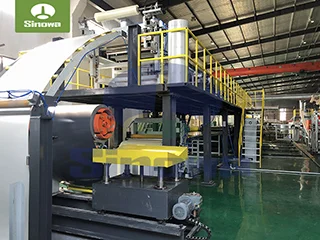
Negative pressure collection and wool felt forming equipment undertake the task of preliminary structural shaping of rock wool fibers, realizing the transition from dispersed single fibers to continuous wool felt blanks. The fiber mixture sprayed with binder is adsorbed and settled on the mesh belt conveying system through stable negative pressure airflow. The rock wool sandwich panel machine adopts a directional lapping process, which can make the fibers interweave and stack in three-dimensional directions, forming a loose, uniform, and continuous fiber wool felt structure. Different from single-layer flat laying, the three-dimensional interwoven forming mode effectively improves the overall structural toughness and compressive uniformity of the wool felt blank, avoiding the problem of local density difference caused by single-direction fiber accumulation. In this link, the equipment can flexibly adjust the negative pressure adsorption intensity, mesh belt operating speed, and fiber lapping thickness according to the production specifications of target rock wool boards, realizing precise control of the initial density and thickness of the wool felt blank, and providing accurate blank parameters for subsequent curing and final shaping.

Constant-temperature curing equipment is the key module to realize the fixed molding and structural stabilization of rock wool board blanks, which transforms loose wool felt blanks into high-strength integrated board structures through precise high-temperature baking. The curing furnace adopts a double-belt uniform heating structure, which can form a constant and uniform high-temperature heating environment inside the furnace body, ensuring that each part of the wool felt blank receives consistent heat treatment. Under the set constant-temperature condition, the binder attached to the fiber surface fully reacts and solidifies, tightly bonding the interwoven rock wool fibers into an integral stable structure. The intelligent temperature control and air circulation system inside the curing furnace eliminates local temperature differences, preventing problems such as incomplete curing, insufficient bonding strength, or excessive baking fiber embrittlement. Meanwhile, the synchronous operating speed of the curing furnace and the front-end forming equipment ensures the continuity and consistency of the production process. After curing, the loose wool felt completely forms a rigid board structure with stable size, uniform density, and excellent mechanical properties, which has the basic performance of finished rock wool boards.

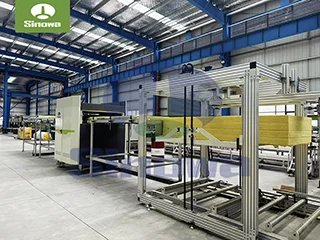
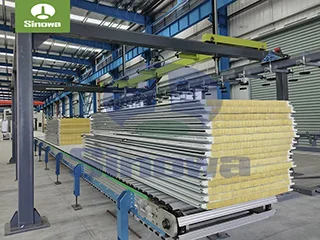
Precision cutting and post-processing equipment completes the final sizing and finishing of rock wool boards, realizing the transformation from continuous cured board blanks to standard finished products. The automated fixed-length cutting system adopts servo-driven high-precision flying cutting technology, which can perform accurate sizing cutting according to customized specification requirements. The cutting equipment runs synchronously with the front-end curing and conveying system, realizing non-stop continuous cutting, which greatly improves production efficiency while ensuring flat cutting sections, straight board edges, and consistent dimensional accuracy of each finished board. In addition, the supporting trimming and finishing modules can optimize the edge structure of rock wool boards, improving the flatness and overall uniformity of finished products. After cutting and finishing, the qualified rock wool board finished products are automatically conveyed to the stacking platform through the conveying system, realizing orderly automatic stacking, which is convenient for subsequent inspection and packaging storage.

The core technical advantages of modern rock wool sandwich panel line are reflected in high automation, precise parameter control, stable product performance, and energy-saving and environmental protection operation. The entire production process realizes automated closed-loop control from raw material feeding to finished product stacking, with minimal manual intervention, which effectively reduces human error in the production process and improves production consistency and stability. All key process parameters, including melting temperature, centrifugal speed, binder spraying amount, curing temperature, and conveying speed, support precise digital adjustment and real-time monitoring, enabling the equipment to quickly adapt to production requirements of rock wool boards with different densities, thicknesses, and strength grades. The standardized and modular design of the equipment ensures the stability of long-term continuous operation, reduces equipment failure rate and maintenance cost, and improves the overall production capacity of the production line.

In terms of environmental protection and energy saving, the upgraded rockwool board production line optimizes the heat insulation structure of the melting furnace and curing furnace, effectively reducing heat loss in the production process and improving thermal energy utilization efficiency. The closed production design avoids dust overflow and material waste in the processing process, realizing clean production. Meanwhile, the intelligent energy-saving system can automatically adjust energy supply according to production load, avoiding invalid energy consumption during equipment no-load and low-load operation. Compared with traditional backward processing equipment, the modern integrated forming system has significant advantages in energy consumption reduction, pollutant emission control, and material utilization rate improvement, conforming to the current industry requirements of green manufacturing and sustainable development.

The performance adaptability of processing and forming equipment directly determines the application scope of rock wool board products. By adjusting the operating parameters of each functional module, the equipment can produce rock wool boards with different physical properties, which can meet the differentiated needs of multiple fields. High-density high-strength rock wool boards produced by parameter optimization are suitable for building exterior wall thermal insulation and fire isolation belt scenarios, with excellent compressive resistance and fire stability; medium-density conventional rock wool boards are widely used for indoor building thermal insulation and sound absorption decoration; low-density lightweight rock wool boards are applicable to industrial equipment and pipeline thermal insulation fields. The flexible parameter adjustment capability of the equipment realizes the diversified production of a single production line, greatly improving the market adaptability and production flexibility of the production system.

With the continuous upgrading of industrial intelligent manufacturing technology, rock wool sandwich panel production machine is developing towards higher intelligence, higher precision, and more integrated operation. The emerging intelligent monitoring system can realize real-time collection and analysis of equipment operating data and product quality data, automatically identify abnormal parameter fluctuations and potential equipment faults, and realize early warning and automatic adjustment, further improving production stability and product qualification rate. The modular integrated design simplifies equipment installation, debugging, and later maintenance processes, reducing the technical threshold of equipment operation and management. In addition, the continuous optimization of fiber forming and curing molding technology further improves the fiber structure uniformity and internal bonding tightness of rock wool boards, effectively enhancing the thermal insulation, fire resistance, and durability of finished products.

In the context of global emphasis on building energy conservation, fire safety, and green environmental protection, rock wool, as a high-quality inorganic environmental protection thermal insulation material, has a continuously expanding market demand, which puts forward higher technical requirements for supporting processing and forming equipment. The future development of rock wool board processing and forming equipment will focus on intelligent full-process automation, ultra-low energy consumption operation, high-precision product molding, and multi-specification flexible production. Through the deep integration of digital control technology, new energy-saving materials, and mechanical optimization design, the equipment will further break through the bottlenecks of traditional production technology, realize higher efficiency, lower consumption, and higher quality production, and provide more reliable technical equipment support for the high-quality development of the rock wool material industry and the popularization and application of green building energy-saving technology.

https://www.cnsinowa.com/sandwich-panel-machines/rock-wool-board-processing-and-forming-equipment.html

Main Products

Any Questins About Continuous Sandwich Panel Production Lines or Other Products

Email us with inquiries or use our contact infomations

Get In Touch