 sandwich panel line
The operational logic of the full automatic rock wool sandwich panel production line is built on seamless coordination between mechanical transmission, automatic control, material conveying, and chemical bonding curing systems, realizing a fully closed-loop production process. The entire manufacturing workflow proceeds in a continuous linear manner, with each functional unit closely connected and synchronized in operation, avoiding production interruptions caused by manual docking and process conversion. Compared with traditional semi-automatic production modes that rely heavily on manual feeding, gluing, and composite positioning, the fully automatic production line optimizes every key link, effectively reducing human error, improving production consistency, and significantly boosting overall production efficiency while lowering long-term operational costs for manufacturing enterprises.
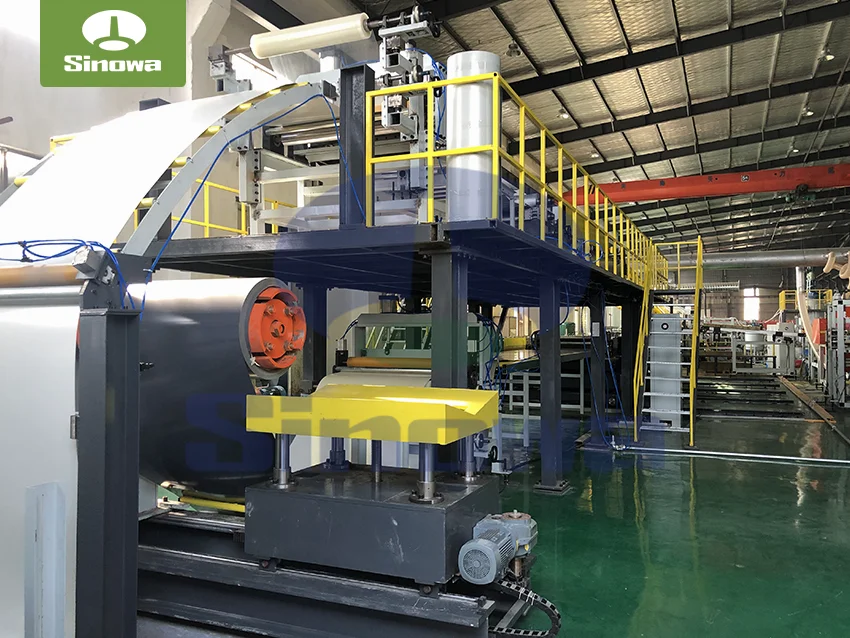
The production process initiates with the automatic raw material feeding and pre-treatment stage, which serves as the foundation for ensuring the surface quality and structural accuracy of finished panels. The system is equipped with a stable coil unwinding unit that supports continuous feeding of metal sheet coils, adopting a structural design that enables uninterrupted coil replacement. This design effectively avoids production shutdowns during raw material replacement, ensuring the continuity of mass production. After unwinding, the metal sheets are automatically transported to the pre-processing module, where multi-stage surface treatment is carried out. Professional cleaning components remove residual oil stains, dust, and oxide layers on the metal surface through physical brushing and mild purification treatment, creating a clean and flat bonding base for subsequent adhesive application. Following cleaning, the leveling unit eliminates internal bending stress and surface unevenness generated during coil winding, ensuring the flatness and dimensional stability of metal sheets throughout the forming process. This meticulous pre-treatment process directly enhances the bonding firmness between metal surface layers and rock wool core materials, preventing delamination, warping, and quality defects in finished panels during long-term use.
Parallel to metal sheet pre-treatment, the system completes the automatic arrangement and conveying of rock wool core materials, another core link that determines the overall performance of sandwich panels. Rock wool raw materials, characterized by porous fibrous structures and excellent fireproof and thermal insulation properties, require standardized cutting, sorting, and arranging before composite molding. The fully automatic rock wool sandwich panel line is fitted with an intelligent core material processing system that automatically cuts whole rock wool blocks into uniform strip structures according to preset panel thickness specifications. The system precisely adjusts the spacing and density of rock wool strips, ensuring uniform filling inside the panels and avoiding hollow or uneven density issues that may affect thermal insulation and fire resistance performance. Meanwhile, a dedicated dust collection and purification device is installed around the core material processing area to collect floating fiber debris generated during cutting and arrangement. This not only maintains a clean and safe production environment but also prevents fiber impurities from adhering to the bonding surface and affecting the composite quality of the panels, realizing environmentally friendly and standardized core material processing.
After the completion of raw material pre-treatment for both metal sheets and rock wool cores, the production process enters the precision adhesive coating and pre-composite stage, which is critical to the structural integrity and service life of sandwich panels. The rockwool sandwich panel production line adopts a high-precision automatic gluing system that evenly sprays environmentally friendly high-performance polymer adhesive on the inner surfaces of upper and lower metal sheets and the contact surfaces of rock wool core materials. The system intelligently controls the glue application volume, spraying range, and uniformity according to different panel thicknesses and production speeds, avoiding quality problems such as insufficient bonding strength caused by uneven glue coating or surface bulging caused by excessive glue accumulation. The selected adhesive material features fast curing speed, strong adhesion, and excellent weather resistance, which can tightly bond metal layers and rock wool fiber structures into an integrated whole. After gluing, the materials enter the pre-composite positioning unit, where the automatic positioning system accurately calibrates the relative positions of metal sheets and rock wool core materials to ensure consistent edge alignment and overall dimensional accuracy of the composite structure, laying a solid foundation for subsequent integral pressing and curing forming.
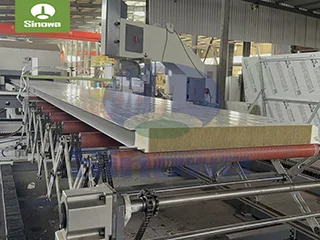
The integral pressing and constant-temperature curing stage is the core process that shapes the structural performance of rock wool sandwich panels. The fully automatic rock wool sandwich panel machine is equipped with a high-stability pressure composite system that provides continuous and uniform pressure for the pre-composite materials. The pressure value is precisely adjusted through an intelligent control system based on panel specifications and material characteristics, ensuring that the rock wool core material is closely attached to the metal surface layers without causing fiber compression deformation or structural damage. While maintaining stable pressure, the constant-temperature curing system provides a reasonable temperature environment for adhesive curing. The temperature is regulated in real time within a scientific range to accelerate the curing reaction of the polymer adhesive, enabling rapid formation of a stable bonding structure between layers. The closed curing chamber design ensures uniform internal temperature distribution, avoiding local incomplete curing or excessive curing aging, which effectively guarantees the overall structural firmness, peel resistance, and durability of the sandwich panels. This integrated pressing and curing process realizes one-time integral forming of composite panels, eliminating the need for secondary processing and greatly improving production efficiency.
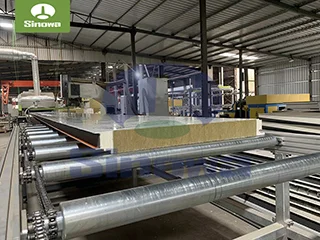
Following curing and forming, the panels enter the automatic cooling, shaping, and fixed-length cutting stage. The initially formed panels retain a certain temperature after high-temperature curing and require gradual and uniform cooling to eliminate internal structural stress and ensure stable flatness of finished products. The rock wool board production line is equipped with a segmented circulating cooling system that adopts gradual cooling treatment to avoid panel warping or deformation caused by rapid temperature change. After cooling and shaping, the panels maintain stable structural performance and flat surface quality. Subsequently, the intelligent fixed-length cutting system automatically identifies and cuts the continuous long panels according to preset dimensional parameters. The high-precision cutting mechanism ensures smooth and neat cutting sections without burrs or edge collapses, realizing accurate dimensional control of finished panels. Notably, the cutting process adopts a non-stop online cutting mode, which does not interrupt the continuous production rhythm of the entire line, further improving the continuity and efficiency of mass production.
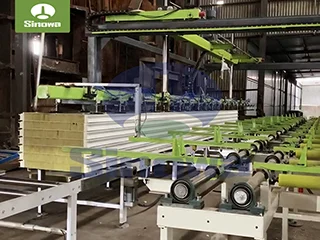
The final stage of the production process includes edge trimming, quality inspection, automatic stacking, and finished product output. After fixed-length cutting, the edge trimming unit finely processes the edges of the panels to optimize the overall appearance and assembly accuracy of the products, ensuring seamless docking during on-site installation of the panels. The built-in online monitoring system conducts real-time detection of key indicators such as panel flatness, bonding uniformity, and dimensional accuracy during the production process, automatically identifying and eliminating unqualified products to ensure that all delivered finished products meet standardized quality requirements. Qualified finished panels are automatically transported to the stacking platform through the conveying system, where the intelligent stacking device performs orderly and standardized stacking according to fixed specifications, facilitating subsequent transportation and storage. The entire post-processing stage is fully automated, reducing manual sorting and handling links, avoiding secondary damage to panels caused by manual operation, and improving the neatness and standardization of finished product output.
The core advantages of the full automatic rock wool sandwich panel production machine are reflected in its high integration, intelligent control, stable performance, and wide adaptability. In terms of production efficiency, the fully automated continuous production mode achieves uninterrupted operation of multiple processes, with a far higher hourly output than traditional semi-automatic equipment, fully meeting the large-scale and batch production needs of building material manufacturers. In terms of product quality control, the unified parameter setting and standardized automatic operation mode eliminate the quality fluctuation problems caused by manual operation differences, ensuring consistent performance and appearance of each batch of panels. The produced rock wool sandwich panels integrate the advantages of metal material’s high structural strength and rock wool material’s superior fire resistance, thermal insulation, and sound insulation, featuring light weight, high rigidity, weather resistance, and corrosion resistance, which can adapt to various complex construction environments.
In terms of operational intelligence, the rockwool board production line adopts a centralized intelligent control system that integrates parameter setting, operation monitoring, fault diagnosis, and data statistics. Operators can complete the switching of different panel specifications, adjustment of production parameters, and real-time monitoring of the entire production process through a simple operation interface. The system has an automatic fault early warning and protection function, which can timely identify abnormal conditions such as material jamming, parameter deviation, and equipment operation failure during production, and trigger automatic protection measures to avoid equipment damage and production waste, improving the safety and stability of long-term continuous operation of the equipment. In addition, the modular structural design of the production line facilitates daily maintenance and later functional upgrading, reducing equipment maintenance costs and extending the service life of the production system.
From the perspective of environmental protection and energy saving, the full automatic rock wool sandwich panel manufacturing line optimizes the production process to reduce resource consumption and pollutant emission. The closed dust removal system in the core material processing stage effectively collects fiber dust, realizing clean production. The precise glue spraying control reduces adhesive waste, and the circulating temperature control system reduces energy consumption during the curing process. The entire production process avoids the use of harmful substances, and the produced rock wool sandwich panels are green and environmentally friendly building materials, which do not produce toxic and harmful substances during use, meeting the development requirements of green buildings and low-carbon manufacturing.
With the continuous development of the construction industry and the continuous improvement of building energy-saving and fire safety standards, the market demand for high-performance rock wool sandwich panels continues to grow, which further promotes the iterative upgrading of fully automatic production line technology. Modern full automatic rock wool sandwich panel production line is gradually developing toward higher precision, higher intelligence, and stronger customization, capable of adapting to the production of panels with different thicknesses, specifications, and surface treatments, meeting the personalized construction needs of different scenarios such as industrial plant enclosures, public building thermal insulation, clean space partitions, and cold storage insulation. As a key equipment for modern green building material manufacturing, the full automatic rock wool sandwich panel production line will continue to play an important role in promoting the standardized, efficient, and green development of the building material industry, providing reliable technical and equipment support for high-quality construction engineering.
https://www.cnsinowa.com/sandwich-panel-machines/full-automatic-rock-wool-sandwich-panel-production-line.html