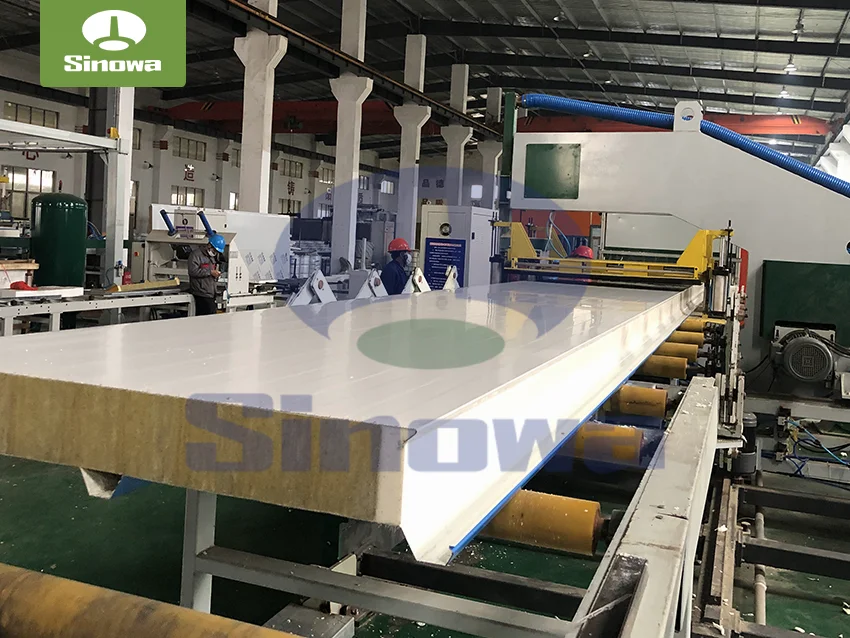
 sandwich panel line
The design logic of fireproof rock wool board production line originates from the physical and chemical characteristics of natural mineral raw materials. The main raw materials adopted in mainstream production lines are basalt, dolomite and blast furnace slag, which are abundant, low-carbon and recyclable natural and industrial auxiliary mineral materials. These raw materials feature high melting points, stable molecular structures and no organic combustible components, which lay the fundamental material foundation for the permanent fireproof performance of finished rock wool boards. Unlike production lines for organic foam insulation boards that rely on chemical polymerization reactions, rock wool board production lines mainly depend on physical high-temperature melting, fiber stretching and mechanical forming processes, with fewer chemical additives added during the whole production process. The overall structural design of the production line follows the principle of continuous streamlined production, avoiding intermittent production gaps that may cause unstable fiber quality and inconsistent board density. The entire production system is divided into multiple interconnected functional modules including automatic batching and feeding, closed high-temperature melting, high-speed centrifugal fibrillation, adhesive spraying and fiber treatment, negative pressure cotton collection and pendulum laying, constant-temperature pressing and curing, cooling shaping, fixed-size cutting and edge trimming, as well as automatic waste recycling and finished product stacking. All modules operate synchronously through centralized electrical control systems, realizing unmanned continuous production for 24 hours and greatly reducing manual intervention in core production links.
The front-end raw material pretreatment and automatic batching system is the first key link to ensure consistent finished product quality, and it undertakes the tasks of raw material crushing, screening, drying and precise proportioning. Collected bulk mineral raw materials often have uneven particle sizes and residual moisture attached to the surface. Large ore blocks will affect the uniformity of melting in the subsequent high-temperature furnace, while excessive moisture will cause instantaneous water vapor expansion inside the furnace, disturbing furnace temperature stability and reducing fiber forming efficiency. Therefore, the rockwool sandwich panel production line is equipped with closed crushing and screening equipment to crush massive ores into uniform small particles with controlled particle size range. Meanwhile, matched drying equipment removes residual moisture on the surface of mineral particles to keep raw material moisture content within a stable low range. After pretreatment, different types of mineral materials are transported to independent storage silos respectively. The automatic batching system adopts dynamic weighing technology to match raw materials according to fixed process ratios. Different mineral components complement each other in melting fluidity and fiber toughness: basalt ensures the high-temperature fire resistance of fibers, blast furnace slag optimizes the fluidity of molten liquid to make fiber stretching smoother, and dolomite adjusts the overall chemical stability of finished fibers. After accurate proportioning, mixed raw materials are sent to the melting furnace through fully sealed conveying pipelines, which effectively prevents raw material dust from escaping and improves the on-site production environment of the workshop.
The closed high-temperature melting furnace is the core heat source module of the entire sandwich panel line and the most energy-consuming link in the whole manufacturing process. After years of technological iteration, modern rock wool board production lines have completely abandoned open melting furnaces with serious heat loss and flue gas leakage, and widely adopted fully sealed integrated furnace bodies with layered temperature control. The internal furnace temperature is stably maintained between 1350℃ and 1500℃, which is enough to completely melt mixed solid mineral particles into homogeneous flowing molten magma without any residual solid ore particles. The layered temperature control design inside the furnace realizes segmented heating: the preheating section gradually raises the temperature of mixed raw materials to avoid furnace body impact caused by sudden high temperature; the main melting section maintains constant extreme high temperature to ensure thorough melting of minerals; the homogenization section keeps molten magma at a constant temperature for a certain period to eliminate internal temperature differences and component differences. The sealed furnace body not only minimizes heat loss to reduce overall production energy consumption, but also concentrates all high-temperature flue gas generated during melting into the supporting waste gas treatment system, avoiding direct emission of high-temperature exhaust gas and dust. Stable and consistent molten liquid state directly determines the diameter uniformity, toughness and tensile strength of subsequent rock wool fibers. Unstable furnace temperature will lead to mixed thick and thin fibers, brittle fiber texture and easy breakage, which will eventually cause local density differences, reduced structural strength and decreased fire resistance of finished rock wool boards.
High-speed centrifugal fibrillation is the core process that converts molten mineral liquid into fibrous raw materials, and it is also the key process to determine the internal porous structure of rock wool boards. High-temperature molten magma flows out stably from the bottom of the melting furnace at a controlled flow rate and falls onto high-speed rotating centrifugal rollers. Driven by ultra-high centrifugal force, the viscous molten liquid is stretched, split and refined into countless fine inorganic fibers with uniform diameter. During this instantaneous fibrillation process, fine slag balls that cannot be stretched into fibers are automatically separated through airflow screening devices. These unformed slag balls have no insulation or fireproof value and will damage the flatness and internal structure of finished boards, so automatic separation and centralized recovery are essential. Synchronously with fiber forming, micro quantitative spraying equipment sprays a small amount of environmentally friendly thermosetting adhesive and water repellent agent evenly on the surface of scattered rock wool fibers. It is worth noting that all additives used in the production process are non-combustible and low-smoke components, which will not damage the original inorganic fireproof performance of rock wool fibers. The adhesive provides bonding force between loose fibers to ensure the overall structural integrity of the board, while the water repellent agent fills tiny gaps on the fiber surface to prevent moisture from penetrating into the internal porous structure of the board, avoiding attenuation of thermal insulation performance caused by moisture absorption in humid working environments.
After fibrillation and surface treatment, loose rock wool fibers enter the negative pressure cotton collection and reciprocating pendulum laying system to form continuous fiber blankets. Disordered single fibers are collected efficiently by negative pressure airflow, which avoids fiber diffusion and floating in the workshop air and reduces production dust pollution. The pendulum laying device adopts bidirectional reciprocating laying mode, which makes fibers overlap uniformly in both horizontal and longitudinal directions. Compared with single-direction laying technology, bidirectional pendulum laying eliminates longitudinal density deviation of fiber blankets, realizing consistent density of rock wool boards in all directions. The thickness of the initial fiber blanket can be adjusted freely through changing pendulum frequency and laying speed, which lays a foundation for producing rock wool boards with different thickness specifications to meet diverse engineering needs. At this stage, the fiber blanket is still loose and fluffy with no fixed structural strength, and needs to go through mechanical pressing and high-temperature curing to form rigid finished boards. The adjustable pre-pressing device first carries out preliminary compression on the loose fiber blanket to discharge excess internal air, preliminarily fix the overall thickness of the blanket and prevent thickness bulging or deformation during subsequent high-temperature curing.
The constant-temperature curing oven is responsible for activating adhesives and realizing permanent bonding between fibers, completing the transition from loose fiber blankets to rigid solid rock wool boards. The curing oven adopts multi-section independent temperature control design, with temperature gradient arranged reasonably inside the oven cavity. The low-temperature preheating section activates the surface adhesive of fibers slowly, the medium-temperature constant-pressure section promotes uniform penetration of adhesives between stacked fiber layers, and the high-temperature final curing section realizes complete curing and cross-linking of adhesives. The whole curing process matches with fixed operating speed of the conveyor belt to ensure consistent curing time for each batch of fiber blankets. Reasonable curing temperature and time parameters are critical: insufficient curing will lead to weak bonding between fibers, easy board delamination and poor structural durability; excessive curing will cause fiber embrittlement, reduce the toughness and impact resistance of rock wool boards, and increase unnecessary energy consumption. After high-temperature curing, integrated rock wool board blanks with stable size, fixed density and complete internal fiber bonding are formed. The high-temperature board blanks are then sent to an air cooling section for rapid and uniform cooling to room temperature, eliminating internal thermal stress generated during high-temperature heating and preventing natural warping or bending of finished boards after stacking.
The post-processing system of the sandwich panel production line includes high-precision fixed-size cutting, edge trimming, surface finishing, waste recovery and automatic finished product stacking. Continuous large-size rock wool board blanks are cut into standard sizes required by the market through longitudinal and transverse integrated cutting machines. The cutting equipment adopts high-speed saw blades with dust removal structures, realizing smooth cutting sections without burrs or fiber tilting. Edge trimming devices remove uneven loose fiber edges on both sides of the boards to ensure uniform overall dimension of each finished board. All cutting leftover materials and trimmed fiber wastes are automatically transported back to the front-end melting system through a closed waste recycling pipeline for secondary melting and reuse. This closed-loop waste recovery design maximizes raw material utilization rate, reduces raw material consumption per unit of finished product, and realizes zero solid waste discharge in the whole production process. Finally, qualified finished rock wool boards are automatically stacked by mechanical stacking equipment, replacing manual stacking, improving packaging efficiency and avoiding surface extrusion damage of boards caused by manual operation.
In recent years, fireproof rockwool board production line has achieved significant upgrading in intelligent control and energy-saving environmental protection technologies, solving two long-standing pain points of traditional production lines: high overall energy consumption and dependence on experienced operators. Modern production lines are equipped with full-process digital monitoring systems, which monitor furnace temperature, conveyor speed, fiber diameter, board density, curing temperature and other core process parameters in real time. Once any parameter deviates from the set standard range, the system will automatically make closed-loop adjustments without manual operation. The human-machine interaction interface integrates all production module control functions, allowing technicians to complete parameter setting, equipment operation monitoring and fault alarm query at a single operation terminal. In terms of energy saving, the production line adds waste heat recovery equipment to recover high-temperature flue gas waste heat generated by the melting furnace, and reuse the recovered heat for raw material preheating and workshop heating. This waste heat recycling technology effectively reduces the overall energy consumption of the production line by nearly one quarter. In terms of environmental protection upgrade, the supporting flue gas purification and dust removal system conducts multi-stage purification on exhaust gas generated by melting and fiber processing, removing particulate dust and trace harmful substances in exhaust gas, so that all discharged gas meets industrial environmental emission standards.
The complete and standardized manufacturing process of fireproof rockwool insulation board production line endows finished products with stable and reliable comprehensive performance, which supports their wide application in multiple industrial scenarios. First of all, the most core fireproof performance comes from inorganic mineral raw materials and complete high-temperature melting process. Finished rock wool boards will not burn, melt or drip molten matter under continuous high-temperature baking or open flame impact, and will not release toxic or corrosive smoke during fire accidents, effectively blocking flame spread and forming reliable fire isolation zones for buildings and industrial equipment. Secondly, the internal porous fiber structure formed by centrifugal fibrillation brings excellent thermal insulation performance. A large amount of static air is locked inside staggered fibers, which greatly hinders heat conduction and convection transmission, helping buildings and industrial high-temperature equipment reduce heat exchange with the external environment and cut long-term energy operation costs. In addition, the porous fiber structure also achieves efficient broadband sound absorption performance, which can attenuate most medium and high-frequency noise, suitable for noise reduction treatment of building interior spaces and high-noise industrial workshops. Meanwhile, after overall water repellent treatment in the production process, rock wool boards have excellent hydrophobic performance, maintaining stable thermal insulation and fireproof performance in long-term humid environments without moisture failure or mold growth.
Compared with intermittent small-scale production equipment, integrated continuous fireproof rock wool sandwich panel machine has prominent advantages in production stability, product consistency and operating cost. Intermittent production equipment is prone to periodic fluctuation of furnace temperature and unstable fiber quality due to repeated start and stop, leading to large performance differences between front and rear batches of products. Continuous production lines maintain stable operating parameters for a long time, ensuring that the density, thickness, fire resistance and thermal conductivity of each finished board keep consistent in the whole production batch. In terms of labor cost, highly automated sandwich panel assembly line reduce on-site operating personnel by more than half compared with traditional semi-automatic equipment, and the centralized control system simplifies daily equipment maintenance work. In terms of production flexibility, the production line can quickly switch product specifications by adjusting operation parameters of laying system, pressing system and cutting system, flexibly producing low-density sound-absorbing rock wool boards for interior decoration, medium-density universal insulation boards for building exterior walls, and high-density high-strength boards for industrial load-bearing insulation scenarios without replacing core equipment.
Looking ahead, the future development of fireproof rock wool board production machine will focus on three major directions: deeper intelligent unmanned production, lower carbon energy-saving transformation, and composite integrated forming technology research. Firstly, combining industrial internet and machine vision detection technology, the next-generation production line will realize full unmanned operation from raw material feeding to finished product warehouse entry. Machine vision equipment will automatically detect fiber uniformity, board surface defects and cutting accuracy in real time, realizing automatic early warning and automatic repair of tiny production defects, further reducing manual participation. Secondly, aiming at the high energy consumption characteristic of high-temperature melting links, production lines will introduce more clean heating modes and optimized furnace body thermal insulation structures to further reduce carbon emissions per ton of rock wool products, adapting to the global low-carbon manufacturing development trend. Thirdly, the production line will integrate one-step composite forming technology, realizing synchronous compounding of rock wool boards with surface protective layers in the production process, avoiding secondary processing procedures of finished boards, shortening the overall production chain and improving the comprehensive production added value of products.
In conclusion, the fireproof rock wool board manufacturing line is a typical modern green manufacturing system that combines high-temperature thermal processing technology, mechanical automation technology and environmental protection waste recycling technology. It efficiently converts low-cost natural inorganic minerals into high-value fireproof and thermal insulation materials through physical manufacturing processes with low chemical pollution. Driven by increasingly stringent global building fire safety regulations and building energy-saving policies, the market demand for high-quality rock wool insulation materials will continue to rise steadily. Continuous technological iteration and process optimization of production lines will further improve production efficiency, reduce carbon footprint and stabilize product performance. As a key carrier connecting mineral raw materials and building fire safety engineering, advanced fireproof rock wool sandwich panel machinery will continue to play an irreplaceable role in promoting the upgrading of the global insulation material industry, improving building safety performance and advancing the progress of green low-carbon construction.
https://www.cnsinowa.com/sandwich-panel-machines/fireproof-rock-wool-board-production-line.html






