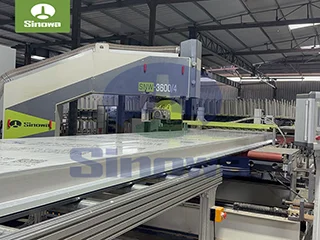
sandwich panel machine
Rock wool sandwich panels for fire isolation belts are composite materials consisting of rock wool as the core insulation layer and metal sheets (usually color-coated steel sheets) as the upper and lower surface layers. The key to ensuring the fire protection performance of these panels lies in the quality of the rock wool core and the firmness of the composite bond between the core and the surface layers. Rock wool itself is made from natural volcanic rock or basalt, which is melted at high temperatures above 1400°C and then drawn into fine fibers through a centrifugal process. This inorganic material exhibits permanent incombustibility, can withstand temperatures exceeding 1000°C, and does not release toxic smoke when exposed to fire, making it an ideal core material for fire isolation applications. The production machine must not only ensure the uniform formation of the rock wool core but also achieve a tight and durable composite with the surface metal sheets, while maintaining the overall structural integrity and dimensional accuracy of the panels.
The rock wool sandwich panel production machine for fire isolation belts is a highly integrated production line composed of multiple functional units, each responsible for a specific stage of the production process. These units work in coordination to realize the continuous and automated production of rock wool sandwich panels. The main components of the production machine include the uncoiling and leveling unit for surface metal sheets, the rock wool feeding and spreading unit, the gluing and compounding unit, the curing and shaping unit, the precision cutting unit, and the automatic stacking and conveying unit. In addition, a centralized control system is installed to monitor and regulate the parameters of each unit in real time, ensuring the stability and consistency of the production process.
The uncoiling and leveling unit is the starting point of the production line, responsible for feeding the coiled color-coated steel sheets into the production process. The unit is equipped with uncoilers that can stably release the steel coils, and leveling machines that correct any deformation or unevenness of the steel sheets caused during transportation and storage. The leveling process is crucial because the flatness of the surface sheets directly affects the bonding effect with the rock wool core and the overall appearance quality of the final panels. The uncoiling and leveling unit is designed with adjustable tension control to adapt to steel sheets of different thicknesses (usually between 0.35mm and 1.6mm) and widths, ensuring smooth and stable feeding.
The rock wool feeding and spreading unit is responsible for uniformly distributing the rock wool core material between the upper and lower surface steel sheets. The rock wool, which is usually in the form of rolls or blocks, is first cut into strips of the required width by a cutting machine, and then conveyed to the spreading mechanism. The spreading mechanism uses a pendulum or three-dimensional spreading process to ensure that the rock wool fibers are evenly distributed in a crisscross pattern, forming a fluffy and uniform core layer with a porosity of more than 90%. This crisscross fiber structure not only enhances the mechanical strength of the rock wool core but also improves its thermal insulation performance by trapping static air within the fibers. The thickness of the rock wool core can be adjusted according to the specific fire protection requirements, with common thicknesses ranging from 50mm to 200mm for fire isolation belt applications. The feeding and spreading unit is equipped with sensors to monitor the thickness and uniformity of the rock wool layer in real time, ensuring consistent quality.
The gluing and compounding unit is the core part of the production machine, responsible for bonding the rock wool core with the upper and lower surface steel sheets. The gluing process uses high-performance adhesives (usually polyurethane-based adhesives) that have excellent bonding strength and high-temperature resistance, ensuring that the composite panel remains intact even under high-temperature fire conditions. The gluing mechanism adopts a roller coating or spraying method to uniformly apply the adhesive to the inner surface of the upper and lower steel sheets. The amount of adhesive applied is precisely controlled to avoid excessive or insufficient gluing, which could affect the bonding strength or increase production costs. After gluing, the upper steel sheet, rock wool core, and lower steel sheet are conveyed together into the compounding machine, where they are pressed together under precise temperature and pressure conditions. The compounding machine uses a double-track hot-pressing system to apply uniform pressure to the composite structure, ensuring that the adhesive fully penetrates the rock wool fibers and forms a tight bond with the steel sheets. The temperature during compounding is usually controlled between 100°C and 180°C, which promotes the curing of the adhesive and enhances the bonding effect.
The curing and shaping unit is used to further solidify the adhesive and shape the composite panel into the required dimensions. After compounding, the semi-finished panel is conveyed to the curing oven, where it is heated at a constant temperature for a certain period of time. The curing temperature and time are precisely controlled according to the type of adhesive used, ensuring that the adhesive is fully cured and the composite panel achieves its maximum bonding strength. During the curing process, the panel is also subjected to slight pressure to maintain its flatness and dimensional stability. Some advanced production machines are equipped with energy-saving curing systems that use closed insulation designs to reduce energy consumption. These systems can maintain the required curing temperature with minimal energy input, enabling all-weather production even in low-temperature environments without the need for additional heating facilities.
The precision cutting unit is responsible for cutting the continuous composite panel into individual panels of the required length. The unit uses a high-speed flying saw that can cut the panel while it is moving, ensuring that the cutting length is accurate and the cutting surface is smooth. The cutting length can be set and adjusted through the centralized control system, allowing for flexible production of panels of different lengths to meet the needs of various construction projects. After cutting, the edges of the panels are trimmed to remove any burrs or irregularities, improving the overall quality and safety of the product. The precision cutting unit is equipped with safety protection devices to prevent accidents during the cutting process.
The automatic stacking and conveying unit is the final stage of the production line, responsible for conveying the finished panels to the stacking area and stacking them neatly. The unit uses conveyor belts to transport the cut panels, and automatic stacking machines to stack them according to a predetermined pattern. This not only improves the efficiency of the production line but also reduces manual labor and the risk of damage to the panels during handling. The stacking unit can be adjusted to accommodate panels of different sizes and thicknesses, ensuring stable and safe stacking.
The centralized control system is the "brain" of the entire production machine, integrating advanced automation technologies such as programmable logic controllers (PLC) and human-machine interfaces (HMI). The system centralizes all control points, enabling real-time monitoring and adjustment of key parameters such as feeding speed, gluing amount, compounding temperature and pressure, curing time, and cutting length. Operators can set production parameters, monitor production status, and troubleshoot faults through the HMI. The control system also has a fault self-diagnosis function, which can automatically detect abnormalities in the production process (such as uneven gluing, insufficient pressure, or temperature deviations) and issue alarms, helping operators quickly identify and resolve problems. Some advanced systems also support remote control and monitoring, allowing for remote operation and maintenance of the production line, further improving production efficiency and reducing downtime.
Modular design is a key technical feature of modern rock wool sandwich panel production machines for fire isolation belts. The entire production line is composed of independent modular units, which can be freely combined and configured according to the specific production needs of users. This modular design not only makes the production line highly adaptable, enabling it to produce different types of rock wool sandwich panels (such as roof panels, wall panels, and cold storage panels) by simply switching configurations but also facilitates installation, maintenance, and upgrading of the equipment. The modular components are designed with interchangeability in mind, ensuring that replacement parts can be easily installed, reducing maintenance time and costs. In addition, the modular design avoids the need for manual splicing during production, ensuring that key processes are completed in processing centers, which greatly reduces the impact of human factors on product quality and improves the consistency and reliability of the products.
Energy efficiency and environmental protection are important considerations in the design of modern rock wool sandwich panel production machines. These machines adopt a variety of energy-saving technologies to reduce energy consumption. For example, the curing oven uses a closed insulation design and high-efficiency heating elements to minimize heat loss; the drive system uses high-power and low-energy-consumption motors to reduce power consumption; and the control system optimizes the production process to avoid energy waste caused by idle operation. Some advanced machines also use waste heat recovery systems to reuse the heat generated during the production process, further improving energy efficiency. In terms of environmental protection, the production machines are designed to minimize emissions of dust and harmful gases. The rock wool feeding and spreading unit is equipped with dust collection devices to collect and treat the dust generated during the spreading process, protecting the health of operators and reducing environmental pollution. The adhesives used in the production process are also environmentally friendly, ensuring that they do not release harmful substances during production or use.
The performance of rock wool sandwich panels produced by these machines directly determines the fire protection effect of fire isolation belts. High-quality rock wool sandwich panels have excellent fire resistance, capable of withstanding high temperatures above 1000°C for a long time without burning or collapsing. They can effectively block the spread of flames and smoke, providing valuable time for personnel evacuation and fire fighting in the event of a fire. In addition to their fire protection performance, these panels also have excellent thermal insulation properties, with a thermal conductivity as low as 0.03-0.04W/(m·K), which can help reduce building energy consumption by reducing heat transfer. They also have good sound insulation performance, capable of reducing noise pollution, and high mechanical strength, able to withstand wind pressure and impact, ensuring long-term durability in harsh environments.
The application of rock wool sandwich panel production machines for fire isolation belts is widespread in the construction industry. These machines are used in the production of fire isolation belt panels for various types of buildings, including high-rise residential buildings, commercial complexes, industrial workshops, and public facilities. In high-rise buildings, where the risk of vertical fire spread is high, fire isolation belts made of rock wool sandwich panels are installed every 2-3 floors to block the spread of flames between floors. In commercial complexes and industrial workshops, which often have large spaces and complex layouts, rock wool sandwich panels are used to divide fire zones, reducing the risk of fire expansion. In addition, these panels are also used in the construction of transportation facilities such as subways, tunnels, and highways, where their fire protection and sound insulation properties are crucial for ensuring the safety and comfort of these facilities.
The use of rock wool sandwich panel production machines has brought significant benefits to the construction industry. Firstly, these machines realize the automated and continuous production of rock wool sandwich panels, greatly improving production efficiency compared to traditional manual production methods. A modern production line can produce hundreds of square meters of panels per hour, meeting the large-scale production needs of construction projects. Secondly, the automated production process ensures the consistency and reliability of product quality, avoiding quality problems caused by human factors. This is particularly important for fire isolation belt panels, as their performance directly relates to building safety. Thirdly, the modular design and energy-saving features of the machines reduce production costs and environmental impact, helping users achieve sustainable production. Finally, the high adaptability of the production lines enables manufacturers to quickly respond to the changing needs of the market, producing customized panels for different projects.
In conclusion, rock wool sandwich panel production machines for fire isolation belts are advanced equipment that integrates automation, precision control, and modular design. They play a crucial role in the production of high-quality rock wool sandwich panels, which are essential for enhancing the fire safety of buildings. The core components of these machines work in coordination to realize the continuous production of panels with excellent fire resistance, thermal insulation, and mechanical properties. The modular design, energy efficiency, and environmental protection features of the machines make them highly adaptable and sustainable, meeting the diverse needs of the construction industry. As building safety and fire prevention standards continue to improve, the demand for high-quality rock wool sandwich panels and advanced production machines will continue to grow. Future developments in these machines will focus on further improving automation levels, enhancing energy efficiency, and developing more environmentally friendly production processes, contributing to the construction of safer, more energy-efficient, and sustainable buildings.
https://www.cnsinowa.com/sandwich-panel-machines/rock-wool-sandwich-panel-production-machine-for-fire-isolation-belt.html