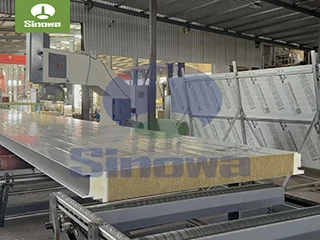
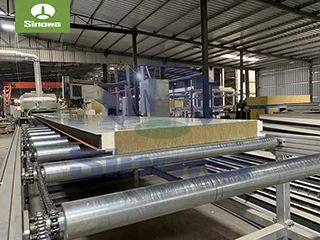
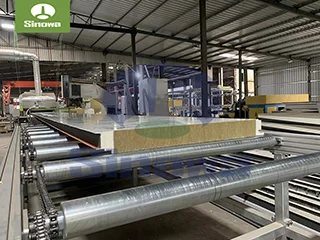
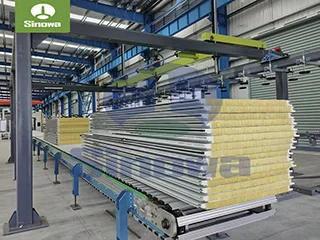
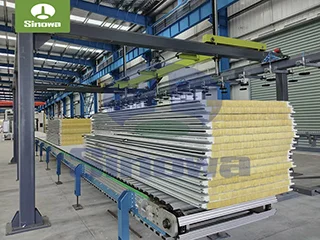
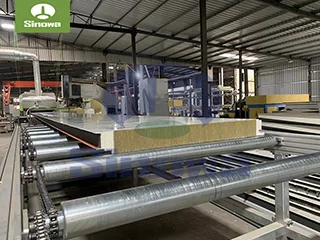
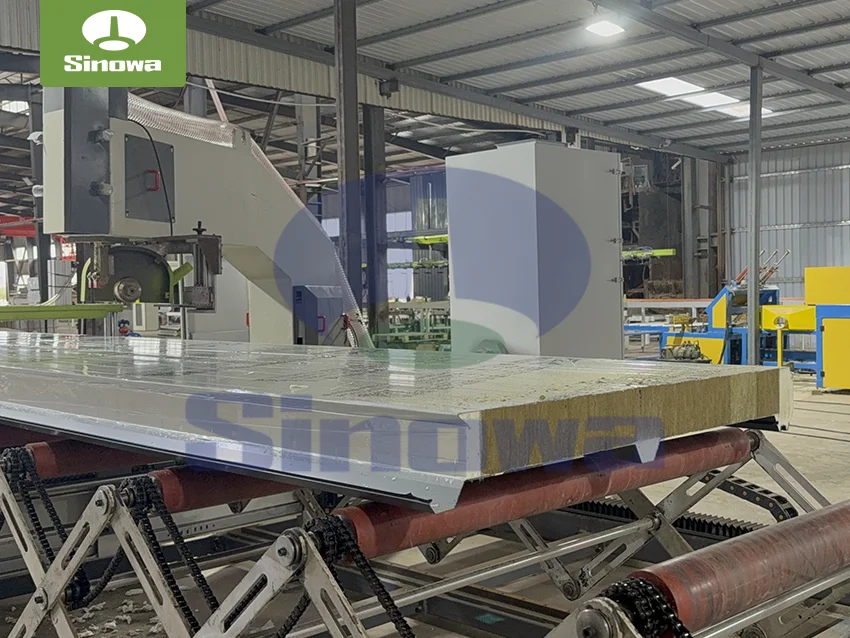
 sandwich panel machine
The whole production workflow starts with raw material pretreatment and quantitative feeding, which lays a fundamental foundation for stable subsequent processing. Natural hard rock minerals and auxiliary materials serve as the core production raw materials, which need to undergo strict crushing, screening and proportional mixing before entering the formal production link. Large bulk raw materials are first crushed into uniform granular particles with consistent particle size distribution, eliminating oversized impurities and heterogeneous raw material blocks that may affect melting efficiency and fiber quality. After crushing, the raw material particles are sent to automatic batching equipment for precise proportional deployment. The internal metering system of the machine controls the feeding speed and proportion of different raw materials in real time, ensuring the uniformity of the mixed raw material components. This standardized batching process avoids performance differences of finished products caused by uneven raw material ratios, and also provides stable material conditions for subsequent high-temperature melting and fibrosis molding. The pretreated mixed raw materials are transported to the closed melting system through a sealed conveying device, preventing external dust from mixing in and reducing raw material loss during transportation.
High-temperature melting is the primary core procedure of the rock wool sandwich panel machine, completing the transformation from solid granular raw materials to homogeneous molten magma. The mixed raw materials enter the closed high-temperature melting furnace, where the internal extreme high-temperature environment completely melts the solid mineral particles into a viscous and smooth molten liquid. The closed structural design of the melting furnace effectively reduces internal heat loss, maintains long-term stable temperature distribution in the furnace, and ensures that all raw materials are fully melted without local unmelted residues or overheating deterioration. During the melting process, the internal fluidity and temperature uniformity of the magma are strictly controlled by the auxiliary temperature control system. Stable magma fluidity can ensure the smooth progress of subsequent centrifugal fibrosis, while uniform temperature distribution avoids inconsistent fiber fineness and structural defects caused by unbalanced material state. After full melting and homogenization, the magma flows out stably through the reserved flow channel at the bottom of the melting furnace, and the flow rate is automatically adjusted by the equipment according to the operating speed of the subsequent processing unit, realizing the dynamic matching of material supply and processing rhythm.
Centrifugal fibrosis acts as the most critical link that determines the basic structure and performance of rock wool fibers, and its working principle is based on high-speed centrifugal stretching and airflow drafting. The high-temperature molten magma flowing out of the furnace steadily falls onto the surface of the high-speed rotating centrifugal roller group inside the fiber forming system. Driven by the ultra-high rotating speed of the centrifugal mechanism, the viscous magma is instantly thrown outward under the action of strong centrifugal force and evenly stretched into ultra-fine continuous mineral fibers. In this process, the precise rotating speed control of the centrifugal system is extremely important. Stable rotating speed can ensure consistent fiber diameter, while the optimized roller structure design makes the stress of magma uniform during stretching, avoiding broken fibers and coarse fiber particles. Cooperating with the centrifugal stretching action, the auxiliary airflow blowing system generates directional uniform airflow, which further drafts and disperses the newly formed fibers, separates overlapping and bonded fibers, and forms a large number of loose, uniform and fluffy inorganic fiber monomers. These fibers have slender and flexible structural characteristics, which constitute the basic unit of the porous heat insulation structure of rock wool boards. At the same time, the equipment is equipped with a fiber screening and filtering mechanism to intercept unqualified coarse particles and unmelted slag balls, effectively improving the purity and uniformity of fiber raw materials.
In the fiber forming and dispersing stage, quantitative atomized adhesive is evenly sprayed on the surface of dispersed fibers, which is a key step to realize fiber bonding and board shaping. The internal adhesive spraying system of the sandwich panel machine converts the diluted adhesive solution into tiny uniform atomized particles through high-pressure atomization technology, and sprays it evenly on the flowing fiber cluster in a closed space. The atomized adhesive can fully adhere to the surface of each fiber without causing excessive adhesion and agglomeration between fibers. The spraying amount and spraying range are automatically adjusted according to the fiber output and production speed, ensuring that the adhesive distribution is always in the optimal state. The adhesive does not change the inherent inorganic characteristics of rock wool fibers, but only plays a bonding and fixing role between fibers, which can effectively enhance the overall structural strength of the finished board while maintaining the porous and breathable characteristics of the fiber layer. The fibers coated with adhesive continue to be transmitted to the subsequent collecting and molding unit under the action of airflow and mechanical conveying force.
Fiber collecting and directional lapping molding completes the preliminary stacking and shaping of rock wool fiber felt. The dispersed fiber monomers with adhesive are uniformly settled and collected on the circulating conveying mesh belt through the negative pressure air suction system inside the equipment. The negative pressure adsorption device forms stable downward airflow, which makes the fibers orderly deposited on the mesh belt and avoids fiber floating and uneven stacking. Different from single-layer random stacking, the modern rock wool board production line adopts a reciprocating pendulum lapping structure, which drives the fiber distribution mechanism to move horizontally and reciprocally, so that the fibers are stacked in multiple layers and directions on the conveying belt. This multi-layer cross lapping principle makes the internal fiber arrangement of the preliminary fiber felt more three-dimensional and uniform, effectively improving the overall tensile strength and structural stability of the board, and avoiding the problem of easy layering and deformation caused by single-direction fiber arrangement. By adjusting the reciprocating lapping frequency and conveying speed, the equipment can accurately control the stacking thickness and density of the fiber layer, realizing the preliminary shaping of rock wool felts with different specification parameters.
Constant-temperature curing and pressure shaping is the core procedure to realize the transformation from loose fiber felt to solid rock wool board. The preliminarily formed loose fiber felt is sent to the constant-temperature curing unit along with the conveying system, and undergoes synchronous treatment of appropriate temperature and pressure. The internal closed curing space maintains a stable constant-temperature environment, which can quickly activate the activity of the adhesive attached to the fiber surface, promote the rapid curing and cross-linking reaction of the adhesive, and make the scattered fibers closely bonded into an integrated structure. At the same time, the uniform pressure applied by the pressing mechanism acts on the surface of the fiber felt, which can eliminate the gap difference inside the fiber layer, balance the overall density of the board, and fix the overall thickness and flatness of the product. The cooperative action of temperature and pressure makes the loose fiber felt gradually form a semi-finished rock wool board with fixed shape, certain mechanical strength and stable internal structure. The curing time and pressure parameters are dynamically adjusted according to the thickness and density requirements of different products, ensuring that the adhesive is fully cured without excessive extrusion damage to the fiber porous structure, so as to retain the excellent heat insulation and sound absorption performance of rock wool materials.
The cooling and shaping process further stabilizes the structural performance of semi-finished rock wool boards and eliminates internal stress. The semi-finished products discharged from the curing unit still have residual temperature and slight internal structural stress, which are prone to deformation and warping if directly processed. For this reason, the equipment is equipped with an automatic circulating cooling system, which adopts uniform air cooling mode to carry out continuous and gentle cooling treatment on the surface and interior of the semi-finished board. The low-speed circulating cold air takes away the residual heat of the product evenly, making the internal and external temperature of the board drop synchronously, avoiding the structural deformation caused by uneven cooling shrinkage. In the cooling process, the internal molecular structure of the adhesive is further stabilized, the bonding performance between fibers tends to be perfect, and the overall hardness, flatness and dimensional stability of the rock wool board are further improved. After full cooling and stress relief, the semi-finished product forms a stable plate structure with uniform density, flat surface and no internal loose layers.
Fixed-size cutting and finishing processing is the final link of the machine's operation, realizing the standardized sizing and high-quality finishing of finished products. The cooled and shaped rock wool board is continuously transported to the precise cutting unit, and the equipment automatically completes edge trimming and fixed-length cutting according to the preset dimensional parameters. The high-precision cutting mechanism adopts stable linear transmission and high-speed cutting tools, which can ensure flat and smooth cutting sections without burrs, fiber falling and edge collapse. The edge trimming procedure removes the irregular edges and redundant parts on both sides of the board to ensure the consistent width of the product, while the fixed-length cutting divides the continuous long plate into independent finished plates that meet the specification requirements. In the finishing stage, the equipment is also equipped with a surface sorting and detection mechanism, which automatically screens out individual products with surface defects, uneven density and dimensional errors to ensure the overall qualified rate of finished products. After cutting and finishing, the qualified rock wool board products are sent to the discharging and stacking device to complete the whole production process.
In addition to the main production procedures, the auxiliary linkage system of the rock wool sandwich panel line also plays an indispensable supporting role in stable operation. The whole set of equipment adopts integrated electromechanical control, and the central control system uniformly coordinates the operating speed, parameter matching and linkage operation of each functional unit. It can realize real-time monitoring and automatic adjustment of key parameters such as melting temperature, centrifugal speed, adhesive spraying volume, curing pressure and cooling air volume, ensuring the dynamic balance of the whole rockwool sandwich panel production line. The closed dust removal and gas recovery system configured inside the equipment can effectively collect the fiber dust and tiny impurities generated during the production process, avoid material waste and environmental pollution, and realize clean and continuous production. The linkage cooperation of all functional systems constitutes the complete working principle of the rock wool board machine, realizing the efficient, stable and standardized transformation from natural mineral raw materials to high-quality rock wool board products.
In essence, the working principle of the rock wool board machinery is a systematic processing process that takes high-temperature physical modification as the core and precise mechanical control as the support. It makes full use of the physical characteristics of natural mineral materials, through melting, fibrosis, bonding, curing and shaping, changes the solid block structure of raw materials into a three-dimensional porous fiber composite structure, and endows rock wool boards with excellent heat insulation, sound absorption, fire resistance and thermal stability. The standardized and continuous mechanical processing mode not only retains the inherent excellent performance of inorganic mineral materials, but also overcomes the defects of uneven quality and low molding efficiency of traditional manual and intermittent production. With the optimization and upgrading of mechanical structure and control technology, the modern rockwool sandwich panel making machine can realize more accurate parameter control and more stable operation process, further improving the structural uniformity and performance stability of finished products, and providing reliable technical support for the large-scale application of rock wool board materials in various industrial and construction fields.
https://www.cnsinowa.com/sandwich-panel-machines/principle-of-rock-wool-board-machine.html