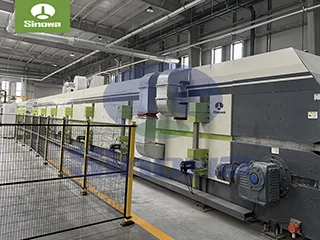
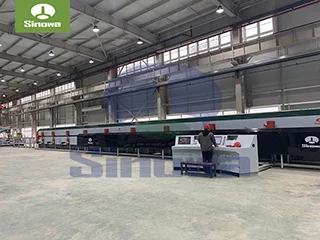
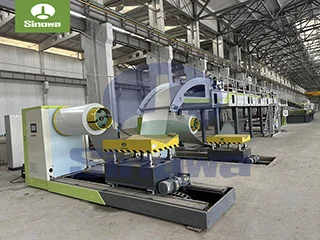
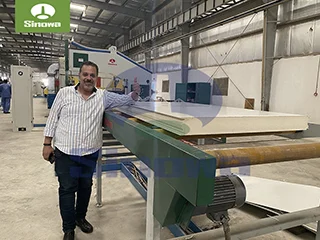
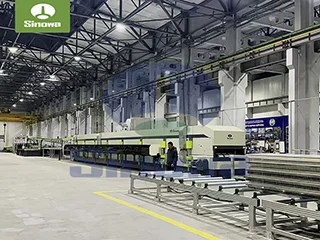
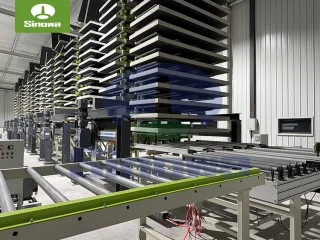
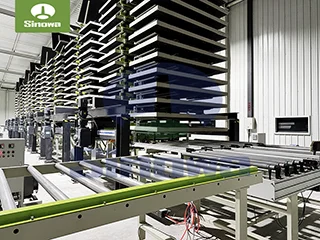
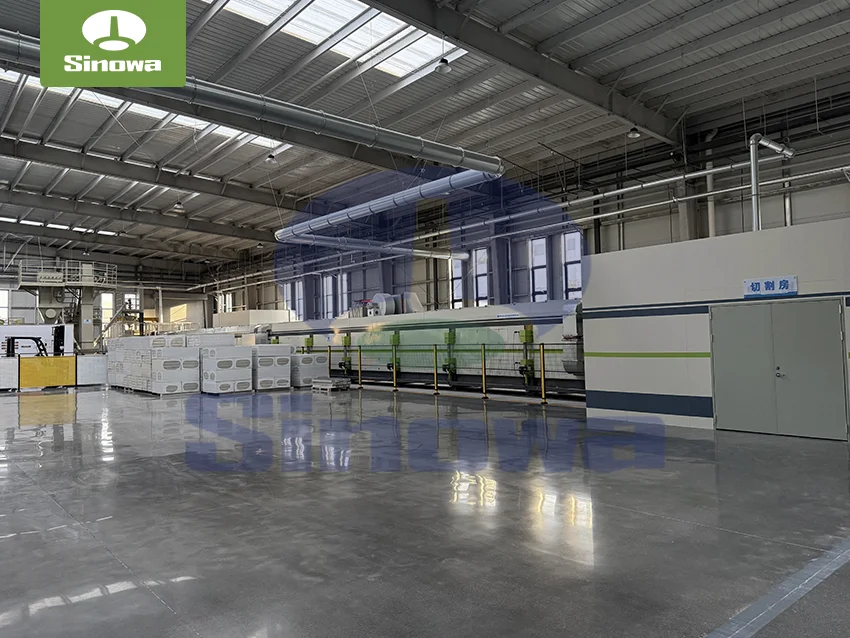
 sandwich panel line
At its core, the continuous PU sandwich panel line is designed to integrate multiple independent production processes into a single synchronized operational system, eliminating the efficiency bottlenecks and quality inconsistencies inherent in traditional batch production methods. The entire production workflow covers surface material unwinding, surface pretreatment, polyurethane raw material metering and mixing, continuous foaming and pouring, roller pressing and composite molding, thermal curing, continuous traction, precise length cutting, and automatic stacking, forming a closed-loop unmanned production process. Every functional module of the production line is precisely calibrated to coordinate speed, pressure, temperature, and flow parameters, ensuring that each batch of sandwich panels maintains uniform thickness, consistent foaming density, tight bonding strength, and flat surface finish. This highly integrated production mode not only simplifies the overall manufacturing process of PU sandwich panels but also greatly reduces manual operation errors, laying a solid foundation for large-scale standardized production.
The structural composition of a standard continuous PU sandwich panel production line is highly systematic and modular, with each functional unit undertaking exclusive and interconnected production tasks. The front-end unwinding system is the starting point of the entire production process, which carries and releases coiled surface materials such as color steel plates, aluminum plates, and other metal or non-metal decorative substrates. Equipped with automatic deviation correction mechanisms, this system can dynamically adjust the feeding position of surface materials in real time during high-speed operation, effectively avoiding lateral offset problems that may cause panel edge defects and ensuring the straightness and flatness of the base material entering the subsequent process. Multiple sets of unwinding units can be configured according to production needs to realize seamless switching of different surface materials, supporting the production of multi-specification and multi-type sandwich panels without stopping the line, which significantly improves the continuity of production operations.
Following the unwinding process, the surface pretreatment module performs fine processing on the surface of the base material to optimize the bonding effect between the surface material and the PU foam core layer. This module includes cleaning, flattening, and micro-texture treatment links, which remove dust, oil stains, and oxide layers on the surface of the substrate, and eliminate wrinkles and uneven areas on the surface material through multi-group roller leveling. A clean and flat bonding surface is essential for enhancing the composite stability of sandwich panels, as it enables the polyurethane foam to form a tight molecular bond with the surface material during the foaming and curing process, preventing delamination, cracking, and peeling of the core layer and surface material during long-term use. The pretreatment process is automatically linked with the production line speed, realizing synchronous operation without affecting the overall production rhythm.
The raw material metering and mixing system is the heart of the continuous PU sandwich panel machine, directly determining the foaming quality, density uniformity, and physical performance stability of the polyurethane core layer. Polyurethane foaming relies on the precise proportioning of multiple raw material components, and the advanced continuous production line adopts high-precision dynamic metering technology to control the feeding flow of each raw material in real time. The system adopts servo-driven metering devices, which can maintain extremely low flow error values during long-term continuous operation, ensuring that the proportion of each component is always within the optimal range required for foaming. After precise metering, all raw materials enter the high-speed mixing chamber for full dynamic stirring, achieving uniform fusion of different components without dead angles. The fully mixed raw material liquid is evenly poured onto the continuously moving lower surface material through a special pouring nozzle, forming a uniform liquid material layer that lays the foundation for subsequent stable foaming.
The foaming and composite molding stage is a key link that shapes the structural form and core performance of PU sandwich panels. After the mixed polyurethane raw material is poured on the lower substrate, it begins to undergo gradual foaming and expansion at a set temperature. With the continuous advancement of the production line, the upper surface material is accurately covered on the top of the foaming material layer through the upper roller system, forming a sandwich composite structure with the lower substrate and the expanding PU foam. The multi-group precision roller sets arranged in the molding section apply uniform and stable pressure to the composite structure, which can accurately control the overall thickness of the panel and squeeze out tiny air bubbles generated during foaming, avoiding hollow cavities inside the core layer. The pressure value of the roller system can be adaptively adjusted according to different panel thickness specifications and material hardness, ensuring that the foaming core layer is dense and uniform, and the bonding interface is completely fitted without gaps.
The thermal curing system undertakes the task of stabilizing the internal structure of the composite panel and fixing the overall shape. The curing tunnel of the continuous production line adopts segmented constant temperature control technology, forming a gradual temperature gradient environment from the inlet to the outlet. This gradual curing mode avoids the quality problems of uneven internal stress and local incomplete curing caused by one-time high-temperature heating. In the curing tunnel, the polyurethane foam completes the final chemical cross-linking reaction, the molecular structure tends to be stable, and the bonding force between the core layer and the surface material is further enhanced. The temperature and running speed of the curing tunnel are intelligently matched, realizing synchronous adjustment according to different panel specifications and production speeds, ensuring that each panel can achieve complete curing within the effective time, and maintaining consistent structural strength and dimensional stability of finished products.
The continuous traction and cutting system is responsible for the fixed-length forming and finished product segmentation of the cured sandwich panels. The high-power traction unit adopts synchronous speed control with the front-end molding system, maintaining stable and uniform conveying speed of the panels throughout the process to avoid panel deformation and size deviation caused by speed fluctuation. After entering the cutting section, the high-precision tracking and cutting device performs fixed-length cutting according to preset parameter settings. The cutting mechanism features fast response and high cutting precision, with smooth and burr-free cutting sections, eliminating secondary trimming procedures. The system supports flexible switching of various cutting lengths, meeting the customized production requirements of different engineering and application scenarios. After cutting, the finished panels are automatically conveyed to the stacking platform, and the intelligent stacking device neatly arranges the finished products according to the set rules, realizing automatic collection and arrangement of finished products and greatly reducing manual handling work.
The outstanding advantages of continuous sandwich panel line in industrial production are mainly reflected in efficiency, quality stability, and production flexibility. In terms of production efficiency, the fully continuous streamlined operation completely breaks the production limit of intermittent equipment. It can realize 24-hour uninterrupted cyclic production, with a far higher single-line output than traditional equipment, effectively meeting the large-scale order demand of industrial manufacturing and large-scale construction projects. The highly automated operation mode minimizes manual participation, only requiring staff to conduct real-time monitoring of equipment operating parameters and regular equipment maintenance, which greatly reduces labor costs and avoids product quality fluctuations caused by human operation differences.
In terms of product quality control, the full-process parameterized precise control of the continuous sandwich panel line realizes standardized production of each link. From raw material proportioning, foaming pressure, curing temperature to traction speed and cutting size, all key parameters are intelligently locked and dynamically adjusted in real time. This enables the produced PU sandwich panels to have consistent core density, stable thermal insulation performance, uniform bonding strength, and excellent flatness. The internal foam structure of the panel is fine and uniform, with no uneven foaming, hollowing, or delamination defects. The overall dimensional error of the finished product is controlled within a tiny range, which can perfectly meet the high-precision installation requirements of modern modular buildings, cold storage engineering, industrial workshops, and other scenarios. In addition, the continuous molding process makes the overall structural integrity of the sandwich panel stronger, with better pressure resistance, bending resistance, and weather resistance, effectively extending the service life of the product in complex application environments.
Production flexibility is another important feature of modern continuous polyurethane sandwich panel line. The equipment can realize rapid switching of production specifications through parameter adjustment, supporting the production of sandwich panels with different thicknesses, surface materials, and structural types. It can adapt to the production needs of wall panels, roof panels, cold storage insulation panels, decorative composite panels, and other multi-functional panels, covering diversified application fields from industrial construction to civil decoration. The modular design of the production line also facilitates functional expansion and later upgrading. According to the market's new product demands, auxiliary functional modules such as edge sealing treatment, surface embossing, and special-shaped processing can be added, enabling the equipment to continuously adapt to the iterative upgrading of composite panel products and maintain long-term production value.
In terms of energy consumption and environmental protection, the optimized structural design and intelligent control system of the new-generation continuous PU sandwich panel line achieve effective energy saving and consumption reduction. The segmented temperature control of the curing system avoids unnecessary energy waste caused by full-load constant temperature operation, and the servo energy-saving drive system of each functional module can automatically adjust power output according to production load, reducing idle energy consumption during equipment operation. At the same time, the closed raw material feeding and mixing system effectively avoids volatile material leakage, reduces material waste, and improves the utilization rate of polyurethane raw materials. The whole production process is stable and controllable, with no excessive waste gas, waste residue, and noise pollution, meeting the green production standards of modern industrial manufacturing and conforming to the global development trend of energy conservation and environmental protection in the building materials industry.
The application value of products produced by continuous polyurethane sandwich panel production line is reflected in multiple industrial fields, driving the innovative development of downstream industries with excellent product performance. In the building construction field, PU sandwich panels have become key materials for prefabricated buildings, industrial workshops, warehouse buildings, and temporary engineering buildings by virtue of their light weight, high strength, thermal insulation, and convenient installation. The lightweight feature of the panels can reduce the self-weight of the building structure, lower the foundation construction cost, and shorten the construction cycle. The excellent thermal insulation and heat preservation performance can effectively reduce the energy consumption of building heating and cooling, realizing energy-saving operation of buildings. In the cold chain logistics industry, high-precision continuous production PU sandwich panels are widely used in cold storage construction, refrigerated vehicle carriage manufacturing, and constant-temperature storage facilities. Their low thermal conductivity can effectively block internal and external heat exchange, maintain stable internal temperature of cold storage and refrigerated equipment, and reduce the operating energy consumption of refrigeration equipment.
In addition, PU sandwich panels produced by continuous line also show outstanding application advantages in special industrial environments. The panels have good corrosion resistance, moisture resistance, and aging resistance, and can maintain stable structural and thermal insulation performance in high-humidity, high-corrosion, and large-temperature-difference environments for a long time, making them suitable for chemical plants, food processing workshops, pharmaceutical clean workshops, and other special industrial scenarios. At the same time, the diverse surface treatment forms and customizable appearance specifications of the panels can meet the dual needs of industrial functionality and architectural decoration, realizing the integration of building structure, thermal insulation function, and decorative effect.
With the continuous development of the composite material industry and the continuous upgrading of downstream market demands, the technological development trend of continuous PU sandwich panel line is moving towards higher automation, higher precision, greater intelligence, and stronger versatility. Modern production line is gradually equipped with full-process data monitoring and fault self-diagnosis systems, which can collect, analyze, and store operating parameters of each module in real time, automatically identify abnormal operating states of equipment, and give early warning of potential faults. This intelligent monitoring mode realizes predictive maintenance of equipment, reduces equipment failure rate and downtime loss, and improves the stability and continuity of production operations.
In terms of precision upgrading, the new generation of production line further optimizes the metering control, pressure regulation, and temperature control systems, realizing more refined parameter control. The improvement of precision enables the production line to produce ultra-thin, ultra-thick, and special-structured PU sandwich panels with more stable quality, meeting the personalized and high-end product demands of the market. In terms of functional expansion, the integrated composite production technology of multi-material and multi-process is gradually mature, enabling the production line to realize composite processing of polyurethane with various new decorative and functional materials, enriching the product types and functional attributes of sandwich panels.
For manufacturers engaged in continuous PU sandwich panel manufacturing line production, technological research and development and process optimization are the core competitiveness of enterprise development. Excellent manufacturers focus on the structural optimization of equipment and the matching improvement of production processes, continuously optimizing the mechanical coordination degree of each functional module of the production line, reducing equipment operation failure rate, and improving production efficiency and product yield. In the equipment manufacturing process, high-precision processing technology and high-quality matching parts are adopted to ensure the structural stability and durability of the equipment during long-term high-load operation, reducing the later maintenance cost and service cycle of the equipment.
At the same time, professional manufacturers will also carry out targeted technical debugging and process optimization according to the production characteristics of different materials and different product specifications, ensuring that the equipment can adapt to the diversified production needs of the market. They focus on the compatibility and scalability of equipment design, reserving space for later equipment upgrading and functional modification, enabling the production line to always adapt to the market product iteration and technological upgrading rhythm, and creating long-term stable production benefits for end users.
In the global industrial layout, the market demand for continuous PU sandwich panel production line is maintaining steady growth. The vigorous development of prefabricated buildings, cold chain logistics, new energy supporting facilities, and industrial upgrading projects in various countries has driven the continuous expansion of the market demand for high-performance PU sandwich panels, which in turn promotes the continuous innovation and upgrading of supporting production equipment. As a key equipment in the building materials composite industry, the continuous PU sandwich panel line plays an irreplaceable role in improving the industrial production level, optimizing product quality, and reducing production costs. Its technical level and manufacturing quality directly affect the development quality of the entire downstream sandwich panel industry.
In the future, with the further improvement of global energy-saving and environmental protection requirements and the continuous innovation of new composite materials and new building technologies, the continuous PU sandwich panel line will usher in more development opportunities and technological breakthroughs. The equipment will develop in the direction of higher energy efficiency, stronger intelligence, more flexible production, and greener operation, and can adapt to more diversified and high-standard application scenarios. As an important supporter of the composite building materials industry, continuous PU sandwich panel line manufacturers will continue to focus on technological innovation and process optimization, provide more efficient and reliable production equipment for the market, and promote the high-quality development of the global sandwich panel manufacturing industry and downstream application fields.
https://www.cnsinowa.com/sandwich-panel-machines/continuous-pu-sandwich-panel-line-manufacturer.html