 sandwich panel machine
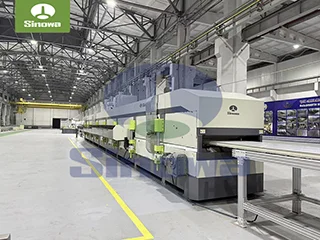
The overall structural design of the PU sandwich panel line for color steel sheet surfaces follows the principles of continuous production and integrated processing, covering a complete set of functional units from raw material feeding, sheet profiling, surface pretreatment, polyurethane foaming and filling, composite pressing, constant temperature curing, fixed-length cutting to finished product conveying and stacking. Each functional module operates in a coordinated and orderly manner, forming a closed-loop production chain that minimizes manual intervention and maximizes production continuity and product consistency. Different from ordinary sandwich panel production equipment, this machine is optimized and upgraded targeting the physical characteristics of color steel sheets, including surface flatness, coating adhesion, bending resistance, and tensile strength, ensuring that the metal surface layer will not be damaged, deformed, or peeled during the high-speed production process, while maintaining the perfect composite state between the color steel sheet and the polyurethane core layer.
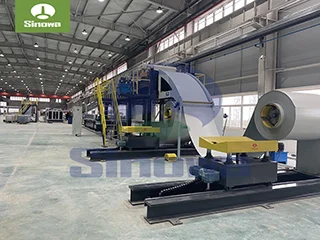
The front-end working module of the color steel sandwich panel line starts with the raw material unwinding and feeding system, which is responsible for stably conveying the coiled color steel sheets required for the upper and lower surfaces of the sandwich panel. The system is equipped with a multi-group buffer and deviation correction structure, which can adapt to color steel coils of different thicknesses and widths within the design range. In the continuous production process, the automatic splicing structure can connect the tail end of the used steel coil with the head end of the new coil without stopping the machine, effectively eliminating production downtime caused by raw material replacement and greatly improving the overall production continuity. After unwinding, the color steel sheets will pass through a precision leveling and cleaning unit, which can eliminate minor bending, wrinkles, and surface particle contaminants generated during coil storage and transportation. A smooth and clean metal surface is a key prerequisite for tight bonding with the polyurethane foam core layer, as it avoids hollowing, delamination, and uneven bonding strength caused by surface impurities or irregularities.
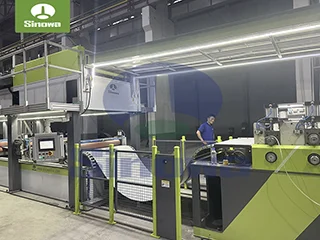
Subsequently, the color steel sheets enter the roll forming system, which is composed of multiple groups of precision forming rollers arranged in an orderly manner. Through progressive rolling and bending processes, the flat color steel sheets are processed into the standardized groove and edge-locking profiles required for sandwich panel assembly. The roller spacing and pressing force of the forming system are finely adjustable, which can meet the profile processing requirements of different specification panels. The whole forming process is stable and gradual, avoiding rigid extrusion damage to the color steel coating and metal base material, and ensuring the dimensional accuracy and structural uniformity of each formed sheet. After forming, the upper and lower color steel sheets are accurately positioned and guided into the closed composite molding cavity of the equipment through the automatic conveying mechanism, forming a fixed-thickness hollow interlayer space for the subsequent injection and foaming of polyurethane raw materials.
The polyurethane high-pressure foaming and injection system is the core functional unit of the polyurethane sandwich panel production line, which directly determines the thermal insulation performance, structural density, and bonding quality of the finished sandwich panel. This system consists of raw material storage and temperature regulation components, precision metering pumps, and a high-pressure dynamic mixing chamber. The two core chemical raw materials for polyurethane foaming are stored in independent sealed tanks with constant temperature control functions, which can stabilize the activity of chemical raw materials by adjusting the ambient temperature, ensuring the stability of the foaming reaction in different production environments. The precision metering pumps accurately control the proportion and delivery volume of the two raw materials according to the preset process parameters, avoiding performance defects such as insufficient foaming, uneven density, or brittle core layer caused by unreasonable raw material ratio.
After being fully mixed in the high-pressure mixing chamber, the liquid polyurethane raw materials are evenly injected into the interlayer space between the upper and lower color steel sheets through the reciprocating sweeping nozzle. The mixed liquid material undergoes rapid chemical reaction and volume expansion after injection, gradually filling the entire interlayer cavity without dead corners. In the foaming stage, the equipment is matched with a closed double-belt pressing and heating system, which provides a constant temperature reaction environment for polyurethane foaming and curing. The double-belt structure can apply uniform and stable pressure on the upper and lower surfaces of the color steel sheets, effectively preventing the deformation of the metal sheet caused by foam expansion, and ensuring the flatness of the finished panel surface. At the same time, the constant temperature heating system accelerates the curing reaction of polyurethane, shortens the molding cycle, and enhances the bonding tightness between the foam core layer and the color steel sheet surface.
The curing and cooling system plays a vital role in stabilizing the final performance of the sandwich panel. After preliminary hot pressing and curing, the composite panel is transported to the constant temperature cooling section through the conveying system, where it undergoes gradual cooling and stress relief treatment. This process can eliminate the internal stress generated by thermal expansion and mechanical pressing during production, effectively preventing the finished panel from warping, deforming, or cracking during subsequent use and storage. The length of the cooling cycle is automatically adjusted according to the panel thickness and production speed, ensuring that the polyurethane core layer is completely cured and shaped, and the bonding interface between the core layer and the color steel sheet reaches the optimal structural strength.
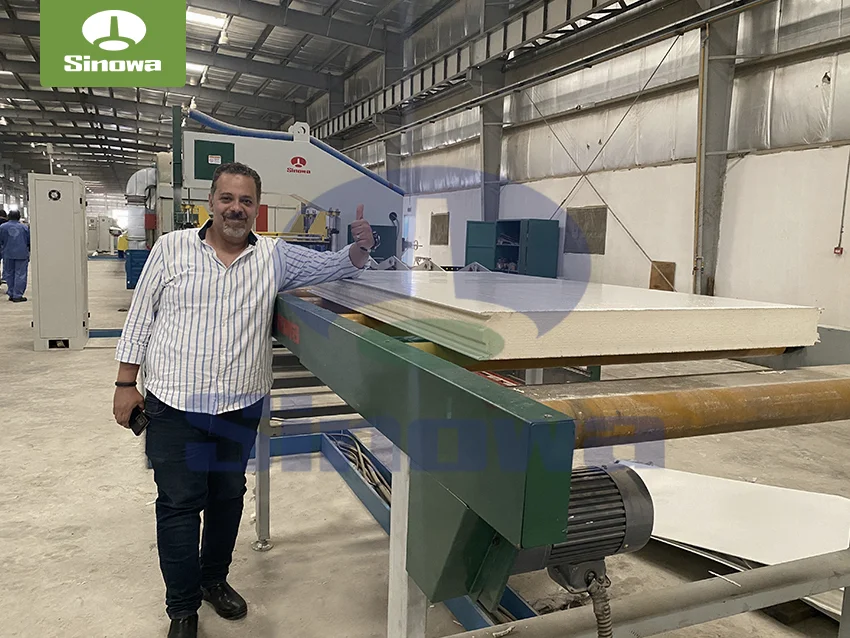
The rear-end processing unit of the equipment includes automatic fixed-length cutting, edge trimming, and finished product stacking systems. The high-precision cutting device adopts non-contact induction positioning technology, which can automatically identify the production length of the panel and complete fixed-length cutting in real time. The cutting process is stable and neat, without burrs, collapses, or color steel coating damage, ensuring the dimensional accuracy and appearance quality of each finished panel. The edge trimming mechanism further calibrates the edge size of the panel to ensure the assembly consistency of the product during on-site construction. Finally, the qualified finished panels are automatically stacked by the stacking system, realizing orderly collection of finished products and providing convenient conditions for subsequent packaging, transportation, and storage.
Compared with traditional manual and semi-automatic production equipment, the PU sandwich panel production line for color steel sheet surfaces has outstanding technical advantages in production efficiency, product quality stability, and operational flexibility. In terms of production efficiency, the fully automated continuous production mode realizes the integration of feeding, forming, foaming, curing, and cutting, with uninterrupted production process and greatly improved unit-time output. The highly automated operation mode reduces manual participation links, lowers the labor intensity of operators, and avoids product quality fluctuations caused by human operation errors.
In terms of product performance, the precise foaming control system enables the polyurethane core layer to have uniform density and stable pore structure, endowing the finished panel with excellent thermal insulation, sound insulation, and shock resistance. The tight composite structure formed by high-pressure hot pressing and chemical bonding makes the color steel sheet and the polyurethane core layer integrated, with high peeling strength and compressive strength. The panel can maintain stable structural performance under long-term external pressure and temperature changes, and is not prone to delamination, bulging, and deformation. In addition, the equipment’s optimized processing technology fully protects the color steel sheet surface coating, maintaining the metal sheet’s good corrosion resistance and weather resistance, so that the finished panel can adapt to various complex outdoor and indoor use environments.
In terms of operational flexibility, the polyurethane sandwich panel line supports the production of sandwich panels with different thicknesses, widths, and profile specifications by adjusting process parameters and replacing simple auxiliary molds. It can meet the diversified material needs of different building scenarios, including thin lightweight panels for interior partition walls and thick high-insulation panels for exterior wall thermal insulation and cold storage enclosure structures. The intelligent parameter adjustment system enables operators to quickly switch production specifications, effectively improving the equipment’s utilization rate and production flexibility, and avoiding the resource waste and time cost caused by equipment replacement and debugging.
From the perspective of production cost and energy saving, the optimized structural design of the polyurethane sandwich panel machine effectively reduces energy consumption in the production process. The constant temperature circulating heating system avoids repeated heating and energy waste, and the precise raw material metering control reduces the loss of polyurethane chemical raw materials. The high yield rate of automated production minimizes the generation of defective products, further reducing the comprehensive production cost. At the same time, the integrated closed production structure reduces the volatilization of chemical materials and the generation of production waste, making the entire production process more environmentally friendly and in line with the development trend of green building material production.
The color steel surface PU sandwich panels produced by this equipment have extremely high application value in the modern construction field. Relying on the excellent thermal insulation performance of the polyurethane core layer and the good weather resistance and decorative performance of the color steel sheet surface, the panels are widely used in the enclosure structures of industrial workshops, logistics warehouses, and large public buildings, which can effectively reduce building energy consumption and improve the thermal insulation and energy-saving level of buildings. In the field of cold storage and constant-temperature workshops, the high-density polyurethane foam core layer can form an efficient thermal insulation barrier, reducing the cold and heat exchange inside and outside the building, and ensuring the stability of the internal temperature environment.
In addition, the lightweight and high-strength characteristics of the sandwich panel make it an ideal material for prefabricated buildings. The overall weight of the panel is low, which can effectively reduce the load-bearing pressure of the building foundation and main structure, and shorten the construction cycle of the project. The neat and uniform surface of the color steel sheet eliminates the need for secondary decoration in most scenarios, simplifying the construction process and improving the construction efficiency. At the same time, the good sound insulation and fire-retardant performance of the optimized panel structure further expand its application scope, covering clean workshops, medical and health buildings, and temporary emergency construction facilities.
With the continuous upgrading of building energy-saving standards and prefabricated construction technologies, the market demand for high-performance color steel PU sandwich panels continues to grow, which also puts forward higher requirements for the performance and intelligence level of supporting production equipment. The modern PU sandwich panel production machine is gradually developing towards higher automation, more precise control, stronger compatibility, and lower energy consumption. The continuous optimization of the foaming system, pressing system, and intelligent control system further improves the comprehensive performance of the equipment, enabling the produced sandwich panels to meet more stringent building performance standards and diverse application scenario requirements.
In practical industrial production applications, the stable operation of the equipment depends on standardized process debugging and daily maintenance. Scientific parameter setting can match the best foaming ratio, pressing pressure, and curing temperature according to different color steel sheet thicknesses and panel specifications, ensuring the optimal comprehensive performance of the product. Regular maintenance of the transmission system, metering system, and heating system can maintain the long-term stable operation accuracy of the equipment, reduce equipment failure rates, and extend the service life of the production line. Reasonable operation and maintenance management not only ensures the continuity and stability of production work but also guarantees the long-term consistency of finished product quality, creating stable economic benefits for production enterprises.
In conclusion, the PU sandwich panel machine specialized in color steel sheet surface materials is a key intelligent and automated equipment in the field of modern building material production. It integrates multiple advanced processing technologies to realize efficient, standardized, and high-quality production of color steel polyurethane sandwich panels. Its excellent production performance, flexible production capacity, and energy-saving and environmentally friendly production characteristics make it an indispensable core equipment for the industrialized production of lightweight energy-saving building materials. With the continuous development of the construction industry towards greening, industrialization, and intelligence, this type of sandwich panel equipment will continue to be optimized and upgraded, providing more powerful technical support for the innovation and application of new building materials and promoting the high-quality development of the entire prefabricated construction and building energy-saving industry.
https://www.cnsinowa.com/sandwich-panel-machines/pu-sandwich-panel-machine-with-color-steel-sheet-surface-material.html